If your tap water is safe to drink and has not been through a home water softener, it will suit most houseplants. Softened water is the one to avoid. Rain is ideal if you can catch it, and distilled water is worth buying for a few highly sensitive plants. Leaving tap water out clears chlorine only.
We found no trial comparing these waters on ordinary houseplants, so this rests on extension and agency guidance rather than side-by-side results. That guidance is calmer than the argument. “Nearly all municipal and well water sources are fine for nearly all plants,” says Iowa State’s Aaron Steil, and Utah State says much the same.
The argument runs well beyond that. A thread on what water people use covers tap water aged in open jugs, filtered pitchers, bought distilled, home reverse osmosis rigs, rain barrels and old aquarium water.
Plenty of replies say plain tap and shrug, and a few recommend sports drinks, with no sign of meaning it.
What Each Water Brings
The table takes each water readers use and sets what sources say beside where that advice stops. It is not a ranking, because no comparison exists to rank them by, and because a home’s tap water depends on its supply. Texas A&M puts the point simply: tap water “can vary in quality”.
Nine waters, and what is actually known
Not ranked, because no trial has compared them on houseplants.
| The water | What sources say | Where it stops |
|---|---|---|
| Tap, drinkable
Municipal or well
|
Iowa State: fine for nearly all plants | Quality varies by supply; a few plants are sensitive |
| Tap, left to stand
A day or more
|
Clears chlorine, which rarely harms at tap strength | Does not clear monochloramine |
| Hard
High in calcium, magnesium
|
Wisconsin: fine for bromeliads. Purdue: alkalinity can raise mix pH over time | No test on a houseplant at home |
| Softened
Softener in the home
|
Avoid: added salts and sodium | All say avoid; timing of harm varies |
| Filtered
Pitcher or tap filter
|
No source found on houseplants | Liberty, Missouri: ask the maker whether a carbon filter removes monochloramine |
| Rain
Caught directly
|
Iowa State and Texas A&M: ideal | Off a roof it is a different water |
| Distilled
Bought or home-made
|
For highly sensitive plants, such as many carnivorous plants | Texas A&M: costly, usually not recommended |
| Reverse osmosis
Home system
|
Texas A&M: ideal for most plants | Written for commercial growers |
| Dehumidifier
Drain pan
|
Maryland: usable. Iowa State: fine for most | Long use can build up metals in the mix |
Softened water is the one sources warn against most consistently. Drinkable tap water suits most houseplants.
Does Letting Tap Water Sit Do Anything?
Partly, and it depends on what your utility adds. “A day’s evaporation should clear the water of chlorine,” says the University of Maryland Extension. Many supplies use something else. EPA says more than one in five Americans drink water treated with chloramines, which are formed by adding ammonia to chlorine.
The City of Liberty, Missouri, which uses monochloramine, is blunt about what that means: “Leaving water to sit for several days is not an effective method for removing monochloramine.” So the open jug works on one supply and does little on the next. Your utility can tell you which it uses.
Whether any of this matters to a plant is a separate question. Utah State says the chlorine and fluorine added to drinking water “will typically not harm plants”, and Liberty says plants “are not affected by monochloramine-treated water.”
For chlorine, there is now a result behind that. C. R. Frink and G. J. Bugbee tested potted foliage plants, flowering plants and seedlings in soilless mix for 12 weeks in 1987, at residual chlorine from 0 to 77 milligrams per liter. Geranium and begonia declined first, at 2. Others held on to 77.
They concluded that tap water under 1 milligram per liter “should not adversely affect either the growth or appearance of most potted plants”. Work on nursery shrubs by Cayanan and colleagues agrees on the order of magnitude.
Both are cited from their abstracts, and the 1 milligram figure is the authors’ 1987 statement of typical tap levels.
Chloramine has no such test. We found no study of it at tap strength on any houseplant, so Liberty’s line is a utility’s statement and not a result. A jug on the counter would not change that supply anyway.
For an ordinary plant, the evidence on chlorine suggests the jug matters less than the argument around it.
Fluoride is the known exception, and it does not leave a jug. Paul Nelson and Douglas Bailey at NC State said in 1994 that fluoridated municipal water is safe for most crops, but named lilies, Chlorophytum (spider plant), Dracaena, Spathiphyllum (peace lily) and a few others as exceptions.
The picture is not simple. Tipburn on spider plants rose with fluoride only at higher temperature and light in a 1984 study by Ben-Jaacov, Poole and Conover, and boron did worse.
A 1973 paper tied fluoride injury to the potting medium and a phosphate fertilizer, not only water. Our article on brown leaf tips covers the rest.
Why Softened Water Is Different
Softened water is not cleaner water. A softener swaps the calcium and magnesium for sodium, as a graduate article in NC State’s grower library explains: the result is “suitable for laundry but not for irrigation of plants.”
Too much sodium depresses uptake of other nutrients, it says, though that piece is undated and written for greenhouse soil.
Maryland says softened water “contains more than others” of dissolved minerals and should be avoided on houseplants. Wisconsin’s Susan Mahr notes that it contains sodium, and Utah State warns of soluble salts building up in the mix, with poor growth and possible toxicity.
Sources agree on the direction and give different speeds. UC ANR’s blog says softened water “contains salt that will quickly kill plants”.
Iowa State is milder, saying only that heavily softened water can leave a buildup of salts, especially in plants that are not repotted often. Either way, the advice points the same way: use unsoftened water. J. Robert Nuss of Penn State said there “isn’t any research” on which plants are injured, which is why the speed is in dispute.
If softened water has already gone on for a while, Utah State’s remedy is a deep rinse with unsoftened water. The method is in the article on drainage holes, and the white crust it can leave is explained in what the white stuff is.
Hard Water Is Not the Same Problem
Readers often lump hard water in with softened, and the sources do not. Writing about bromeliads, Mahr says “Hard water can be used without affecting plant health,” though it can spot shiny leaves. For other plants the concern is slower, and it is about the potting mix and not the leaves.
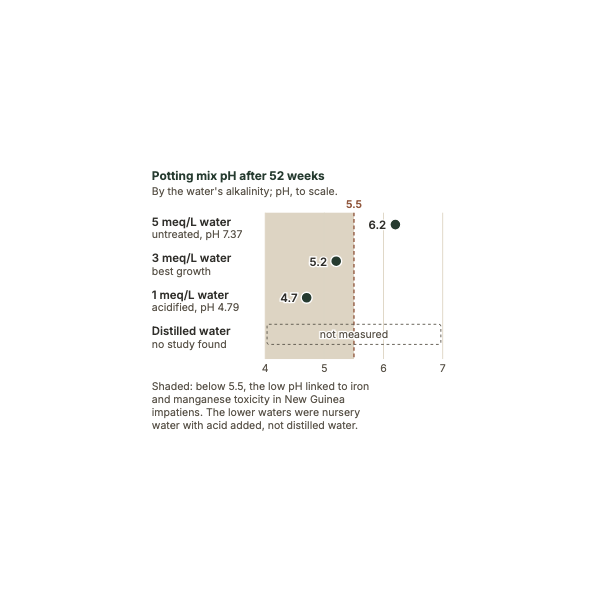
Hard water usually carries alkalinity. Nelson and Bailey call the bicarbonates “liquid limestone”, and Purdue Extension’s Lopez and colleagues say irrigating with high-alkalinity water “has the same effect as adding lime to the substrate.”
The pH of the mix drifts upward, and Purdue says the commonest result is iron deficiency: yellowing between the veins of new leaves.
Two conditions make it worse, Purdue says: small volumes of mix, and plants held for months or years. A houseplant has both, though that step is ours, since the guide is about commercial crops.
Hardness is only a rough stand-in for alkalinity, and no study has tested this on a houseplant at home. Your water report will list both.
Minerals can still collect. Maryland describes soluble salts concentrating as water evaporates from the mix, with brown tips, lower leaves dropping and a crust around the pot. Its answer is to water from the top until water runs out of the bottom.
Filtered, Distilled and Reverse Osmosis
Filtered water has almost no houseplant evidence. None of the extension pages we read mentions pitcher filters. Liberty says that whether a carbon filter removes chloramine varies, and that buyers should check with the maker.
Readers report good results, and that is all there is. If you already drink filtered water, nothing we found argues against using it. Distilled water has a narrower case than its popularity suggests. Iowa State reserves it for “highly sensitive species, like many carnivorous plants”, and Mahr says miniature bromeliads should always get it.
Texas A&M calls it expensive and “usually not recommended for use on plants”, while rating reverse osmosis water as ideal, in a guide written for commercial growers. Mahr also warns that very pure water “can draw nutrients out of the leaves” of bromeliads.
Dehumidifier water is the free version, and both sources accept it, one with a caution. Maryland recommends using it. Iowa State says it is “fine for most houseplants”, but that long use can build up metals in the soil. That caution concerns extensive use over a long period.
Rainwater
This is the water sources like best. “The ideal water for most plants is rainwater,” Iowa State says, and Texas A&M agrees while admitting that collecting it “can be tedious”. Maryland’s method is simple: stand buckets outside when rain is due. It values rain for having no added chemicals.
That advice describes rain caught directly. Water that has run over a roof and down a gutter has picked up more on the way, which is why gutter rainwater on houseplants is covered separately.
If You Think Water Is Hurting Your Plant
Start by ruling out the softener, then look at the plant. Brown tips, a crust on the mix and dropped lower leaves match Maryland’s list for salt buildup, though brown leaf tips have other causes too. Check the mix as well, with the six checks, since watering itself may be the problem.
If salts look likely, Utah State’s deep rinse with unsoftened water is the sourced first step. Iowa State adds that regular repotting and thorough watering both help to reduce the buildup of salts and metals.
Wisconsin’s advice is to use deionized or rain water when you have a water problem, written for bromeliads.
What Remains to Be Explored
The central gap is a side-by-side trial. We searched for one comparing tap, filtered, distilled and rain on ordinary houseplants and found none. Most statements above are guidance, not results, and much of what readers report is one plant in one home with several things changing at once.
Smaller gaps follow from that. We found no test of chloramine at tap strength on any houseplant, no houseplant test of pitcher filters or boiled water, no measurement of how much softened water it takes to cause harm, and no measured link between tap-strength fluoride and tipburn in a home.
Readers also wait for cold tap water to warm up, and no page we read addresses that. A trial on a sensitive species would answer more than any further opinion.
Sources
- How to Care for Houseplants — Aaron Steil. Iowa State University Extension and Outreach, Yard and Garden. October 2023.
- Watering Indoor Plants — University of Maryland Extension. March 10, 2023.
- Help for Houseplants — JayDee Gunnell. Utah State University Extension. December 6, 2007.
- Watering Your Houseplants — UC ANR, The Backyard Gardener. June 1, 2021.
- Bromeliads — Susan Mahr. Wisconsin Horticulture, UW-Madison Division of Extension. September 2026.
- Water and Water Quality — Texas A&M AgriLife Extension, Aggie Horticulture. Undated.
- Monochloramines FAQ — City of Liberty, Missouri. Undated.
- Chloramines in Drinking Water — US Environmental Protection Agency. March 12, 2026.
- Response of Potted Plants and Vegetable Seedlings to Chlorinated Water — C. R. Frink and G. J. Bugbee. HortScience 22(4):581-583. August 1987. Cited from its abstract.
- Sensitivity of Five Container-Grown Nursery Species to Chlorine in Overhead Irrigation Water — Cayanan et al. HortScience 43(6):1882-1887. October 2008. Cited from its abstract.
- Tipburn of Chlorophytum comosum Vittatum — Ben-Jaacov, Poole and Conover. HortScience 19(3):445-447. June 1984. Cited from its abstract.
- Fluoride Induced Necrosis of Cordyline terminalis — Poole and Conover. Journal of the American Society for Horticultural Science 98(5):447-448. September 1973. Cited from its abstract.
- Water Quality — Paul V. Nelson and Douglas A. Bailey. N.C. Flower Growers Bulletin 39(3). June 1994.
- Alkalinity Management in Soilless Substrates (HO-242-W) — Lopez, Mickelbart and Pasian. Purdue Extension. Undated.
- Softened Water May Ruin Your Crop — Betty B. Messier. NC State Horticulture Document Library. Undated.
- Softened Water Can Cause Hard Times For Indoor Plants — quoting J. Robert Nuss. Penn State. March 19, 2009.
- What Type of Water Do You All Use for Your Plants? (R/Houseplants Thread) — multiple community members. Reddit, r/houseplants. Undated.