Water a potted tank bromeliad every week or two by filling its central cup until water runs over into the mix, then let the mix dry, and flush the cup now and then. The sources disagree on keeping the cup full or draining it, and one trial found water in the cup was not essential. A bromeliad that dies after flowering is usually not a watering fault: most die slowly after blooming and leave pups.
What This Article Covers
This article covers the tank bromeliads sold as houseplants, the kinds whose leaves form a central cup: how to water the cup and the mix, how each source handles the cup, what water to use, and why the mother plant declines after flowering.
It draws on Florida, Wisconsin, Colorado, Washington and North Carolina extension pages and on studies of how bromeliads take up water and nutrients. For red marks on the leaves, see red spots on a bromeliad; for the water itself, see whether plants can have distilled water.
How a Tank Bromeliad Takes Up Water
Wisconsin Extension’s bromeliad article, by Susan Mahr, explains that many bromeliads grow on trees in the wild, where their small roots are used mainly to hold on, and the leaves have taken over taking up water and nutrients.
Tank bromeliads have leaves that form a reservoir at their bases; the largest hold up to two gallons. The University of Florida’s Gardening Solutions page says bromeliads absorb water and nutrients mainly through their leaves and the cups at their base.
The leaf surface does the absorbing through scales called trichomes, but not equally in every kind. Benzing and colleagues placed labeled amino acids on intact leaves.
Trichomes of every member of one subfamily, Tillandsioideae, took up substantial amounts wherever they grew. On tank-forming members of another, Bromelioideae, trichomes on the leaf sheaths took up much less, and those on the blades little or none.
Roots take up nutrients too. Young and colleagues grew silver vase bromeliads, an Aechmea, in pots of pine bark for 240 days and applied nutrient solution only to the mix.
Growth and biomass rose with the solution’s strength, and they note that recent work shows the roots of epiphytic bromeliads can help take up water and nutrients.
The clearest test of the cup is older. Poole and Conover grew Aechmea in a greenhouse and found that putting the nutrient solution and water in the vase was not essential for producing quality plants. That was a production study, not a houseplant trial, and the abstract does not say how the plants were otherwise watered.
Water reaches a bromeliad through the cup and the roots
The cup holds water among the leaf bases and the roots take it from the mix. The sources agree on a mix that does not stay soggy and on flushing the cup, but not on whether to keep it full.
Benzing, Henderson, Kessel and Sulak, 1976, and Poole and Conover, 1976, from the abstracts; Young and colleagues, 2022, from the abstract; UF/IFAS ENH1071 (Park-Brown, 2023); Wisconsin Extension (Mahr, 2026); Colorado State PlantTalk; WSU Skagit County (Jacoby, 2018); N.C. Cooperative Extension, Beaufort County (2025).
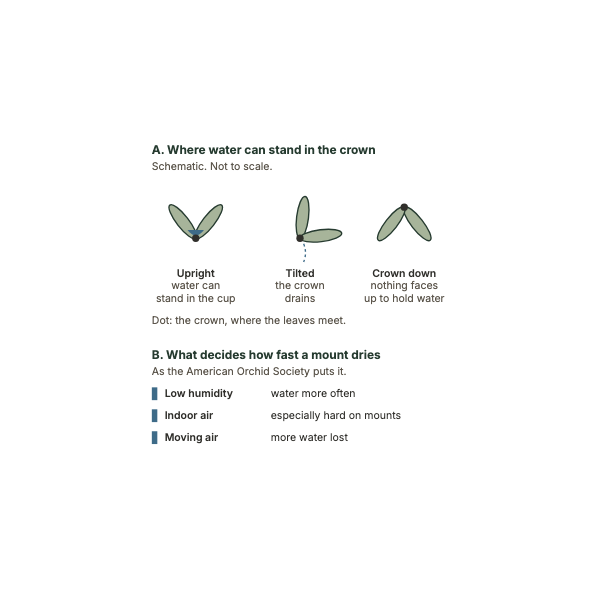
Every source keeps the mix from staying wet and flushes the cup; they keep the cup full, half full or drained.
What the Sources Say About the Cup
The University of Florida’s bulletin by Sydney Park-Brown, revised in 2023, gives the most specific method: water once every week or two, put the plant in a sink or shower, let lukewarm water fill the cup and run over the leaves into the soil, and then drain the cup.
Colorado State’s PlantTalk page also waters every week or two, fills the cup, and lets the soil dry between waterings.
Others keep water in the cup. N.C. Cooperative Extension’s Beaufort County article says to keep the tank filled with clean, non-chlorinated water, flush it weekly to prevent stagnation and mosquito breeding, and water the soil lightly, just enough to keep the roots barely moist.
WSU’s Skagit County article, by Kristie Jacoby, says to keep the cup half full, drain and refill it once a month, and water less in cooler, darker months.
Wisconsin says that where the water has a moderate mineral content, the centers of tank bromeliads should be flushed every week to stop minerals concentrating and causing leaf tip dieback.
Colorado State and the Florida bulletin both say to flush the cup occasionally to prevent stagnation and to remove salts left as the water evaporates.
So every source flushes the cup, and none cites a trial for its schedule. Whether to keep it full, half full or drained between waterings is where they part, and the one trial read, on Aechmea in a greenhouse, found the cup not essential to the plant’s quality.
The Mix and the Roots
The sources agree that the mix should not stay wet. WSU says to let the pot drain completely and not let plants sit in water.
Gardening Solutions warns not to overwater because bromeliads do not like wet feet, and gives as an example mix one part peat, one part bark and one part coarse sand.
Colorado State wants a mix that holds some moisture without getting soggy and lets water drain and air reach the roots.
The Beaufort County article says overwatering is a more common problem than pests, and that if a plant begins to rot, the cup should be emptied, dead tissue trimmed and the plant allowed to dry before care resumes.
Cold, Mosquitoes and Water Quality
Water in the cup can do harm in two settings. The Florida bulletin says to remove the water from the cup when temperatures below 40°F are likely, because cold damage shows as a brown line across each leaf at the water level.
Outdoors, it says, mosquitoes breed in the cups, and recommends flushing them with a hose once a week during the summer and fall rainy season.
Wisconsin says most tap water is satisfactory but to avoid alkaline or softened water, which contains sodium, and that hard water can spot shiny leaves.
It says rain or deionized water can be used, but that very pure water can draw nutrients out of the leaves. WSU says distilled or rain water is best for the cup, because high minerals or salts can damage the plant.
Why a Bromeliad Dies After It Blooms
A bromeliad that seems to be dying after it flowered is usually following its life cycle. Colorado State says bromeliads slowly die over a year or two after flowering, while pups develop at the base, and that pups can be separated when they reach half the size of the parent. WSU says each rosette generally flowers once and then dies slowly, replaced by its pups.
Wisconsin says the rosette dies after flowering in most bromeliad species, and names one genus, Dyckia, as an exception.
The Beaufort County article calls the decline part of the natural cycle and separates pups at one third to one half the size of the parent, cutting them off with a clean knife and letting the cut dry for a day before potting.
A rotting plant is a different problem: the Beaufort County article treats rot as the sign of overwatering, with the fix above, while the slow decline of a flowered mother beside its pups is the life cycle the other sources describe.
What to Do
1. Every week or two, fill the cup until water runs over into the mix, then let the mix dry before the next watering. 2. Choose a cup routine: drain it after watering (UF/IFAS), keep it half full and refresh it monthly (WSU), or keep it filled and flush it weekly (NC State). Whichever you choose, flush it regularly.
3. Empty the cup if the plant will be below 40°F, or outdoors where mosquitoes breed, flush it weekly. 4. Avoid softened or alkaline water. 5. After the plant flowers, let it decline, and separate pups once they reach a third to a half of its size.
What Remains to Be Explored
No trial read compared keeping the cup full, half full or drained on a houseplant bromeliad, and none tested how often to flush it. The one cup trial was on Aechmea grown for sale in a greenhouse, and the trichome study found that kinds differ in how much their leaves absorb, so the answer may differ between kinds.
How much a houseplant bromeliad relies on its roots against its cup, and whether the mother’s decline after flowering is hastened by watering, has not been measured in anything read here.
Sources
- Bromeliads at a Glance (ENH1071) — Sydney Park-Brown. UF/IFAS Extension (EDIS). August 2023.
- Bromeliads — Susan Mahr. University of Wisconsin-Madison Extension. September 2026.
- 1305 – Bromeliads — Colorado State University Extension. Colorado State University Extension, PlantTalk Colorado. Undated.
- The Gift of Bromeliads — Kristie Jacoby. Washington State University Extension, Skagit County. February 2, 2018.
- From Pineapples to Air Plants: The Surprising World of Bromeliads — Gene Fox. N.C. Cooperative Extension, Beaufort County Center. April 22, 2025.
- Bromeliads — UF/IFAS Gardening Solutions. Undated.
- The Absorptive Capacities of Bromeliad Trichomes — David H. Benzing, Karen Henderson, Bruce Kessel and JoAnne Sulak. American Journal of Botany (Wiley). 1976. Cited from its abstract.
- Nitrogen, Phosphorus, and Potassium Fertilization of the Bromeliad, Aechmea fasciata Baker — Richard T. Poole and Charles A. Conover. HortScience. 1976. Cited from its abstract.
- Nutrients Uptake by Silver Vase Bromeliad Roots — Jorge Luiz Marx Young, Matheus Casarini Siqueira, Shoey Kanashiro, Emerson da Silva and Armando Reis Tavares. Ornamental Horticulture (SciELO). 2022. Cited from its abstract.