Limp, wrinkled moth orchid leaves mean the plant is short of water, but they look the same whether the roots rotted from too much water or dried out from too little. The American Orchid Society says the only way to tell is to take the plant out of its pot and look at the roots.
Three things in the thread change how much water reaches those roots: bark that holds more water as it breaks down, a pot that cannot drain, and very dry room air. No trial read times how long to soak an orchid; the methods the sources give are below.
The question comes from a thread on r/orchids. A grower’s three moth orchids, potted in bark in clear liners inside decorative cache pots, kept dying though the grower watched the color of the roots.
Replies read the limp, ridged leaves as dehydration, from too little water or from roots lost to rot. The poster, in a very dry home, had stretched watering to every two weeks for fear of overwatering, then decided one plant had rotted the same day it was soaked.
The replies split on method: soak for minutes, for hours or overnight; water from the top and let it drain; water when the roots turn silver or the bark is dry; every week or every two; and replies warned that cache pots trap water and that old bark breaks down and holds it.
What This Article Covers
This article covers moth orchids, Phalaenopsis, grown indoors in bark or moss: what limp leaves mean, how to read the roots, and what changes how wet the roots stay.
It names no pot, mix or product. Ice cubes are covered in the article on ice cubes on orchids and orchids in peat in the article on an orchid in potting soil or peat moss.
Why the Leaves Cannot Tell You
The American Orchid Society’s beginners’ lesson on water is blunt about it. Orchid leaves wrinkle and go flaccid whether the plant was overwatered or underwatered, because in either case the roots are damaged and cannot take in enough water. The only way to confirm which, it says, is to remove the plant from its pot.
The society’s answer on wrinkled, leathery leaves says the same in other words: shriveled leaves mean water is not reaching the tissue, and if the plant has no working roots, it cannot take up water however much it is given (AOS).
Not every source frames it that way. The New York Botanical Garden’s troubleshooting guide calls wrinkled leaves a sign of underwatering and says to water well and more often.
That fits a plant with sound roots; the society’s point is that a plant whose roots have rotted shows the same leaves, and more water would not help it.
Reading the Roots
The society gives three readings. Healthy roots are plump and firm; if they are white or green and plump, the potting mix is in good shape and the pot is very light, suspect too little water.
Black, mushy roots mean the plant was overwatered. Dry roots that fall apart mean it was underwatered (AOS lesson 4 and wrinkled-leaves answer).
The NYBG’s moth orchid guide gives the color test the same way: green, beige or white roots are healthy, and black or brown ones are rotting or close to it.
Root color seen through a clear liner, which the poster was watching, is part of this, but the society’s test is the root in the hand, firm or mushy, plump or falling apart. The sources read do not say that color seen through the pot, alone, separates a living root from a rotting one.
Limp leaves can’t tell you which; the roots can
Moth orchid leaves go limp and wrinkled from too much water or too little. What the roots look like separates the two, and bark mix holds more water as it ages.
Panel A follows the American Orchid Society’s descriptions; the leaves wrinkle the same way whichever happened, because damaged roots cannot take up water. Panel B: the bark’s stages are the society’s general timeline, not a measurement, and decay speed is not given for any one mix.
Take the plant out of its pot and look: plump roots and a light pot mean it needs water, black mushy roots mean too much, and an old, broken-down mix holds more water than it did.
How Roots Take up Water
A moth orchid root is wrapped in velamen, a spongy layer of dead cells. The society’s lesson describes the actual root as about the thickness of fishing line running down its center, and says the velamen, like any sponge, breaks down and decays when it sits in water.
Work on aerial roots of eight orchid species found that water enters the velamen by imbibition, soaking into its pores, and that how fast it soaks in varies widely between species with the structure of the layer (Hauber and colleagues 2020, abstract).
A preprint, not yet peer reviewed, adds that parts of the velamen carry a water-repelling layer that limits water loss, while root parts touching bark grew root hairs (Li and colleagues 2020, abstract). Neither study tested a potted moth orchid or a soaking time.
Old Bark, Cache Pots and Dry Air
Bark changes under the plant. The society’s Beginner’s Series says fir bark dries fast at first, even if wetted before potting, and is usually “seasoned,” thoroughly moistened, within about a month. Then it decays, and generally within two years it is reduced to fine-particled humus that holds large amounts of water.
Because of that decay, recently repotted plants are likely to need more frequent watering than those repotted a year or more earlier, the same series says.
The society’s culture sheet repots every one to three years, and an Orchids magazine article adds that roots rot when the mix itself is breaking down, and that a white mold in decaying mix repels water from the roots it covers (Bottom 2025).
A pot inside a pot is the second trap. The society’s lesson says to let the pot drain before it goes back into a saucer or decorative container, and never to water an orchid sitting in a decorative container with no drain hole, because the water sits at the bottom and rots the roots. The NYBG says not to let the plant sit in run-off water.
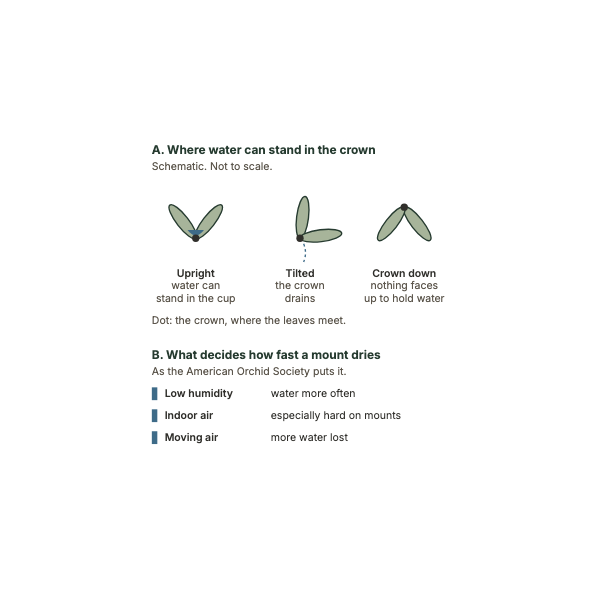
Dry air pulls the other way. The Beginner’s Series recommends 50 to 60 percent relative humidity, citing older growing guides, and says that in very dry air moth orchids may hold only two or three flaccid leaves.
The NYBG gives a minimum of 50 percent and notes that a home in the northeastern United States can fall to 25.
Low humidity, warmth and bright light all raise water loss and how often a plant needs watering, the series says. A trial of bare-root moth orchids out of their pots found the same direction for water loss: plants lost more mass, mostly water, the warmer they were kept and the longer (Wang 1997, abstract).
How Long to Soak, and How Often
No study read compared soaking times for a potted moth orchid, so the thread’s minutes against overnight is not settled by evidence. What the sources give is a method.
The society’s lesson suggests running water through the medium, letting it drain, waiting a few minutes and repeating, or watering over a bucket. The NYBG says to let water soak through and drain out completely in a sink, and to keep watering until bark is saturated, because bark first repels water.
For a new, dry bark mix, the NYBG’s reference answer has you run water through it several times, for 3 to 4 minutes, so it starts to absorb.
On frequency, the society’s culture sheet says once a week is generally enough for a moth orchid in bark, and to water moss when the top feels dry.
Both sources check before watering. The society says that after a few waterings the weight of the pot tells you, and “If in doubt, wait a day.” The NYBG suggests feeling the mix through the drainage hole about four days after watering and waiting if it is still damp.
The NYBG also cautions that a moth orchid has no water-storage organ and should not dry out entirely. A two-week gap is twice the society’s weekly guide for bark, and in a dry room the series expects more frequent watering, not less.
After Root Loss
The society’s lesson treats it as recoverable. Take the plant out, clean out the dead roots, gently wash the remaining roots in warm water if some have decayed, and repot in new mix in a new or disinfected pot. If a lot of root was lost, water more often until new roots grow.
The wrinkled-leaves answer adds raising the humidity around the plant to ease the strain on whatever roots remain. Wrinkled leaves will not smooth out, both the society and the NYBG say, but new leaves should come in normal.
For a moth orchid that has finished flowering, see the article on a brown moth orchid spike.
What Remains to Be Explored
No study was found that compared soaking times, or watering intervals, for a potted moth orchid in a home. The weekly guide and the methods here are the society’s and the garden’s practice, not trial results.
How fast bark decays in a given pot was not measured in anything read; the two-year timeline is the society’s general account. Whether root color seen through a clear pot can separate a living root from a rotting one was not tested in any source read.
The velamen studies are on aerial roots, one of them a preprint, and the water-loss trial was on bare-root plants in storage, not plants in pots.
Sources
- How Do You Not Overwater Your Orchids? — multiple community members. Reddit, r/orchids. Undated.
- Your Orchid Adventure, Lesson 4: Water Requirements — American Orchid Society. Undated.
- Why Are My Orchid’s Leaves Wrinkled and Leathery? — American Orchid Society. Undated.
- Growing Phalaenopsis. What Can Go Wrong? — Sue Bottom. American Orchid Society (Orchids magazine). June 2025.
- Beginner’s Series 23: Phalaenopsis, Part 4 — American Orchid Society. Undated.
- Phalaenopsis (Culture Sheet for Beginners) — American Orchid Society. Undated.
- Phalaenopsis (Research Guide) — NYBG Mertz Library. New York Botanical Garden, LuEsther T. Mertz Library. Undated.
- Troubleshooting Orchids (Research Guide) — NYBG Mertz Library. New York Botanical Garden, LuEsther T. Mertz Library. Undated.
- Why Are My Phalaenopsis Orchid’s Leaves so Dry Looking? — NYBG Mertz Library. New York Botanical Garden, Mertz Library Reference. Undated.
- Aerial Roots of Orchids: The Velamen Radicum as a Porous Material for Efficient Imbibition of Water — Hauber F, Konrad W, Roth-Nebelsick A. Applied Physics A. October 22, 2020. Cited from its abstract.
- Cuticle-Like Layer Covering Velamen Realizes Functional Zoning of Aerial Roots in Epiphytic Orchids — Li JW, Zotz G, Xi HP, Zhang SB, Zhang JL. Authorea (preprint). June 22, 2020. A preprint, not peer reviewed; cited from its abstract.
- Effect of Postharvest Temperature and Storage Duration on Growth and Flowering of the Phalaenopsis Orchid — Wang YT. HortScience (ASHS). 1997. Cited from its abstract.
- Impact of Salinity and Media on Growth and Flowering of a Hybrid Phalaenopsis Orchid — Wang YT. HortScience (ASHS). April 1998. Cited from its abstract.