Yes. Plants can have distilled water, and for many carnivorous plants and the most salt-sensitive bromeliads it is the water extension guides and growers advise. No study has tested it against tap water on ordinary houseplants.
What distilled water lacks is what hard tap water carries: calcium, magnesium and the carbonate that buffers a pot against turning acidic. A plant watered only with distilled water gets those from its potting mix and its feed alone.
Care pages pull two ways. Some say a plant needs distilled water; others call it empty, acidic, or a drain on the plant’s nutrients. The research below separates the claims that hold from the ones that rest on nothing measured.
What This Article Covers
This article covers distilled water used on plants in pots indoors: what it lacks, what that does to the mix over months, which plants need it, and how to use it.
It names no product and gives no feeding rate. All the studies cited, except Adamec’s 2013 review, are cited from their abstracts. How tap, filtered and rain water compare is covered in what water houseplants actually need.
What Distillation Takes Out
Iowa State Extension’s houseplant care guide, by Aaron Steil, recommends distilled water for highly sensitive species, like many carnivorous plants, to avoid damage from the minerals, salts and other contaminants in other water. Those minerals, salts and contaminants are what separate distilled water from tap water.
The International Carnivorous Plant Society measures them as total dissolved solids, or TDS, in parts per million (ppm). It also warns that filtering does not remove dissolved salts. The exception it names is a filter made with chemicals to remove salts, which must be replaced often or it releases the salt it has collected.
Two of those dissolved minerals matter most in a pot. A 1994 bulletin for greenhouse growers at NC State, by Paul Nelson and Douglas Bailey, separates them.
Hardness is the calcium and magnesium in the water. Alkalinity is the bicarbonate and carbonate. In the same issue, Bailey adds that alkalinity sets a water’s buffering capacity, how strongly it resists a change in pH.
The bulletin notes that hard water usually carries both, and calls the calcium and magnesium bicarbonates added with each watering “liquid limestone”, because over time they push the pH of the growing mix up. Distilled water, chosen precisely for having none of these minerals, adds none.
Is Distilled Water Acidic?
Another worry is that distilled water is acidic and will sour the mix. The pH reading of a water, on its own, is a poor guide to that.
The same NC State bulletin says alkalinity and pH are not necessarily linked, and that a good crop can be grown with water at pH 7.6 when its alkalinity is low.
Brian Krug’s grower lecture on water quality, from the University of New Hampshire, puts it the same way: alkalinity is the buffering capacity of water to resist a change in pH.
The water extension sources rate highest is slightly acidic too. Iowa State calls rainwater the ideal water for most plants, and the EPA puts normal rain at about pH 5.6, slightly acidic because carbon dioxide dissolves into it.
In the bulletin’s terms, what a water does to a pot depends on its buffering, not only on its pH.
What Changes in the Pot Over Months
One long trial shows what happens when the buffering is taken out of a water. Albano and colleagues grew a nursery shrub, thyrallis, for 52 weeks in a Florida nursery’s own substrate, watering it with that nursery’s alkaline water either untreated or with acid added to neutralize part of the carbonate.
Less buffering in the water, a more acidic pot
In a year-long nursery trial, each step down in the water’s alkalinity left the potting mix more acidic. No such test with distilled water was found.
Thyrallis (Galphimia gracilis) in a Florida nursery’s substrate and water: Albano and colleagues, 2017. The 5.5 line: Owen and colleagues, 2018, for New Guinea impatiens. Both cited from their abstracts.
Lower alkalinity left a lower pH in the pot, and the middle water grew the best plants. Where distilled water would land is not measured.
The three waters carried 5, 3 and 1 milliequivalents per liter (meq/L) of alkalinity. After a year the potting mix measured pH 6.2, 5.2 and 4.7, falling with each step down. The middle water grew the most, with the greenest leaves; the lowest-alkalinity water did not grow the best plants.
The lowest pH matters because of what an acidic mix does to some plants. A diagnostic guide by Owen and colleagues ties a substrate pH below 5.5 to iron and manganese toxicity in New Guinea impatiens.
Two of the three mixes in Albano’s trial ended below that line, though the guide concerns impatiens, not thyrallis.
Low alkalinity does not always cost growth. LeBude, Owen and Holmes watered five flowering shrubs at six North Carolina nurseries with pond water of low alkalinity, pH 4.9 to 8.1, and found no difference in growth against the same water adjusted to pH 5.8 to 6.2.
Neither trial used distilled water, and no study read measured a potting mix watered with nothing else. One trial shows the direction for a nursery shrub; what distilled water alone does to a houseplant pot, and how fast, is not known.
Calcium and Magnesium: The Water’s Share
Hard water feeds plants a little with every watering. The NC State bulletin tells growers that irrigation water may contain essential nutrients, so the fertilizer program is reduced to account for them.
A plant on distilled water gets no such share, and every bit of its calcium and magnesium comes from the mix and the feed.
Argo and Biernbaum measured how closely plants follow that supply. Impatiens grown 17 weeks in a limed peat mix took up calcium and magnesium in a straight line with the amounts the water and fertilizer delivered. Where both were low, tissue calcium and magnesium fell after week 8 with one of the two limes.
The fertilizers in that trial differed in their calcium and magnesium, so a feed is not automatically a source of either.
Iowa State says most indoor plants benefit from fertilizer but do not need much. Any feed goes on as its label directs.
Does Distilled Water Pull Nutrients Out of Plants?
The claim has an extension source, for one group of plants. Susan Mahr’s guide to bromeliads for Wisconsin Extension warns that very pure water can draw nutrients out of the leaves, and advises adding a very small amount of fertilizer to distilled water to prevent it. The page cites no study.
The research behind the idea concerns water on leaves. Tukey and Mecklenburg reported in 1964 that rain, dew and mist leach minerals and sugars from the leaves of 125 plant species, and that calcium and phosphorus leached from squash leaves were taken up again by roots and carried back up into plants.
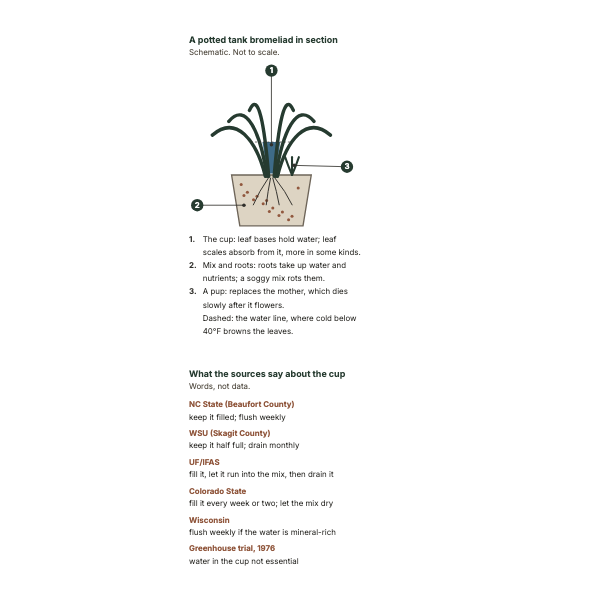
Leaves are where that research applies, which matches the bromeliads Wisconsin writes about. Many are tank species, whose rosette forms a central tank that the guide drenches along with the mix and the leaves.
It says nothing about roots in a pot of mix, and no source read measured distilled water drawing minerals out through roots. For an ordinary houseplant watered at the soil, the claim is untested.
Plants That Do Need It
Carnivorous plants head every list. Lubomír Adamec’s review of how they feed describes plants of nutrient-poor, wet or aquatic places that add minerals from prey to what their roots take up. Prey made the roots of three sundews take up more minerals, mostly by growing more root.
So these plants still feed through their roots, from soils poor in minerals. In a Mississippi savanna, Holloway and Brewer found that adding phosphorus to the soil slightly softened the loss of growth when pitcher plants were kept from catching prey, where neighboring plants were left in place.
The carnivorous plant society gives a usable line for Venus flytraps: tap water under 90 ppm TDS is fine, and above it, use distilled, reverse osmosis or clean rain water. Its page cites no trial for the figure. Why store-bought flytraps fail is covered under Venus flytrap care indoors.
Not every carnivorous plant wants acid conditions. In a survey of soil pH where they grow, Adamec found most terrestrial species on acid soils of pH 3.5 to 5.5, but dozens, mostly mountain and rock-dwelling butterworts, on neutral or slightly alkaline soils of pH 7 to 8.
Wisconsin adds the miniature bromeliads, which it calls very sensitive to salts and says should always get distilled water.
The NC State bulletin lists Chlorophytum, Dracaena, Maranta, Spathiphyllum and a few other plants as sensitive to fluoride at the 1 ppm often added to municipal water, though brown leaf tips have other causes, set out in what actually causes brown leaf tips.
If You Use Distilled Water
- Decide whether you need it. Iowa State says that if tap water is safe to drink, it can be used on most indoor plants. For a carnivorous plant, find your tap water’s TDS from the water supplier’s report or a TDS meter, and keep to the society’s 90 ppm line.
- Feed by the label. With no minerals coming in through the water, the feed and the mix supply all of them. Use a fertilizer as its label directs.
- Water thoroughly. Iowa State says that watering thoroughly, so the water flushes the mix, and repotting regularly help reduce the build-up of salts and metals. Why the water should leave through the bottom is set out under whether pots need drainage holes.
- Consider rain. Iowa State calls rainwater ideal for most plants, and the carnivorous plant society lists clean rain water beside distilled.
Local Regulations and Safety Advisory
If you use fertilizer products, follow the label. Rules on them vary by country and locality, and your agriculture department can say what applies where you live. This article is general information, not legal advice.
Authorities to consult:
- Local agriculture department
What Remains to Be Explored
The central gap is a houseplant trial. No study read compared distilled water with tap water on ordinary houseplants, or measured what a potting mix watered with nothing but distilled water does to its pH over months. The figure leaves that row empty for that reason.
Two smaller gaps follow. No source read measured pure water drawing minerals out through roots, as opposed to off leaves, and the carnivorous plant society’s 90 ppm line and Wisconsin’s leaching warning are both guidance without a cited test.
A long trial of a sensitive and an ordinary houseplant on distilled and tap water would settle more than another care guide.
Sources
- How to Care for Houseplants — Aaron Steil. Iowa State University Extension and Outreach, Yard and Garden. October 2023.
- Bromeliads — Susan Mahr. Wisconsin Horticulture, UW-Madison Division of Extension. September 2026.
- Growing Dionaea — International Carnivorous Plant Society. Undated.
- Water Quality; Water Acidification — Paul V. Nelson and Douglas A. Bailey; Douglas A. Bailey. N.C. Flower Growers’ Bulletin, NC State University Department of Horticultural Science. June 1994.
- Understanding the Chemistry of Plant Nutrition: Water Quality, Alkalinity and pH Management — Brian A. Krug. University of New Hampshire (slides hosted by the University of Vermont Entomology Research Laboratory). March 11, 2012.
- What Is Acid Rain? — U.S. Environmental Protection Agency. Undated.
- Irrigation Water Acidification to Neutralize Alkalinity for Nursery Crop Production: Substrate pH, Electrical Conductivity, Nutrient Concentrations, and Plant Nutrition and Growth — Joseph P. Albano; James Altland; Donald J. Merhaut; Sandra B. Wilson; P. Chris Wilson. HortScience (American Society for Horticultural Science). October 2017. Cited from its abstract.
- Effect of Lime, Irrigation Water Quality, and Water-Soluble Fertilizer on pH and Macronutrient Management of Peat-Based Root Media — William R. Argo; John A. Biernbaum. HortScience (American Society for Horticultural Science). July 1995. Cited from its abstract.
- High pH, Low Alkalinity Pond Water Used for Overhead Irrigation Does Not Affect Plant Growth of Select Flowering Shrubs — A.V. LeBude; J.S. Owen; C. Holmes. Journal of Environmental Horticulture. March 2021. Cited from its abstract.
- Low Substrate pH-Induced Iron/Manganese Toxicity of New Guinea Impatiens: A Diagnostic Guide — W. Garrett Owen; Brian E. Whipker; Josh B. Henry; Paul Cockson; Hunter Landis. Plant Health Progress. January 2018. Cited from its abstract.
- Leaching of Metabolites From Foliage and Subsequent Reabsorption and Redistribution of the Leachate in Plants — H. B. Tukey; R. A. Mecklenburg. American Journal of Botany. August 1964. Cited from its abstract.
- Foliar Mineral Nutrient Uptake in Carnivorous Plants: What Do We Know and What Should We Know? — Lubomír Adamec. Frontiers in Plant Science. January 31, 2013.
- Soil pH Values at Sites of Terrestrial Carnivorous Plants in South-West Europe — Lubomír Adamec. Carnivorous Plant Newsletter. December 2015. Cited from its abstract.
- Growth and Tissue Nutrient Responses of Adults of Sarracenia alata to Prey Exclusion, Nutrient Addition, and Neighbor Reduction — Jalen C. Holloway; J. Stephen Brewer. American Journal of Botany. December 2022. Cited from its abstract.