Usually light or water, and it may not be dead yet. A flytrap on a windowsill probably gets too little sun, and tap water may carry too many dissolved salts. Black traps alone prove nothing, because leaves die normally and the plant can survive in its rhizome. Whether it needs a winter rest is a disagreement between experts, and no source here calls for the fridge.
Before you throw it out, stop judging by the traps. Move the plant to your brightest spot, change the water and watch for new leaves.
The rest of this explains why, and says plainly which famous flytrap rules have been tested and which are only repeated.
The argument has a familiar setting. On r/IndoorGarden, a shopper posted a home store display of flytraps in closed boxes, then bought a discounted one at another store to try to save.
The replies split. Some saw novelties bound to die. Others called the plants hardy, given plenty of light and mineral-free water, and one reader ranked them among the hardiest plants they had grown.
Readers also disagreed on humidity and on winter, with one insisting on months in the fridge and another content to skip a single winter’s rest. One more learned from the thread that water might have been the problem all along.
Dead or Just Losing Traps?
Flytrap leaves are not built to last. The New York Botanical Garden says, “Leaves turn black and die after a few months,” and adds, “On a healthy plant the leaves only last this long and are replaced by new ones.” A plant with some black traps and some green ones is, on that account, doing what it should.
Winter goes further, and a dormant plant can look dead. North Carolina Extension says that as dormancy arrives, “The above-ground parts die back, but the plant survives underground in its rhizome,” which it describes as a bulb-like structure that stores energy until spring.
Its article opens on the reader who watched a plant turn black in November and assumed the worst.
What dies back, and what stays
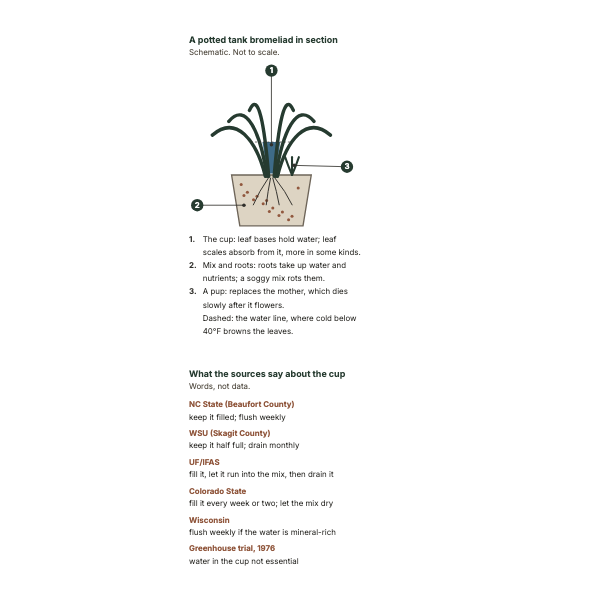
The same plant drawn twice with the soil cut away. The part you see is not the whole plant.
Black traps and leaves are not the test. Leaves die in the normal course of things and in winter dieback, while the plant survives in its rhizome. A plant can also be truly dead, and we found no reliable test for that.
That is why a flytrap can look finished and return. The reader who rated them so highly reported exactly that: all the traps lost after a sudden move outside into the sun, then new ones within weeks. That is one report, without a rate behind it, and a plant can of course also be dead.
We found no reliable test for a dead rhizome in any source. New leaves would settle it, which means waiting.
A plant going into its winter rest has a rough calendar: NYBG says it will be ready to resume growth around March, and North Carolina Extension puts dormancy in the wild at three to five months. For a plant that collapsed at any other time of year, no source says how long to wait.
A single trap that has finished is no alarm either. NYBG says traps “will eventually die after repeated digestion but that is natural.”
One ecologist, writing for Scientific American, gave figures: “After three to five meals, the trap will no longer capture prey” and it will keep photosynthesizing for two to three months. No study is cited for those numbers.
Light Is the Usual Problem
On light the sources are blunt. “Insufficient light is probably one of the main reasons these plants don’t do well,” says NYBG’s plant service. Its care guide is blunter: “A gently lit windowsill is too dim for your plant to survive.”
The guide says full, direct sun of “at least 6 hours per day,” from a southern exposure, is best, and that “most owners will need to consider supplementing with artificial light.” For a small plant, it says a single horticultural LED light may be enough, kept on 12 to 16 hours a day.
The International Carnivorous Plant Society agrees that the plant “requires more light than it can get on a typical house window sill.” NC State’s plant profile is the mildest, at “full sun to partial shade.”
Its figure for indoor growing is white LED light at 15,000 to 25,000 lux, a measure of the light reaching a surface, for about 14 hours a day. North Carolina Extension calls that significantly more light than most houseplants require.
Those are care-guide numbers rather than trial results, and we found no study testing flytraps at home light levels. Still, none of these sources treats a dim spot as enough.
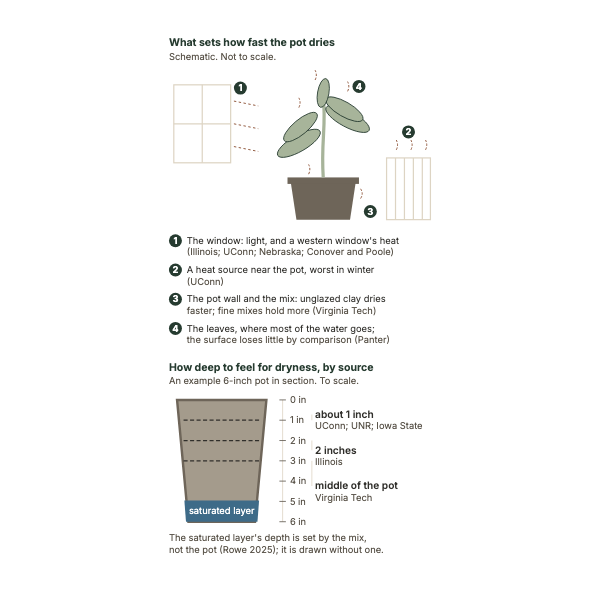
A plant from sunny open ground was put in a box on a store shelf, then on a windowsill. The article on light and winter slowdown covers how window light falls off.
Water: The Rule, and How Far It Has Been Tested
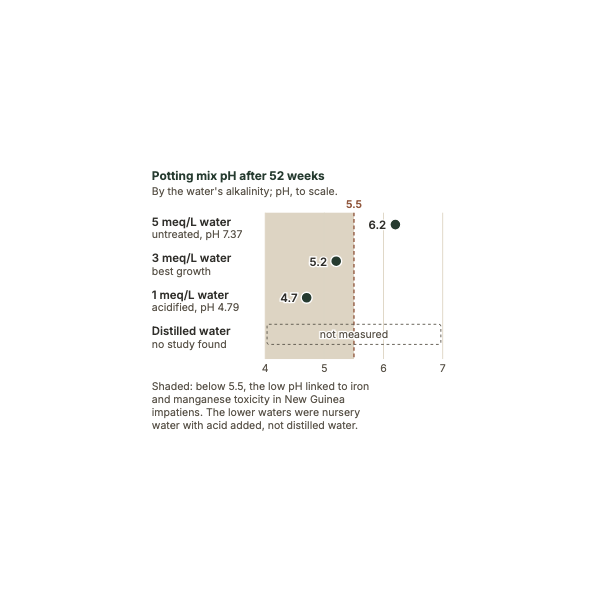
The rule is real and widely stated. NC State says, “Irrigate with rainwater or distilled water; treated (chlorinated) water or hard water can kill the plant.” NYBG says tap, bottled and filtered water “will probably have too much dissolved salt for the plant and can kill it.”
The Society is more exact: tap water is usable if its total dissolved solids are under 90 ppm, and “Filtering water will NOT remove the dissolved salts.” It adds that filters built to remove salts do work, but must be replaced often or they release the salt back into the water.
It also warns that a plant’s soil can turn salty over time, until new leaves fail to form traps.
Dissolved solids are the salts and minerals carried in water. The Society says your city, your water company or a well test can give the number, or you can measure it with a TDS (total dissolved solids) meter.
Here is the limit. We searched for a study measuring what tap water does to a flytrap and found none.
The rule comes from experienced growers, a botanical garden and extension pages, and the plant’s habitat is at least consistent with it: North Carolina Extension describes “wet, sandy, nutrient-poor soils,” and a 2025 paper, cited from its abstract, says the plant lives there with “a vestigial root system,” meaning a much reduced one.
So follow the rule, which every care source here gives in some form, and treat the 90 ppm figure as a grower’s line rather than a measured threshold. The wider question of water types is in what water houseplants need.
How you water matters too. NYBG advises keeping the pot in a dish holding about ½ to 1 inch of water, adding water to the dish and letting it seep up, with “at least a 2 inch margin” between the water level and the soil surface.
The Society gives the same margin and sums it up: “The plants do not enjoy being soggy but must always be wet.”
Besides light, NYBG lists the common troubles as salt building up in the potting mix when distilled water is not used, root rot when the mix is too wet, and roots drying out completely, even briefly.
Do Flytraps Need a Fridge?
Here the question is open among experts, and NYBG says so directly: “There are differences of opinion regarding whether winter dormancy is necessary among Venus flytrap experts.” Dormancy is the winter rest, which North Carolina Extension says is triggered mainly by shorter days, with cooler temperatures in support.
The two ends are clear. The Society says the plants do not “require dormancy to survive long term indoors,” and that “Putting an indoor plant in the refrigerator to encourage dormancy is a waste.”
North Carolina Extension reports that “while you can skip dormancy once or twice without killing the plant, doing so repeatedly leads to decline,” attributing that to professional growers.
Those positions are closer than they look, because they mostly concern different plants. The answer depends on your setup:
| Your plant | What the sources say | Source |
|---|---|---|
| Under strong grow lights all year | Can skip dormancy if light stays strong and it is fed | North Carolina Extension; Carnivorous Plant Society; NYBG |
| On a windowsill | Expect dormancy as light falls; keep it cool and bright, about 45 to 50°F | North Carolina Extension; NYBG |
| Outdoors | Let it happen; protect from hard freezes below about 20°F | North Carolina Extension |
Among these sources, only the Society addresses the fridge as a winter rest, and it is against the idea for indoor plants. North Carolina Extension suggests “at least 10 weeks at temperatures between 35–50°F” if you do provide a rest. Neither that article nor NYBG’s guide calls for a fridge.
The risky case is the middle: a warm room with dim winter light. For plants on natural light, North Carolina Extension says, “Trying to force such plants to keep growing through winter usually results in weak, stressed specimens.”
Its advice is to pick one approach, because “Consistency matters most.” During a rest, NYBG says to stop feeding and limit water so the medium stays “just barely moist,” which differs from summer care. No controlled test of dormancy on potted flytraps was found.
Do You Have to Feed It?
Outdoors in summer, usually not, since it catches its own. Indoors, the Society says, “VFTs must eat regularly,” and warns that a plant that stops being fed will decline. NYBG is milder: feed “about once a week to two weeks,” though plants “can survive for extended periods without being fed but they will grow more slowly.”
The research supports the idea that prey matters. Schulze and colleagues, cited from their abstract, estimated that soon after a fire about 75 percent of a wild plant’s nitrogen comes from insects, falling to 46 percent about 10 years after fire as other plants overtop it.
Feeding also appears to pay. A 2014 study, again cited from its abstract, found that, depending on the plant’s nitrogen status, insect capture was “followed by enhanced photosynthesis and growth,” with nitrogen moved to build new traps.
The first measured wild plants and the second plants fed insect powder in an experiment, so neither says how often a pot plant needs food. No schedule in the sources has a trial behind it.
What to feed is firmer. NYBG says, “NEVER use beef or chicken or any other animal flesh.” Its guide suggests small insects, or rehydrated dried bloodworms from a pet store, and notes you need to feed only “just one or two” traps.
NYBG’s limit is food no bigger than about 1/3 the size of the trap, since larger insects take too long to digest and can cause rot that kills the trap. Massage the trap gently after feeding dead food, so it seals.
Skip the fun of setting traps off with a finger. A 2010 study, cited from its abstract, found closing a trap temporarily cut photosynthesis and raised respiration, so each snap costs the plant something. Scientific American’s writer says that after “approximately 10 unsuccessful trap closures” a leaf stops responding, a figure given without a study.
Do not fertilize. NC State, NYBG and the Society all say so, the last in capitals, though it allows that expert growers may and calls that “tricky to do safely.” Oddly, a 2015 study, cited from its abstract, found flytrap roots took up nitrogen in large amounts, so the roots are not idle.
We found no test of what fertilizer does to a potted flytrap, so the rule rests on experience.
Humidity and the Plastic Box
The thread argued about this, and so do the sources. NC State says the plant “needs high humidity.” NYBG says, “Often, no additional misting is needed as long as you are careful with water,” because the wet pot makes its own damp air. The reader with the regrowth story also reported healthy plants in a very dry, high climate. We found no measurement.
NYBG makes the dish the test: if dry air empties it too fast, it suggests a terrarium-like setting, best with adjustable ventilation, because heat can build up in summer and wilt the plant.
The Society says flytraps do not “require a terrarium.” NYBG is clear about the store packaging: “Just take off the protective plastic cover.”
What to Do With the One You Have
- Take off any cover and leave the plant in its pot. NYBG says not to repot a new plant, which should be fine as bought for two years or more. The exception is a plant that has filled its container or whose new traps are failing to develop: NYBG says it is then time to repot, and spring is best.
- Give it your strongest light. NYBG’s first choice is a southern exposure, with a horticultural LED light if that falls short. A sudden jump into direct sun carries its own risk for houseplants, as moving plants outdoors explains, so step it up gradually. No flytrap source gives a schedule for that.
- Change the water to distilled, reverse-osmosis or rainwater, and water from a dish.
- Trim leaves only once they are fully black, as NYBG advises.
- Remove a flower stalk if one appears. NYBG says to cut it back near the base of the plant, because flowering takes energy and “can reduce the number of leaves being produced,” though this is advice rather than a tested result.
- Then wait for new growth before judging it.
If you replace it, buy nursery stock. NC State says the plant is “widely available from nursery-propagated stock,” and the U.S. Fish and Wildlife Service notes that “Poaching Venus flytrap plants became a felony in North Carolina in 2014.” Rules elsewhere vary, so check locally before collecting any wild plant.
The fragile reputation may be unfair. A plant that needs full sun, pure water and insects is being sold in a closed box, with a houseplant’s expectations attached.
Local Regulations and Safety Advisory
If you use fertilizer products, follow the label. Rules on them vary by country and locality, and your agriculture department can say what applies where you live. Collecting wild Venus flytraps is restricted in some places, so check with your state wildlife or plant protection agency before collecting any wild plant. This article is general information, not legal advice.
Authorities to consult:
- Local agriculture department
- State wildlife or plant protection agency
What Remains to Be Explored
The best-known rule has the thinnest evidence we could find. We searched for any study of tap or hard water on flytraps and found none, and none testing the 90 ppm line.
We found no trial of flytraps at home light levels and no controlled test of dormancy on potted plants, so no trial settles whether dormancy is needed.
Three smaller gaps matter to owners. No source gives a test for a live rhizome, or says how long to wait for regrowth outside a winter rest. No measurement shows how much humidity a flytrap needs. And the familiar counts of trap closures and meals appear with no study cited.
A simple home comparison would help. The same cultivar on tap and distilled water, in measured light, with and without a cool rest, recorded for two years, would answer much of what readers argue about. Until then, follow the care sources where they agree, and be skeptical of anyone stating those rules as proven.
Sources
- Venus Flytrap Dormancy — Gabriella de Souza. N.C. Cooperative Extension, New Hanover County Center. March 3, 2026.
- Dionaea muscipula, North Carolina Extension Gardener Plant Toolbox — NC State Extension. Undated.
- Do You Have Advice on Growing and Caring for a Venus Flytrap? — New York Botanical Garden, Mertz Library. November 4, 2022.
- Venus Flytrap Houseplants (Dionaea muscipula), Carnivorous Plant Care — New York Botanical Garden, Mertz Library. Undated.
- Growing Dionaea muscipula — International Carnivorous Plant Society. Undated.
- Venus Fly Trap (Dionaea muscipula) — U.S. Fish and Wildlife Service. Undated.
- How Does the Venus Flytrap Digest Flies? — Lissa Leege. Scientific American. December 29, 2003.
- Quantification of Insect Nitrogen Utilization by the Venus Fly Trap Dionaea muscipula Catching Prey With Highly Variable Isotope Signatures — Schulze W, Schulze ED, Schulze I, Oren R. Journal of Experimental Botany 52(358):1041-1049. 2001. Cited from its abstract.
- Integration of Trap- and Root-Derived Nitrogen Nutrition of Carnivorous Dionaea muscipula — Gao P et al. New Phytologist 205:1320-1329. 2015. Cited from its abstract.
- Strategy of Nitrogen Acquisition and Utilization by Carnivorous Dionaea muscipula — Kruse J et al. Oecologia 174:839-851. 2014. Cited from its abstract.
- Trap Closure and Prey Retention in Venus Flytrap (Dionaea muscipula) Temporarily Reduces Photosynthesis and Stimulates Respiration — Pavlovic A, Demko V, Hudák J. Annals of Botany 105:37-44. 2010. Cited from its abstract.
- It’s a Question at the ‘Root’ of the Problem: Fungal Associations of Dionaea muscipula (Venus’ Flytrap) Roots in Its Native Habitat — Carnaggio AA, Barthet MM. Microorganisms 13:2269. 2025. Cited from its abstract.
- Poor venus Flytraps, They Always Get Neglected. (R/IndoorGarden Thread) — multiple community members. Reddit, r/IndoorGarden. Undated.