A running grass like quackgrass keeps its rhizomes in the top few inches of a bed, which is where every low-labor fix works. An opaque tarp left on for a growing season or longer, clear plastic in the hottest weeks of a sunny summer, or a shallow scrape can take out most of it without digging by hand.
Field horsetail is the exception. Its rhizomes and tubers run feet below any cover or scrape and regrow from small pieces, so it takes years of persistent control, not one big push.
New soil is only as weed-free as its supplier’s process and a test sample can show. Ask where it came from, and grow seeds in a sample before the whole load goes in.
The problem comes from a thread on r/landscaping. About seven years ago, a load of bulk soil from a local nursery went into a large raised bed in front of a house in western Oregon. Horsetail came with it, and spread through the bed and into the lawn.
Three years of spraying brought the horsetail down. By then the perennials were gone, and the bed had become a thick stand of grass, which was also growing out between the blocks of the wall.
Illness and an injury mean the owners cannot dig it out by hand, and hiring the work out is not in the budget. They want the easiest way to clear the bed, and a way to refill it without buying the same problem a second time.
The replies split along familiar lines. Many said to lay cardboard and mulch over everything; one answered that sheet mulch does nothing against running grasses, which come through it and up the wall.
Others said black plastic for a year, clear plastic to cook the soil, a herbicide followed by a pre-emergent, or repeated rounds of letting weeds sprout and killing them.
Most of those answers can work on this bed’s grass, and none of them reaches its horsetail. The reason is how deep each plant lives.
Two Weeds Living at Two Depths
The thread never identified the grass, so the best-studied running grass stands in for it here. In Manage Weeds on Your Farm, published by SARE, Charles L. Mohler, John R. Teasdale and Antonio DiTommaso describe quackgrass rhizomes as mostly in the top 4 inches of untilled sod, reaching about 8 inches down.
Rhizomes are underground stems that run sideways and send up new shoots, and they are what make a grass “run”, the same habit that makes running bamboo hard to contain.
The same book notes that quackgrass rhizomes are sometimes carried in the soil around the roots of nursery stock, and that cutting a rhizome can wake dormant buds on the piece.
Not every lawn grass has them. The book describes tall fescue as a clump-forming grass with no rhizomes, and ryegrasses as lacking them too.
SARE describes quackgrass rhizomes as spreading stems with fibrous roots at their joints, so lifting one clump from the bed and looking for stems running sideways under the surface tells a reader which kind they are facing.
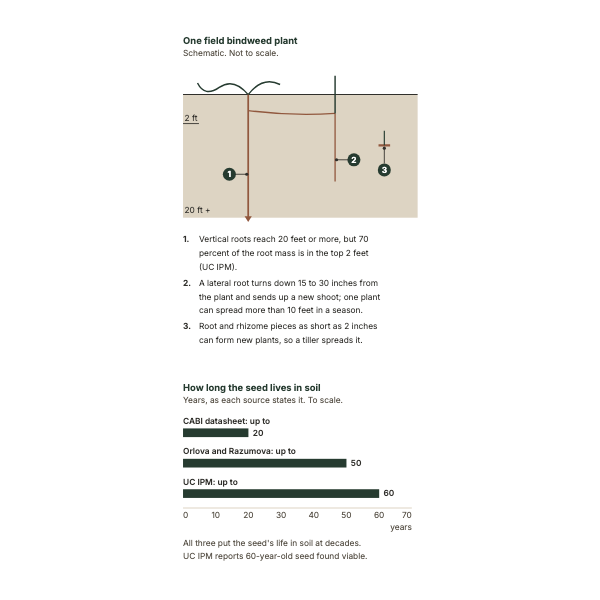
Field horsetail is built differently. Ohio State University’s Weedguide describes a system of dark rhizomes about 5 feet below ground, “sometimes as deep as 20 feet”, with small tubers along them that survive in the soil for long periods. New shoots can come up from 3 feet or more.
Horsetail makes no seeds. It spreads by spores and, much more often, by rhizome pieces and tubers, which “are easily spread to new areas in infested soil.”
That is how a load of bulk soil can bring it into a bed. The same page says it does best in wet, poorly drained ground, which describes this bed’s wet clay and high water table.
Why Pulling Horsetail Never Got Ahead of It
The owners say they fought the horsetail by hand for a couple of years before deciding that pulling was making it worse. The research does not show pulling spreads it faster, but it shows something nearly as discouraging: pulling does not wear it down.
Daniel Cloutier and Alan Watson, working in field plots and a greenhouse, found that field horsetail “regrew as well whether it had been hoed once or 16 times during the growing season” (Weed Science, 1985, cited from the abstract). The next summer, plots kept weed-free all the previous season grew as much horsetail as plots left alone.
In their greenhouse, rhizome pieces 1 cm long, less than half an inch, regrew from 15 cm (6 inches) down. Every shoot pulled from the surface leaves the rest of a system that reaches feet deeper, and every piece that breaks off is a potential new plant.
Herbicides have the same problem. Ohio State calls field horsetail resistant to most agronomic herbicides.
In a New Zealand field trial, Trevor James and Ayub ur Rahman found that products which worked on potted plants left significant regrowth two months after one application in the field (2010, cited from the abstract). Their follow-up applications did better, but also killed all the other vegetation.
A 2024 review by Morgan Pratt, Anna Westbrook and Antonio DiTommaso sums up the field: neither chemical nor mechanical tactics “are likely to achieve full control in a single operation”, though they “may be successfully combined” in an integrated program (Weed Technology, cited from the abstract).
The owners’ three years of spraying fit that picture. Horsetail is managed over seasons, and nothing in the literature read for this article clears it in one operation.
Cardboard and Mulch Against Running Grass
Mulch, cardboard included, works mainly by blocking light. The University of California’s guide to landscape weeds says mulches suppress annual weeds by cutting off the light they need to establish, which is why a seedling under a deep layer never gets going.
Perennials are another matter. The same guide warns that perennial weeds “often have sufficient root reserves to enable them to penetrate even thick layers of mulches.” A rhizome is a store of food, and a shoot from it can push up through mulch that would smother a seedling.
That supports the reply that doubted sheet mulch, at least in part. SARE adds a detail that cuts against piling on mulch and hoping: quackgrass stops forming new rhizomes only when light is cut by 97 percent, and in lower light more of its rhizome buds turn into shoots.
The one controlled test of cardboard on grass found for this article is encouraging but far from this bed. Fernando Gonçalves and colleagues, at a federal university in Rio de Janeiro, Brazil, laid cardboard on mown tropical pasture grasses around tree seedlings, and both grasses died back over 80 percent or more of the covered area in 20 to 50 days (2021, cited from the abstract).
No trial of cardboard or sheet mulch against a temperate running grass was found, and none gives the mulch depth that would stop one. The thread’s own figure for that depth has no published source behind it.
Depth has a cost of its own. UC’s guide keeps coarse organic mulch at 3 to 4 inches and warns that mulch deeper than 4 inches can injure plants by keeping the soil too wet. For a bed on wet clay that already drains poorly, that matters once shrubs go in.
Cardboard can still be part of the answer, in the job UC’s guide gives mulch: keeping new seedlings from establishing once the grass is dead. Against a running grass, the sources read here do not show it doing the killing on its own.
Black Tarp or Clear Plastic
The two plastics work differently. A black or opaque tarp heats the soil only a little, 1 to 3°C in the trials below; it kills what is under it by keeping it in the dark. Clear plastic lets sunlight through and traps the heat, cooking the top of the soil, which is called solarization.
Opaque tarps are fast on small weeds. In trials in New York and Maine, Haley Rylander and colleagues found that 3 weeks under black tarps cut weed cover by 95 to 100 percent at removal, and longer did not do more (HortScience, 2020, cited from the abstracts). Those were annual weeds after a cover crop, though, not an established sod.
For a grass with rhizomes the timeline is longer. A 2022 review by Roger Kubalek and colleagues, which includes a case study from a farm in northwestern Washington, says established perennials may need a tarp for “several months during critical weed growth phases or a full year to break the vegetative life cycle” (HortTechnology, cited from the abstract).
A tarp works by making each shoot spend its stored food on growth that never reaches light. A review of tarping Asian knotweeds, a far tougher rhizomatous plant than any grass, describes the cover as depriving plants of light “to deplete their rhizomatous reserves” (Dusz and colleagues, 2021, cited from the abstract).
That review recommends covering past the edges of the stand. It applies here because this bed’s grass is also growing out of the wall. A tarp that stops at the top of the blocks leaves those shoots in the light, still feeding the rhizomes under the cover.
Clear plastic works by heat, if the weather allows. UC’s solarization guide calls for four to six weeks in the hottest part of the year, on soil wetted to at least 12 inches, with the plastic’s edges buried. Heating is “greatest at the surface”, and control “is usually best for organisms found in the upper 6 inches.”
In California, Clyde Elmore and colleagues controlled bermudagrass and johnsongrass, two running grasses, this way; the edges of fields regrew wherever the plastic did not cover them (1993, cited from the abstract). In Israel, Menashe Horowitz and colleagues found that established perennials escaped (1983, cited from the abstract).
Killing rhizomes outright is possible but slow or costly. A review of couch grass control, another name for quackgrass, by Björn Ringselle and colleagues found that methods able to kill its rhizomes, solarization among them, “often have high costs or time requirements” (Agronomy, 2020, cited from the abstract).
Climate decides the rest. In Maine, Sonja Birthisel and Eric Gallandt cut weed emergence by about four-fifths with two weeks of clear plastic (2019, cited from the abstract).
At a cool, short-season site in Idaho, Jo Ann Robbins and Carol Blackburn found it gave little to no advantage over hoeing (1997, a conference abstract).
UC adds that in cooler or coastal areas black plastic is sometimes the better choice, because weeds can keep growing under clear plastic when the air is not hot enough to kill them.
No solarization trial from western Oregon was found, so whether a given summer there gets hot enough is something only a soil thermometer under the plastic will tell.
How deep each weed lives, and how far each fix reaches
Depths drawn to scale from the sources; band widths and shading are not to scale.
Scraping and clear plastic work in the top few inches, where running grass lives. Horsetail reaches far below both, and regrows from what they leave.
Getting the Dead Mat Out
The owners expect the dead grass to leave a mat of roots so dense there is almost no soil in it, and plan to scrape off the top three or four inches.
The depth figures above support that: if the grass is a running type like quackgrass, most of its rhizomes are in that layer, and a few go deeper.
What stays behind matters. Pieces of rhizome left in the soil survive on their own, as the University of Vermont’s quackgrass fact sheet notes, and Solèmne Skorupinski and colleagues found that heavier pieces sprouted and grew faster than light ones (Weed Research, 2024, cited from the abstract).
Read together with the tarping reviews, which describe a cover as using up rhizome reserves, that argues for scraping after a long cover rather than before it, so the pieces left behind have less to regrow from.
No study found for this article measured how long a dead turf mat takes to break down under a tarp, or how much easier it is to lift afterward.
After solarizing, UC advises keeping any cultivation shallow, under 2 inches, so that weed seeds from deeper soil that did not get hot enough are not brought up to the surface. UC’s landscape guide gives the same reason for avoiding deep tilling in any bed: it brings buried weed seeds to the surface.
A small rented excavator, which the owners discussed, would do the scraping without their backs. It would also lift whatever horsetail is in the top few inches, but the figure shows how little of the plant that is.
Herbicides, Pre-Emergents and Vinegar
Herbicides were the thread’s other main answer, and they divide by what they act on. UC’s landscape guide describes non-selective products that move through a plant, glyphosate among them, as able to kill many perennial weeds, and grass-selective herbicides as able to remove perennial grasses from among ornamentals.
Contact products, which UC’s definitions set apart from those that move through the plant, work differently. UC lists acetic acid, the acid in vinegar, among organic contact ingredients that are “effective for controlling young annual plants as long as there is good spray coverage.”
That describes small annual weeds. No source read for this article says a contact product kills a grass rhizome or a horsetail tuber below the surface.
Pre-emergents act earlier still. UC describes them as preventing the germination or survival of weed seedlings, and says they must be applied before seedlings emerge.
A shoot rising from a rhizome is not a seedling, so a pre-emergent laid over this bed is aimed at new seed, not at the grass or horsetail already there.
Which product to use, how much, how often and where is set by its label, and the label is legally binding. The label also lists which sites and plants a product may be used around, which matters in a bed meant for shrubs and perennials.
Running Down the Seed Bank
One long reply argued that killing the grass once is not enough, because the soil is full of weed seeds waiting to sprout. That is the seed bank, and it is a separate problem from the rhizomes.
UC’s guide gives the method for it: water the area, let the weeds emerge, remove them while small with a shallow scrape or hoe, and repeat that two or three more times. Each round uses up seeds that would otherwise have come up among new plants.
Covers differ here. Kubalek’s review says plainly that “tarping does not reduce the weed seed bank.” Clear plastic can: Birthisel and colleagues found that four weeks of field solarization in Maine cut the viability of buried weed seeds by 64 percent (2019, cited from the abstract).
Running down the seed bank does nothing to rhizomes or tubers, and horsetail has no seeds to deplete. It is the step that keeps a cleared bed clear, not the one that clears it.
New Soil Without New Weeds
The owners’ fear is reasonable. UC’s landscape guide says weeds are “sometimes introduced in the soil brought to the landscape site”, and warns that perennial weeds brought in with plants “will create a long term weed management problem.” Ohio State says the same of horsetail in infested soil, and SARE of quackgrass around nursery roots.
There is no label to rely on. The University of New Hampshire’s extension guide notes that the state has no legal definition of topsoil, and that quality is “impossible to judge” by looking at a pile. UConn’s Home Garden Education Office says Connecticut has no grading or certification system either.
Compost helps with seeds. UC says the heat of composting “should have killed most weed seeds”, with two cautions: compost stored uncovered can catch blown-in seed, and it should be checked for other propagules such as tubers. A study of Alberta feedlot compost windrows by Larney and Blackshaw shows why “most” is the right word (2003, cited from the abstract).
Most seeds died, but the temperature needed varied by species, from 39°C (102°F) for some to over 60°C (140°F) for others, and temperature explained only part of what killed them. “Weed-free” on a compost load is a claim about seeds, and not a guarantee even for those.
That leaves questions a buyer can ask and a check they can run. Both extension guides say to ask where the soil came from and whether it was screened; UNH adds to ask for test data.
UConn suggests asking whether any compost in it comes from a testing program such as the US Composting Council’s Seal of Testing Assurance.
UConn describes that program as requiring routine testing for heavy metals and pathogens. No source read for this article says whether it screens for weed seeds or rhizome pieces, so the seal is not evidence either way on weeds.
The check is UNH’s. Take a sample home, plant a few kinds of seed in it, and watch what comes up.
It shows herbicide residue that could keep seeds from germinating, and “will also help a prospective buyer determine if the soil is infested with difficult-to-control perennial weeds, such as quackgrass or thistles.”
The owners also asked about solarizing a pile of new soil on a tarp in the driveway before it goes into the bed.
UC’s guide supports the idea in a smaller form: moist soil in bags, pots or buckets, set on pallets under a double layer of clear plastic, heats from all sides, and a soil thermometer in the middle shows whether it got hot enough.
A pile on the ground is a different shape from containers on pallets, and no source read tested one. UC’s guide says to keep the treatment going until the coolest spot in the soil reaches the target heat, which means checking more than one place before trusting it.
A Plan for a Bed You Cannot Dig by Hand
Every step below rests on the sources above.
- Find out which grass it is. Lift one clump and look for stems running sideways under the surface, rooting at their joints. If there are none, it is a clump grass with no rhizomes to regrow from. If there are, plan on the longer timeline below.
- Cut it low and cover all of it. Cut the grass down with a string trimmer, then use an opaque tarp, black plastic or a silage tarp, laid over the whole bed and down the outside of the wall, weighted so no light gets in at the edges. For established perennial grass, Kubalek’s review gives several months to a full year.
- Or use clear plastic, if the summer is hot. Wet the soil to about a foot, lay the plastic tight against it, bury the edges, and leave it four to six weeks in the hottest stretch, longer in cooler weather. A soil thermometer under it will show whether the top 6 inches are actually heating.
- Lift the mat, not the bed. Scrape or have someone scrape the dead top layer once it has been covered long enough. Keep any digging after that shallow, so buried seeds stay buried; whether a bed needs tilling at all is its own question.
- Keep after the horsetail for years. Expect shoots to come up through new soil, since they can rise from 3 feet or more. Pulling them does not wear the plant down; if you treat it, follow the product’s label, and judge progress season by season rather than by one treatment.
- Buy soil with questions and a test. Ask its source, whether it was screened, and for test data. Grow seeds in a sample before the full load arrives, and look for grass or horsetail coming up.
- Plant, then mulch. Put in the shrubs, spread a coarse mulch 3 to 4 inches deep, keep it topped up, and pull new grass while it is small.
Local Regulations and Safety Advisory
If you use pest control products, follow the label. Rules on them vary by country and locality, and your pesticide regulator can say what applies where you live. This article is general information, not legal advice.
Authorities to consult:
- Pesticide regulatory authority or environmental protection agency
What Remains to Be Explored
No trial of cardboard or sheet mulch against a temperate running grass was found, and none gives the mulch depth that would stop one. The only controlled cardboard result is on tropical pasture grasses.
No study found for this article measured how long a dead turf mat takes to break down under a tarp, or tested whether hand pulling makes horsetail spread faster rather than simply failing to slow it.
No solarization trial from western Oregon summers was found, and none tested solarizing a pile of soil rather than a bed or containers. How deep this bed’s horsetail runs below its gravel layer is unknown, and so is whether the compost testing seal screens for weed seeds.
Sources
- Feeling Overwhelmed With a Big Problem..How Would You Tackle This? — multiple community members. Reddit, r/landscaping. Undated.
- Field Horsetail (Equisetum arvense) — unknown. Ohio State University, Ohio Weedguide (CFAES). Undated.
- Pest Notes: Soil Solarization for Gardens & Landscapes (Publication 74145) — J.J. Stapleton, R.H. Molinar, C.A. Wilen. University of California Statewide IPM Program. Undated.
- Pest Notes: Weed Management in Landscapes (Publication 7441) — C.A. Wilen. University of California Statewide IPM Program. Undated.
- Quackgrass, in Manage Weeds on Your Farm — Charles L. Mohler, John R. Teasdale, Antonio DiTommaso. SARE (Sustainable Agriculture Research and Education). July 22, 2021.
- Quackgrass (Fact Sheet) — unknown. University of Vermont Extension, Vermont Vegetable and Berry Program. Undated.
- Purchasing Topsoil — Richard Uncles, Tom Buob. University of New Hampshire Cooperative Extension. August 2016.
- What to Know Before You Buy Topsoil — Heather Zidack. University of Connecticut, Home Garden Education Office. May 17, 2026.
- Growth and Regeneration of Field Horsetail (Equisetum arvense) — Daniel C. Cloutier, Alan K. Watson. Weed Science. 1985. Cited from its abstract.
- Reproductive Strategy, Management, and Medicinal Uses of Field Horsetail (Equisetum arvense) — Morgan K. Pratt, Anna S. Westbrook, Antonio DiTommaso. Weed Technology. 2024. Cited from its abstract.
- Chemical Control of Field Horsetail (Equisetum arvense) — Trevor Kenneth James, Ayub ur Rahman. New Zealand Plant Protection (Proceedings of the New Zealand Weed Control Conference). 2010. Cited from its abstract.
- Solarization for Weed Control — Menashe Horowitz, Yael Regev, G. Herzlinger. Weed Science. 1983. Cited from its abstract.
- Perennial Weeds Respond to Control by Soil Solarization — Clyde L. Elmore, John A. Roncoroni, Deborah Giraud. California Agriculture. 1993. Cited from its abstract.
- Solarization for Weed Control in a Short-Season Climate — Jo Ann Robbins, Carol Blackburn. HortScience (conference abstract). 1997. A meeting abstract, not a full paper.
- Black Plastic Tarps Advance Organic Reduced Tillage I: Impact on Soils, Weed Seed Survival, and Crop Residue — Haley Rylander, Anusuya Rangarajan, Ryan M. Maher, Mark G. Hutton, Nicholas W. Rowley, M. T. McGrath, Zachary F. Sexton. HortScience. 2020. Cited from its abstract.
- Review of Tarping and a Case Study on Small-Scale Organic Farms — Roger Kubalek, David M. Granatstein, Doug Collins, Carol A. Miles. HortTechnology. 2022. Cited from its abstract.
- Review of Existing Knowledge and Practices of Tarping for the Control of Invasive Knotweeds — Dusz MA, Martin FM, Dommanget F, Petit A, Dechaume-Moncharmont C, Evette A. Plants (Basel). 2021. Cited from its abstract.
- Trials Evaluating Solarization and Tarping for Improved Stale Seedbed Preparation in the Northeast USA — Sonja K. Birthisel, Eric R. Gallandt. Organic Farming (Librello). 2019. Cited from its abstract.
- Effects of Field and Greenhouse Solarization on Soil Microbiota and Weed Seeds in the Northeast USA — Sonja K. Birthisel, Grace Smith, Gavriela M. Mallory, Jianjun J. Hao, Eric R. Gallandt. Organic Farming (Librello). 2019. Cited from its abstract.
- Efficiency of Cardboard Crowning on the Suppression of Invasive Alien Grasses — Fernando Lima Aires Gonçalves, Izar Aximoff, Alexander Silva de Resende, Guilherme Montandon Chaer. Floresta e Ambiente. 2021. Cited from its abstract.
- A Review of Non-Chemical Management of Couch Grass (Elymus repens) — Björn Ringselle, Benny De Cauwer, Jukka Salonen, Josef Soukup. Agronomy. 2020. Cited from its abstract.
- Rhizome Fragment Weight and Density of Competing Shoots Determine Belowground Regrowth of Elymus repens — Solèmne Skorupinski, Nathalie Colbach, Hugues Busset, Annick Matéjicek, Delphine Moreau. Weed Research. 2024. Cited from its abstract.
- Weed Seed Viability in Composted Beef Cattle Feedlot Manure — Larney FJ, Blackshaw RE. Journal of Environmental Quality. 2003. Cited from its abstract.