A snake plant that droops or falls over has most often been overwatered: its shallow roots rot and the plant tips over, especially in winter. Too little sun while it is growing makes leaves fold and flop, and cold below 55°F can bring rot too. Look first at how often it has been watered, then at its light and warmth.
The New York Botanical Garden’s library guide puts it plainly: “Over-watering is the most frequent problem, especially during the winter, and results in rot, capsizing foliage and plant death.”
What This Article Covers
This article covers snake plant leaves that bend, fold or fall outward: overwatering and rot, too little light, cold, how to tell which, and how to save the plant. Dividing a crowded plant is covered in dividing a root-bound snake plant.
Flowers on a snake plant are covered in why a snake plant flowers, and how dim a room any houseplant can take in what low light does to houseplants.
Overwatering and Rot
NYBG’s guide says “Too much water is the most frequent cause of failure,” and explains the fall directly: “succulents do have shallow roots and they will rot easily if over-watered, causing the plant to fall over.”
The University of Connecticut’s Home and Garden Education Office agrees: “Overwatering is the quickest way to kill any houseplant, but especially so with these.” It warns, “Do not let them get soggy or this otherwise hardy plant will rot.”
NYBG says this happens especially in winter, and two findings help explain why a pot can stay wet.
A drained pot keeps a saturated layer at its base after watering, “known as a perched water table,” whose depth is set by the potting mix, not the pot (Rowe 2025, reviewing earlier work).
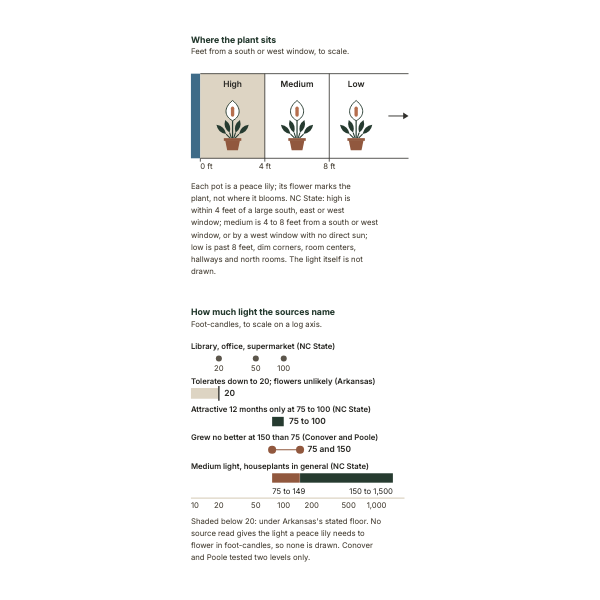
And plants use less water in less light. In a trial with six other foliage plants in self-watering containers, all six used more water at 150 foot-candles than at 75 (Conover and Poole 1992, from the abstract). None was a snake plant.
The guides water accordingly. NYBG lets the soil just dry between waterings in active growth and, from October through February, waters “only as often as is necessary to prevent the leaves from puckering, no more than every two weeks.” UConn suggests about once a month in winter, sparingly.
Too Little Light
Light is the second cause NYBG names. Its guide says folding and flopping leaves indicate a plant that has been overwatered or is not getting enough sun while in active growth, often because it is kept growing through the winter when it should rest.
Snake plants tolerate dim rooms for a long time without growing.
NC State’s handbook rates them as staying attractive about 12 months at 15 to 20 foot-candles, very low light, and lists the signs of too little light: leaves that do not expand fully, pale color, long spaces between leaves, and leaves that may detach.
UConn describes the end point: placed in the darkest corner, snake plants “hang on for a few months, but then eventually run out of stored resources and die.”
NYBG adds that they “will not grow without moderate sunlight,” and NC State’s plant record suggests direct sun for 2 to 6 hours of the day. Where light cannot be raised, NC State’s handbook gives a short rule: “Do not overwater”.
One older greenhouse trial shows how growing conditions shape the plant. Grown in sunlight, snake plant was more compact as air movement increased, and its leaves became smaller as air movement declined (Carpenter and Nautiyal 1969, from the abstract).
Cold
Most drooping snake plants have wet roots
Overwatering rots the shallow roots and the plant falls over; too little sun while it grows makes leaves fold and flop; cold below 55°F brings rot too.
Panel A: New York Botanical Garden, Mertz Library; Rowe, PLOS ONE, 2025. Panel B: New York Botanical Garden; University of Connecticut (Lisy, 2024); Wang, HortScience, 1992, a meeting abstract.
Overwatering is the most frequent problem, especially in winter (NYBG).
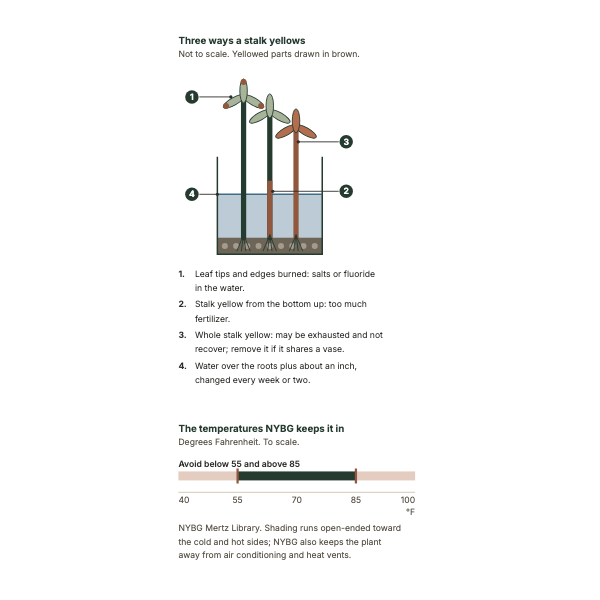
Both sources set the same floor. NYBG: “Do not keep below 55°F,” with 65 to 80°F ideal. UConn: “avoid anything below 55 degrees F.” NYBG also warns that “Cold winter drafts will also cause rot and sudden plant death.”
That floor sits inside the range where tropical plants are generally hurt by chilling. A review of tropical crops put most of them as sensitive below 10 to 15°C, about 50 to 59°F, with the exact temperature varying by species and tissue (Wang 1992, a meeting abstract). No study read measured the limit on snake plant itself.
Is It Root-Bound?
A crowded pot is sometimes blamed, but the guides read do not treat it as a cause of drooping.
NYBG says “Snake plants like to be root-bound and can stay in the same pot for several years,” with some surface soil replaced each year, and says to repot once the plant is running short of room.
UConn notes the other side of that: the rhizomes spread until the plants “tend to break the pots they are in,” and it suggests a plastic pot, set inside a clay one if you want the look. Neither source ties a full pot to leaves falling over.
How to Tell Which It Is
The sources point to a few checks. A plant that falls over from the base, after regular watering in winter or in a dim spot, fits NYBG’s account of rot. Leaves that fold and flop in a dim place, without a soft base, fit its account of too little sun.
A plant that drooped after a cold night by a window or a draft fits the cold account.
These are matches to what the guides describe, not a tested way to tell the causes apart, and more than one can act at once: NYBG links the flopping to plants kept growing through a dim winter.
Saving the Plant
NYBG’s guide allows cutting floppy foliage: “Remove no more than 1/4 of the plant’s total leaf surface by cutting individual leaves to just above the soil,” with a clean tool, keeping the cut dry while it heals. Spring, when the plant is starting new growth, is best.
For a plant with a healthy new center, the same guide suggests repotting in spring, removing older, unhealthy parts with their roots and keeping the vigorous center, in a smaller pot with a drain hole and quick-draining soil, such as potting soil with a third sand or perlite.
Its last instruction matters most: “Be sure to correct the conditions that encouraged the unhealthy leaf growth so that new, sturdy leaves are formed.”
The cut leaves leave a withered stub, and as new leaves grow, more of the old ones can be cut away over time. The guide also notes that a leaf whose pointed tip breaks may stop growing.
Do not move it suddenly into strong sun. NYBG warns: “Do not move a snake plant from a shady position into the bright sunlight or it will scorch.”
What to Do
- Start with the watering. Overwatering is the most frequent problem, especially in winter, and a plant that falls over from the base fits rot (NYBG).
- Let the mix dry. Water only when it has dried in growth, and in winter no more than every two weeks to once a month (NYBG; UConn).
- Empty the saucer. NYBG removes water left in the dish after 15 minutes.
- Give it more light, but not all at once. NC State suggests some direct sun; a sudden move from shade scorches (NYBG).
- Keep it above 55°F and out of drafts. Both NYBG and UConn set that floor.
- Cut no more than a quarter of the floppy leaves. Cut at soil level, in spring if you can (NYBG).
What Remains to Be Explored
No trial was found on what makes snake plant leaves droop, so the causes rest on botanic garden and extension practice, and the mechanisms on studies of other plants.
No study read measured how long the mix stays wet in a dim winter room or the cold limit for this plant.
No source read gives a test that separates rot, low light and cold by sight. A trial growing snake plants under set light, water and temperature, and recording which leaves fall, would answer the question most readers have.
Sources
- Snake Plant (Dracaena) Research Guide — New York Botanical Garden, Mertz Library. New York Botanical Garden, LuEsther T. Mertz Library. November 22, 2026.
- How Should I Water a Snake Plant? — New York Botanical Garden, Mertz Library. New York Botanical Garden, LuEsther T. Mertz Library. November 22, 2026.
- Sensational Sansevieria — M. Lisy. University of Connecticut, Home and Garden Education Office. March 28, 2024.
- Plants Grown in Containers, Chapter 18 (Tables 18-10 To 18-13) — D. Mays, K. Richter, L.K. Bradley, J. Sherk, M. Kistler, and J. Neal; K.A. Moore and L.K. Bradley (eds). NC State Extension, North Carolina Extension Gardener Handbook, 2nd ed.. February 1, 2022.
- Dracaena trifasciata (Snake Plant) — NC State Extension. NC State Extension Gardener Plant Toolbox. November 12, 2026.
- Water Utilization of Six Foliage Plants Under Two Interior Light Intensities — Conover C. A., Poole R. T. Journal of Environmental Horticulture. 1992. Cited from its abstract.
- Effect of Drainage Layers on Water Retention of Potting Media in Containers — A. Rowe. PLOS ONE. February 25, 2025. Read in full.
- Light Intensity and Air Movement Effects on Leaf Temperatures and Growth of Shade-Requiring Greenhouse Crops — W. J. Carpenter and J. P. Nautiyal. Journal of the American Society for Horticultural Science. 1969. Cited from its abstract.
- Chilling Injury of Tropical Horticultural Commodities — Chien Yi Wang. HortScience. 1992. A meeting abstract, not a full paper.