A peace lily will live in a dim room, but it is unlikely to flower there: give it bright light out of direct sun, keep the mix moist, letting it dry a little between waterings, never leave it standing in water, keep it warm, and keep it away from pets and children.
Most extension pages read describe it as tolerant of low light, and their numbers for how low run widely. The University of Arkansas puts its floor at 20 foot-candles, NC State’s figure for a library, while NC State’s handbook lists a peace lily as staying attractive for a year only at 75 to 100.
The sources also keep it moist. South Dakota State, Arkansas and Iowa State add never to leave it standing in water, and Iowa State calls overwatering much more fatal to a peace lily than drought. Salt in its irrigation water slowed its growth in trials.
What This Article Covers
It covers caring for a peace lily indoors: light, watering, root rot, the pot, temperature, brown tips and yellow leaves, its flowers, and its safety around pets and children. It prints no feeding rate; that belongs to the fertilizer’s label.
A peace lily that collapses between waterings has its own guide in why a peace lily droops, and one that has stopped flowering in getting a peace lily to bloom again.
How Much Light a Peace Lily Needs
Most sources read share one point: a peace lily gets by in less light than many houseplants. South Dakota State calls it the closet plant, Iowa State one of few tropical houseplants that prefers moderate light yet tolerates low light, and Washington State’s tip sheet files it under low light.
They part on how much less. Gerald Klingaman of the University of Arkansas wrote in 1999 that peace lilies tolerate very low light, down to 20 foot-candles, but at such low levels probably will not flower. NC State’s plant record gives it partial to deep shade.
NC State’s Extension Gardener Handbook rates it higher, at high to medium light. Its table of how long houseplants stay attractive lists a peace lily in one column only, 12 months at 75 to 100 foot-candles; the same chapter puts an office at 50 and a supermarket at 100.
One trial measured growth at room light. Conover and Poole grew six foliage plants at 75 and 150 foot-candles, two levels they describe as common in homes and offices. Growth was better at 150 for all of them except three, and the peace lily was one of the three.
A newer trial grew peace lilies for eight months in an indoor living wall under lamps alone, at low light.
Ntoulas and colleagues found growth and flowering largely unaffected by the lamps’ color, and wrote that the plant can adapt to a wide range of white LED spectra at low irradiance.
Flowers ask for more. Iowa State says a peace lily should receive at least moderately bright conditions to flower, and Klingaman advised a spot bright enough to read a newspaper.
NC State, the University of Florida and South Dakota State all keep it out of direct sun.
Without a light meter, NC State’s chapter gives distances. High light is within 4 feet of a large south, east or west window; medium is 4 to 8 feet from a south or west window, or by a west window with no direct sun; low is past 8 feet, in dim corners, hallways and north-facing rooms.
South Dakota State suggests an east or a north window. No source read gives, in foot-candles, the light a peace lily needs to flower, so the figure draws none; the newspaper test and the moderately bright room are the guidance on offer.
A peace lily lives in dim light; the sources ask for more to flower
Extension pages call it a low-light plant. NC State’s table lists it as staying attractive 12 months only at 75 to 100 foot-candles, brighter than its office figure of 50, and Arkansas doubts it flowers near its floor of 20.
NC State Extension Gardener Handbook, chapter 18 (Mays and colleagues 2022), Tables 18-10, 18-12 and 18-13 and its window distances; Klingaman, University of Arkansas (1999); Conover and Poole (1992).
NC State rates peace lily for high to medium light; for flowers, Iowa State and Arkansas ask for moderately bright light; NC State, UF/IFAS and SDSU keep it out of direct sun.
Watering by the Mix, Not the Calendar
The sources share the aim: a mix that stays moist without staying wet. South Dakota State asks for soil that is moist but not soggy and dries a little between waterings, and Arkansas for soil kept uniformly moist. Both say never to let the plant sit in water.
Iowa State’s Linda Naeve wrote that a peace lily typically does well watered once a week in winter. A droop between waterings calls for a thorough watering, she added, and may mean once a week is not often enough for the plant’s size, its mix and its light.
Light changes how much water the plant uses. In Conover and Poole’s trial every plant, the peace lily among them, used more water at 150 foot-candles than at 75. Iowa State also asks for more water while the plant is blooming.
Iowa State warns as well against leaving a peace lily standing in a saucer or in the bottom of a lined basket. How to read the pot before watering, and what a droop does and does not mean, are in why a peace lily droops.
When the Roots Rot
Iowa State and South Dakota State tie losing the plant to wet soil; South Dakota State names root and stem diseases from overwatering.
Migotto and colleagues describe Cylindrocladium spathiphylli, a fungus that rots the crown and roots of spathiphyllum and turns the leaves above yellow and wilted. Their abstract does not say what conditions favor it.
A CABI description records the same fungus as a root and leaf disease of spathiphyllum, probably spread by wind and splashing water, in Florida, Hawaii, Italy and Australia. Its signs above ground, yellowing and wilting, overlap with the signs South Dakota State gives for a pot kept too dry.
NC State’s chapter checks the roots: tip the plant out of its pot and look. Overwatered roots are brown and soft and may smell. Its advice is to trim off the brown roots and repot, possibly in a smaller container.
After that move, it says, “it is crucial not to overwater nor let the few remaining roots dry out.” No source read gives a way for a home grower to tell the crown rot fungus from other rots by eye.
Pot, Repotting and Dividing
The sources agree a peace lily can stay in a snug pot. NC State’s plant record says it should be kept somewhat pot-bound, South Dakota State that it tends to get rootbound, and Klingaman advised repotting only once plants crowd their container and are hard to keep watered.
South Dakota State gives two signs that the time has come: roots showing through the drainage holes, or roots circling the top of the soil. It also says older leaves yellow when a plant has not been repotted in a while, and asks for a well-drained potting soil.
A crowded plant can also be divided. Klingaman described the leaves rising from a much-branched rhizome, a creeping stem along the soil surface.
Nebraska’s propagation guide lists division as the way to multiply a peace lily, and the University of Florida divides it in spring.
Warmth and Cold
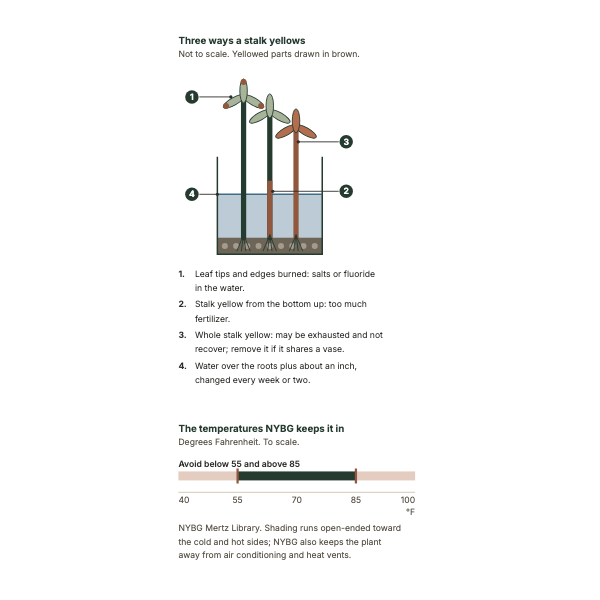
The sources agree a peace lily wants room warmth. South Dakota State gives 65 to 80°F, says to avoid anywhere at 55°F or below, and adds that the plant will die if exposed to cool temperatures for a long time. NC State’s record says 40 to 60°F slows growth considerably.
Klingaman added keeping it away from cold drafts. None of these pages says how long a chill takes to injure a peace lily or what the injury looks like.
Iowa State adds a note on flowering: peace lilies typically bloom best after a few months at a cool 60 to 65°F followed by 70 to 75°F. Its column cites no study for the sequence, and no other source read repeats it.
Brown Tips, Yellow Leaves and Feeding
Brown tips have several causes in the sources, and over-fertilizing appears in two of them. South Dakota State lists too much light, over-fertilizing, too little water and low humidity. NC State’s plant record says over-fertilizing and salt build-up can burn leaf tips and roots.
NC State’s 1994 growers’ bulletin lists spathiphyllum among the plants hurt by fluoride at the level added to town water, with toxic levels scorching the tips of older leaves. Which water suits houseplants is covered in what water to use for houseplants.
Two reports by Campos and Reed measured salt on peace lily ‘Petite’. Height and leaf area fell as salt in the irrigation water rose, and at the saltiest level tested the best growth came at a lower fertilizer level than with no salt added. They suggest sodium and chloride in the leaves may have done the harm.
Brown tips across houseplants are taken apart in what causes brown leaf tips. Yellow leaves, by South Dakota State’s account, come from watering too much or too little; the patterns are in why houseplant leaves turn yellow.
South Dakota State feeds a peace lily in spring and summer, and Washington State’s tip sheet says to feed it to encourage blooming. The amount and how often come from the fertilizer’s label.
What Happens to the Flowers
What looks like a white petal is a spathe, a bract that wraps the true flowers on the central column, Iowa State explains; NC State calls it a modified leaf.
NC State says the bloom turns pale green after 10 days and stays attractive for at least another month.
Klingaman wrote that a peace lily left to itself flowers erratically, a few blooms at a time, and that growers time flowering with a gibberellic acid spray, the blooms appearing about two months later. NC State’s record says instead that it flowers freely, with no set bloom time.
Iowa State names two possible reasons one stops: a variety bred for its foliage rather than its flowers, and too little light. Whether to cut a spent flower, and how to bring a plant back into bloom, are in getting a peace lily to bloom again.
How Long Does a Peace Lily Live?
Iowa State says peace lilies survive a long time, and the plant can be divided as it crowds its pot. No source read gives a lifespan in years, for a plant in a pot or in the wild.
Is It Safe Around Pets and Children?
The sources agree it is not a plant to chew. NC State’s record rates its poison severity as medium, from calcium oxalate crystals in the leaves, and names cats, children, dogs and horses. Eaten in large quantities, it says, it can cause severe mouth pain, burning, drooling, vomiting and trouble swallowing.
The ASPCA lists the peace lily as toxic to dogs and cats, citing insoluble calcium oxalates.
South Dakota State calls it mildly toxic and advises keeping small children, cats and dogs from chewing on it, and notes that it is not a true lily but a member of the Araceae.
One allergy case is on record: a caretaker who supplied plants to offices developed an allergy, his skin tests reacting to the flower, pollen, stem and leaves (Kanerva and colleagues, 1995). What a toxic rating means for a cat is in what toxic to cats means.
Local Regulations and Safety Advisory
If you use fertilizer products, follow the label. Rules on them vary by country and locality, and your agriculture department can say what applies where you live. This article is general information, not legal, medical or veterinary advice.
Authorities to consult:
- Local agriculture department
- Poison control service
- Veterinarian or animal poison control service
If a child or pet may have eaten part of a plant, contact a poison control service or a veterinarian, because toxicity depends on the species, the amount and the individual.
What Remains to Be Explored
The light a peace lily needs to flower has not been put in foot-candles in any source read; Arkansas and Iowa State describe it in words.
Conover and Poole tested one cultivar at two levels, so whether growth rises between 150 foot-candles and a window is outside that trial.
No source read gives a lifespan, a time for a chill to injure the plant, or a way to tell the crown rot fungus from other rots at home. A trial of flowering across measured home light levels, and a measured chill threshold indoors, would change the advice.
Sources
- Chapter 18: Plants Grown in Containers (Extension Gardener Handbook) — D. Mays, K. Richter, L.K. Bradley, J. Sherk, M. Kistler, and J. Neal. North Carolina State Extension. 2022.
- Spathiphyllum (Peace Lily, Spathe Flower, White Sails) — NC State Extension, North Carolina Extension Gardener Plant Toolbox. Undated.
- Plant of the Week: Spath (Peace Lily) — Gerald Klingaman. University of Arkansas System Division of Agriculture. December 3, 1999.
- Peace Lily: Houseplant How-To — Cindy Schnabel. South Dakota State University Extension. April 25, 2024.
- Lily Brings Peace of Mind (Reiman’s Pick) — Linda Naeve. Iowa State University Extension. December 31, 2003.
- Peace Lily (Gardening Solutions) — University of Florida IFAS Extension. Undated.
- #15 Houseplants (Master Gardener Tip Sheet) — Washington State University Extension, King County. Undated.
- Propagating House Plants (NebGuide G1853) — David E. Lott and Dale T. Lindgren. Nebraska Extension. December 2012.
- Water Quality; Water Acidification — Paul V. Nelson and Douglas A. Bailey; Douglas A. Bailey. N.C. Flower Growers’ Bulletin, NC State University Department of Horticultural Science. June 1994.
- Water Utilization of Six Foliage Plants Under Two Interior Light Intensities — C.A. Conover, R.T. Poole. Journal of Environmental Horticulture. 1992. Cited from its abstract.
- Effects of White LED Correlated Color Temperature on Growth, Flowering, Physiology, and Visual Perception of Spathiphyllum wallisii in Indoor Living Walls — Ntoulas N, Mougiakou A, Bertsouklis K, Liakopoulos G, Papafotiou M. Horticulturae. 2026. Cited from its abstract.
- Influence of Irrigation Water Salinity on Optimal Nitrogen, Phosphorus, and Potassium Fertilizer Rates on Spathiphyllum ‘Petite’ — Campos R, Reed DW. HortScience. 1992. A meeting abstract, not a full paper.
- Influence of Irrigation Water Salinity on Optimal Nitrogen, Phosphorus, and Potassium Liquid Fertilizer Rates for Spathiphyllum ‘Petite’ — Ricardo Campos; David Wm. Reed. Journal of Environmental Horticulture. 1994. Cited from its abstract.
- Cylindrocladium Spathiphylli De Espatifilo (Spathiphyllum wallisii Rengel): Detecção De Enzimas Extracelulares Em Isolados Normais E Alterados Por Temperatura — Bruna Cristina Migotto; Ana Beatriz Monteiro Ferreira; César Júnior Bueno. Summa Phytopathologica. 2013. Cited from its abstract.
- Calonectria Spathiphylli. [Descriptions of Fungi and Bacteria] — P. W. Crous. CABI. 1993. Cited from its abstract.
- Occupational Allergy Caused by Spathe Flower (Spathiphyllum wallisii) — Kanerva L, Mäkinen-Kiljunen S, Kiistala R, Granlund H. Allergy. 1995. Cited from its abstract.
- Peace Lily — American Society for the Prevention of Cruelty to Animals. Undated.