Pads that grow thin, pale and lanky in a dim room are the stretched growth Iowa State University Extension describes when a succulent gets too little light.
Some succulents recover over time and some need the lanky growth cut back, Iowa State says. A healthy pad can also be rooted upright after its cut has dried, as UF/IFAS describes. Move the plant into brighter light slowly, because a sudden move into sun scalds it.
The question comes from a thread on r/cactus. A cactus with flat pads sat in a basket in a dim room, which the post says was a bathroom. Its pads were thin and collapsed, and pale roots hung from them above the soil.
The poster wondered whether the plant thought it was underground. Replies called the growth etiolated, blamed the dim light, warned that sun would now burn it, and suggested cutting a piece, drying it and replanting it, laying pads flat, or giving up on the plant.
The thread does not name the plant. Most of the studies read below are on prickly pears, Opuntia, so where a finding comes from them the article says so, and whether it holds for this plant is not known.
What This Article Covers
This article covers why a cactus like this stretches in low light, whether its pads fill out again, what is and is not known about roots growing above the soil, and how the trials and extension guides root a new plant from a pad. An aloe stretching the same way is covered in a skinny, tall aloe.
Why the Pads Went Thin
Iowa State’s guide to succulent problems, by Aaron Steil, says tall, spindly, lanky new growth that is pale points to too little light. Indoors, it says, succulents need abundant bright light, ideally ten or more hours a day, or grow lights set within 12 inches and run 12 to 16 hours.
In one model of prickly pear growth, light is one of three limits. Park S. Nobel and Victor Garcia de Cortázar predicted its growth across 169 sites in the United States from water, temperature and light, and found the light term lowered the prediction in the Northeast and Northwest.
A prickly pear pad is a flattened stem, as UF/IFAS Gardening Solutions puts it, and pads join only at a small point.
Nobel and Richard W. Meyer measured the joint at about 3.5 percent of a pad’s edge, yet found the shoots quite rigid, each pad bending less than 10 degrees under its own weight.
Will the Stretched Pads Fill Out?
Iowa State gives three outcomes. Some succulents recover from low light over time; others need the lanky growth pruned away so new growth forms in better light; and in many barrel cacti the narrow, misshapen growth stays with the plant even after more light arrives.
It does not say which group a prickly pear falls in, and no source read followed a stretched pad after a move to better light.
Before giving up on the plant, Iowa State’s other signs are worth checking. Soft, mushy stems with yellowing go with too much water; wrinkled, mottled stems with too little. No source read gives a test for whether a stretched pad cactus will live.
The Roots in the Air
No source read explains why a pad cactus grows roots above the soil, or whether low light or a humid room sets them off. The thread’s guess, that the plant thinks it is underground, is not tested anywhere read.
Some cacti make such roots as a matter of course. Bennett Pauls and colleagues describe Selenicereus undatus, a climbing cactus, holding on to its supports with roots that grow from the stem and join its water-carrying tissue.
Humid air favored roots in the air in other plants. Laura Sheeran and Amanda Rasmussen grew three tropical aroids at high and ordinary indoor humidity; all grew more at high humidity, and their aerial roots gained the most. Whether a bathroom does the same to a cactus is not known from them.
Moving It Into Light
The replies were right that sun can burn it. Iowa State says brown or tan patches on stems are sun scald. The primary cause, it says, is moving a succulent kept in low light suddenly into bright or direct sun. The damaged areas do not recover, and stems scar.
Its advice is to move succulents to new light slowly. It gives no schedule, and no source read gives one for a pad cactus coming out of a dim room.
Rooting a Healthy Pad
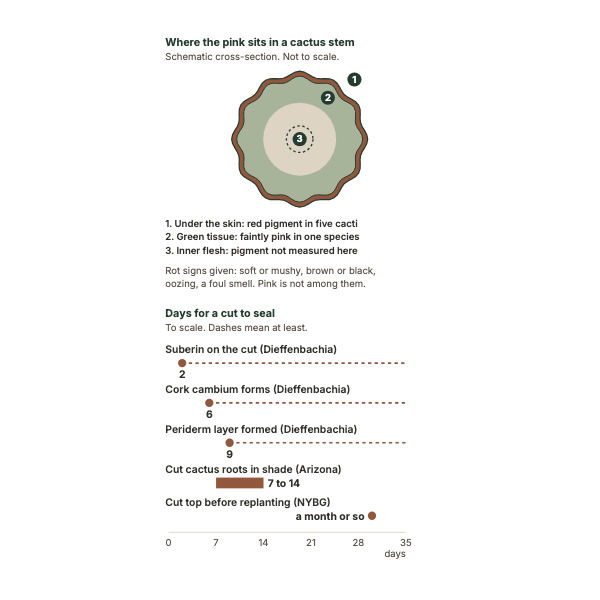
UF/IFAS Gardening Solutions, writing about prickly pear, calls propagation from pads simpler and quicker than seed. Cut a pad at least six months old, let it stand upright until the cut has callused, a week or two, then set it upright about an inch deep in a mix of soil and sand.
Stretched growth points to too little light; a healthy pad can be rooted
Iowa State says some succulents recover over time and others need the lanky growth cut back.
Iowa State University Extension (2023); UF/IFAS Gardening Solutions; Mulas and Dessena (2019).
In one trial, pad pieces rooted at 84 to 93 percent across three drying times, with 96 hours the highest (Mulas and Dessena 2019).
The same page says to leave the pad unwatered for about a month, then water once the soil has dried. That advice is written for Florida yards in sun, not a pot indoors.
Upright beat flat in a Tunisian trial on prickly pear. Sondes Stambouli-Essassi and colleagues planted halves, quarters and tenths of pads horizontally or vertically; pieces taken in spring and set upright, the right way up, rooted best, and all of one set rooted.
Smaller pieces kept their ability to root and sprout: the bottom tenths grew the most roots, up to 80, and new pads appeared most often on the top pieces, 70 and 74 percent.
Drying the Cut
Iowa State’s propagation guide says to let a cut stem dry and callus for several days so it is less likely to rot. The trials put numbers on it.
Maurizio Mulas and Leonarda Dessena cut year-old prickly pear pads into pieces of 10 to 12 cubic cm, each with at least two bud areoles, and dried them in an oven at 35°C for 72, 96 or 120 hours, losing 30.7, 34.4 and 35.4 percent of their weight.
Set on sand outdoors for 120 days, 85.7, 92.6 and 83.9 percent of the pieces rooted. The 96-hour pieces grew the longest roots, 17.0 cm on average, and were the only ones to gain weight.
Drying did not help in every trial. Rafael Llinas and colleagues found pad sections of another species, Opuntia cochenillifera, rooted more than whole pads whether or not they were dried for 14 days first. Shading them was harmful; the authors suggest humidity and the pads’ own water favored rot.
Pot, Mix and Water
Iowa State says to use a container with a drainage hole and well-drained mix, and to let the soil dry out thoroughly between waterings; soil that is too fine or organic holds too much water.
UF/IFAS adds that in moist, rich soil a prickly pear grows soft and is open to root and stem rot.
Prickly pear roots answer to drying and rewetting. Joseph G. Dubrovsky and colleagues found that 7 days of fast drying killed most root tips after 3 days, and 2 days of rewetting restored the roots’ water conductance through new side roots. Slower drying over 14 days killed few root tips.
For a piece that will not root, a succulent pup that won’t root covers water, drying and rot. Cutting and callusing cactus pieces is also covered in pink inside a cut cactus.
What Remains to Be Explored
No source read explains roots above the soil on a pad cactus, tests how long pads survive in a dark cupboard, or follows a stretched pad after it is moved into better light.
The rooting trials used farm cultivars and a forage species of prickly pear, not a cactus kept as a houseplant, and none timed how fast to bring a dim-grown plant into sun.
The thread does not name its plant, so whether the prickly pear results apply to it is not known.
Sources
- What’s up With This Plant? — multiple community members. Reddit, r/cactus. Undated.
- Common Problems and Issues of Succulents — Aaron Steil. Iowa State University Extension and Outreach, Yard and Garden. August 2023.
- How to Propagate Succulents — Aaron Steil. Iowa State University Extension and Outreach, Yard and Garden. August 2023.
- Prickly Pear — UF/IFAS Gardening Solutions. Undated.
- Propagation of Opuntia ficus-indica by Cladode Fragments — Maurizio Mulas; Leonarda Dessena. Acta Horticulturae. 2019. Cited from its abstract.
- Evaluation of the Efficiency of Opuntia ficus-indica Cladode Cuttings for Vegetative Multiplication — Sondes Stambouli-Essassi; Rania Harrabi; Sadok Bouzid; Féthia Harzallah-Skhiri. Notulae Botanicae Horti Agrobotanici Cluj-Napoca. 2015. Cited from its abstract.
- Effect of Sectioning, Drying, and Shading on the Propagation of Opuntia cochenillifera (L.) Mill. Cladodes — Rafael Llinas; Carlos Atencio; Andy González; Gisela Castro Rivero; Jorge Ortega; Ciolys Colmenares; R Daniel Arturo León. Revista de la Facultad de Agronomía. 2026. Cited from its abstract.
- Root Growth, Developmental Changes in the Apex, and Hydraulic Conductivity for Opuntia ficus-indica During Drought — Joseph G. Dubrovsky; Gretchen B. North; Park S. Nobel. New Phytologist. 1998. Cited from its abstract.
- BIOMECHANICS OF CLADODES AND CLADODE-CLADODE JUNCTIONS FOR OPUNTIA FICUS-INDICA (CACTACEAE) — Park S. Nobel; Richard W. Meyer. American Journal of Botany. 1991. Cited from its abstract.
- Growth and Predicted Productivity of Opuntia ficus-indica for Current and Elevated Carbon Dioxide — Park S. Nobel; Victor Garcia de Cortázar. Agronomy Journal. 1991. Cited from its abstract.
- Anatomical and Biomechanical Properties of the Junction Between Stem and Aerial Roots of Selenicereus undatus — Bennett Pauls; Thea Lautenschläger; Christoph Neinhuis. Plants. 2023. Cited from its abstract.
- Aerial Roots Elevate Indoor Plant Health: Physiological and Morphological Responses of Three High-Humidity Adapted Araceae Species to Indoor Humidity Levels — Laura Sheeran; Amanda Rasmussen. Plant, Cell & Environment. 2023. Cited from its abstract.