An aloe that is tall, thin and pale is most likely short of light. Iowa State lists tall, spindly, pale new growth, and rosettes that open up and flatten, as signs of too little light. Tan or brown patches after a move outdoors point to the move itself: leaves that go suddenly from low light into strong sun scald, and the damage does not recover.
Pups are a different matter. Aloe vera makes several a season as a matter of course, and no source read ties their number to light or pot shape. If you want one large plant, the sources’ answer is to separate the pups.
Four threads raise the same question from different sides. In one on r/houseplants, an aloe grown for about ten years has become a crowded mass of small spotted rosettes, and its owner wants one big plant. Replies blame pot shape, sun shock, watering and a different kind of aloe.
In a thread on r/gardening, a young aloe in a large tub grows but never thickens, and yellows whenever it sits in direct sun. Replies split between patience, the wrong mix or pot, gradual sun, misting and feeding.
In a thread on r/plants, a plant sold as aloe vera grew tall and thin on a winter windowsill, fell over and broke; its owner rooted the top.
And in a thread on r/plantclinic, a plant almost 2 feet tall leans near a south window. In both, replies argued between too little light and a climbing kind of aloe sold under the wrong name.
What This Article Covers
This article covers potted aloes, mostly Aloe vera, the species the cultivation studies measured. It does not identify the plant in any of the threads, and naming a plant from a photo is left to someone who can examine it. It gives no fertilizer rate.
Tall, Thin and Pale Is a Light Problem
Iowa State’s Aaron Steil describes the signs of too little light in succulents: tall, spindly, lanky new growth that is pale in color. Rosette succulents often open up and flatten their leaves to catch more light. The fix the page gives is to move the plant to more light.
Indoors, Steil writes, succulents need abundant bright, indirect light, ideally ten or more hours a day. If no window gives that, the page suggests grow lights set within 12 inches of the plant, on a timer for 12 to 16 hours a day.
Terril Nell and Ria Leonard, at the University of Florida, wrote in a trade magazine that succulents with too little light tend to stretch toward it, becoming lanky or lopsided. They advise turning plants near a window regularly, and in winter a direct, southern exposure for most succulents.
Dan Mahr of the University of Wisconsin-Madison writes, of small aloes, that at least several hours of bright light daily are needed for ideal growth.
Sun Scald After a Move
Yellowing or browning in direct sun, the complaint in two threads, has a named cause. Steil writes that brown or tan patches on leaves or stems, especially interior leaves or new growth, are sun scald.
Its main cause is a plant kept a long time in low light and then moved suddenly into bright or direct sun.
The burned areas will not recover, the page says, and scalded leaves usually drop. Its advice is to move plants to new light slowly. Ralph Mitchell, writing for UF/IFAS in Charlotte County, Florida, says the same of Aloe vera: a plant adapted to less light can sunburn if suddenly brought outdoors into full sun.
Three aloes, three kinds of light
Stretching and pale new growth point to too little light; tan patches to a sudden move into sun. Pups come with a mature plant.
1: Schalau, University of Arizona, 2024; Cristiano and colleagues, Frontiers in Plant Science, 2016. 2 and 3: Steil, Iowa State University, 2023; Nell and Leonard, Floral Management, 2010.
Move a stretched aloe into more light gradually: a sudden move scalds leaves that will not recover, and lanky growth may need cutting back.
Nell and Leonard add that aloes are among the succulents that change color in full sun, and that too much light can leave brown or yellowish lesions.
No source read covers misting a plant against sunburn, a suggestion in one reply. The schedule for moving a plant outdoors is covered in moving a houseplant outdoors and back.
Why It Keeps Making Pups
Pups are how Aloe vera spreads. Jeff Schalau of the University of Arizona writes that it forms a rosette that spreads outward by underground rhizomes, with offsets around the base of mature plants. Mitchell describes one small pot of it, planted in a bed, spreading into a four-foot-wide patch of tightly packed plants.
A review of Aloe vera cultivation by Cristiano, Murillo-Amador and De Lucia reports, from earlier work, that each mother plant makes three to four suckers through a growing season in commercial production. Mahr notes that many aloe species form clumps of offsets while others stay solitary.
Two findings in the review bear on the threads. A water deficit substantially reduces the number of both leaves and suckers, it reports from earlier work. And some farmers remove suckers of 5 to 10 cm by hand so the plants put more into growth and yield. That is farm practice, not a measured result.
No source read tests whether a shallow or wide pot makes more pups, as one reply claimed. The University of Arkansas notes that, like many succulents, Aloe vera’s size is controlled by the root room available, and plants in small pots stay smaller.
One Big Plant Instead of a Clump
The sources’ answer to a crowded clump is to separate it. Schalau writes that offsets can be removed when they are a couple of inches tall, cut from the mother plant with a clean, sharp knife if needed.
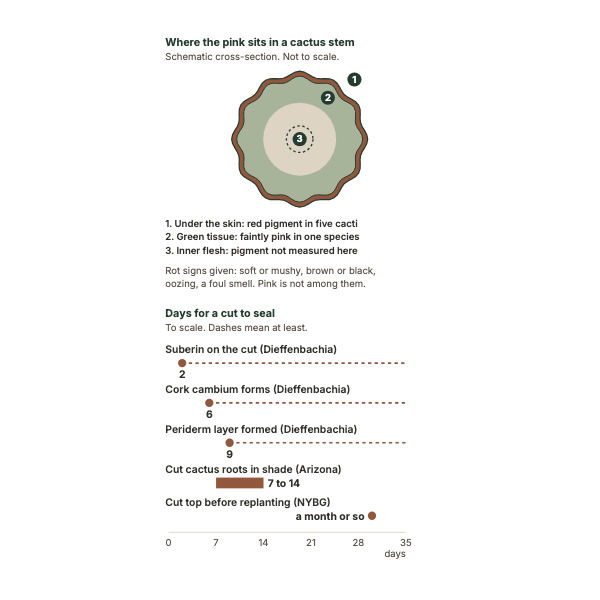
The wound is left to dry and scab over for a week or so before replanting, and roots form after about a month.
The University of New Hampshire says pups can be divided from the mother plant and repotted. In container production, the review reports, a rooted sucker goes into a 2.5 to 3.5 L pot and moves after 6 to 9 months into a 24 L container. An offset that will not root is taken up in a succulent pup that won’t root.
What the Shade Studies Found
Two studies looked at Aloe vera in less light, and they do not line up with the extension advice or with each other.
The review reports a study by Paez and colleagues, published in 2000, in which young plants under partial shade, 30 percent of full sunlight, had 27 percent more leaves than plants in full sun.
In a 110-day pot trial at Sylhet Agricultural University, Robi and colleagues grew young plants under complete shade and partial shade with different composts. With one compost, partial shade gave the tallest plants and the most leaves, and complete shade the most stems, the abstract reports. There was no full-sun treatment.
Neither study measured leaf thickness or stretching, and both used young plants. Leaf and stem counts are not the signs of too little light that Iowa State describes, so the studies and the extension advice measure different things.
A Tall Plant That Leans or Breaks
Stretched growth does not always come back. Steil writes that some succulents recover from low light over time, while others need pruning or cutting back to remove lanky growth so new growth can form in better light.
A top that has broken off, as in the r/plants thread, can be rooted; the steps are in a succulent pup that won’t root.
Whether a leaning plant should be staked is taken up in a jade plant loose in its pot, which sets out what the staking studies found.
Whether the tall plants in two threads are a climbing aloe sold under the wrong name cannot be settled here: no source read covers the labeling of aloes in the trade.
If the plant is failing rather than stretching, with soft or collapsing leaves, that is covered in an aloe vera that is dying. A tall stalk with flowers is a different thing again, taken up in an aloe flower stalk.
What to Do
- Give a stretched or pale aloe more light: a bright window, ten or more hours a day if you can, or grow lights within 12 inches on a timer for 12 to 16 hours (Iowa State). Turn the pot regularly near a window (Nell and Leonard).
- Move it into stronger light, or outdoors, slowly. A sudden move scalds leaves, and the scalded patches will not recover (Iowa State).
- Cut back lanky growth if it does not recover (Iowa State). A broken top can be rooted.
- For one large plant, separate the pups: remove offsets a couple of inches tall, let the cut dry for a week or so, then pot them (Arizona).
- Water in a full wet-then-dry cycle (Iowa State); drought cut both leaves and suckers in the studies the review cites.
- Keep pets and children from chewing the plant: South Dakota State University cautions that people and pets should not eat it.
Local Regulations and Safety Advisory
Plant toxicity depends on the species, the amount and the individual, and a poison control service or a veterinarian can say whether a particular plant is a concern for your household. This article is general information, not medical or veterinary advice.
Authorities to consult:
- Poison control service
- Veterinarian or animal poison control service
If a child or pet may have eaten part of a plant, contact a poison control service or a veterinarian.
What Remains to Be Explored
No study read measured stretching or leaf thickness in Aloe vera at different light levels, and the two shade studies used young plants and measured leaf and stem counts. No source read tests whether pot shape changes how many pups an aloe makes.
No source read covers misting against sunburn or the labeling of aloes sold in shops, and the plants in the four threads are not identified here.
Sources
- No Matter What I Do, My Aloe Vera Keeps Multiplying — multiple community members. Reddit, r/houseplants. Undated.
- Why Is My Aloe Plant so Skinny? — multiple community members. Reddit, r/gardening. Undated.
- Why Is My Aloe Vera so Tall and Thin? — multiple community members. Reddit, r/plants. Undated.
- How Do I Prop This Almost 2′ Tall Aloe (?) So It Doesn’t Fall? — multiple community members. Reddit, r/plantclinic. Undated.
- Common Problems and Issues of Succulents — Aaron Steil. Iowa State University Extension and Outreach, Yard and Garden. August 2023.
- Succulent Care Savoir Faire — Terril A. Nell, Ria T. Leonard. Floral Management (Society of American Florists), hosted by NC State Extension HortScans. November 2010.
- Propagation Techniques and Agronomic Requirements for the Cultivation of Barbados Aloe (Aloe vera (L.) Burm. F.) – A Review — Giuseppe Cristiano, Bernardo Murillo-Amador, Barbara De Lucia. Frontiers in Plant Science. 2016.
- The Effects of Organic Amendments and Shade Levels on the Growth Performance of Aloe Vera Plants — MAS Robi, S Das, N Akter, F Shafrin, MSA Talucder. Journal of the Sylhet Agricultural University. 2024. Cited from its abstract.
- One of the Most Popular Houseplants – Aloe, Easy-Going Growing — Ralph Mitchell. UF/IFAS Extension Charlotte County. November 2025.
- Aloe Vera (Backyard Gardener 169) — Jeff Schalau. University of Arizona Cooperative Extension, Yavapai County. February 2024.
- What Should I Know About Growing Aloe at Home? — UNH Extension. University of New Hampshire Extension. Undated.
- Small Aloes – Interesting, Colorful, and Easy Succulents — Dan Mahr. University of Wisconsin-Madison Extension. June 2026.
- Medicine Plant (Burn Plant) — University of Arkansas Cooperative Extension Service. University of Arkansas Cooperative Extension Service, Plant of the Week. Undated.
- Aloe Vera: Houseplant How-To — Cindy Schnabel, reviewed by Kristine Lang. South Dakota State University Extension. April 2024.