Oval black and red bugs on a maple’s flowers or seeds key to boxelder bugs, the insects that mass on sunny walls in fall. Both extension pages read say they do no significant damage to the tree, and both put sealing the house before fall ahead of spraying or cutting the tree.
Both pages describe the bugs as a nuisance in fall, when they leave the trees for buildings, and both call work on the tree limited help against them. The gaps in the house are where they say to start.
What This Article Covers
This article covers boxelder bugs on maples and in houses: which bugs they are, what they do to the tree, why they come indoors, and what the sources say works. It names no product and gives no spray mixture, rate or interval; a product’s label governs its use.
Other insects that come indoors are covered in German cockroaches and leaves in the compost and fruit fly trap baits. Damage to a maple’s own trunk and roots is covered in a long bare strip down a tree trunk and roots circling inside a tree ring.
Which Bugs Are on the Maple
A maple carries many insects, and they look different. The University of Kentucky’s key to maple pests sends “oval black and red bugs on flowers or seeds” to the boxelder bug. Scales on twigs, clusters of soft-bodied aphids, caterpillars and leaf galls key to other insects.
Wisconsin’s extension page describes the adults as gray and red, “about ½ inch long,” and the young, called nymphs, as bright red with darker heads and no developed wings.
The nymphs pass through five stages, told apart by size and wing pads, in a field study by Bouldrey and Grimnes.
The boxelder that gives the bug its name is itself a maple, Acer negundo. Dawson and Ehleringer describe it as a species with separate male and female trees, and Wisconsin says the bugs are “found primarily on female boxelder trees.”
What They Do to the Tree
On the tree, the bugs feed by sucking sap “from leaves and developing seeds,” Wisconsin says. They can be found on ash, maple and other plants, “but normally cannot complete their development on these other plants.”
Iowa State lists boxelder, maple and ash among the plants they live, feed and reproduce on, so the two pages weigh other maples differently.
On damage the pages agree. Wisconsin says they “rarely cause significant damage to any plants,” and Iowa State says they “feed on sap from their host plants but do not cause significant damage.”
The boxelder tree has its own reputation. A University of Florida tree sheet calls it “an undesirable tree for many urban situations,” listing “brittle, weak wood, short life and susceptibility to boxelder bug and trunk decay,” and notes that planting it may be illegal in some cities.
The bug is native to North America and is not considered a pest in its native range (our translation from Spanish), according to Aragon-Traverso and Sanabria, who recorded it in San Juan, Argentina, in 2024. Where it has newly arrived the picture is less settled.
Faúndez reports an explosive rise in central Chile in the 2022 to 2023 season. He argues that calling it harmless, as media and some municipal notices there did, is not always correct, though the abstract names no harm (our translation from Spanish).
Why They Come Indoors
Wisconsin gives the year in order. Adults leave their winter sites in spring, females lay small red eggs on host plants, and the nymphs hatch in 10 to 14 days.
Nymphs mature by mid-summer and lay eggs for a second generation, and the adults of that generation leave the trees for the winter.
Grimnes and colleagues found that females enter winter sites with only immature eggs, then provision them quickly after emerging in spring, with a major change in about 6 days.
The tree feeds them; the house is where the sources start
Boxelder bugs feed on trees in summer and look for winter shelter in fall. Both extension pages read put sealing the house ahead of spraying the tree.
Wisconsin Horticulture, Division of Extension (Mahr); Iowa State University Extension and Outreach, Yard and Garden, reviewed December 2021.
Both pages put sealing gaps first, and call damage to the trees rare or not significant.
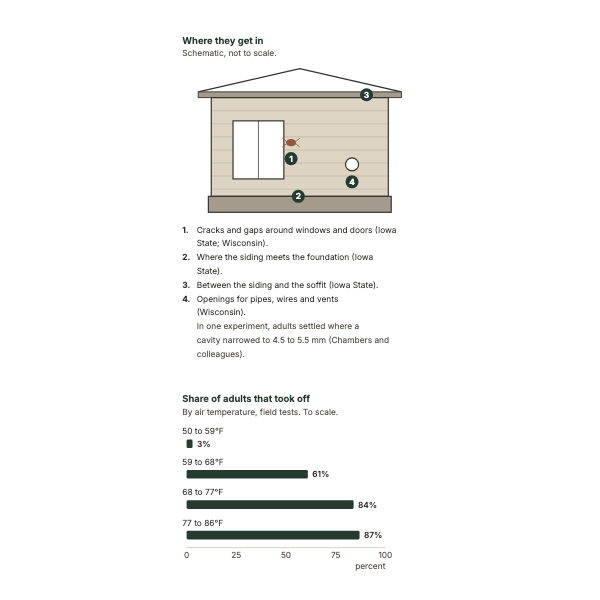
In fall the bugs gather “in sunny spots on the south sides of buildings, trees and rocks,” Wisconsin says, and are attracted to buildings with a lot of southern exposure “regardless of the color.”
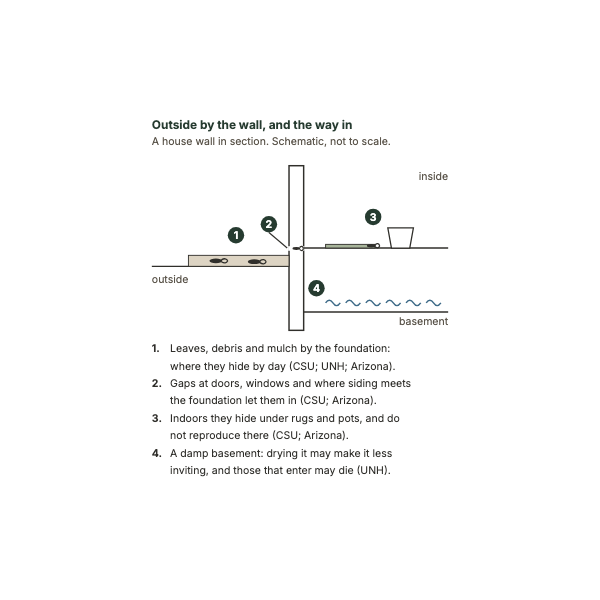
They enter “through small gaps around windows, doors, and pipes and through small cracks in the foundation or siding.”
What draws them into one mass is not settled. Sharma and Kells write that “field observations suggest that alarm pheromones and chemical cues mediate their end-of-season aggregation,” and mapped the sense organs on the antennae as a first step. They do not report a test of those cues.
Inside the walls the bugs stay still while they are cold. Both pages say the trouble comes when the furnace or the sun warms them and they crawl into rooms during the winter.
Spray the Tree, Cut It Down, or Seal the House
Iowa State says the bugs could be controlled on the trees in mid-summer, “but the effectiveness is limited. Spraying large trees is difficult and tree spraying is usually impractical.” It adds that there is no easy way to know when and where there will be a problem until it starts.
Wisconsin says removing boxelder trees or spraying heavily infested trees “may help reduce boxelder bug numbers,” and advises clearing piles of boxelder, ash, elm and maple seeds, where the bugs can also feed and reproduce.
But “the adults are good fliers, and can move a considerable distance from host trees, so this will not eliminate boxelder bug problems.”
Both pages name the house as the place to start. Wisconsin calls preventing entry “the best means of preventing problems,” and Iowa State calls caulking and sealing entry sites “the best deterrence.”
Both say sprays on masses of bugs outside, of an insecticide or of soapy water, need repeating, especially soapy water.
Neither page advises cutting down a maple that is not a boxelder. For new planting, Wisconsin suggests choosing species other than boxelder for shade trees.
Once They Are Inside
Iowa State calls the bugs a considerable nuisance indoors but harmless. It says they “do not reproduce indoors” and “do not feed indoors,” and says they cannot damage the house, its furnishings or occupants. Wisconsin says they “will not bite humans or pets,” but may stain curtains and walls.
Iowa State says the bugs “are generally not killed by aerosol household insecticide products, and most residual insecticides are not of much benefit.” Wisconsin says insecticide sprays “are generally not recommended” for bugs already inside. Both name the vacuum cleaner; Iowa State adds sweeping or picking them up.
What to Do
- Check what the bugs are. Oval black and red bugs on the maple’s flowers or seeds key to boxelder bug (Kentucky); scales, aphids and caterpillars are other insects.
- The tree does not need treating for the bugs’ feeding alone; both pages call the damage rare or not significant (Wisconsin; Iowa State).
- Before fall, caulk and seal gaps around windows, doors and pipes and cracks in the foundation and siding (Wisconsin; Iowa State).
- Rake up piles of boxelder, ash, elm and maple seeds (Wisconsin).
- If you spray masses on an outside wall, use a product whose label covers boxelder bugs and follow it; expect to repeat (Iowa State; Wisconsin).
- Indoors, vacuum or sweep them up rather than spraying (Wisconsin; Iowa State).
- When planting a shade tree, choose a species other than boxelder (Wisconsin).
Local Regulations and Safety Advisory
If you use pest control products, follow the label. Rules on them vary by country and locality, and your pesticide regulator can say what applies where you live. This article is general information, not legal advice.
Authorities to consult:
- Pesticide regulatory authority or environmental protection agency
What Remains to Be Explored
No source read measured how far boxelder bugs travel from a tree to a house, or whether removing a boxelder lowers the numbers on a nearby house. Wisconsin says the adults fly a considerable distance but gives no figure.
What gathers the bugs on one wall is also open; Sharma and Kells point to chemical cues without having tested them. A test of those cues, or of sealing against no sealing on matched houses, would change the advice.
Sources
- Boxelder Bug, Boisea trivittatus — Susan Mahr. University of Wisconsin-Madison Division of Extension, Wisconsin Horticulture. Undated.
- Boxelder Bug — Iowa State University Extension and Outreach. Iowa State University Extension and Outreach, Yard and Garden. December 2021.
- Key to Common Insect Pests of Maple (Acer) — L. Townsend and J. Larson. University of Kentucky Department of Entomology. February 20, 2020.
- Acer Negundo: Boxelder — Edward Gilman and Dennis Watson. University of Florida IFAS Extension (EDIS). 2003. Cited from its abstract.
- Gender-Specific Physiology, Carbon Isotope Discrimination, and Habitat Distribution in Boxelder, Acer Negundo — Todd E. Dawson and James R. Ehleringer. Ecology. 1993. Cited from its abstract.
- Mapping Antennal Sensilla of Boxelder Bugs (Boisea trivittata) as the First Step in Understanding Overwintering Aggregation Behavior — Anika Sharma and Stephen A. Kells. Insects. 2025. Cited from its abstract.
- Egg Production in the Boxelder Bug Boisea Trivittata (Hemiptera: Rhopalidae) — Karin A Grimnes, Deborah Miller and Aaron J Wyman. The Great Lakes Entomologist. 2018. Cited from its abstract.
- An Allometric Study of the Boxelder Bug, Boisea Trivittata (Heteroptera: Rhopalidae) — Scott M Bouldrey and Karin A Grimnes. The Great Lakes Entomologist. 2017. Cited from its abstract.
- La Chinche Del Arce Boisea trivittata (Say, 1825) En Chile: ¿Inofensiva, Dañina; O Un Problema En Ascenso? — Eduardo I. Faúndez. Revista Chilena de Entomología. 2023. Cited from its abstract.
- New Record of the Boxelder Bug Boisea trivittata in Argentina Suggests a Rapid Spread — Juan Hector Aragon-Traverso and Eduardo Alfredo Sanabria. Revista Peruana de Biología. 2025. Cited from its abstract.