Trapping is the dependable way to get rid of a mole in a yard, set in a straight, active runway rather than a wandering surface ridge. Nebraska Extension calls it the most effective and practical method, and UC IPM the most universally applicable and dependable one.
Treating the lawn for grubs is the common advice that does not work on its own: earthworms are a mole’s main food. Castor oil repellents have shown only a minor or inconsistent effect, and vibrating devices, chewing gum and flooding have no proven value.
What This Article Covers
This article covers how to tell a mole from a gopher, what moles eat, how to find an active runway and set a trap, and what the sources say about grub treatment, castor oil, baits, barriers and home remedies. It names no trap brand or product.
For gophers, whose mounds look different, see pocket gopher mounds in the lawn; for small holes dug overnight, see a skunk or raccoon digging a lawn; and for animals tearing at grubby turf, see turkeys tearing up a lawn.
Is It a Mole or a Gopher?
Look at the mounds. Nebraska Extension (Ferraro, Vantassel and Hygnstrom) says moles push up small, conical mounds, usually less than a foot across, from vertical tunnels, while pocket gophers build larger, fan-shaped mounds from slanted tunnels.
Moles also raise surface ridges. Iowa State University Extension says the surface feeding tunnels push the sod up into ridges that wander aimlessly; the grass over them can dry out and die, and mowers scalp the ridges. Nebraska says travel runways are long and straight, while feeding burrows wander.
The animal itself differs. Nebraska describes the eastern mole as 4 to 6 1/2 inches long, with broad, outward-turned front feet built for digging, no external ears and tiny hidden eyes; gophers are rodents with large gnawing teeth that feed on roots.
What Moles Eat, and Why Grub Control Is Not the Fix
Earthworms first. Iowa State says a mole’s main meal is earthworms, supplemented with insect larvae, centipedes, millipedes and spiders, and that moles eat more than their own weight in earthworms daily. Nebraska gives 70 to 100 percent of body weight a day, with insect larvae, ants and earthworms the preferred foods.
In an arboretum in Chernihiv Oblast, Ukraine, Panasenko (2023) found annelid worms dominating European mole stomach contents, and tunnels running where soil animals were densest.
So grubs are only part of the menu. Iowa State says having moles does not mean you have grubs and that applying insecticide for grubs will not solve a mole problem.
Nebraska adds that moles may dig more for several weeks before moving on once grubs are gone, and that soil insecticides can harm beneficial soil animals and songbirds.
Purdue ADM-10 says the same: grubs make up only a portion of the diet. Virginia Tech (Parkhurst) notes that moles switch to earthworms when grubs are removed. UC IPM says reducing grubs may make turf less attractive to moles, but that this has not been confirmed by research.
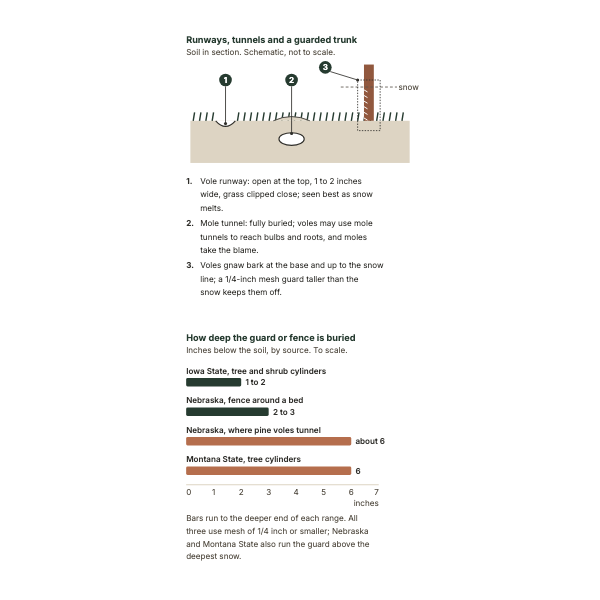
Moles seldom eat bulbs or roots, Iowa State, Nebraska and Purdue agree. Nebraska says voles and mice can use mole tunnels and may be the animals damaging bulbs and roots.
Trap the straight runways; skip the grub treatments and gadgets
The extension sources agree that trapping in active travel runways is the dependable fix, and that treating for grubs does not remove moles.
Nebraska Extension G1538 (Ferraro, Vantassel and Hygnstrom); Iowa State University Extension; UC IPM Pest Notes: Moles (Baldwin); Purdue ADM-10; Virginia Cooperative Extension 420-201 (Parkhurst).
To find an active runway, flatten a short stretch and check within 24 hours whether it has been pushed up again (Nebraska).
How to Find an Active Runway
Nebraska says traps work best in active travel runways: look for fresh soil, runs that are straight, connect two mounds, or follow a sidewalk or other edge. Avoid twisting surface ridges, which Iowa State says may be used only once, while main runways may be used for years.
To test a run, flatten a short stretch with your foot and check within 24 hours whether it has been pushed back up, Nebraska says.
If the runs are hard to read, it suggests rolling all of them flat and trapping where new ones appear. In dry weather, watering first draws moles back to surface tunnels.
Timing helps. Nebraska says trapping succeeds best in spring and fall, especially after rain, because in summer and winter the tunnels run deeper and are harder to find.
Iowa State says moles are active near the surface in early morning and late afternoon in spring and fall, and spend the rest of the year in tunnels 6 to 24 inches down.
How to Set a Mole Trap
The sources describe three common designs: harpoon, scissor-jaw and choker-loop traps. Nebraska says each can work well and that mole traps usually kill quickly and are safe for the user, pets and other wildlife with reasonable caution. UC IPM notes that traps made for gophers rarely suit moles.
For a harpoon trap, Nebraska says to press down a short section of an active ridge, no wider than the trigger, and push the set trap in until the trigger pan rests on the flattened ridge.
For scissor-jaw and loop traps, dig out a short section of burrow, rebuild a firm soil plug under the trigger, set the jaws or loops to straddle the tunnel, and cover the set so it stays dark.
Use several traps and move them. Nebraska recommends at least three, moved if nothing happens in two to three days, and flagged so a mower does not hit them. UC IPM says patience is needed, since a mole may take several days to visit a set, and more traps in more places speed things up.
Live traps come with rules. Nebraska describes a buried bucket as a pit-fall trap but does not recommend live trapping, since a released mole renews the damage and Nebraska’s rules govern where it may be released; Iowa State says pit-fall trapping is labor intensive and often unsuccessful.
Castor Oil, Baits and Other Remedies
The evidence for castor oil is thin. Nebraska says castor oil products have shown minor effectiveness against the eastern mole, must be watered in thoroughly and wash out quickly in heavily irrigated lawns, and that moles burrow under a treated border.
UC IPM says repellents move animals from one place to another rather than removing them. Purdue says no scientific research has shown a consistent result.
Virginia Tech says castor oil products for moles were once registered but those registrations have expired or been canceled, and that only products registered with the U.S. Environmental Protection Agency for moles can be applied legally.
UC IPM says research has shown some effect for eastern moles, but none has been published on moles in the western United States.
Grain baits rarely work because moles eat worms and insects, not grain, Nebraska and Purdue say. Baits shaped like worms or made as gels have been developed; UC IPM says limited studies found gel baits more effective than grain baits. Any bait or fumigant is a pesticide governed by its label, and Nebraska says some are restricted-use pesticides.
Gadgets and folk remedies fail. Virginia Tech says sonic and vibrating devices show little deterrence, and visual devices have no value for an animal that lives underground and sees poorly.
Nebraska and Purdue list pinwheels, broken glass, chewing gum, car exhaust and flooding among remedies with no proven value, and UC IPM advises against flooding tunnels.
Barriers work in small spaces. Nebraska says 36-inch hardware cloth or aluminum sheeting buried 24 to 30 inches deep, with 6 inches above ground, can keep moles out of a small, valuable area.
Living With Moles
A yard rarely holds many. Iowa State and Nebraska put numbers at about three moles per acre or fewer, and Virginia Tech says a lawn’s damage is likely the work of only one or two animals. Moles also mix and aerate soil and eat some insect pests, Iowa State says.
They live for years. In South Carolina, Hartman (1995) aged 382 eastern moles by tooth wear: mean and median ages were about two years and the oldest was in its seventh year, though more than half are estimated to die in their first six months.
Removal is not permanent. Virginia Tech says trapping gives only temporary relief if the conditions that drew a mole remain, and in Saint Petersburg’s Pavlovsk Park, Yakovlev (2020, in Russian, translated by us) reports trapping 21 to 86 European moles a season from the same 11 hectares over six years, with more caught in wetter years.
Local Regulations and Safety Advisory
If you use pest control products, follow the label. Rules on them vary by country and locality, and your pesticide regulator can say what applies where you live. Rules on trapping, releasing, baiting and fumigating moles differ by state, so ask your wildlife or pesticide agency before using a bait, fumigant or live trap. This article is general information, not legal advice.
Authorities to consult:
- Pesticide regulatory authority or environmental protection agency
- State wildlife or pesticide agency
What Remains to Be Explored
No trial read compared trap designs, or tested castor oil, gel baits or barriers in a home lawn. The castor oil products for moles are no longer registered, by Virginia Tech’s account.
No source read measured how fast a cleared lawn is reoccupied in North America, or whether watering, mowing height or soil type change mole numbers in a yard.
Sources
- Moles and Their Control (G1538) — Dennis M. Ferraro; Stephen M. Vantassel; Scott E. Hygnstrom. University of Nebraska-Lincoln Extension. January 2010.
- Moles in the Lawn, Control — Iowa State University Extension and Outreach. Undated.
- Pest Notes: Moles — Roger A. Baldwin. University of California Statewide IPM Program. Undated.
- Moles (ADM-10) — Purdue University Extension. Undated.
- Managing Human-Wildlife Interactions: Moles (420-201) — Jim Parkhurst. Virginia Cooperative Extension. Undated.
- Age Determination, Age Structure, and Longevity in the Mole Scalopus aquaticus (Mammalia: Insectivora) — Gregory D. Hartman. Journal of Zoology. 1995. Cited from its abstract.
- Seasonal Trapping of European Mole Talpa europaea in Parkland — А.А. Яковлев. Pest-Management (Пест-Менеджмент). 2020. A trapping record; cited from its abstract.
- The European Mole (Talpa europaea) in the Trostianets arboretum: Features of Morphology and Ecology — Nina Panasenko. Novitates Theriologicae. 2023. Cited from its abstract.