If the vine is porcelainberry, as replies named it, it comes back two ways: from a large root that sends up new vines when the top is cut, and from berries whose seed birds carry off and which keeps sprouting for years.
So clearing the yard is two jobs. Take out or kill every rooted crown, by digging young plants whole or treating a fresh cut, and then pull the seedlings that follow for several seasons. Bag the berries for the trash. Fall is one good window for treating cut stems, not the only one.
The question comes from a thread on r/gardening. Someone helping to reclaim a girlfriend’s backyard found vines across nearly all of it, up the deck railings and along the fences, and asked what it was, whether it was invasive, how it spread and how to be rid of it.
They said they were ready for the physical work. The replies settled on porcelainberry, with a squash or pumpkin vine running through it, and then split.
Pull it by hand, said some; cut it to the base and paint the stems with herbicide in fall, said others; cover the stumps, bag every berry, or rent goats.
First, Is It Porcelainberry?
A photo cannot settle it, and this article does not identify the poster’s plant. Replies named porcelainberry, Ampelopsis glandulosa var. brevipedunculata, and a few suggested a nightshade, English ivy or bindweed. The tests below come from extension sources and separate porcelainberry from wild grape, the plant it is most often taken for.
Cut a stem first. Porcelainberry’s pith, the soft core, is white and runs unbroken through the joints, while grape’s is brown and broken at each joint (UConn Extension; the Plant Conservation Alliance).
Its bark carries small raised dots called lenticels and does not shred, where grape bark peels away in strips (Wisconsin DNR; University of Maryland Extension; Rutgers).
In fall the fruit gives it away. Porcelainberry holds hard, speckled berries in upright clusters even on drooping stems, in mixed shades from white and lilac to turquoise and blue, while grape clusters hang down (University of Maryland Extension; UConn; Joe Boggs, Ohio State). Its seedlings are glossy underneath, where young grape leaves are usually whitish and matte (Rutgers).
Two native relatives, Ampelopsis arborea and Ampelopsis cordata, can be confused with it, and so can Virginia creeper (UConn; Wisconsin DNR).
NC State’s Plant Toolbox lists the berries as poisonous to eat, of low severity, from calcium oxalate crystals that irritate mucous membranes, and says it does not cause contact dermatitis, a rash from touching it. It gives nothing for pets, and no pet source was read, so keep pets away from the berries.
Invasive, or Just Aggressive?
Porcelainberry is not native to North America. It comes from northeast Asia and was brought to the United States in the 1870s as a landscape plant (Rutgers; UConn).
A 2005 fact sheet from a federal plant conservation working group already reported it invasive in “twelve states in the Northeast,” a list that counts Washington, D.C., and takes in Wisconsin.
States treat it differently. Wisconsin lists it as prohibited, which makes it illegal there to buy, possess, transport or introduce.
Minnesota prohibits its propagation and sale but does not require landowners to control it, while urging them to. Where the yard is decides which rules apply, so check your state’s invasive plant list before you plan disposal.
Raw vigor is not what sets it apart. In a greenhouse trial, Sherrie Emerine and colleagues grew cuttings of porcelainberry against the native Virginia creeper and found similar stem growth, with porcelainberry “similar to Virginia-creeper” overall (cited from the abstract). Pots of cuttings say nothing about seed, which is the other half of the problem.
Roots, Seeds or Both
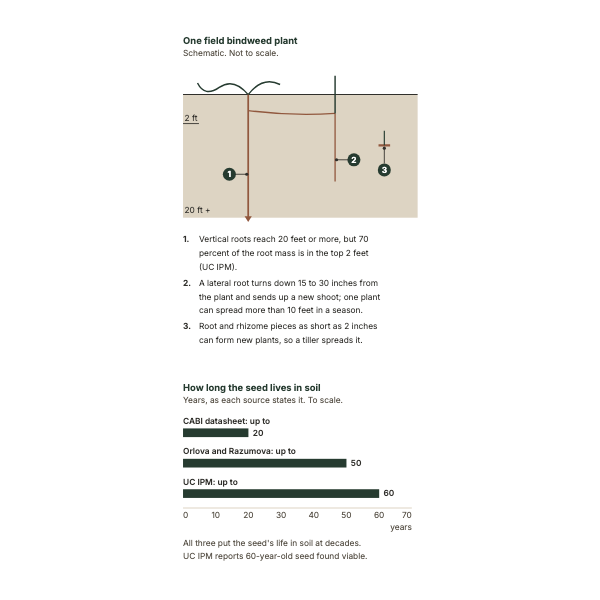
Both, and that is the whole difficulty. Porcelainberry has a large, vigorous taproot, and cutting the vines makes it resprout (Plant Conservation Alliance; Minnesota Department of Agriculture). Any piece of root left in the soil can send up a new vine, and stems lying on the ground can root where they touch (Rutgers; UConn).
Each berry holds two to four seeds. Birds and small mammals eat the fruit and carry the seed long distances (Rutgers; UConn; Minnesota).
The seed sprouts readily after the soil is disturbed and stays alive in the soil for years, so new seedlings keep emerging for several years (Minnesota; UConn; Wisconsin DNR). No source read says how many years.
Porcelainberry comes back two ways
From the root it already has, and from the seed it has already dropped. Five places a cleared yard regrows from.
| 1. Root crown | A large taproot sends up new vines after the top is cut (Plant Conservation Alliance; Minnesota Department of Agriculture). What the guides give for it: treat the fresh cut surface at once, dig a young plant out whole, or cut the regrowth again as often as it comes. |
| 2. Root pieces | Any part of the root left in the soil can sprout a new vine (Rutgers; UConn), which is why a pulled vine that snaps at the crown is not finished. |
| 3. Stems on soil | Vines lying on the ground can re-root (UConn; Rutgers), and UConn advises against cut-stem treatment where stems carpet the ground. |
| 4. Berries | Two to four seeds each, eaten and spread by birds and small mammals (UConn; Plant Conservation Alliance). Vines cut in fruit go in bags to the trash, not the compost (Wisconsin DNR; UConn; Rutgers). |
| 5. Seed in soil | Stays alive in the soil for years, and new seedlings keep coming up (UConn; Wisconsin DNR). No source read says how many years. |
Dark red-brown: the root system. Green: stems and leaves. Black dots: seed in the soil. No depth, distance, count or time is drawn.
Cutting the vines ends neither route by itself: the root resprouts and the seed keeps coming, so each is its own job, over more than one season.
That is why so much of the thread’s advice reaches one route and not the other. Cutting or pulling the tops does nothing to the seed already in the ground, and bagging the berries does nothing to a crown.
Ohio State’s Joe Boggs goes further for established plants: ripping out the vines, he writes, usually results in more vines.
What to Do With a Yard This Size, in Order
No trial of porcelainberry removal in a home yard was found, so the order below follows the extension guides.
Every herbicide step defers to the product label, which is the law, and this article gives no rate. If you would rather not handle herbicides, Rutgers and UConn both suggest hiring a licensed applicator.
- Deal with the berries first. The berries persist through winter (UConn), so a late-fall clearing starts with them. Collect every fruit as you cut fruiting stems, and bag it so the seed does not scatter as you work (University of Maryland; Wisconsin DNR).
- Cut the vines free. Cut each vine near the ground where it climbs the deck and fence (Plant Conservation Alliance). Iowa State’s Aaron Steil notes that everything above a cut dies and can then be pulled off a structure. On trees, Rutgers advises cutting at ground level and again at shoulder height and leaving the vines in the canopy, because pulling them down damages the tree.
- Find the rooted points. Follow the cut vines back to where they enter the soil. One young plant can send leaders out in several directions and root again along the ground (Rutgers), so expect rooted points along the runners, not one crown in the middle.
- Dig the young ones. Seedlings and small plants can be pulled or dug, most easily when the soil is moist. Make sure the whole root comes out, with the crown, where stem meets root just under the soil (UConn; Rutgers); UConn advises pulling steadily and slowly to disturb the soil as little as possible. Iowa State suggests digging after a soaking rain. UConn advises tamping the soil down afterward to keep seed from sprouting.
- Treat or keep cutting the big ones. Rutgers says a plant is deeply rooted after three to nine months of vigorous growth, and pulling it by hand becomes impossible. For these the guides give three routes: treat the fresh cut at once, cut and treat the regrowth, or cut every regrowth again.
- Mind the runners. UConn advises against cut-stem treatment where stems grow along or carpet the ground, because the plant can re-root from stem pieces touching the soil. That describes much of this yard. In carpeted areas the guides’ other routes are pulling and a herbicide applied to the leaves (UConn; Rutgers).
- Come back. The guides expect resprouts and new seedlings and say to check and treat again for several years (Rutgers; UConn; Plant Conservation Alliance; Minnesota).
For the three routes in step 5: Iowa State and Maryland say to treat a cut surface as soon as it is made, and UConn names glyphosate and triclopyr as the systemic herbicides, the kind a plant moves through its tissues, used on leaves or cut stems. Maryland and the Plant Conservation Alliance describe cutting in summer, letting the vines resprout, and treating the regrowth.
Cutting alone is the slow route. Wisconsin DNR says untreated cut vines resprout and need cutting again and again.
Iowa State’s general advice on weedy vines sets the bar: repeated cutting exhausts a perennial root over several seasons only if the vine is never allowed to grow new leaves, which is hard to keep up.
Is Fall Really the Time?
One reply said late summer through fall is ideal because the plant is drawing nutrients down into its roots for winter.
Virginia’s Department of Conservation and Recreation says much the same: herbicide works best toward the end of the growing season, when the plant is moving nutrients from its stems and leaves to its roots.
The other guides draw the window wider. Rutgers says to treat in the second half of the growing season, and that large vines can still be cut and treated in late fall on a mild day. UConn gives early summer through fall. Maryland and the Plant Conservation Alliance suggest summer cutting and treating the regrowth.
No timing trial on porcelainberry was found. The nearest is Benjamin Ballard and Christopher Nowak’s test of cut-stump treatments on hardwood trees under power lines (cited from the abstract).
After two years, at least one herbicide mix had killed more than 90 percent of the trees at each of three dates: April, June and November.
Whether the date mattered depended on the mix. One did worse than the others in April and June and slightly better in November, and the authors advised using it in late summer or fall; the other two worked equally well from April to November.
A thesis on tree-of-heaven, another woody invader, recommended early summer for its treatment (William Eck, cited from the abstract).
So fall is a sound time to treat cut stems, with the product and conditions the label allows, but it is not the only time. The reason the reply gave is the reason the Virginia sheet gives, and no source read has measured it in porcelainberry.
Black Plastic, Buckets and Goats
Covering a stump to starve it of light has not been tested on porcelainberry in anything read. The closest trial, by Iduna Arduini and colleagues, cut potted tree-of-heaven saplings and put black covers over the stump alone or over the whole pot (cited from the abstract).
Covering only the stump did not stop new shoots from it in the first season, and it gave the most root sprouts at the first cutting, after which sprouting in that treatment stopped.
Covering the whole pot stopped shoots from the stump, and repeated cutting slowly wore down the root sprouts. The authors called covering after cutting a promising technique without herbicides. Pots are not a yard and a tree is not a vine, so this is a hint, not an answer.
Maryland Extension’s table of invasive vines lists smothering under cardboard, newspaper or plastic for English ivy, but not for porcelainberry, for which it lists pulling or digging and cut-and-treat. The thread’s other ideas, vinegar, salt and hot water, were not tested on porcelainberry in anything read.
Several replies suggested goats. No study of goats on porcelainberry was found. In a trial on common buckthorn, an invasive shrub, Katherine Marchetto and colleagues found goat browsing cut it back at once, and a year later the buckthorn had recovered; the native plants, which had dropped too, had also recovered (cited from the abstract).
A 2007 paper on goat and sheep browsing against invasive weeds put it plainly: the key word is reduction, not eradication, because target plants come back from their rootstocks and soil seed banks (James Muir and colleagues, cited from the abstract). Those are the two routes this article is about.
What to Do With the Pile
Vines carrying berries go in bags to the trash or landfill, not the compost (Wisconsin DNR; UConn; Rutgers; Maryland).
Dumped elsewhere, they carry seed, and stems that can root where they lie, to a new spot. Minnesota adds a quieter warning: do not spread soil that holds root pieces.
Vines without fruit can be composted once they are dead. UConn advises drying them in the sun until they are completely dead first, because pieces of stem touching the soil can root again. Some replies suggested leaving the vines in bags, in the dark or the sun, until dead; no source read tested either.
Why not compost the berries? In the one compost study read, heat decided whether seed survived.
Andrea Grundy and colleagues held seeds of eight weed species in moist compost and found three days at 55°C (131°F) killed all of them, while at cooler temperatures some survived, depending on the species (cited from the abstract).
They traced the seeds that survive composting to cool spots in windrows, long municipal piles, that were not turned well. Porcelainberry was not among the species tested. Our article on burying scraps in a worm compost bin covers how warm a home bin gets.
Next Spring and After
Expect seedlings. They can come up at almost any time in the growing season (Rutgers), and new ones keep emerging for several years (Wisconsin DNR).
Clearing and digging disturb the soil, and the Minnesota Department of Agriculture notes that the seed germinates after disturbance, natural or human.
Seedlings are the easy part if you catch them. Pull them while small, with the root, and learn the glossy leaf underside that sets them apart from grape seedlings (Rutgers). Rutgers’ window is short: after three to nine months of vigorous growth, the plant is too deeply rooted to pull by hand.
Resprouts from crowns you missed get the same treatment as before, and Rutgers says spot treatments are often needed every year. Birds bring seed from plants outside the yard, so new seedlings can arrive even after every crown inside it is gone.
A small area can be cleared. At the Jamaica Bay Wildlife Refuge in New York City, Richard Stalter and colleagues counted porcelainberry among the three most aggressive woody invaders and judged it removable from small areas of a few square meters by cutting, herbicide or hand-pulling, though perhaps impossible to eradicate from the refuge (cited from the abstract).
For what goes in afterward, Rutgers and UConn suggest native vines such as Virginia creeper or trumpet honeysuckle.
Our article on a raised bed lost to grass and horsetail covers what covers can and cannot do to cleared ground, and the one on running bamboo covers barriers against a plant that spreads underground.
The Squash
The big-leaved vine in the photos is a separate plant, a squash or pumpkin by the replies’ reading. This article does not identify it or cover its control. If it fruits, Poison Control’s advice is plain: do not eat wild squash that you did not plant in your garden.
Bitter squash can carry high levels of cucurbitacin, which causes toxic squash syndrome, mostly nausea, vomiting, diarrhea and stomach pain, and cooking does not destroy it (Poison Control).
French poison centers recorded 353 cases from 2012 to 2016, a quarter of them from garden squash, and the authors advise throwing out any squash that tastes bitter (G. Le Roux and colleagues, cited from the abstract).
Local Regulations and Safety Advisory
If you use pest control products, follow the label. Rules on them vary by country and locality, and your pesticide regulator can say what applies where you live. Rules on porcelainberry and on disposing of plant waste differ by state and town, so check your state's invasive plant list and your local waste service. Eat no volunteer squash on the strength of this article. This article is general information, not legal, medical or veterinary advice.
Authorities to consult:
- Pesticide regulatory authority or environmental protection agency
- State department of agriculture or natural resources, and your local waste or yard-waste service
- Poison control service
- Veterinarian or animal poison control service
If a child or pet may have eaten part of a plant, contact a poison control service or a veterinarian, because toxicity depends on the species, the amount and the individual.
What Remains to Be Explored
No controlled trial of any porcelainberry removal method turned up in the sources read, so the order here rests on extension practice and on trials of other woody plants.
How long porcelainberry seed lives in the soil has not been measured in any source read; the guides say “years” or “several years”.
Whether fall treatment beats summer treatment in porcelainberry is untested: the only timing trial found is on hardwood stumps, and its answer depended on the product.
No study of goats or of covered stumps on porcelainberry was found, nor any test of vinegar, salt or hot water on it.
The thread gave no location, and the plant was named by replies, not by anyone holding a stem. A seed-burial study and a timing trial on the vine itself would change this answer most.
Sources
- What Is This Vine Taking Over My Girlfriend’s… — multiple community members. Reddit, r/gardening. Undated.
- October Invasive Species of the Month: Porcelainberry — Jean Epiphan, Phaedra Singelis. Rutgers Environmental Stewards, Rutgers Cooperative Extension (New Jersey Agricultural Experiment Station). September 29, 2025.
- Porcelain-Berry (Ampelopsis glandulosa var. brevipedunculata), EXT211 — Alyssa Siegel-Miles, Carla Caballero, Victoria Wallace. UConn Extension, University of Connecticut. May 2026.
- Invasives in Your Woodland: Porcelain-Berry (Updated 2025) — Andrew Kling. University of Maryland Extension. June 25, 2025.
- Invasive Vine and Groundcover Control — University of Maryland Extension, Home and Garden Information Center. February 22, 2023.
- Porcelain Berry: Prohibited Invasive Species in Wisconsin (Fact Sheet) — Wisconsin Department of Natural Resources. Undated.
- Invasive Alien Plant Species of Virginia: Porcelain-Berry — Virginia Department of Conservation and Recreation, with the Virginia Native Plant Society. Undated.
- Monstrous Porcelain-Berry Barrage — Joe Boggs. Ohio State University Extension, Buckeye Yard and Garden onLine. August 11, 2018.
- Managing Weedy Vines — Aaron Steil. Iowa State University Extension and Outreach, Yard and Garden. June 2026.
- Ampelopsis glandulosa var. brevipedunculata (Porcelain Berry), Plant Toolbox — North Carolina State University Extension Gardener Plant Toolbox. Undated.
- Fact Sheet: Porcelain-Berry — Jamie Young. Plant Conservation Alliance’s Alien Plant Working Group (National Park Service), hosted by Vermont Invasives. May 20, 2005.
- Porcelain Berry — Minnesota Department of Agriculture, Noxious and Invasive Weed Program. Undated.
- Porcelain Berry (Ampelopsis brevipedunculata), Bushkiller (Cayratia japonica), and Virginia-Creeper (Parthenocissus quinquefolia) in Interspecific Competition — Sherrie Emerine, Robert J. Richardson, Consuelo Arellano. Invasive Plant Science and Management. 2013. Cited from its abstract.
- Timing of Cut-Stump Herbicide Applications for Killing Hardwood Trees on Power Line Rights-Of-Way — Benjamin D. Ballard, Christopher A. Nowak. Arboriculture & Urban Forestry. 2006. Cited from its abstract.
- Resprouting Control of Ailanthus altissima by Means of Cut and Stump Covering: Experimental Evidence for a Promising Technique — Iduna Arduini, Silvia Pampana, Viola Alessandrini. Diversity. 2024. Cited from its abstract.
- Investigating Treatment Windows for Effective and Environmentally Sound Herbicide Applications for Controlling Tree-Of-Heaven — William E. Eck. West Virginia University (thesis). 2005. Cited from its abstract.
- The Effect of Temperature on the Viability Of Weed Seeds in Compost — Andrea C. Grundy, J.M. Green, Margi Lennartsson. Compost Science & Utilization. 1998. Cited from its abstract.
- The Enemy of My Enemy: Concomitant Impacts of Goat Browsing on Native Vegetation During Invasive Plant Control — Katherine M. Marchetto, Sara Nelson, Tiffany M. Wolf, Daniel J. Larkin. Restoration Ecology. 2026. Cited from its abstract.
- Small Ruminants for Biological Control of Invasive Weeds — JAMES PIERRE MUIR, Elide Valencia, Weiss, Stuart, Thomas H Terrill. RePEc: Research Papers in Economics (conference paper). 2007. Cited from its abstract.
- Control of Nonnative Invasive Woody Plant Species at Jamaica Bay Wildlife Refuge, New York City — Richard Stalter, Dwight T. Kincaid, Michael D. Byer. Arboriculture & Urban Forestry. 2009. Cited from its abstract.
- Toxic Squash Syndrome: If It’s Bitter, It’s Not Dinner — Wendy Klein-Schwartz. Poison Control, National Capital Poison Center. July 28, 2026.
- Poisoning by Non-Edible Squash: Retrospective Series of 353 Patients From French Poison Control Centers — G. Le Roux, I. Leborgne, M. Labadie, R. Garnier, S. Sinno-Tellier, J. Bloch, M. Deguigne, D. Boels. Clinical Toxicology. 2018. Cited from its abstract.