Do not prune yet. Get the plant cool, check whether the stems are firm, and look at the mix before you water. Root any plump fallen leaves, and leave pruning until new growth shows or spring arrives. No source covers a jade stripped by heat, so this draws on jade care pages and general heat guidance.
That limit matters, because nobody has measured how often a stripped jade comes back. Wisconsin’s jade page says that burnt leaves die and fall, “but new leaves will sprout”. It names sunburn, insecticide and frost, not a hot room, so this is the nearest evidence, not a direct match.
A reader came home from a short trip to a bare jade and an apartment that had reached around 40 degrees, and asked whether to prune or leave it.
One reply was a dad joke built on the word “devastated” in the title. The rest split between cutting it back, leaving it alone, and blaming the watering.
How Hot Is Too Hot for a Jade?
Forty degrees Celsius is 104°F, far above any comfort range. Clemson gives 65 to 75°F by day, UConn 60 to 70°F, and South Dakota State 60 to 75°F. Oregon State Extension says that most plants grow best between 59 and 86°F, and that growth slows when temperatures above 90°F are sustained.
Above 104°F, Oregon State says, “many plants will survive but will show different signs of heat stress”. That covers plants generally. We found no heat limit for jade; Wisconsin says only that it likes the warm, dry conditions found in most homes.
The nearest jade-family data is biochemistry. Jade plants store carbon at night as malic acid, then use it by day, a system called crassulacean acid metabolism. In Crassula argentea, the name Iowa State uses for jade, T. P. Chardot and R. T. Wedding found the nightly buildup peaked at 10 to 12°C and fell to about 25 percent of that at 35°C, per their abstract.
That says warm nights slow how a jade feeds itself, and U. Lüttge’s review notes that night temperatures somewhat below 20°C suit this system best.
It does not show damage, and Lüttge warns against reading enzyme results as plant limits. So a hot apartment with no cool night is a different stress from one hot afternoon.
Do not borrow desert figures. Cacti and agaves tolerate tissue temperatures above 60°C, but Smith and Nobel found tolerance tracks a species’ native habitat, and rises only after days of warming.
Jade is not a desert cactus in a sealed room. A 218-species study of ordinary leaves found disruption began around 41.5 to 50.8°C of leaf temperature, in the wild and not in succulents.
If you meant 40°F, which some readers assumed, Wisconsin says jade may tolerate light frost, so the cold alone may not explain it.
Leaf drop itself is a known response. UC’s pest program, writing about gardenias, says excessive heat can cause it, and New Mexico State notes that many tropical houseplants drop their leaves after a drastic change in environment. Neither page mentions jade.
Was It the Heat at All?
Readers were right to ask. Wisconsin says overwatering “will cause the leaves to drop and the stem to rot”, and that drought can cause leaf drop too.
Clemson says the same of a plant left extremely dry, and South Dakota State calls leaf drop “a symptom of watering issues”. A hot week can dry a pot faster, as UConn notes, so heat and thirst may have arrived together.
There is a third suspect. A. Garibaldi and colleagues reported Fusarium wilt on jade on an Italian commercial farm in summer 2010. First signs were yellowing and “premature drop of still turgid leaves”, then wilting, and stems that rotted from the base, with brown discoloration inside.
So firm leaves falling in summer do not prove heat, though that report is from a farm and not a home.
So check before you act. The table runs through what you can find in a few minutes, and it applies whichever cause is true.
Reading a jade after it drops its leaves
Check the stems and the mix before anything else. The same bare stems can come from heat, drought or too much water.
| What you find | What it points to | What to do |
|---|---|---|
| Stems firm, mix dry | Too little water, heat, or both | Water deeply, let it drain, and keep it out of the heat |
| Stems firm, mix wet | Overwatering may be the real cause | Hold the water and look at the roots |
| Stems soft and collapsing | Possibly bacterial soft rot | No control exists; discard the plant |
| Plump leaves on the mix | Still usable | Let them callus, then root them |
| New growth appears | The plant is growing again | Water more; prune in spring if it needs it |
Hold the pruners either way. No source covers a jade stripped by heat, so this table is drawn from jade care pages and general heat guidance.
The soft stem is the one finding that changes everything. UConn says bacterial soft rot makes stems and branches “grow soft and collapse”, with no control method, and South Dakota State says the same.
If yellowing and a rot start at the base, the Italian report fits better than heat does, and no source offers a home remedy.
Prune or Wait?
The sources on heat say wait. “Hold off on pruning,” says Oregon State’s Heather Stoven, warning that pruning too soon “can encourage tender new growth that may be vulnerable to future heat” and can open the way to pests and disease.
That guidance was written for garden plants after a heat wave, not for a jade indoors. The jade evidence is about healthy plants. Wisconsin says pruning is best done in spring, by cutting stems back to a lateral branch, and that “new growth will sprout within a few weeks.” A jade that keeps its leaves but stops growing is a different problem, covered in why a jade plant is not growing.
Nothing we read addresses cutting back a jade that has just lost its leaves, and one page points the other way: New Mexico State told a reader with a bare bougainvillea to prune before growth began.
Given that, the sourced advice on heat is the closer fit, and a cut can still be made later. Readers argue that bare stems will not re-leaf and need cutting for shape.
That may be so, but no source we found confirms it, and a shaping cut can wait until you know which stems are alive.
How to Water a Jade With No Leaves
“When it has no leaves, it will use water very slowly,” New Mexico State says of the bougainvillea, and it warns against overwatering. Once growth begins, the same page says, watering must increase. No jade page says this directly, but UConn makes the same point about plants that have stopped growing.
Wisconsin’s rule for jade still applies: let the mix dry out between deep waterings, and never let the pot sit in water. So check with a finger or a stick first. Readers advise a tiny sip to be safe, but no source supports that, and Wisconsin’s wording is a deep watering.
Does It Need More Light?
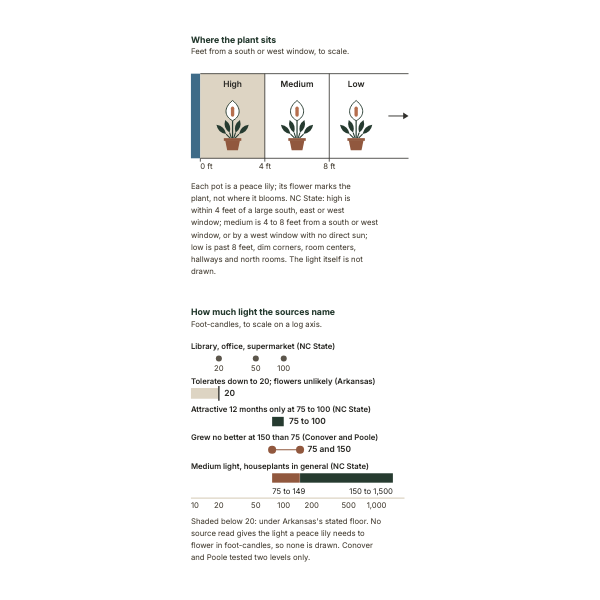
Several readers said this was the key, and the jade pages back them in general. Wisconsin wants four or more hours of direct sun, and Clemson and Iowa State agree.
But a heat-hit plant should not go straight into strong sun. UConn says not to move a jade from subdued light into full sun, and to raise the light gradually so leaves do not burn.
Oregon State’s advice during a heat wave is to move containers into shade. So get through the heat first, then raise the light slowly. We found no test of what light does for a leafless jade.
What to Do With the Fallen Leaves
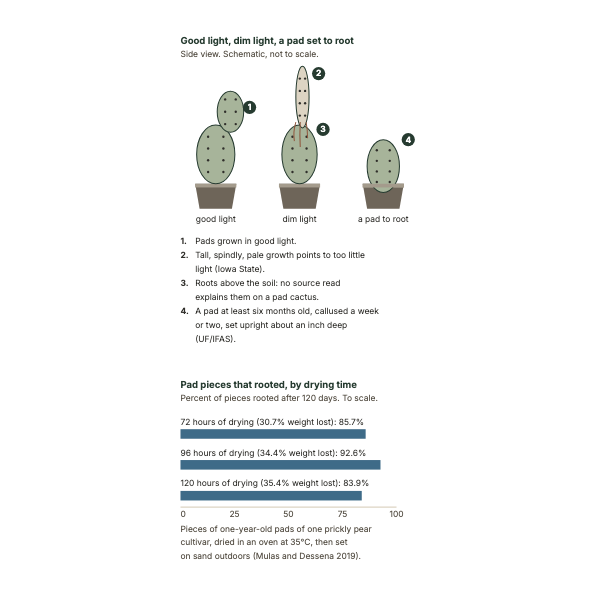
Keep the plump ones. Wisconsin calls jade “especially easy to propagate from stem or leaf cuttings”, and advises letting pieces dry for a few days so the cut surface heals over.
UConn’s method is to let the ends callus, set them in moistened potting mix, and cover them with a clear bag, with roots forming “in a few weeks”.
On moisture, Wisconsin adds that fairly dry, well-drained soil speeds rooting. Readers who say to leave leaves on the mix are close to Wisconsin’s note that pieces falling outdoors root by themselves.
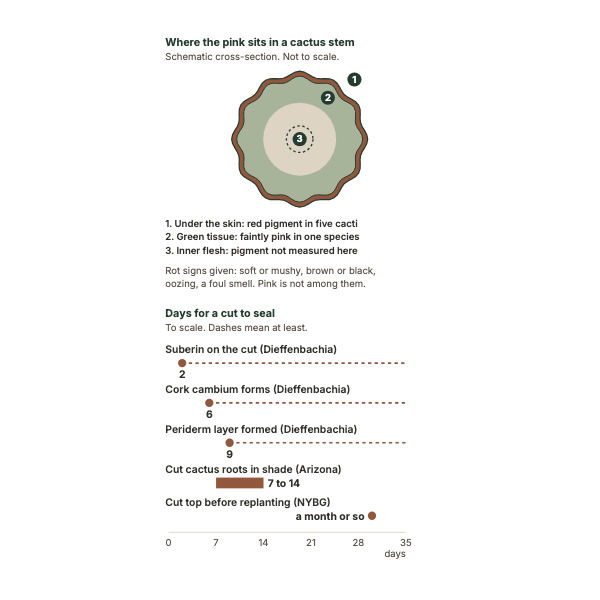
We found nothing on whether heat-damaged leaves root as well. The nearest study of how it happens is an undergraduate thesis on Pachyphytum, a relative, where a healing layer formed at the break in the first days, and a new plant had leaves and roots by about day 16.
That is a different genus, so treat it as a sense of the process and not a timetable.
What Remains to Be Explored
We searched for a whole-plant heat limit for jade, for any test of heat causing leaf drop in a succulent, and for any record of how long a stripped jade takes to regrow, and found none.
A 1991 paper on three succulents exists but names no species in its record, so we cite nothing from it. Readers report months, but those reports are single plants.
We also found no source on pruning a jade straight after it loses its leaves, on watering a bare jade, or on whether bare stems re-leaf. A simple record of stripped plants, some pruned and some left alone, would answer more than any further advice.
Sources
- Jade Plant, Crassula ovata — Susan Mahr. Wisconsin Horticulture, UW-Madison Division of Extension. April 2025.
- Jade Plant (HGIC 1507) — Karen Russ, Al Pertuit and Barbara H. Smith. Clemson Cooperative Extension. October 16, 2015.
- Jade Plants — UConn Home Garden Education. Undated.
- Jade Plant: Houseplant How-To — Kristine Lang, Sydney Paulsen and Cindy Schnabel. South Dakota State University Extension. April 25, 2024.
- How Do I Care for a Jade Plant? — Richard Jauron. Iowa State University Extension and Outreach, Yard and Garden. June 2, 2025.
- How to Care for Plants After a Heat Wave — Kym Pokorny, quoting Heather Stoven. Oregon State University Extension Service. July 2025.
- Heat Wave in the Garden: How to Identify and Prevent Heat Stress in Plants (EM 9556) — Nicole Sanchez. Oregon State University Extension Service. June 2021.
- Bougainvillea Dropped All Its Leaves — Marisa Y. Thompson. New Mexico State University, Southwest Yard and Garden. December 1, 2007.
- Leaf and Bud Drop — UC Statewide IPM Program. Undated.
- Regulation of Crassula argentea Phosphoenolpyruvate Carboxylase in Relation to Temperature — Chardot and Wedding. Archives of Biochemistry and Biophysics 293(2):292-297. 1992. Cited from its abstract.
- Ecophysiology of Crassulacean Acid Metabolism (CAM) — U. Lüttge. Annals of Botany 93(6):629-652. June 2004.
- High-Temperature Responses of North American Cacti — Smith, Didden-Zopfy and Nobel. Ecology 65(2):643-651. April 1984. Cited from its abstract.
- High and Low Temperature Tolerances and Their Relationships to Distribution of Agaves — Nobel and Smith. Plant, Cell & Environment 6(9):711-719. December 1983. Cited from its abstract.
- Thermal Limits of Leaf Metabolism Across Biomes — O’Sullivan et al. Global Change Biology 23(1):209-223. 2017. Cited from its abstract.
- First Report of Fusarium oxysporum Causing Wilt on Jade Plant (Crassula ovata) in Italy — Garibaldi et al. Plant Disease 95(9):1191. 2011. Cited from its abstract.
- Aspectos Anatomicos Da Folha E Da Organogenese Adventicia Em Pachyphytum Hookeri — Abreu. Universidade Federal de Minas Gerais. 2025.
- I’m Devastated (R/Houseplants Thread) — multiple community members. Reddit, r/houseplants. Undated.