Probably not, unless a piece of stem came away with the leaf. A new stem grows from a bud, and buds sit on the stem at the node, not in the leaf. Check the base of the stalk, then keep the leaf as a long-lasting cut leaf or take a new cutting through the stem. Nobody has tracked rooted Monstera leaves, so this rests on plant biology and on tests of other plants.
One reader kept a broken-off Monstera leaf in water just to look at it a while longer, then wondered where all the water was going. The leaf had been drinking, through a set of roots it had grown without asking anyone.
The replies split. Some said the roots are a dead end and the leaf will only ever be a leaf, a “zombie leaf” in growers’ slang. Others said theirs turned into a full plant.
A second thread asked whether rooting powder would save a cutting with no node, drew mostly flat refusals, and got one reply saying it can be done in tissue culture. Each camp has hold of part of the answer.
Why a Leaf Can Root and Still Not Grow
Roots and shoots are separate jobs, and a leaf is far better placed to do the first. NC State’s Extension Gardener Handbook states the limit plainly: “Because leaf cuttings do not include an axillary bud, they can be used only for plants that are capable of forming adventitious buds.”
An axillary bud is one already sitting at a node. An adventitious bud is one a plant builds somewhere it had none.
The handbook defines a bud as “an undeveloped shoot from which new leaves or flower parts arise”, and it says where to find one: “Within the node is a bud.”
So the stem you are hoping for already exists in miniature, on the parent plant. Snap a leaf off through its stalk, and that bud stays behind on the stem.
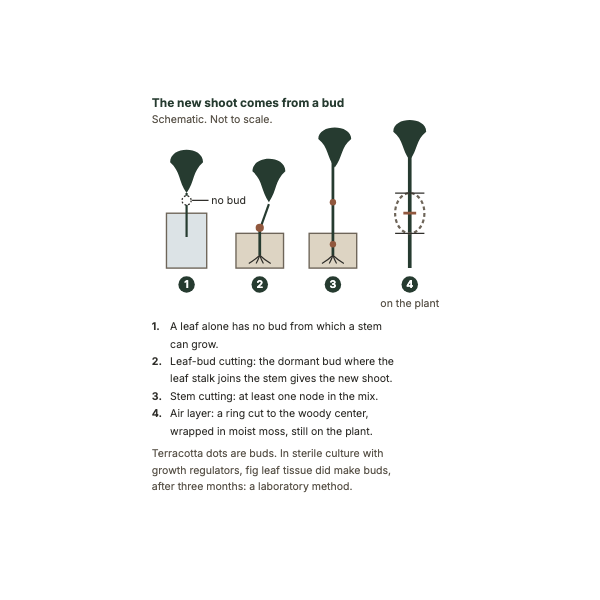
The same leaf, cut in two places
A leaf stalk meets the stem at a node, and the bud sits there. Which side of it the cut falls on decides what comes away.
Roots can form on a leaf alone. A new stem needs a bud, so a rooted leaf with no stem tissue has nothing to grow from unless the plant can build a new bud, and most cannot.
Roots need no such head start. A 2023 review by Qihui Wan and colleagues, cited from its abstract, describes roots regenerating naturally from the wounded sites of detached leaves, a process wired into auxin signaling.
Auxin is the plant hormone at the start of that chain. That work is on Arabidopsis, a small laboratory weed, so it shows a general route and tells us nothing specific about Monstera.
The best count of how often the second job fails is J.B.M. Custers’s 1986 thesis at Wageningen. Cuttings from 40 kinds soon wilted or rotted. That left 132 species and cultivars, 20 leaf cuttings of each, and 30 of them formed shoots.
The other 102 did not, even though in most of those at least a quarter of the cuttings had rooted by six weeks.
Treat that as a rough guide and not as odds, because the list leans toward garden plants and has no Monstera in it.
Slides from a University of Vermont propagation course make the same point in a line: “Limiting factor in leaf cutting propagation is the formation of adventitious buds NOT adventitious roots!” Their example is a rubber tree leaf, which roots readily and never forms shoots.
How to Tell Whether Your Leaf Has a Chance
Look at the very bottom of the stalk. A clean end, cut or snapped through the stalk itself, carries no stem. If a sliver of stem came with it, you may have part of a node.
Illinois Extension describes the spot: “A node is where the leaf emerges. Sometimes it is a bumpy or raised area.” A rooted leaf that arrived without that area is the case the rest of this article is about.
That sliver is the best explanation we can source for leaves that did go on to grow. NC State’s plant database says single rooted Hoya kerrii leaves “are not likely to grow well unless a bit of the stem tissue was included with the leaf when it was cut”.
Horticulture writer Jane Perrone reports the same from growers, adding that a shoot can take several years to appear.
Hoya is a different plant, and nobody has examined the base of a Monstera leaf that grew, so for Monstera this stays an inference. One reply in the first thread reached for the same idea, suggesting a little node tissue may come away unseen.
It would explain why several readers report full plants, and we have no reason to doubt what they saw. What those reports cannot show is what was on the cutting the day it was taken.
Can a Leaf Ever Build Its Own Bud?
Yes, in some plants, which is why “never” goes too far. It also corrects the reply saying aroids as a group cannot do this. Monstera belongs to the arum family, Araceae, and so does ZZ plant, whose leaflets can grow into new plants.
Leelawadee Thongkham and Lop Phavaphutanon reported 90 to 100 percent success in rooting and rhizome formation from ZZ leaflets, and their account has the first shoot emerging from the new rhizome.
Yet two Anthurium species, also aroids, had not rooted at all after six weeks in Custers’s test, and formed no shoots. The family does not decide it. A review the thesis cites concluded that the ability cannot be treated as a systematic characteristic, and the thesis itself found an easy and a difficult cultivar within one chrysanthemum species.
| Plant | What a leaf alone does | Where that comes from |
|---|---|---|
| Monstera | Roots; a new stem is unconfirmed | Reader reports only; no test found |
| Hoya kerrii | “Not likely to grow well” without stem tissue | NC State |
| Rubber plant | Roots readily, never forms shoots | University of Vermont slides |
| Anthurium, two species | No roots after six weeks, no shoots | Custers 1986 |
| ZZ plant | Rhizome and roots, then a shoot | Thongkham and Phavaphutanon 2018 |
| African violet, rex begonia, sansevieria | A new plant, by a standard method | Wisconsin 4-H; Illinois |
In plants with the ability, the new bud really is built from leaf cells. Tomoyuki Nabeshima and colleagues watched cultured African violet leaf segments and found outer-layer cells dividing by day 14 and, in one cultivar, taking part in forming shoots.
Illinois notes that such cuttings must start both roots and shoots, and usually take longer to make a mature plant than a stem cutting does.
It can take a long time. In Custers’s survey one Hibiscus syriacus shoot appeared after 4 months and one Viburnum shoot after 14 months. So a rooted leaf doing nothing this season has proved little either way, though nothing suggests a Monstera leaf is merely running late.
Will Rooting Powder or Hormones Make It Grow?
Rooting powder works on the wrong job. Custers dipped half the cuttings of each kind in an auxin powder before planting. Plants able to form shoots mostly did so with or without it, and the 102 that could not gained nothing.
ZZ plant shows the same pattern from the other side: Mousa Solgi and colleagues found that an auxin raised rhizome and root numbers on leaflets that were already able to form them.
The obvious next idea is cytokinin, the hormone family that favors shoots. The thesis tested it on 47 kinds before planting and 36 after rooting. It raised shoot numbers in a few species that made shoots anyway and brought shoots to none of the plants that lacked them. Applied before planting, it reduced or prevented rooting.
The reply pointing to tissue culture is right, and the distance between that and a jar is the point. Dinh Van Khiem and colleagues grew callus, an unorganized mass of cells, from 90 percent of leaf pieces and 48 percent of stalk pieces of Anthurium scherzerianum in culture with hormones, and induced shoots from callus.
That is one of the species that managed neither roots nor shoots on Custers’s bench.
Wichada Sunpui and Kamnoon Kanchanapoom got shoots from African violet leaf and stalk pieces in culture too. Momoko Ikeuchi and colleagues explain in a 2016 review, cited from its abstract, that supplied hormones can enhance regeneration in the laboratory, with the balance of auxin and cytokinin setting what forms.
None of this carries over to a windowsill, and we give no doses for these compounds. If you use a rooting product on a proper cutting, follow its label.
How Long Will a Rooted Leaf Live?
Longer than an unrooted one, on the evidence available, though nobody has measured it for Monstera. Hans Kende’s account of the history says Chibnall reported in 1939 that protein in a detached leaf fell quickly, ending in death, and that this reversed once roots formed on the stalk.
Chibnall proposed a hormone from the root, and Kende’s later work found cytokinins moving up from roots in sunflower.
A 2022 tomato study by Noga Glanz-Idan and colleagues fits that picture: raising cytokinin production in the roots delayed leaf aging, while raising it in the leaf did not. Those were whole plants, so applying this to a rooted Monstera leaf is our inference.
A leaf still ages, and with no bud nothing replaces it. One reply in the first thread reports a rooted cut leaf looking fine after at least a year. Longer figures in the replies, for Hoya, are unsourced.
What to Do With the Leaf You Have
Enjoy it as what it is, a long-lasting cut leaf. If it is in water, keep the water fresh. Nevada Extension’s advice for cuttings in water is “changing every few days”. NC State says Monstera prefers “moderate brightness but not direct sunlight”.
We found nothing on whether a rooted leaf does better in water or in potting mix, and Nevada warns that cuttings can suffer when moved from water to soil, so there is no sourced reason to move it.
It is still Monstera, wherever the vase stands. NC State lists the plant as poisonous at low severity and says contact with cell sap may cause skin irritation, and the page tags it as a problem for cats and dogs.
Keep it away from pets and children, and see what “toxic to cats” means for a Monstera.
How to Get a New Plant Instead
Go back to the parent and take the bud with the leaf. NC State calls this a single node cutting, made by “cutting the stem below and above the leaf petiole having a well-developed axillary bud”.
Wisconsin’s 4-H guide makes the useful point that a leaf-bud cutting “actually is a stem cutting but it has only one node”. That is cut B in the drawing.
NC State lists heart-leaf philodendron, devil’s ivy and rubber plant among plants propagated this way. It does not name Monstera there, but its Monstera entry recommends stem cuttings or layering.
In a rooting medium, the handbook says to cover the bud, to 1 inch, and leave the leaf exposed. Use a clean, sharp blade, as Nevada advises.
From there, the choice of medium is covered in rooting cuttings in perlite or LECA, and what happens when you cut a houseplant back covers the parent. The stem that lost your leaf keeps its bud at that node.
Local Regulations and Safety Advisory
If you use pest control products, follow the label. Rules on them vary by country and locality, and your pesticide regulator can say what applies where you live. This article is general information, not legal, medical or veterinary advice.
Authorities to consult:
- Pesticide regulatory authority or environmental protection agency
- Poison control service
- Veterinarian or animal poison control service
If a child or pet may have eaten part of a plant, contact a poison control service or a veterinarian, because toxicity depends on the species, the amount and the individual.
What Remains to Be Explored
We searched for any trial of leaf cuttings on Monstera, or on any vining aroid, and found none. Nor did we find a measured lifespan for a rooted Monstera leaf, an examination of the base of one that grew, or a test of a home rooting product on a cutting with no node.
The evidence above comes from a survey of other plants, a few named species, and laboratory work.
Custers’s thesis gives no fixed end to its watching period that we could find, and one shoot took 14 months, so the 102 kinds are best read as “did not form shoots in that test”.
What would settle it is simple: rooted Monstera leaves, photographed at the base on the day they were cut, sorted by whether stem tissue was present, and followed for years.
Sources
- 13. Propagation, North Carolina Extension Gardener Handbook — K.A. Moore and L.K. Bradley (eds), 2nd ed., AG-831. NC State Extension. February 1, 2022.
- 3. Botany, North Carolina Extension Gardener Handbook — K.A. Moore and L.K. Bradley (eds), 2nd ed., AG-831. NC State Extension. February 1, 2022.
- Hoya kerrii — NC State Extension, North Carolina Extension Gardener Plant Toolbox. Undated.
- Monstera deliciosa — NC State Extension, North Carolina Extension Gardener Plant Toolbox. Undated.
- Cuttings — University of Illinois Extension, Houseplants. Undated.
- Propagating and Growing Indoor Plants, Member Guide — University of Wisconsin-Extension, 4-H. Undated.
- Propagating Houseplants (FS-98-92) — Aggie Roberts and M. L. Robinson. University of Nevada Cooperative Extension. 1998.
- Chapter 9, Principles of Propagation by Cuttings (Course Slides) — University of Vermont, plant propagation course. Undated.
- Adventitious Shoot Formation on Leaf Cuttings in Vivo, a Tool in Horticulture — J.B.M. Custers. Agricultural University, Wageningen (doctoral thesis). November 7, 1986.
- WOX11: The Founder of Plant Organ Regeneration — Qihui Wan et al. Cell Regeneration 12:1. January 4, 2023. Cited from its abstract.
- Plant Regeneration: Cellular Origins and Molecular Mechanisms — Momoko Ikeuchi et al. Development 143(9):1442-1451. May 1, 2016. Cited from its abstract.
- Effect of Position and Size of Leaflets on Rooting and Rhizome Formation of ZZ Plant (Zamioculcas zamiifolia (Lodd.) Engl.) Leaflet Cuttings — Leelawadee Thongkham and Lop Phavaphutanon. Agriculture and Natural Resources 52:246-249. 2018.
- Vegetative Propagation of Zamioculcas zamiifolia (G. Lodd.) Engl. Managed by IBA Application, Substrate Quality, and Leaflet Cutting — Mousa Solgi, Fatemeh Badizadegan and Mina Taghizadeh. International Journal of Horticultural Science and Technology 12(4):987-996. 2025.
- Histogen Layers Contributing to Adventitious Bud Formation Are Determined by Their Cell Division Activities — Tomoyuki Nabeshima et al. Frontiers in Plant Science 8:1749. October 17, 2017.
- In Vitro Regeneration and Acclimatization of Anthurium scherzerianum Schott Plants — Dinh Van Khiem, Phan Xuan Huyen, Nguyen Thi Thanh Hang and Nguyen Thi Phuong Hoang. Academia Journal of Biology 44(3). September 28, 2022. Cited from its abstract.
- Plant Regeneration From Petiole and Leaf of African Violet (Saintpaulia ionantha Wendl.) Cultured in Vitro — Wichada Sunpui and Kamnoon Kanchanapoom. Songklanakarin Journal of Science and Technology 24(3):357-364. 2002.
- This Week’s Citation Classic, Kinetinlike Factors in the Root Exudate of Sunflowers — Hans Kende. Current Contents, Citation Classic 11, reproduced by University of Pennsylvania. March 14, 1983.
- Delayed Leaf Senescence by Upregulation of Cytokinin Biosynthesis Specifically in Tomato Roots — Noga Glanz-Idan et al. Frontiers in Plant Science 13:922106. July 6, 2022.
- The Problem With the ‘Sweetheart Plant’, Hoya kerrii — Jane Perrone. March 11, 2022.
- Confused…Why Did Single Monstera Leaf Grow Roots?!?! (R/Houseplants Thread) — multiple community members. Reddit, r/houseplants. Undated.
- Would this Magically Make a Monstera Cutting Without a Node Root? (R/Houseplants Thread) — multiple community members. Reddit, r/houseplants. Undated.