It may be short of light, and it is not a zombie by rule. Snake plant leaf pieces do form new shoots at their base, so a lone leaf can in principle start a plant. The growth the sources describe is a new shoot at the base, not the old leaf getting bigger, and we found no measurement of how long a whole leaf in a pot can sit before it does anything.
Stop watching the leaf. Give it stronger light, let the mix dry between waterings, and if you are curious, ease it out to see whether a rhizome, an underground stem, or a new shoot has formed below the soil. The rest of this explains why those moves come first, and which explanations have no test behind them.
The case that started this is a good one. On r/houseplants, an owner posted a single leaf that had sat unchanged for nearly three years. It had come out of a huge pot and was now in one of about 3.75 inches.
It looked so unchanging that readers asked whether it was plastic. The owner was fairly sure it was not, on the evidence of its roots.
The replies then produced almost every theory available. It was a zombie leaf that could never grow. It had a broken tip. It needed a smaller pot, or a bigger one.
It wanted more light, more neglect or more fertilizer. Readers also reported the opposite experience: a lone leaf that sat for years and then produced a pup, a new shoot from the base.
Is It a Zombie Leaf?
A zombie leaf is a rooted leaf that lives on but can never make a new plant, and the term is a real one. Our article on rooted Monstera leaves explains why: most plants tested did not build a new shoot from a leaf.
In J.B.M. Custers’s 1986 Wageningen thesis, a greenhouse test of 132 species and cultivars, only 30 formed shoots on leaf cuttings. The rule is real, but it does not apply to every plant.
Snake plants are one of the exceptions. Iowa State Extension says, “Leaf section cuttings work well for species such as snake plant (Sansevieria),” and that “New roots and leaves form at the base of the cutting buried in the media.”
University of Wisconsin’s youth guide lists sansevieria among plants “easily grown from leaf cuttings,” and Illinois Extension describes the method too.
Laboratory work points the same way. García-Hernández and colleagues, cited from their abstract, reported “de novo shoot production” from snake plant leaf pieces in tissue culture, which means growing plant tissue on a laboratory medium. That used a plant hormone treatment in the lab, so it shows the tissue has the capacity, not that a leaf on your table will use it.
So a reader who calls this leaf a zombie is applying a good rule to the wrong plant. The honest position is narrower.
A leaf that has sat for three years has not done what a prepared cutting usually does, and that does not prove it never will. We found no test of a whole leaf left in a pot.
Where New Growth Would Come From
The important detail is that the old leaf is not what you are waiting for. Iowa State says new shoots or plantlets appear “at the base of the leaf section.”
In their tissue culture work, Bahnamirei and colleagues, from the abstract, got shoots from single-node pieces of rhizome, the underground stem. So in these sources new growth starts low down, not on the old leaf.
Maryland’s Ask Extension answer adds that snake plants can form stolons, creeping stems that produce new clumps of leaves, as they mature.
Where new growth would come from
The sources describe new growth as new shoots, not more from an old leaf. Look around its base.
Shoots form at the base of leaf pieces and from rhizome nodes. We found no measure of whether a whole leaf in a pot will do the same, or how long it takes.
That is why the visible leaf tells you so little. Iowa State gives two months for shoots on a leaf section, but those sections are cut, kept warm, in bright indirect light and high humidity.
A whole leaf in a dim room is a different case, and we cannot tell you how long it may take, or whether it will happen.
Readers reported both outcomes, pups after years and leaves that never changed. Those are unmeasured stories on both sides, and neither gives a rate.
Why It May Have Stalled
Light is the first suspect, and here there is a clear statement. An Ask Extension answer from Maryland, on another owner’s plant, says, “Snake Plant has a reputation for tolerating low light, but they do not thrive in those conditions.”
It says they “need moderately bright light to do well over the long term,” and suggests a spot closer to a window with some sun or bright indirect light, or a grow light.
It adds, “Ambient room light is not enough, including for low-light plants, even though it can take a while for slow-growing species like this to show signs of decline.”
That fits this plant, which was surviving and doing nothing. The owner confirmed it got little direct light and moved it closer to a window.
Light is no guarantee, though. Another reader’s lone leaf had stayed the same for nearly two years under a grow light, with fertilizer.
NC State suggests a spot with direct sun for only part of the day, 2 to 6 hours, while saying it “will tolerate very low light.” Tolerating is the key word, as why no houseplant likes low light explains.
Water is the second suspect. NC State says, “do not overwater, as the roots will rot.” It advises letting the soil dry between waterings from spring to autumn, and watering only every one to two months in winter.
One reader asked whether the mix might be repelling water, which is worth checking. Virginia Cooperative Extension says dry peat or bark mix can turn hydrophobic, meaning it repels water, and that water draining straight through has usually not wet it.
To test, lift the pot after watering and see whether it still feels light, or push a finger in to see whether the middle is dry. If so, two or three slow waterings will help. Our article on milk on a houseplant has more on this.
Does a Broken Tip Stop It?
Several replies said the leaf could not get any taller because its tip was broken, and one of them expected pups anyway. We found no source on this for snake plants.
The nearest general point cuts against it. New Mexico State notes that the meristem, the growing zone, of many monocots, the plant group that includes grasses, is at soil level, so with lawn grasses “you can cut the tips of the leaves and the meristem just continues producing new cells.”
That is grass, so it proves little here. We found no measurement on snake plants in either direction, and no source links a tip to whether a new shoot forms at the base.
A Smaller Pot or a Bigger One?
This argument ran through the thread, and we found no test behind either side. The table sets the theories beside what we could find.
| Theory in the replies | What we found |
|---|---|
| Smaller pot triggers pups | No test found; reader reports only |
| Bigger pot gives room | No test found; Maryland warns a large pot makes overwatering easier |
| More light | Supported as advice by Maryland and NC State |
| Let it dry between waterings | Supported as advice by NC State and Maryland |
| More fertilizer | No test found; replies disagreed |
| It can never grow | Not supported as a rule for this plant |
Maryland’s answer says “repotting into larger containers can make it easier to accidentally over-water plants that don’t have enough root mass to fill the container yet.”
That is a reason not to go larger, but it is not evidence that tightness causes pups. NC State’s handbook goes the other way, calling root restriction “a physical stress on the plant that causes a pronounced decrease in root and shoot growth.” It gives no size for that decrease and names no species.
Its working rule is that interior plants “grow best in pot sizes that are one size larger than their root system.” For pots of 8 inches or less, that means 1 to 2 inches wider than the root ball. So size the pot to the roots you find, not to the leaf.
What to Do With Yours
- Give it more light. Move it closer to a window with some sun or bright indirect light, or add a grow light.
- Let the mix dry between waterings, and use the lift test above to check that it takes up water when you do.
- Look below the soil if you want to know. Ease the leaf out over a tray. A shoot at the base would show that it has started. Our article on root rot as a saturation problem describes what rotted roots look like. Compare the roots with the pot, using the handbook’s rule above, and replant at the same soil level, as Maryland advises.
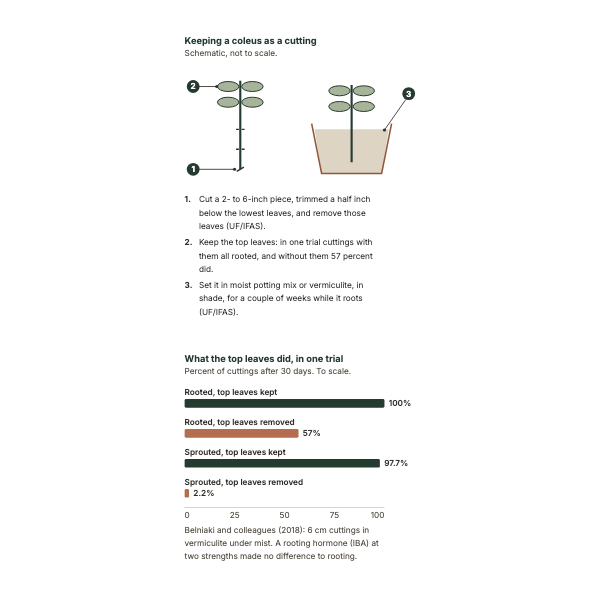
- Consider a fresh start from the leaf if it is long enough, knowing that this means cutting up the leaf you have. Iowa State’s method cuts sections 3 to 4 inches tall and keeps them the same way up, with the end nearest the old base at the bottom. Dip that end in a rooting hormone, following its label, and insert it one to two inches deep in moist rooting medium. Keep it warm, in bright indirect light and high humidity.
Then be patient, without a date. No source says when a leaf is finished. One reply took the kinder view that staying alive counts for something.
Take care when handling it. NC State rates poison severity as low and flags the plant as a problem for children, cats and dogs. It names saponins as the toxin, lists symptoms including vomiting, occasionally with blood, nausea and diarrhea if eaten, and says “The sap can cause skin irritation.” If a pet or child eats any, the advisory below says who to call.
If It Is Variegated
A new shoot from a leaf cutting may not look like its parent. Iowa State says named varieties (cultivars) with variegated edges, such as ‘Laurentii’, “lose their interesting coloration when propagated by cuttings,” because the pattern is a chimera, tissue of two kinds. Bahnamirei’s abstract agrees that such tissues “are compromised when propagating plants through leaf cuttings.” Iowa State says to divide the plant instead to keep the pattern.
Local Regulations and Safety Advisory
If you use pest control products, follow the label. Rules on them vary by country and locality, and your pesticide regulator can say what applies where you live. This article is general information, not legal, medical or veterinary advice.
Authorities to consult:
- Pesticide regulatory authority or environmental protection agency
- Poison control service
- Veterinarian or animal poison control service
If a child or pet may have eaten part of a plant, contact a poison control service or a veterinarian, because toxicity depends on the species, the amount and the individual.
What Remains to Be Explored
We found no test of the direct question. We searched for any study of a whole snake plant leaf left rooted in a pot, and found none: not how often it forms a shoot, not how long that takes, not what light it needs. We also found no test of pot size on pup formation and no source on broken tips.
The laboratory work is tissue culture, read here from abstracts, which shows capacity rather than what happens at home. The light, watering and pot advice is general extension guidance, not a test on lone leaves.
A plain record would help. Note the date, the light at the leaf and the pot size, repeat for a few dozen lone leaves, and see which ones pup. Until then, a still leaf is a question and not a verdict.
Sources
- How to Propagate Houseplants by Leaf Section Cuttings — Aaron Steil. Iowa State University Extension, Yard and Garden. January 2025.
- Snake Plant Question (Ask Extension Question 942732) — Ask Extension, Maryland. August 17, 2026.
- Yard and Garden Column, April 2, 2005 — New Mexico State University, Southwest Yard & Garden. April 2, 2005.
- Innovative in Vitro Shoot Regeneration in Variegated Snake Plant (Sansevieria trifasciata cv. Laurentii) Through Utilization of Light Exposed Single-Node Rhizome Tissue — Bahnamirei MK et al. Scientific Reports 15:39505. 2025. Cited from its abstract.
- Indirect organogenesis for High Frequency Shoot Regeneration of Two Cultivars of Sansevieria trifasciata Prain Differing in Fiber Production — García-Hernández E et al. Scientific Reports 12:8507. 2022. Cited from its abstract.
- Cuttings — University of Illinois Extension, Houseplants. Undated.
- Propagating and Growing Indoor Plants, Member Guide — University of Wisconsin-Extension, 4-H. Undated.
- Adventitious Shoot Formation on Leaf Cuttings in Vivo, a Tool in Horticulture — J.B.M. Custers. Agricultural University, Wageningen (doctoral thesis). November 7, 1986.
- Dracaena trifasciata, North Carolina Extension Gardener Plant Toolbox — NC State Extension. Undated.
- Properly Watering Container Houseplants (SPES-804P) — Virginia Cooperative Extension. Undated.
- North Carolina Extension Gardener Handbook, Chapter 18: Plants Grown in Containers — NC State Extension Publications, North Carolina Cooperative Extension. Undated.
- I’ve Had This Snake Plant for Nearly 3 Years, Hasn’t Grown a Bit (R/Houseplants Thread) — multiple community members. Reddit, r/houseplants. Undated.