No test shows that it does. We found no study of milk on a houseplant, and the one controlled field study we read found little to no effect on pasture. If a dry plant perks up after milk, a better-documented explanation is that its potting mix finally took up liquid, and plain water can do that without the smell.
If you have a struggling plant in very dry mix, skip the fridge. Water slowly, more than once, and check that the pot feels heavier afterward. The rest of this explains why, and why one good result does not settle it.
The story is hard to resist. On r/houseplants, a snake plant owner reported that a co-worker examined the soil, prescribed milk, and the plant recovered after one dose. The owner reported no noticeable smell, and described watering twice a week, only a tablespoon or two at a time.
Some readers credited calcium. One proposed that fats and proteins helped water soak into repellent mix. Others worried about smell, mold and rot, and many focused on that watering routine. The detail that matters may be the tablespoons.
What Has Been Tested
Milk on plants has been tested, just not on a houseplant. The best study we read is a University of Vermont project, funded by USDA, that sprayed dilute raw milk on pasture on working farms. “We found no significant difference in forage quality, soil quality, and forage production between areas sprayed with milk and non-treated control areas.”
Forage here means the pasture plants. The Vermont researchers’ report adds that “Participating farms were not able to distinguish the areas that had been treated with milk from the controls.” Their conclusion was that spraying milk on pasture “is not an economical means of enhancing forage production.”
That says less about a pot than it seems to. The milk was sprayed onto grass, in 2012 during a dry summer, and the authors suspect little of it reached the soil.
There was a small hint in the other direction. In a greenhouse pot study, ryegrass given dilute milk tillered faster at first, meaning it put out side shoots sooner, and made more top growth, but the difference was gone by the next growth period.
In a second greenhouse test, in pots of pasture soil, soil ammonium, a form of nitrogen, spiked one day after application and was unaffected on later sampling days. So milk did something measurable in those pots, but not for long.
For gardens, an Ask Extension expert, Alison O’Connor, wrote in 2024: “As for using milk as a fertilizer, I am unable to find any supporting studies for gardens (there are some for farms).”
We could not find any either. Milk research also exists on a different question, powdery mildew on leaves, covered in the article on white on a leaf.
Was It the Calcium?
This is the popular explanation, and it has little behind it for a pot. Milk contains calcium, and the Vermont team did see slightly higher calcium in forage at one farm’s first sampling, which they suspected came from milk residue. It was gone by the next one. That is the only calcium result we found.
For a calcium explanation to work, the plant would need to have been short of calcium, the calcium would need to reach the roots in usable form, and one dose would need to be enough.
We found no evidence for any of those steps in a snake plant. A reply in the thread doubted the nutrient route too, arguing that a plant cannot use what is in milk until soil microbes have digested it. Nothing we read measured that in potting mix.
The same pattern appears with eggshells in a pot, where a real mineral meets a plant with no shown need for it.
A Better-Documented Explanation: Dry Mix That Repels Water
Here the evidence is solid, though it is about mix and not milk. Virginia Cooperative Extension says “Dry potting soils, especially peat or bark-based ones,” can become hydrophobic, meaning they repel water.
University of Maryland Extension says soilless mixes, the peat-based kind sold for pots, “tend to be hydrophobic.” A conference abstract by Michel and colleagues says this appears when peat undergoes “a high degree of desiccation,” meaning severe drying.
Where the water goes
Very dry peat or bark mix can repel water, so a pot can be watered often and stay dry inside.
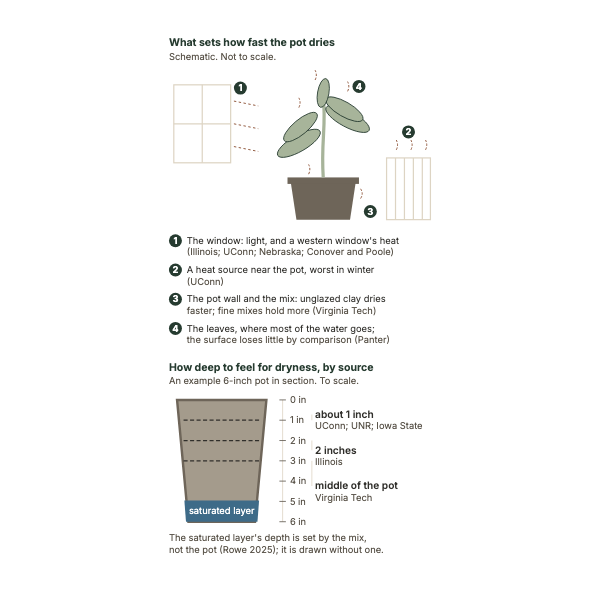
Water that runs straight through has usually not wet the mix. Lift the pot, and check the middle. Two or three slow waterings will help hydrate it.
Virginia Tech explains the trap: “Excessive and quick drainage usually indicates that the potting soil did not hydrate sufficiently.” In other words, water coming out of the bottom does not prove the mix got wet. It may have passed through and left the middle of the pot dry.
Now look at the routine in that story. A tablespoon or two, twice a week, is frequent and very small. If that was how the plant was watered before the milk, and the mix had dried out, that amount may never have wet the root zone, which would leave a plant thirsty despite regular watering.
That is our inference. Nobody measured that pot, and the owner’s replies describe the routine in the present tense, so we cannot say how long it had run.
On that reading, what helped may have been any change that got liquid into the mix. Milk was poured in once, and it was followed by a recovery. No water-only comparison exists, so we cannot separate the two and we do not know whether anything else changed.
Could Milk Act as a Wetting Agent?
The idea is untested, but it starts from a known effect. Wetting agents, additives that help dry material take up water, are in common use. Maryland mentions them as a chemical ingredient that organic soilless mixes leave out.
Michel’s team found that adding one made no significant difference to wet peat but gave “a progressive increase in wettability and hydration efficiency for drier peat.”
Beta-casein, a milk protein, can form tiny clusters called micelles, the subject of a 2026 paper we cite from its abstract. That abstract says nothing about soil or wetting.
Going from there to milk rewetting potting mix is a long step. We found no test of milk as a wetting agent on peat, so this stays a hypothesis.
What the Sips Were Doing
Readers objected to watering twice a week, and the answer depends on how much. NC State says, “Well-drained soil and careful watering are a must; do not overwater, as the roots will rot.”
It advises letting the soil dry between waterings from spring to autumn, and in winter to “only water every one to two months.”
Virginia Tech says to “apply large volumes of water to thoroughly hydrate the potting soil and wait until the rootzone sufficiently dries before watering again.”
It says succulents, a group NC State puts this plant in, rely on “thorough but infrequent waterings, for example, once or twice a month.” A sip twice a week is neither thorough nor infrequent.
One reply warned that now the mix takes up water, the same frequency could become a problem. No source tests this, but NC State’s advice to let the soil dry between waterings still applies.
Most houseplants “do not need a rigid or regular watering schedule,” Virginia Tech says, so let the mix decide, by checking it, as the article on telling when a houseplant needs water sets out.
What Milk Can Cost You
The benefit is unproven, and nobody has measured the costs in a pot. O’Connor warns, “Using milk as a fertilizer, again, can lead to bad odors.”
Readers feared the same, and one described a dorm room that smelled after a roommate spent months pouring leftover chocolate milk into plants, until the plants left. That was repeated dumping, not one dose. The original poster reported no noticeable smell, so a smell is not certain.
We found nothing on whether milk encourages mold or gnats in a pot, only readers’ concern. For milk sprayed on plants in summer heat, O’Connor mentions “possible encouragement of other microorganisms.” NC State’s rot warning is about overwatering, and nothing we read says whether milk adds to it. See root rot and saturation.
If milk has already gone into your pot, we found no guidance on what to do next, including whether flushing it out helps.
What to Do Instead
- Lift the pot. Virginia Tech says to ask, “Does it feel light?” after watering. A light pot after watering suggests water ran through.
- Check the middle. Poke a finger into the mix to see if the middle of the pot is dry. Or hold your hand flat over the surface, carefully turn the pot upside down and lift it off to look for wet and dry patches. Virginia Tech gives both checks.
- Water slowly, more than once. Virginia Tech says “two or three slow applications of water will help hydrate dry potting soils.” If you still find dry spots, it says to add more slowly and check again until the whole root zone is moist. Maryland suggests working water in by hand where a mix is being prepared.
- Or water from below. If the pot has drainage holes, stand it in a shallow basin with 2 to 3 inches of water. Virginia Tech says bottom watering works best for rehydrating an underwatered plant. Its usual soak is 15 to 30 minutes, repellent mix may take longer or need repeating, and a pot should not sit for more than 60 minutes.
- Suspect rot if it stays limp in wet mix. Iowa State warns that root rot symptoms in succulents “are often confused for underwatering,” and Virginia Tech lists mushy leaves and rotten-smelling mix among the signs of overwatering. Stop watering and let the mix dry. Iowa State says plants sometimes recover that way, and that when they cannot, to discard the plant or propagate healthy-looking segments.
- Then let the mix dry between waterings, as NC State advises for this plant.
If you use a fertilizer, follow its label. We give no milk rate, because none has been tested on houseplants.
Keep snake plants away from pets and children. NC State rates the poison severity as low and names saponins, but marks the plant as a problem for cats, dogs and children. Eaten, it can cause vomiting, occasionally with blood, along with nausea and diarrhea. NC State adds, “The sap can cause skin irritation.” If a pet or child eats any, the advisory below says who to call.
Local Regulations and Safety Advisory
If you use fertilizer products, follow the label. Rules on them vary by country and locality, and your agriculture department can say what applies where you live. This article is general information, not legal, medical or veterinary advice.
Authorities to consult:
- Local agriculture department
- Poison control service
- Veterinarian or animal poison control service
If a child or pet may have eaten part of a plant, contact a poison control service or a veterinarian, because toxicity depends on the species, the amount and the individual.
What Remains to Be Explored
The basic test has not been done. We searched for any trial of milk on a houseplant or in potting mix, for its effect on the wetting of dry peat, and for any measure of what it does to smell, mold or gnats in a pot, and found none. We also found no study of how small waterings move through dry mix in a home pot.
The fair way to settle this is simple. Take dry, matching pots with the same plant. Give one milk, one the same volume of water and one a slow double watering, and weigh all three.
That would show whether milk wets dry mix any better than water does. Until then, the snake plant in that story recovered, and nobody can say why.
Sources
- Raw Waste Milk as a Pasture Amendment, Final Report ONE12-155 — Hilshey and Bosworth. USDA SARE, University of Vermont. 2014.
- The Evaluation of Raw Milk As A Pasture Biostimulant — Hilshey and Bosworth. University of Vermont Extension. March 2014.
- Milk Bath for Plants (Ask Extension Question 878345) — Alison O’Connor. Ask Extension. July 23, 2024.
- Properly Watering Container Houseplants (SPES-804P) — Virginia Cooperative Extension. Undated.
- Growing Media (Potting Soil) for Containers — University of Maryland Extension. Undated.
- Common Problems and Issues of Succulents — Iowa State University Extension, Yard and Garden. Undated.
- Wetting Agent Addition for Limiting Risks of Hydrophobicity of Peat Substrate — Jean-Charles Michel, Brian Jackson and William Fonteno. HortScience 50(9) suppl., S284. August 2015. Cited from its abstract.
- Dielectric Response of Micelles Built From Intrinsically Disordered Beta-Casein — Zuev YF et al. International Journal of Molecular Sciences 27:8810. 2026. Cited from its abstract.
- Effectiveness of Cow’s Milk Against Zucchini Squash Powdery Mildew (Sphaerotheca fuliginea) in Greenhouse Conditions — Wagner Bettiol and colleagues. Crop Protection 18:489-492. September 1999. Cited from its abstract.
- Dracaena trifasciata, North Carolina Extension Gardener Plant Toolbox — NC State Extension. Undated.
- Weird Co-Worker’s Weird Advice Saved My Snake Plant (R/Houseplants Thread) — multiple community members. Reddit, r/houseplants. Undated.