Soil that grows plants well in the ground stays wet and short of air in a pot, because a pot holds its leftover water at the bottom and fine soil holds that water high. Mixing in a little sand makes it denser, and stones under it do little for it. Move the plant into a potting mix, in a pot with a hole, and water until water runs out.
The question came from an r/plantclinic post about a flowering plant that had looked poor since it was moved from a small pot into a bigger one.
It sat in a shaded spot on a balcony, got about a cup of water whenever it looked dry, and was soaked before a trip.
The replies looked past the plant to the soil, which they called clay. From there they split. Some said to buy potting soil, which costs little; others said to work in compost, bark, twigs, rice hulls, gravel or coarse sand to let air in.
Others answered that sand and gravel turn clay into something like concrete and that organic matter is the cure.
One suggested filling most of the pot with stones and using an unglazed clay pot to draw water out. Some called the pot far too big; others said to size up only an inch or two.
On watering, one reply said a cup was far too little and the plant should be soaked until water drains, and another doubted water could get through that soil to the hole at all.
One reply named the plant as a Madagascar periwinkle. Most of these claims can be checked against what soil scientists and extension services have published.
Why Soil That Grows Plants in the Ground Fails in a Pot
A pot is not a small piece of garden. After it is watered and has drained, a pot that drains through a hole keeps a layer of saturated soil at its base, a layer growers call a perched water table.
A 2025 drainage study by Rowe in PLOS ONE, reviewing earlier work, puts the rule plainly: “The depth of this saturated volume is constant for any specific soil, and unaffected by container size and shape. As a result, soil in a shallower container has a greater percentage water-holding capacity (WHC) than the same soil in a deeper container.”
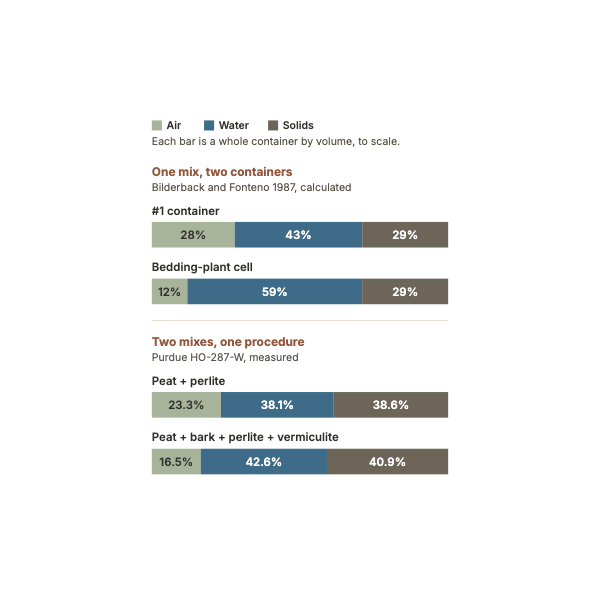
Bilderback and Fonteno calculated what that means for air in 1987. One medium that was 28 percent air in a #1 nursery container was 12 percent air in a bedding plant cell, and its water after draining rose from 43 to 59 percent (cited from the abstract).
What sets the height of the wet layer is the size of the pores. Art Spomer of the University of Illinois, writing in 1977 about drained putting greens, explained that soils with smaller pores hold more water in their upper levels than sands do.
Over a shallow drainage level, he wrote, any good, medium-textured natural soil “will likely be saturated throughout.” He was not writing about pots, but a pot has the condition he describes: a drain at the bottom and not much soil above it.
Extension services say the same thing about containers directly. NC State’s gardener handbook says field soils “often retain too much water, have too little pore space (for oxygen), are too heavy, and potentially harbor harmful diseases, insects, and weeds,” and that for these reasons they are no longer used in containers.
University of Maryland Extension says soils hold water very well in their small pores and can drown roots, especially in shallow containers. Illinois Extension is blunter: never use garden soil by itself, because in a container “both drainage and aeration are severely impeded,” and plants grow poorly or not at all.
Iowa State adds two things a reader with clay in a pot may notice. Garden soil compacts when it is put in a container, which drains and aerates it poorly, and it “pulls away from the inside of the container when it dries, making it difficult to properly water plants.”
The figure below draws the difference. How high the wet layer reaches in a pot of garden soil has not been measured in any source read, so the pots are a schematic; the chart under them, from Spomer’s worked example, is drawn to scale.
Why garden soil stays wet in a pot, and what sand does to it
The water a pot keeps after draining sits at the bottom, and fine soil holds it higher. Below, one worked example of adding sand to a soil.
| 1. Potting mix | A pot that drains through its hole keeps a saturated layer at the base. Its depth is set by the mix, not the pot (Rowe 2025, reviewing earlier work), so the same mix holds less air in a smaller, shallower container (Bilderback and Fonteno 1987). The coarse mix above it drains. |
| 2. Garden soil | Field soil holds water in small pores. In a container it keeps too much water and too little air for roots, especially in shallow pots (NC State; Maryland Extension). Spomer wrote that a good, medium-textured soil over a shallow drain is likely to be saturated throughout. |
Blue: saturated. Gray-brown dots: coarse grains. Small dark dots: fine soil. Bars: dark green, with the threshold in terracotta.
Garden soil’s small pores keep a pot wet from the bottom up. Sand does not open it up in small amounts: in Spomer’s example, pore space fell until sand was about three quarters of what was mixed.
Will Sand or Gravel Open It Up?
Spomer’s work points the same way as the reply that sand turns clay to concrete. In a 1974 paper in HortScience on container soils, he described a threshold proportion, the least amendment needed before aeration begins to improve, and showed it depends on the space between the amendment’s grains (cited from the abstract).
His 1977 article explains what happens below that amount. When sand is added to a soil, total pore space “first decreases then increases,” because at first “the sand floats in the soil.” The sand grains take up room that soil, with its pores, used to fill, without making any large pores of their own.
Large pores appear only once there is enough sand for the grains to touch each other and the soil merely fills the gaps between them.
In his worked example, a soil with 50 percent pore space fell to 39 percent when sand was about a third of what was mixed, and to 18 percent at about three quarters.
Only beyond that point did the pore space climb again, and even pure sand ended at 36 percent. The amount needed, he wrote, is “usually quite high (75-90 percent of the total bulk volume of components).”
His 1980 model of sand and soil mixtures, built on the same idea, predicted measured porosities to within 3 percent (cited from the abstract).
The worked example in the figure is for a putting-green soil, not for anything in a pot, so its numbers show the shape of the effect rather than a recipe.
NC State’s soils chapter, by Luke Gatiboni, reaches the same conclusion for garden beds: “Adding sand to clay will reduce soil structure, lowering pore space.” It lists sand among the amendments that do not adequately improve clay. Our article on fixing a bed of heavy clay covers sand in the ground.
Sand does appear in container recipes. Illinois Extension’s soil-based mix is one part garden soil, one part peat moss and one part perlite or coarse builder’s sand, and it says not to use fine beach or play sand.
Maryland Extension also says to use only coarse builder sand, not play sand, in a container mix. In both, the sand is one ingredient among several, alongside peat and perlite, not a handful worked into a pot of clay.
NC State’s advice on organic matter is written for clay in the ground. It names pine bark and composted leaf mold as the best organic amendments there, and lists peat moss among those that do not adequately improve it there.
For a pot, the extension recipes go further than amending: Iowa State’s homemade mix is equal volumes of garden soil, sphagnum peat moss and perlite, so the soil is a third of the pot, not all of it.
Stones in the Bottom of the Pot
The extension advice and the one test found both look at a drainage layer. NC State’s handbook says never to put gravel or rocks beneath the potting mix, because “Doing so causes the water to collect in the potting mix just above the gravel.”
Rowe’s 2025 study tested that warning with four drainage-layer materials at two depths under three potting media, and found the opposite direction. “Overall, any drainage layer was likely to reduce water retention of any medium, and almost never increased it.”
For loam-based media, the kind that contains soil, “most drainage layers had no effect on the overall water retention.” The pots held no plants, and the study says its results “cannot be used to predict whether a given plant will benefit from this intervention.”
Neither source tested garden clay, so what stones do under it is not known. In the one test, under the media that contain soil, most layers changed nothing.
Filling a third of an oversized pot with stones mostly means less soil in it; no source tested whether that dries the rest.
Our article on whether pots need drainage holes goes through drainage layers in more detail.
A Cup of Water, or Water Until It Drains?
The extension advice sides with the reply that said to soak the plant. Kansas State’s watering guide, by Ward Upham and colleagues, says to water a container to saturation “to ensure that water has soaked through the entire container,” and that water should run out of the bottom drainage hole.
The same guide says to empty any water that collects in the saucer, and warns that a flat-bottomed pot standing on a flat surface may seal itself off and stop draining.
Wisconsin Extension’s Bruce Spangenberg says that ideally water drains through the soil and out of the holes each time a plant is watered.
Kansas State’s reason is that watering to saturation ensures the entire soil mass is moistened. It also warns to make sure the water is not just running down the side where dry soil has pulled away from the pot, which is Iowa State’s point about garden soil.
The reply that water cannot get through clay to the hole may be right for this pot, but no source read measured how fast water moves through clay in a container.
Kansas State also says it is impossible to water a houseplant properly on a predetermined schedule. For most houseplants, including tropicals and flowering pot plants, its rule is to water when the soil is dry an inch below the surface in a 6-inch pot, or two inches down in a 10-inch pot.
The terracotta suggestion has some support. Kansas State says potting soil in plastic pots does not dry as fast as soil in unglazed clay pots, and that “if you tend to over-water, clay would be a good choice.” It gives no figure for how much faster.
Is the Pot Too Big?
Because the saturated layer’s depth is set by the soil rather than the pot, a bigger pot of the same soil does not make that layer deeper. Whether a bigger pot stays wet longer is a question of drying time.
That is what the replies calling the pot far too big, and the ones saying to size up an inch or two, were arguing about.
Our article on root rot and pot size covers what the trials show about how long a larger pot stays wet. Changing the pot without changing the soil leaves the problem in place, since a smaller, shallower pot of the same soil holds a greater share of water (Rowe).
If the Plant Is a Periwinkle
One reply named the plant as a Madagascar periwinkle. We cannot confirm it, but if it is right, the plant’s own care advice points to the same fix.
NC State’s plant database says to grow it in “moist, well-drained soil,” and that it “tolerates a range of soil types, so as long as it has good drainage.”
The same record gives it moderate to high drought tolerance, and says it grows in full sun to partial or dappled shade.
Purdue Extension’s guide to Phytophthora diseases, by Janna Beckerman and Tom Creswell, opens with a photograph of annual vinca and the caption that in “hot, wet summer months, annual vinca (Catharanthus roseus) often falls victim to Phytophthora nicotianae,” a water mold that rots roots and stems.
It says infection “is commonly worse on heavy clay soils, alkaline soils, or soils that are poorly drained.” Its warning about how the disease looks matters for anyone tempted to water more. Root infection on annual vinca “can mimic drought or nutrient deficiency symptoms, resulting in overwatering and overfertilization, making the root rot worse.”
That does not mean this plant has the disease. Purdue notes the pathogen itself can be seen only under a microscope, so the look of the roots alone cannot confirm it.
NC State notes that some cultivars have shown good resistance to Phytophthora root rot, so how a particular plant fares also depends on which one it is.
NC State also rates periwinkle as a low-severity poison for people and a problem for cats, dogs and horses. Every part of the plant contains the toxic vinca alkaloids, and it says that eating large quantities can cause symptoms including vomiting, diarrhea, low blood pressure and seizures, and at worst death. Keep it, and any trimmings, away from pets and children.
What to Do With the Plant in Front of You
The steps below each rest on a source named above. None of them has been tested on this plant in this soil.
- Look at the roots. Slide the plant out of the pot. Purdue says infected roots often discolor as they rot, and that severe root rot can leave a young plant easily dislodged from the soil.
- Change the soil, not just the pot. Move the plant into a bagged potting mix (Illinois, Iowa State, NC State). If you want to use some of the soil, Iowa State’s homemade mix is equal volumes of garden soil, peat moss and perlite; Illinois allows coarse builder’s sand in place of perlite, never fine sand.
- Use a pot with holes, as Wisconsin advises, and mind Kansas State’s warning that a flat-bottomed pot on a flat surface may seal itself off.
- Water until water runs out of the hole, then empty the saucer (Kansas State). Water again when the soil is dry an inch below the surface in a 6-inch pot, not on a schedule (Kansas State).
- If the roots are discolored and rotting, Purdue’s advice for a plant with established Phytophthora is to remove the infected parts or the whole plant.
Several replies suggested rinsing the old soil off the roots or keeping the plant in a glass of water for a while.
No source read tested either for a plant moved out of garden soil, so neither is recommended here. Our article on what to check before you repot covers how much root disturbance plants tolerate.
Is Garden Soil Ever Fine in a Pot?
As one ingredient, yes, by the extension services’ own recipes. Illinois says soil-based mixes have real advantages: they are heavier, which steadies a pot in wind, they dry more slowly, and they hold nutrients longer. The cost is that the soil may bring insects, weed seeds and disease with it.
Illinois also suggests that about a quarter soil can stretch a soilless mix. Maryland is stricter: topsoil only in very large containers, at no more than 10 percent of the volume (another line on the same page gives 5 to 10 percent).
One trial shows a soil-based mix can work. Fonteno, Cassel and Larson grew poinsettias in a mix of 2 parts loamy soil, 1 part peat moss and 1 part perlite, and it gave “adequate water-holding capacities” for container production (cited from the abstract). That soil was a loam, not a clay, and it made up half the mix, not all of it.
One reply guessed which country the poster lives in and said dug soil is the only kind sold there; another said bagged soils of every kind are.
No source read says what is sold where. Where bagged mix is hard to find, Iowa State’s and Illinois’s recipes need only peat moss and perlite or coarse builder’s sand alongside the soil.
Local Regulations and Safety Advisory
Plant toxicity depends on the species, the amount and the individual, and a poison control service or a veterinarian can say whether a particular plant is a concern for your household. This article is general information, not medical or veterinary advice.
Authorities to consult:
- Poison control service
- Veterinarian or animal poison control service
If a child or pet may have eaten part of a plant, contact a poison control service or a veterinarian.
What Remains to Be Explored
No source read measured how high the wet layer reaches in a pot of garden soil, or compared a plant grown in garden clay with one in potting mix in the same pot.
The case against garden soil in pots rests on extension guidance and on soil physics worked out for putting greens and nursery containers.
Spomer’s sand figures come from a model for a putting-green soil, checked against measured mixes, not from a potting soil. Rowe’s drainage-layer test used potting media and no plants, and no study tested stones under garden soil, the case in this thread.
No source gave a figure for how much faster an unglazed clay pot dries than a plastic one, how fast water moves through clay to a drainage hole, or whether rinsing field soil from the roots helps a transplanted plant.
The plant’s identity rests on one reply.
Sources
- Been Like This for … After Transplanting — multiple community members. Reddit, r/plantclinic. Undated.
- Effect of Drainage Layers on Water Retention of Potting Media in Containers — A. Rowe. PLOS ONE 20(2):e0318716. February 25, 2025. Read in full.
- Effects of Container Geometry and Media Physical Properties on Air and Water Volumes in Containers — T.E. Bilderback, W.C. Fonteno. Journal of Environmental Horticulture 5(4). 1987. Cited from its abstract.
- Principles of Soil Physical Amendment — Art Spomer. Weeds Trees and Turf, August 1977 (Michigan State University Turfgrass Information Center archive). August 1977.
- Optimizing Container Soil Amendment: The “Threshold Proportion” and Prediction of Porosity — L. Art Spomer. HortScience 9(6). 1974. Cited from its abstract.
- Prediction and Control of Porosity and Water Retention in Sand-Soil Mixtures for Drained Turf Sites — L. Art Spomer. Agronomy Journal 72. 1980. Cited from its abstract.
- Physical Properties of Three Container Media and Their Effect on Poinsettia Growth — W. C. Fonteno, D. K. Cassel, R. A. Larson. Journal of the American Society for Horticultural Science 106(6). 1981. Cited from its abstract.
- Plants Grown in Containers (Extension Gardener Handbook, Chapter 18) — Diane B. Mays, Kim Richter, Lucy Bradley. NC State Extension, AG-831. February 1, 2022.
- Soils and Plant Nutrients (Extension Gardener Handbook, Chapter 1) — Luke Gatiboni. NC State Extension, AG-831. February 1, 2022.
- Growing Media (Potting Soil) for Containers — University of Maryland Extension. March 23, 2026.
- Soil (Container Gardens) — University of Illinois Extension. Undated.
- I Would Like to Grow a Few Vegetables in Containers. Can I Use Garden Soil or Should I Purchase a Commercial Potting Mix? — Iowa State University Extension and Outreach, Yard and Garden. February 28, 2022.
- Healthy Roots, Healthy Houseplants — Bruce Spangenberg. University of Wisconsin-Madison Division of Extension. Undated.
- Watering Raised Beds, Berms, Containers, and Houseplants (MF2805) — Ward Upham and colleagues. Kansas State University Agricultural Experiment Station and Cooperative Extension Service. January 2008.
- Catharanthus roseus (Madagascar Periwinkle), Extension Gardener Plant Toolbox — NC State Extension. Undated.
- Phytophthora Diseases in Ornamentals (BP-215-W) — Janna Beckerman, Tom Creswell. Purdue Extension, Botany and Plant Pathology. November 2020.