Scrape one gently. A scale insect’s shell or whole body lifts away from the stem, while a root is part of the stem and shows green or creamy tissue. Color, stickiness and position on the stem will not settle it. The test comes from general indoor-plant guidance rather than a pothos study, and the root anatomy below comes from other plants.
One reader posted a pothos stem crowded with brown nodules and asked what they were. The replies turned into a small diagnostic conference: hardened roots, callus, a mutation, too much rooting hormone, armored scale, and one request for a dissection video.
The advice ran from growing it on to see what happened, through to throwing it out. In the replies we read, nobody reported scraping one. We cannot diagnose that plant either, but the disagreement has a physical answer you can check on your own.
Why Roots and Scale Get Confused
Scale is a likely suspect on this plant. Susan Mahr of Wisconsin Extension names mealybugs and scale as the most common insect pests of pothos in homes. She describes scale as bark-colored bumps on stems and leaves, and warns that they can be hard to tell from the plant they are feeding on.
Their coverings run from 1/25 to 1/4 inch long, according to the University of California’s pest management program. NC State adds that armored scale covers often blend into bark, so a colony can grow large before anyone notices. A brown bump on a stem fits that description well.
It also fits a root. A 2026 paper by André Mantovani and Yago Chagas Groba, cited from its abstract, followed pothos roots from soil into air. Roots in soil were smooth and light brown, while aerial roots had a “rough, dark brown surface”, because a hardened cork layer replaced their outer tissue and cut water loss.
That study looked at aerial roots, not at stubby nubs on a shelf plant. It still removes one common assumption. Dark, rough and hard is how a pothos root is built for life in air, so those three traits do not by themselves mean a bump is dead, diseased or an insect.
How a Root Gets Out of a Stem
Roots along a stem do not begin at the surface. In a 2015 paper on sweetpotato, Jun Ma and colleagues found that root primordia, the beginnings of a root, form inside the stem and “are well developed before emerging.” The number of roots that grew matched the number of primordia found inside.
That paper is cited from its abstract, as are the rice and nightshade papers below.
They can also wait. A 2016 study of Solanum dulcamara, a nightshade, describes “preformed, dormant primordia on the stem” that flooding woke up. So in that plant, at least, a stem can carry formed roots that are not yet growing, and a trigger decides when they move.
Getting out is a controlled break. In a 2000 study of deepwater rice, Heidi Mergemann and Margret Sauter found that skin cells over the root tip died “until the epidermis split open”, and the root came out through that crack. A 2019 paper from Sauter’s lab, with Chen Lin, describes this as programmed death of the cells covering the primordium.
None of these plants is a pothos. Rice is a grass and sweetpotato is a morning glory relative, so this shows how roots emerge in those plants. We found no section through a pothos root coming out of its stem, and the drawing below is a schematic on that basis.
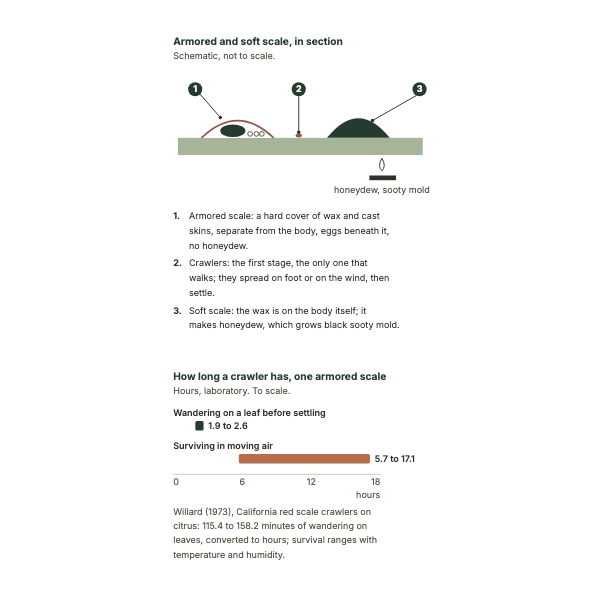
A scale works the other way around. It settles on the plant and feeds, in NC State’s words, “by sucking fluids through straw-like mouthparts”, and Iowa State says it stays at that spot for the rest of its life.
One reply put the distinction well: these bumps seemed to break out from under the skin, and scale sits on top of it.
A root comes through the skin. A scale sits on it
Both can look like a hard brown bump. The difference is whether the bump is part of the stem, and a gentle scrape shows that.
A root is continuous with the stem. A scale is a separate animal feeding through its mouthparts, and what lifts away depends on the kind.
The Scrape Test
Washington State University’s guidance on indoor plants gives the method, because it recognizes the problem: some natural plant structures resemble scale. Handle the stem with the sap warning below in mind.
- Pick several bumps, on more than one stem. One bump tells you about one bump, and the two can share a plant.
- Scrape each one gently with a knife, taking care not to bruise the stem.
- Look at the result under a magnifying glass, because the details are small.
Green or creamy white tissue under the bump means plant. A shell that lifts to show a six-legged insect, or a cottony mass with eggs or tiny crawlers, the newly hatched young, means scale.
That wording is Washington State’s, and it is the one published test we found aimed at exactly this confusion.
The University of California’s account explains why two scale results can look different. On an armored scale the cover is separate, so “the insect body will remain on the plant” when you remove it. A soft scale has no separate cover, and flipping it takes body and cover off together. Either way, something came away.
There is one trap. A scale can be dead and still attached, so a shell that lifts with nothing alive under it can still be scale. The same program gives a check for life, which matters later when you judge a treatment: dead or parasitized scales fail to give up fluid when squished.
What Does Not Settle It
Most quick answers lean on one clue. Each clue below points somewhere, but none of them closes the question.
| Clue | Why it falls short | Where that comes from |
|---|---|---|
| No sticky residue | Armored scales make no honeydew, the sticky waste some sap feeders leave, so a dry plant does not clear it | UC IPM; NC State |
| Sticky leaves | Soft scale makes honeydew, but so can mealybugs, so it points to insects and not to which one | UC IPM; Wisconsin |
| The bump sits at a node, where a leaf joins the stem | Roots are expected there, but Wisconsin says clasping roots arise from nodes and internodes, the stretches between them, and scale settles on stems generally | Wisconsin; Yu et al. 2025 |
| Brown color | Aerial roots and scale covers are both brown | Mantovani and Groba 2026; Wisconsin |
| Hard to the touch | A corky root is hardened, and armored covers are built as protection | Mantovani and Groba 2026; NC State |
Position deserves a caution, because it is the clue most people reach for. A 2025 review of climbing aroids, the plant family that includes pothos, by Pinger Yu and colleagues says clasping roots emerge at the node.
Wisconsin’s sentence on nodes and internodes describes the wild plant. So a bump at a node fits a root without proving one, and a bump between nodes does not prove an insect.
The Other Explanations in the Thread
The scrape separates insects from plant tissue and goes no further. If it says plant, several ideas from the thread remain open, and none of them involves an insect, so none gives you anything to spray.
Callus. This is real, and in tissue culture a mass of it can sit in a state close to a root beginning. We found nothing that separates callus from young root tips by eye on a pothos stem, and it would pass the scrape as plant tissue either way.
Too much rooting hormone. One reply blamed an overdose. In a 2017 opinion article, Jie Yu and colleagues describe a high level of auxin, the hormone in rooting products, inducing callus on leaf pieces on a culture medium. That is a lab system, not a stem in a pot.
The nightshade study cuts the other way, finding that auxin treatment alone “was not sufficient” to bring dormant primordia out.
We found no test of a rooting product causing bumps on a pothos stem, so this stays a possibility, not an explanation. Our article on rooting cuttings in perlite or LECA covers how cuttings root in the first place.
Mutation or fasciation. South Dakota State describes fasciation as “enlargement, flattening or cojoining” of plant parts, most often stems or flowers. Separate bumps along a round stem are not that picture, and we found nothing describing it on pothos roots.
A mutation may be involved in a case like the one in the thread, but nobody can show that from a photo.
If They Turn Out to Be Roots
There is nothing to treat. Aroid vines use clasping roots to hold onto a surface and feeder roots to reach the soil, and the roots of the climbing plants Mantovani and Groba studied absorbed water where they touched their host and kept root hairs there.
A reply suggested a moss pole or trellis to give dried roots something to grab.
Contact is what those roots are for, and a support is what changes a pothos’s leaves, but nothing we read shows that a dried nub revives when it touches one. Treat a support as a benefit for new growth.
Should you pick them off? No source we read tests what removing aerial roots does to a pothos, so we cannot call it harmless or harmful. If a bumpy section bothers you, cutting the stem is the better-documented route, and what happens when you cut a houseplant back explains where.
If They Turn Out to Be Scale
Move the plant away from the others first. Iowa State warns that the insects could spread to other houseplants, so check the neighbors with the same scrape.
Our article on how long to quarantine a new houseplant covers how long published advice says to keep a plant apart. Severity then decides the rest. Iowa State says a small infestation does little harm to a healthy houseplant, while a heavy one can stunt or kill it.
A few scales. Scrape them off, or dab each one with a cotton swab soaked in rubbing alcohol. Washington State warns that too much alcohol can harm some plants, so test on one leaf and wait a few days.
New Mexico State warns you not to bruise the plant while you rub. Iowa State says this hand work suits only small, large-leafed plants, so a long vine with many stems is a harder job.
More than a few. One reply suggested neem oil or insecticidal soap, and there is a catch.
Iowa State says the shell protects scale from contact insecticides, so they work only on crawlers, the young stage that is often yellow to orange. Houseplant scale has no set breeding time, so one application will not reach them all.
Use a product labeled for houseplants and for scale, and follow its label for how much and how often. We give no rates here, because the label is the legal instruction and it varies by product.
Washington State suggests treating outdoors in shade where practical, letting sprays dry first, and using no chemical controls on edible plants grown indoors.
Which family you have matters if you reach for a systemic product, one the plant takes up into its tissue. NC State says imidacloprid does not kill armored scales, though it kills soft scales, and Iowa State calls systemics generally ineffective against houseplant scale.
That is one more reason to look closely at what your scrape turned up.
A heavy infestation. Iowa State’s advice is to remove the worst stems on plants that regrow after pruning, and it says discarding is often best, because control is nearly impossible.
Mahr agrees that it is often better to start over with clean plants or cuttings. Clean is the operative word, so scrape-check anything you plan to keep.
Afterward, sticky residue and black sooty mold wipe off with lukewarm water, according to Washington State. Before treating again, use the squish check, since UC advises confirming that scales are alive before applying anything.
Before You Touch the Stem
Pothos sap is worth respecting. Mahr says it may irritate skin, and NC State’s plant database lists calcium oxalate crystals as the toxic principle and contact dermatitis as a hazard. Keep the sap off your skin when you scrape or cut.
Wisconsin says pothos is toxic if eaten in large quantities and causes burning in the mouth. The ASPCA lists pothos among plants with insoluble calcium oxalates.
Keep the plant, trimmings and any treated swabs away from pets and children. Our article on what “toxic to cats” means covers what to do if a pet chews one.
Local Regulations and Safety Advisory
If you use pest control products, follow the label. Rules on them vary by country and locality, and your pesticide regulator can say what applies where you live. This article is general information, not legal, medical or veterinary advice.
Authorities to consult:
- Pesticide regulatory authority or environmental protection agency
- Poison control service
- Veterinarian or animal poison control service
If a child or pet may have eaten part of a plant, contact a poison control service or a veterinarian, because toxicity depends on the species, the amount and the individual.
What Remains to Be Explored
We found no anatomical study of a pothos root emerging from its stem, so the mechanism here is borrowed from rice and sweetpotato.
Nor did we find the scrape test checked against pothos. It rests on one university fact sheet written for indoor plants generally, and a false result on a pothos stem is possible.
Nothing we read explains a stem covered in brown nodules like the one in the thread. We found no measured count of root nubs on a normal pothos, so no one can say how many is too many.
No test ties rooting products to that growth, and no source shows what removing aerial roots does to the plant.
Two questions from the thread are not answered here. No source we read covers flat mites on pothos, so that suggestion is unassessed.
And this article does not cover stem disease, so a soft or wet stem needs a different answer from a hard brown bump. A section through a real nodule under a microscope would settle the case in the thread.
Sources
- Sclerified Cork Outperforms the Exodermis: Root Water Permeability Decreases in the Soil-To-Canopy Transition of the Aroid Vine Epipremnum aureum — André Mantovani, Yago Chagas Groba. Physiologia Plantarum 178(2):e70779. 2026. Cited from its abstract.
- Ethylene Induces Epidermal Cell Death at the Site of Adventitious Root Emergence in Rice — Heidi Mergemann, Margret Sauter. Plant Physiology 124(2):609-614. 2000. Cited from its abstract.
- Adventitious Root Primordia Formation and Development in Stem Nodes of Georgia Jet Sweetpotato, Ipomoea batatas — Jun Ma, Roni Aloni, Arthur Villordon, Don Labonte, Yanir Kfir, Hanita Zemach, Amnon Schwartz, Leviah Althan, Nurit Firon. American Journal of Botany 102(7):1040-1049. 2015. Cited from its abstract.
- A Co-Opted Hormonal Cascade Activates Dormant Adventitious Root Primordia Upon Flooding in Solanum dulcamara — Thikra Dawood and colleagues. Plant Physiology 170(4):2351-2364. 2016. Cited from its abstract.
- Polar Auxin Transport Determines Adventitious Root Emergence and Growth in Rice — Chen Lin, Margret Sauter. Frontiers in Plant Science 10:444. 2019.
- Auxin Control of Root Organogenesis From Callus in Tissue Culture — Jie Yu, Wu Liu, Jie Liu, Peng Qin, Lin Xu. Frontiers in Plant Science 8:1385. 2017.
- Diverse Climbing Strategies in Aroid Vines: Functional Adaptations and Environmental Drivers — Pinger Yu, Shufei Weng, Bo Zhang, Yichun Huang, Feican Xu. Frontiers in Plant Science. 2025.
- Pothos, Epipremnum aureum — Susan Mahr. University of Wisconsin-Madison Extension, Wisconsin Horticulture. Undated.
- Epipremnum aureum — North Carolina Extension Gardener Plant Toolbox. Undated.
- Armored Scale Identification and Management on Ornamental Plants — James Baker, Steven Frank. NC State Extension, Entomology Insect Notes. December 2, 2022.
- Scales, Pest Notes Publication 7408 — University of California Statewide IPM Program. Undated.
- Scale Insects — Washington State University, Pestsense. Undated.
- The Leaves on My Houseplant Are Covered With a Sticky Sap. There Are Also Small “Bumps” on the Stems. What Is the Problem? — Iowa State University Extension, Yard and Garden. December 3, 2024.
- Scale Insects on Houseplants — Iowa State University Extension, Yard and Garden. Undated.
- Yard and Garden, September 6, 2003 — New Mexico State University. September 6, 2003.
- Fasciation: What’s Going on With My Plant? — Cody Molnar, Sara Ogan. South Dakota State University Extension. Undated.
- Golden Pothos — American Society for the Prevention of Cruelty to Animals. Undated.
- What Are Those Brown Things on My Pothos? (R/Houseplants Thread) — Reddit. Undated.