Yes, but the limit sits above the range an anthurium prefers. NC State Extension gives anthurium a humidity of 60 to 80 percent, and the plant problems reported begin higher, at about 85 to 90 percent.
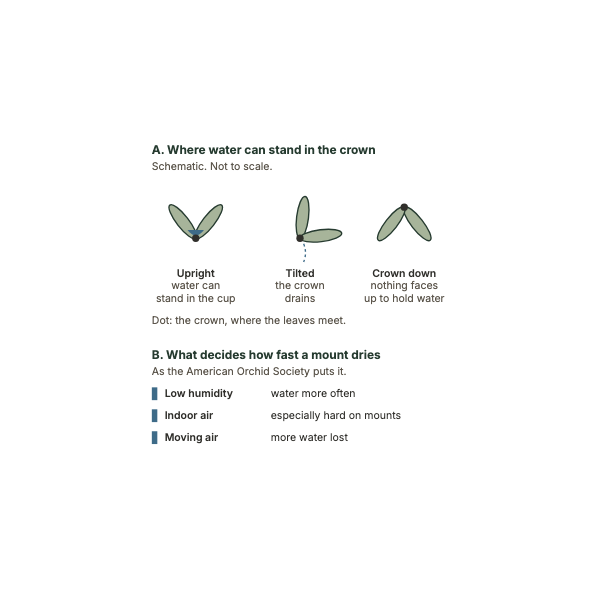
Saturated, still air harms a plant by three separate routes: water moves through it more slowly, water settles on its leaves as the air cools, and leaves that grow in it form pores that fail to close.
Moving air and dry leaves answer the first two; only lower humidity while leaves grow answers the third. A room held that humid also sits above what the US Environmental Protection Agency advises for a home.
The question comes from a post on r/houseplants in which a collector showed off a whole room given over to anthuriums: an enclosed garden in the middle of a house, plants hung on the walls, and a humidifier.
Many replies simply wanted to move in. The question that kept returning was how the room avoids mold, and one reply warned that without circulation, fungus spreads. The poster said the room is open at the top, stays humid even with the humidifier off, and has had no mold so far.
The poster also mentioned, almost in passing, that a calathea in the same room was not thriving despite all that moisture. That detail is the real question. If humid air is good, why would a humid room ever be bad, and for whom: the plant or the house?
How Much Humidity Does an Anthurium Want?
A good deal. NC State’s Plant Toolbox describes the flamingo flower, Anthurium andraeanum, as native to Colombia and Ecuador, where it “thrives in warm, humid, and shaded rainforests,” often growing on trees as an epiphyte. It gives a preferred humidity of 60 to 80 percent.
Commercial growers push the air higher still. Anthura, an anthurium breeder, tells greenhouse growers that at high humidity “the stomata are opened to a maximum,” letting the plant take up carbon dioxide easily, that leaves cool better, and that leaf and flower color hold up better.
Stomata are the small pores on a leaf that let carbon dioxide in and water vapor out. Anthura ties wide-open stomata to more growth and calls humidity of great importance for the crop. Nothing in either source suggests that humid air itself is the enemy.
Where Too Much Starts
The same breeder names the limit. “When Anthurium is grown for a long time at a high RH (> 90%),” Anthura writes, using the growers’ shorthand for relative humidity, “and there is a lack of moisture removal, problems can occur.”
Both conditions are in that sentence: the level, and air that is not being exchanged. The short-term problem Anthura describes is glassiness, which “develops because the root pressure is high and the plant has insufficient evaporation options.” Water is pushed into the spaces between leaf cells.
Over longer spells, Anthura reports calcium shortfalls in the flowers. It also says too little moisture removal leaves the roots poorly activated, which “makes the roots weaker and root rot can occur more easily.”
The calcium point rests on how a plant moves water. Calcium uptake “is a passive process,” in Anthura’s words: the element rides the water stream up to the parts that are actively losing water. With too little evaporation, in Anthura’s words, “the intake of calcium will stay behind.”
Primary studies on other crops point the same way. Transpiration is the evaporation of water from leaves that pulls the stream upward, and in four greenhouses run at different humidities, Maher Trigui and colleagues found in 1995 that high humidity “reduces the hourly and daily transpiration levels significantly” in tomato.
That tomato study is cited from its conference abstract, as is a 2005 lettuce experiment by Hans Chris Wien and David de Villiers, who raised and lowered the humidity over hydroponic plants to see what it did to tipburn.
Tipburn, which they describe as a localized calcium deficiency in young leaves, was “most severe in ponds whose atmosphere was constantly humid,” and least where the air stayed dry. Transpiration, they concluded, matters more than root pressure in carrying calcium to the edges of young leaves.
Neither study involved anthurium, so applying them to it is an inference. What they add is the mechanism behind Anthura’s warning: a leaf that loses little water draws little calcium in behind it, and in the lettuce it was the young leaves that showed the shortage.
Water That Settles on the Leaf
The second route works at night. John Bartok of the University of Connecticut Extension explains it for greenhouses: on sunny days plants and wet surfaces load the air with water vapor, and “as the air cools to the dewpoint,” the temperature at which the air can hold no more water vapor, “condensation occurs and water droplets are formed on cooler surfaces such as the leaves.”
That film of water, Bartok writes, “promotes the germination of fungal pathogen spores such as Botrytis or the powdery mildews.” Warm air holds far more moisture than cool air: “Air at 70 deg. F will hold twice as much moisture as air at 50 deg. F.”
As a result, Bartok notes, “slight changes in temperature result in large changes in relative humidity,” so the evening cooling he describes is enough to bring humid air to the dew point.
Plants packed together make it worse. “In a dense canopy of foliage the relative humidity can be 20% – 40% higher than the air above it,” Bartok writes.
Continuous air circulation, he adds, reduces that difference and “keeps the leaf temperature higher.” A room reading high on its meter may be higher still among the leaves.
For anthurium specifically, NC State says that “leaf spots can occur if there is poor air circulation or if the foliage gets wet.”
Anthura adds that leaves should not stay “fully wet for a long time with little energy (radiation) on the crop,” because growth stalls. Wet leaves in dim, still air are the combination both warn against.
Bacteria use water on the leaf too. Ryo Fukui, H. Fukui and Anne Alvarez showed in 1999 that the bacterium behind anthurium blight grows in guttation fluid, the sap a plant pushes out at its leaf edges, and invades “through hydathodes at leaf margins.” The study is cited from its abstract.
Hydathodes are the pores that release those droplets, and guttation shows most when evaporation from the leaf is low, which our article on why houseplant leaves drip water explains.
Fukui’s team tested ways to block the bacterium rather than humidity levels, so their work shows the route in, not the humidity at which infection begins.
Field records from Trinidad fit the same picture. Annelle Holder and colleagues found in 2015 that bacterial leaf spot of anthurium “was a problem only in the wet season” on the commercial farms they surveyed, with severity tracking rainfall.
That was rain on outdoor farms, not humid air indoors, and it is cited from the abstract.
Leaves That Grow in Saturated Air
The third route outlasts the humid room itself. Dimitrios Fanourakis and colleagues wrote in 2011 that “plants of several species, if grown at high relative air humidity (RH ≥85%), develop stomata that fail to close fully” when the leaf is short of water.
Their experiments with roses showed that it depends on timing. “Stomatal functionality is strongly dependent on the humidity at which the leaf completed its expansion,” they concluded, and once a leaf had fully expanded, changing the humidity no longer changed how its stomata behaved. The paper is cited from its abstract.
Sissel Torre and colleagues found the same pattern in 2003. Roses grown at 90 percent humidity had more stomata, longer stomata and wider openings than roses at 70 percent, and thinner leaves.
Moved to 40 percent, the moderate-humidity roses cut their water loss over three days, while the high-humidity roses barely changed theirs.
Torre’s team concluded that stomata “should occur at RH conditions below 85%” for roses to keep their quality after sale.
That study is also cited from its abstract. No study of this effect in anthurium was found, so carrying it to anthurium is an inference, though Fanourakis reports it in several species.
The practical meaning is about moving plants. A plant whose leaves grew in a saturated room carries those leaves into drier air, and by the rose results they will lose water faster than leaves grown at moderate humidity. By the same results, leaves that expand afterward in moderate air form stomata that work better.
Reading the Levels
Put the sourced numbers on one scale and the tension in the thread becomes visible. The range NC State gives for anthurium starts where EPA’s advice for a home ends, and the plant problems in the research and in Anthura’s advice start higher again.
How humid is too humid?
The range an anthurium prefers sits above the level EPA advises for a home, and the plant problems reported begin higher still.
Near saturation, what matters is whether moisture is removed: air that moves, and leaves that dry.
The two problem levels are thresholds, not bands. Nothing in the sources says 86 percent is safe and 91 percent harmful; they say that leaves formed at 85 percent or more, or plants kept above 90 percent with no moisture removed, are where trouble was found, not a line below which none can occur.
The Room, Not Just the Plant
The thread’s readers were right to ask about mold, and the answer for the building is simpler than for the plant. “The key to mold control is moisture control,” EPA says.
It advises keeping indoor humidity “below 60 percent (ideally between 30 and 50 percent),” which is below the range NC State gives an anthurium.
EPA’s warning sign is the same physics that wets the leaves. “Condensation can be a sign of high humidity,” it says, and it tells readers to act when they see moisture collecting on windows, walls or pipes.
Its remedies are reducing the humidity and increasing “ventilation or air movement.”
A plant room, then, is a trade between what the plants prefer and what the building is advised to hold. EPA’s guidance is written for homes in general; no source read here assesses a dedicated plant room, and this article does not judge the one in the thread.
If you can see or smell mold, EPA’s guide covers what to do next, and our article on old-house smell covers how to tell the sources apart.
Cleaning up mold is beyond this article; EPA notes that a background level of spores always remains and does not grow once the moisture problem is solved.
What to Do With the Humid Setup You Have
Measure it. EPA notes that relative humidity can be measured with a small humidity meter from a hardware store. Bartok’s point about dense canopies means a reading taken in open air can understate the humidity the leaves themselves sit in.
Keep the air moving. Bartok’s greenhouse advice is continuous air circulation, which thins the humid layer around the leaves and keeps them warmer.
EPA’s advice for homes is the same in plainer terms: more ventilation or air movement, opening doors or windows when practical and using fans as needed.
Water the mix, not the leaves. NC State links anthurium leaf spots to wet foliage, Bartok recommends watering that wets only the soil, and Anthura warns against leaves staying wet for long in low light. Pour water onto the potting mix at the base of the plant rather than over the leaves.
Look for condensation. Check windows, walls and leaves for droplets after the air has cooled overnight, which is when Bartok says condensation forms. Droplets on glass or walls are EPA’s sign of high humidity; droplets on leaves are the film Bartok describes.
Let the top of the mix dry. Anthura says drying of the top layer “is also necessary” for potted anthurium, and NC State says to water when the top inch feels dry. Bartok notes that besides the leaves, “considerable moisture comes from evaporation from wet surfaces.”
Moving a plant out. If a plant leaves a saturated room, expect its existing leaves to lose water faster than leaves grown in drier air, by the rose findings, and its new leaves to form stomata that work better.
No source gives a schedule for weaning a houseplant to drier air, so none is offered here.
Running the humidifier less is a choice the sources leave open. Anthura’s warning is about long spells above 90 percent without moisture removal, and NC State’s range tops out at 80, so a room that holds its humidity in that range, with moving air and dry leaves, is close to what both describe.
If your question is the opposite one, how to raise humidity for a plant in a dry home, our article on what actually raises humidity covers what works.
Local Regulations and Safety Advisory
If mold in your home raises a health concern, your public health department or a qualified mold inspector can advise. This article is general information, not medical or professional safety advice.
Authorities to consult:
- Public health department or qualified mold inspector
What Remains to Be Explored
No study of stomata grown at high humidity in anthurium was found; the rose results are carried to it by inference. Nor was any measurement found of humidity, air movement and leaf disease in a home plant room, as distinct from a greenhouse, where most of this evidence comes from.
No source gives a humidity at which anthurium leaf disease starts indoors; the blight study shows the route in, not the threshold. Anthura’s limit of 90 percent comes from a breeder’s advice to growers, with no trial cited on its page, and its moisture figures are written for greenhouses.
Why a calathea would fail in a room this humid is not answered by any source read here, and nothing above should be taken as the reason.
A weaning schedule for plants moved to drier air, and a test of how much a household fan changes humidity among the leaves, would both change the advice.
Sources
- Anthurium andraeanum (Flamingo Flower) — North Carolina State University Extension, Plant Toolbox. Undated.
- Humidity in the Cultivation of Anthurium — Anthura. Undated.
- Reduce Greenhouse Humidity — John W. Bartok, Jr. University of Connecticut Extension, Integrated Pest Management. 2013.
- A Brief Guide to Mold, Moisture and Your Home — US Environmental Protection Agency. February 18, 2026.
- Avoiding High Relative Air Humidity During Critical Stages of Leaf Ontogeny Is Decisive for Stomatal Functioning — Dimitrios Fanourakis, Susana M. P. Carvalho, Domingos P. F. Almeida, Ep Heuvelink. Physiologia Plantarum 142(3):274-286. April 2011. Cited from its abstract.
- Leaf Anatomy and Stomatal Morphology of Greenhouse Roses Grown at Moderate or High Air Humidity — Sissel Torre, Tove Fjeld, Hans Ragnar Gislerød, Roar Moe. Journal of the American Society for Horticultural Science 128(4):598-602. July 2003. Cited from its abstract.
- Suppression of Bacterial Blight by a Bacterial Community Isolated From the Guttation Fluids of Anthuriums — Ryo Fukui, H. Fukui, Anne M. Alvarez. Applied and Environmental Microbiology 65(3):1020-1028. March 1999. Cited from its abstract.
- Status of Bacterial Leaf Spot Disease of Anthurium in Trinidad and Characterization of Native Isolates of the Causal Organism, Acidovorax anthurii — Annelle Holder, Winston Elibox, Pathmanathan Umaharan. HortScience 50(7):1023-1027. July 2015. Cited from its abstract.
- Effect of Humidity on the Transpiration of Greenhouse Tomato Crops — Maher Trigui, Laurent Gauthier, Suzelle F. Barrington. HortScience 30(4):847B (conference abstract). July 1995. Cited from its abstract.
- Inducing Lettuce Tipburn With Relative Humidity Modification — Hans Chris Wien, David S. de Villiers. HortScience 40(4):1053C (conference abstract). July 2005. Cited from its abstract.
- Is this Humid Enough for My Anthurium Room? (R/Houseplants Thread) — multiple community members. Reddit, r/houseplants. Undated.