Ants in a houseplant pot are usually nesting there, not eating the plant. Check the stems and leaves for aphids, mealybugs and scale, rule out fire ants where they occur, then flush the pot or repot it by what the plant tolerates. Water moves ants but has not been shown to kill a colony, and no study has measured how much a nest harms a houseplant.
A snake plant went a couple of months without water, and its first drink brought ants out of the pot. That is the whole story in one r/houseplants thread, and the replies did the rest: the dry mix had invited them, they might be eating the plant, and here was a long list of things to pour on it.
The remedies ranged from repotting and drenching to bait, peroxide, neem, cornmeal, diatomaceous earth and cinnamon. The sources below sort that list into what has been tested, what has not, and what was tested only on a different ant outdoors.
What to Do With Ants Pouring Out Right Now
Work in this order. The first step matters where imported fire ants occur, and the rest apply anywhere. Each step comes from an Extension source named in the sections below, where the reasons are given.
- Look before you touch. Texas A&M describes fire ants as workers of mixed sizes up to 1/4 inch that emerge in large numbers and run up anything vertical when the nest is disturbed. If that is what you see, leave the pot alone and read the fire ant section first.
- Clear the strays. UC IPM says vacuuming the trail or wiping it with soapy water removes the scent trail other ants follow. It can be done where the pot stands.
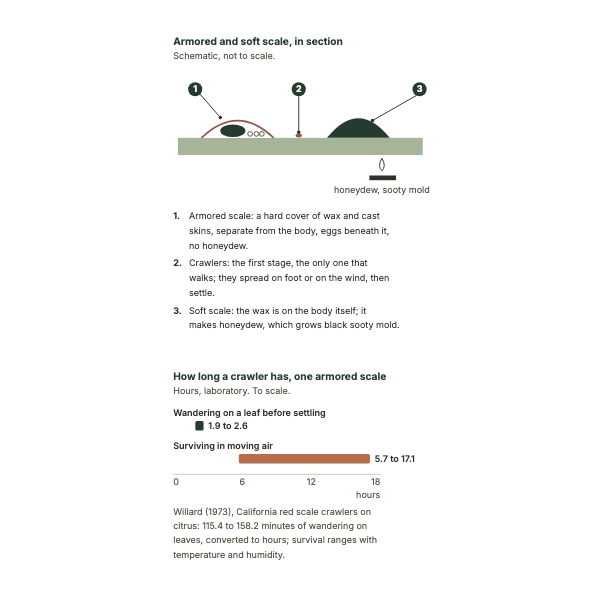
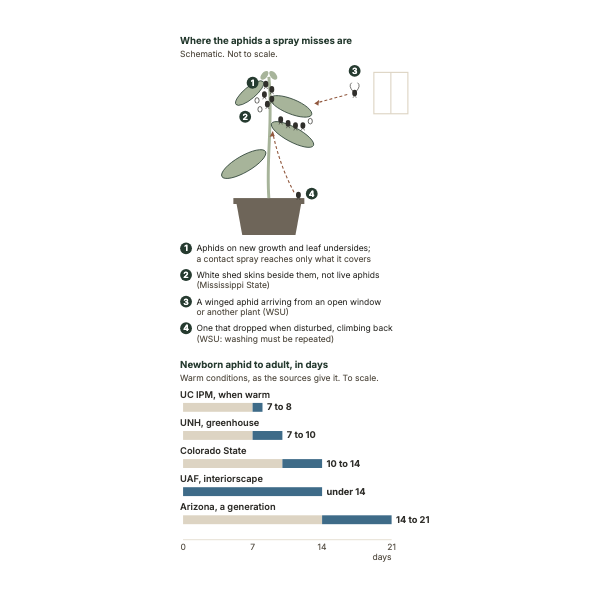
- Check the plant. Look along stems and under leaves for aphids, mealybugs and scale, the insects whose sugary waste ants collect. If they are there, they are the pest to deal with.
- Take the pot out of the house, then flush it or repot. UC IPM’s instruction is to remove infested pots from the building. Which treatment follows depends on whether the plant can stand a soaking.
- Follow any trail to its far end. If ants keep arriving afterward, Utah State’s diagnostic lab notes they may be coming from a nest nearby rather than the pot.
Step four has a gap in it. Every source that moves the pot assumes it can go outside, and Illinois Extension’s Ken Johnson treats a steady 55°F as the point when houseplants should already be in. None says what to do when it is freezing.
So in cold weather the sources leave you with the indoor steps: the trail, the leaves and a careful look at the pot. Whether a quick trip outdoors would harm a tropical plant on a freezing day is not something any of them addresses.
Why They Appear the Moment You Water
The ants did not arrive with the water. They were already in the mix.
Candice Anderson of Illinois Extension writes that submerging a pot can “send insects that were in the soil scrambling for higher ground”, and a thorough watering of dry mix does a smaller version of that.
Michael Waldvogel of NC State Extension says the same of a drench, that it “may bring ants and other overwintering pests up to the surface”. Both Illinois and NC State use water to drive insects out of a pot. Neither says it kills a colony.
Ants are hard to drown. When a summer flood in 2013 put a German grassland under water for 4 to 24 days, Hertzog and colleagues found its dominant ant, Lasius niger, as widespread a month later as before, and argued the colonies survived below the water.
They cite an earlier laboratory study, by Boomsma and Isaaks, in which survival of workers of the same species, held under water with air bubbles, fell below half only after 9 to 10 weeks. That is one species, reported secondhand, but it puts survival in weeks, not hours.
Skip the hot water. Pouring scalding water is a published method for fire ant mounds in open ground, and even there Texas A&M warns to “take care to not pour hot water on desired plants and grasses” and to guard against serious burns. In a pot, the root ball is the desired plant.
What the Ants Around a Pot May Be Telling You
Where you see them matters more than how many there are. A column of ants on the stems is a different situation from a nest in the mix, and a crowd after watering is different again. More than one can be true of the same pot.
What the ants around a pot may be telling you
Where the ants are, and how they behave when disturbed, points to different explanations and a different next step.
| What you see | What it may mean | Next step |
|---|---|---|
| Ants pour out when you water | A nest in the mix. Water sends insects in the soil to higher ground | Check the leaves. Then flush or repot, and repot if the plant likes dry mix |
| Small heaps of fine soil on the mix, or around the drain holes | Ants digging a nest in the pot | Repot into fresh mix |
| Ants on the stems and leaves | Ants collecting honeydew from aphids, mealybugs or scale | Look for those insects first. They are the plant problem |
| A trail across the floor to the pot, and no sign of a nest in the mix | Ants foraging. The nest may be somewhere else | Wipe the trail clean and look for where it starts |
| Mixed-size ants up to 1/4 inch that swarm out and run up anything vertical, where fire ants live | Possibly imported fire ants, which sting | Keep hands off. Ask your county Extension office to identify them |
| Large ants, black to red, 1/4 to 1/2 inch, indoors | Possibly carpenter ants, which usually nest in wood | Have them identified. The pot may not be the main concern |
Each row is a possibility, not a diagnosis, and more than one can be true. No published measurement of how often a nest harms a houseplant was found, so this table does not rank them.
The stems are the row to take seriously, because that is where a plant problem hides. UC IPM says that on outdoor and sometimes indoor plants, ants “protect and care for honeydew-producing insects”, which increases the damage those pests do. Honeydew is the sugary liquid aphids, mealybugs and soft scales excrete.
UC IPM adds that outbreaks of scales and aphids often follow ant tending, because the ants guard them from their natural enemies.
Field trials put numbers to it. In two Spanish citrus orchards over two years, Plata and colleagues kept ants off trees with sticky barriers, and both mealybug density and damaged fruit fell.
In California vineyards, Nelson and Daane report that Argentine ants raise mealybug numbers, and that as more liquid bait stations went out, ant activity and mealybug density at harvest both declined. Both studies are cited from their abstracts.
The picture is not one-sided. Reviewing 30 studies, Styrsky and Eubanks found that in 73 percent the plant came out ahead, because the tending ants also drove off herbivores that did more damage than the sap feeders. That review is cited from its abstract.
Those are outdoor food webs, with predators and other plant eaters in play. None was a houseplant, so which way the balance tips in a pot is not known. What the Extension sources agree on is the practical point: if mealybugs or scale are on the plant, removing the ants leaves the feeding pest in place.
Why mealybugs keep coming back covers what clearing them takes. If you see tiny jumping insects after watering instead, they are probably springtails, which is a different case.
Why a Houseplant Pot at All?
Because a pot is a good nest site. The Royal Horticultural Society lists flower pots among the places ant nests often occur.
UC IPM tells anyone tracing ants indoors to “look for indoor nesting sites, such as potted plants”, and notes that ants usually nest in soil, often near plants carrying honeydew insects.
There are two routes in. Waldvogel describes the first: plants that summer outdoors may carry small colonies inside, particularly if they already have honeydew insects. He names odorous house ants, Argentine ants and Asian needle ants as species that do this.
The second route is the ants’ own. UC IPM says they enter buildings seeking food and water, warmth and shelter, or refuge from hot, dry weather or flooding, and that they may appear suddenly when weather changes or other food runs out.
The thread’s theory was that dry mix attracts them, and the plant fits: a couple of months between waterings. But no source read says dryness draws a nest, and the evidence that exists on moisture runs the other way for at least one common household ant.
UC IPM says Argentine ants nest just below the surface but go deeper under dry conditions.
Resurveying two California reserves after nearly thirty years, Hathaway and colleagues found Argentine ants least established on the soils that hold the least water, which they read as soil moisture limiting the species in dry places. Their paper is cited from its abstract.
UC IPM also says that in temperate climates the Pharaoh ant, the main indoor nester in California, nests in warm, moist spots such as wall voids and near hot water pipes. None of this was measured in a pot, so the dry-mix theory stays untested rather than disproved.
Once inside, Waldvogel writes, the warmer interior lets ants that came in with a plant forage for food or “relocate to new real estate”. A colony that arrives in a pot need not stay in it, which is one more reason to follow any trail to where it ends.
Are They Hurting the Plant?
Probably not much directly, and possibly a little around the roots. The RHS says ants “do little direct damage to plants, although they can disturb soil around plant roots”, that this applies in pots and containers, and that disturbed plants can be “more prone to wilting especially when dry at the roots”. That is garden guidance with no number attached.
Soil science says what a nest does to the ground it occupies. Reviewing the field work, Frouz and Jílková describe ant galleries raising soil porosity and sorting particles by size, nest soil shifting toward neutral pH, and nitrogen and phosphorus building up where food collects.
Those are outdoor soils, cited from the review’s abstract, and nobody has measured the same changes in potting mix. They do explain why a nest is not inert. It moves mix around, opens channels, and changes the chemistry of the patch it occupies.
The thread also worried that the ants were eating the plant. No source read describes household ants feeding on houseplant tissue. UC IPM lists what they eat indoors as sugar, syrup, honey, fruit juice, fats and meat, and outdoors as honeydew.
So if a plant with ants is declining, the sources point first at honeydew insects and then at the roots. Look for those insects, and check whether the mix is staying wet, as covered in root rot and a saturated root zone, before blaming the ants.
Could These Be Fire Ants?
If you live where imported fire ants occur, stop and check. Texas A&M says red imported fire ant workers vary in size up to 1/4 inch, and that when a nest is disturbed they emerge in large numbers and “run up vertical objects to bite and sting”.
The stings swell into pustules and, for some people, “cause serious health problems”, Texas A&M adds.
Seattle Children’s Hospital says a fire ant grips with its jaws and stings repeatedly, and lists wheezing or trouble breathing, trouble swallowing or drooling, and fainting or being too weak to stand as emergencies.
Texas A&M’s account of a disturbed nest is the reason to keep children and pets clear of the pot until you know what you have. Your county Extension office can identify a sample, and Texas A&M describes collecting ants on a swab dipped in rubbing alcohol.
Water is a poor answer here. Mlot and colleagues found that a single fire ant struggles in water but a group links bodies into a raft that floats for days, so soaking a fire ant pot may bring a live colony to its surface rather than end it.
That work, cited from its abstract, filmed rafts forming; it did not test a pot.
We found no published method for a fire ant colony in a pot kept indoors, so ask the Extension office what to do as well as what they are.
Large ants are a different question. Arkansas Extension gives carpenter ant workers as 1/4 to 1/2 inch, black to red depending on species, and says they usually nest in logs, stumps, hollow trees or decayed wood, though they can be found in sound lumber.
If those are what you see indoors, have them identified, because the pot may not be the main concern.
Flush the Pot, or Repot?
Flushing is the lighter option, and it suits plants that tolerate wet mix. Johnson’s instruction is to “flush pots with water to drive them out”, and he adds: “You may need to repot the plant if ants are present in the growing media.”
Anderson suggests submerging smaller plants for 15 minutes. Shawn Banks of NC State’s Carteret County center describes soaking the roots and container “to force any insects that might be living in the container out”.
Neither claims the colony dies, and the flood study above suggests it may not.
Anderson’s limit is the one that matters for this thread. She would not use a soak for plants that prefer a dry soil, “as the soil will be very saturated after this soaking”.
She names no species. A snake plant watered every couple of months is being grown on the dry side, and its care guide will say whether it should be.
For a plant that should not sit saturated, the sources leave repotting. Maggie Wolf of Utah State University Extension gives a plain sequence, written for an outdoor herb pot with soil built up around its drain holes.
Dump the mix well away from the house. Shake the roots and dip them in water to remove the ants, rinse and scrub the container, and replant in fresh mix. Then move the pot somewhere new, in case ants were traveling from a nest nearby.
Do not reuse that mix, for the reasons in reusing old potting mix. If the plant needed repotting anyway, what to check before you repot covers the rest.
Do You Need a Product?
Often not, and the sources do not fully agree. Waldvogel writes that “Pesticides are not needed in most cases.” UC IPM’s pest note says to take infested pots outdoors and submerge them in a solution of insecticidal soap and water.
UC IPM gives a strength and a soak time for that. We do not repeat either, because an insecticidal soap’s label sets its use and formulations differ. Waldvogel’s version is water with a little dish detergent, which he describes as bringing ants and other pests up to the surface.
On baits, UC IPM calls them “the only type of insecticide recommended in most situations”, and says sprays “only provide temporary control and may not be safe to use indoors”. Workers carry bait back to the nest, which is how it reaches the queens.
The same page says to use baits primarily outdoors, indoors only for a serious infestation whose entry point cannot be found, because bait can draw ants in, and to keep them where pets and small children cannot reach.
That condition applies to Waldvogel’s suggestion of bait set on squares of wax paper on the soil surface of the pot itself. Check that any product is labeled for where you plan to use it, and follow that label exactly.
The thread’s home remedies are mostly untested. Texas A&M reports that evaluations of baking soda, cinnamon, club soda, coffee grounds, grits, a hot cereal, aspartame and molasses “failed to document control” of imported fire ant mounds, which is outdoor work on one species.
We found no test of cornmeal, neem, peroxide or diatomaceous earth against a nest in a houseplant pot, and none of the Extension pages above recommends any of them for one.
Keeping It From Happening Again
Most of the prevention advice comes down to one moment: bringing plants back in.
Banks calls ants, pillbugs and fungus gnats “usually repeat offenders”, and says getting them out of the container first “will reduce infestation problems later”. Waldvogel says to check plants carefully outdoors for foraging ants.
Johnson adds that ants and earwigs often live in the growing media, so the mix needs checking as well as the leaves. The steps for the move itself are in moving a houseplant outdoors and back.
For plants that never go outside, the sources offer the general indoor routine. UC IPM’s list is to wipe up trails as soon as they appear, caulk the cracks where ants enter, fix leaky faucets because water attracts them, and keep sweet food sealed.
Local Regulations and Safety Advisory
If you use pest control products, follow the label. Rules on them vary by country and locality, and your pesticide regulator can say what applies where you live. This article is general information, not legal, medical or veterinary advice.
Authorities to consult:
- Pesticide regulatory authority or environmental protection agency
- Poison control service
- Veterinarian or animal poison control service
If a child or pet may have been exposed to a product, contact a poison control service or a veterinarian.
What Remains to Be Explored
How much a nest harms a houseplant is unknown.
We looked for a study measuring root damage or growth in potted plants with ants and found none. The RHS statement that roots can be disturbed and plants may wilt is the nearest thing, and it carries no number, no species and no houseplant.
Whether dry mix attracts nests is open too. Readers report it, the moisture evidence for Argentine and Pharaoh ants points the other way, and nothing tests it in a pot.
A survey of which species nest in houseplant pots, beyond Waldvogel’s list for plants brought in from outdoors, would change how much of this applies to you.
The water questions are only half settled. Flooding moves ants, and in one field study colonies appear to have survived weeks under water, but no one has measured how much of a pot’s colony leaves during a soak, or whether the queen goes with it.
Whether ants tending sap feeders on a houseplant help or hurt it overall has not been studied indoors. And we found no published method for fire ants in a pot kept indoors, or for any of this when it is freezing outside.
Sources
- Ants (Pest Notes Publication 7411) — University of California Agriculture and Natural Resources, M.K. Rust and D.H. Choe. October 2012.
- Ants — Royal Horticultural Society. Undated.
- Ants in Your Plants (and Your Firewood Too?) — NC State Extension, Michael Waldvogel. November 1, 2019.
- Tips for Moving Houseplants Indoors and Overwinter Care — University of Illinois Extension, Ken Johnson. September 9, 2022.
- Time to Bring Plants in for Winter, Minus the Insects — University of Illinois Extension, Candice Anderson. October 13, 2015.
- Bringing Houseplants Indoors — N.C. Cooperative Extension, Carteret County Center, Shawn Banks. September 27, 2022.
- Ant Colony (Utah Plant Pest Diagnostic Lab FAQ) — Utah State University Extension, Maggie Wolf. May 3, 2007.
- Living on the Edge: Managing Imported Fire Ants in West Texas (ENTO-003) — Texas A&M AgriLife Extension Service, Wizzie Brown. March 2014.
- Natural, Organic, and Alternative Methods for Imported Fire Ant Management (ENTO-009) — Texas A&M AgriLife Extension Service, Wizzie Brown. March 2014.
- Carpenter Ants (FSA7013) — University of Arkansas System Division of Agriculture, John D. Hopkins. Undated.
- Fire Ant Sting — Seattle Children’s Hospital. May 5, 2025.
- Ecological Consequences of Interactions Between Ants and Honeydew-Producing Insects — John D. Styrsky and Micky D. Eubanks. Proceedings of the Royal Society B 274(1607):151-164. October 31, 2006. Cited from its abstract.
- Exclusion of Mediterranean Ant Species Enhances Biological Control of the Invasive Mealybug Delottococcus aberiae in Citrus — Ángel Plata, María A. Gómez-Martínez, Francisco José Beitia and Alejandro Tena. Pest Management Science. 2023. Cited from its abstract.
- Improving Liquid Bait Programs for Argentine Ant Control: Bait Station Density — Erik H. Nelson and Kent M. Daane. Environmental Entomology. 2007. Cited from its abstract.
- High Survival of Lasius Niger During Summer Flooding in a European Grassland — Lionel R. Hertzog, Anne Ebeling, Sebastian T. Meyer, Nico Eisenhauer, Christine Fischer and Anke Hildebrandt. PLoS ONE. November 16, 2016.
- Fire Ants Self-Assemble Into Waterproof Rafts to Survive Floods — Nathan J. Mlot, Craig A. Tovey and David L. Hu. Proceedings of the National Academy of Sciences 108(19):7669-7673. April 25, 2011. Cited from its abstract.
- Historical Resurveys Provide Support for Abiotic Limits to Argentine Ant Invasion in Southern California — Shane Hathaway, Sean B. Menke and David A. Holway. Biological Invasions 27(5). April 19, 2025. Cited from its abstract.
- The Effect of Ants on Soil Properties and Processes (Hymenoptera: Formicidae) — Jan Frouz and Veronika Jílková. Myrmecological News. 2008. Cited from its abstract.
- Watered My Snake Plant for the First Time in a Couple of Months and Found an Ant Infestation — r/houseplants. Undated.