Protect the people on the patio and stop trying to clear the yard. An EPA-registered repellent, a fan aimed at you, and a clear-out of standing water have the best support. Zappers and sound devices do not earn a place. No single product makes a whole patio mosquito-free, and no trial has tested one that way.
That limit shapes everything here. We found no study of any method on a real seating area. The evidence comes from yards, woodland and trap sites, and each figure below belongs to one species and one setting, so they cannot be ranked against each other. Pesticide use follows the label, and this article gives no rates.
The question is usually put as what actually works, and the honest answer is that mosquitoes come from further away than most yard fixes reach. So the sensible order is your skin and your seat first, your own yard second, and the neighbors third.
What Each Method Has Done
Read the table one row at a time. A 42 percent reduction in bites and a 54 percent reduction in yard catch are different measurements in different places, which is why nothing here is scored or sorted by size.
What each method has done
Each row comes from a different species, outcome and setting, so these figures cannot be ranked against each other.
| The method | What was measured | Where it stops |
|---|---|---|
| Removing standing water
Yard scale
|
Slow; a decline, not significant alone over 33 days | Containers refill; neighbors matter |
| Skin repellent
EPA-registered
|
CDC: proven when used as directed | Label and age limits apply |
| Fan on people
Aimed at you
|
Trap catch falls as wind rises; no fan-only landing figure | Works on the scent plume |
| Emanator at your seat
Metofluthrin
|
89.5 percent fewer landings within about 1 m | About 14 percent at 3 to 8 m |
| Citronella candle
5-minute bite counts
|
42 percent fewer bites in one trial | Not significant in another |
| Barrier spray
Yard vegetation
|
About 54 percent on average, for weeks | Aedes more than Culex; effect on other insects unknown |
| Trap networks
Several per block
|
64 to 87 percent fewer landings | One trap on a patio was not tested |
| Zappers
Electric grid
|
31 biting flies in 13,789 insects | Mostly kill harmless insects |
| Sound devices
Ultrasonic
|
No effect in all 10 field studies | Skip them |
| Bats, martins
Wildlife
|
Eat mosquitoes; effect on yard numbers unknown | No yard trial |
Protection close to you is what the trials support. Clearing a whole yard depends on what the neighbors do.
Repellent Is the Base Layer
CDC lists DEET, picaridin, IR3535, oil of lemon eucalyptus, para-menthane-diol and 2-undecanone as active ingredients, and says EPA-registered products are “proven safe and effective” when used as directed, including in pregnancy. It says not to use oil of lemon eucalyptus or para-menthane-diol on children under 3.
EPA runs a search tool for choosing a registered product by protection time. CDC says “we do not know the effectiveness” of unregistered repellents, including some natural ones. This is the one method here that goes where you go, and it does not depend on wind or on the neighbors.
Mosquitoes do favor some people. A 2022 Cell study led by M. E. De Obaldia found people who were exceptionally attractive or unattractive to mosquitoes, with the differences stable over several years and linked to acids in skin emanations.
That was a lab test on one species, and it offers no treatment, but it explains the one guest who is always bitten.
Why a Fan Works, and What the Famous Figure Really Measured
The usual explanation is that mosquitoes are weak fliers and a fan blows them away. Michigan State researchers E. J. Hoffmann and J. R. Miller tested that, and found otherwise. Wind cut catches in carbon dioxide traps “primarily by diluting attractants rather than by exceeding mosquito flight capability.” The fan scrambles the scent trail mosquitoes follow.
Illinois Extension’s advice to sit in front of an oscillating fan, in addition to personal protection, is sound, even if its reason is the older one. Hoffmann and Miller recommended fan-generated wind as a practical protection for people in backyards. The catch fell along a negative logarithmic curve, up to 3.7 meters per second.
Be careful with the figure sometimes quoted for this. Their 2002 field test reported 75 percent fewer landings, but that fan was drawing air through a DEET-treated screen, and the comparison was against neither wind nor DEET.
We found no landing figure for a fan alone, and no measured advice on fan height or distance. Aim it at people.
Devices at Your Seat
Spatial repellents release a vapor into the air around you. In a trial near Atlanta on the Asian tiger mosquito, O. Zarella and colleagues found a metofluthrin emanator cut landings by 89.5 percent for someone sitting next to it.
Further away, between 3 and 8 meters, raw landings fell only about 14 percent, by our arithmetic from their counts.
A 2025 meta-analysis in eBioMedicine pooled 58 publications at 56 percent protection from bites, a useful check on the single-trial figures. Its authors note funding ties with repellent makers. So think of a device as protecting a seat, and read the label, because metofluthrin is an insecticide.
A 2026 trial in Mali put two heat-activated devices far ahead of coils and candles, with Aedes catches down about 94 percent by our arithmetic. That was in traps at sheltered sites, with no people, and one author worked for a company connected to a tested product.
A breezy patio is a different place.
Coils and vapor mats need care too: a BMJ Clinical Evidence review says not to use them in a confined space where people are asleep.
Citronella Candles
A candle is a limited help. In an Ontario woodlot trial, L. R. Lindsay and colleagues counted 6.2 bites per five minutes beside citronella candles, 8.2 beside plain candles, and 10.8 with no candle. Plain candles matched the citronella incense.
So some of the effect may have nothing to do with citronella, though the abstract does not say why.
NC State says these candles work best with little air movement, and Illinois says they can be somewhat effective in large numbers on calm days. In the Mali trial, a citronella candle did not differ significantly from no treatment for Aedes.
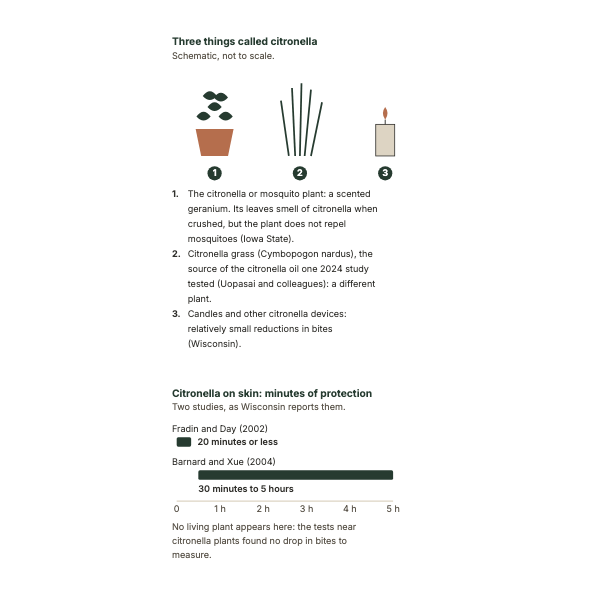
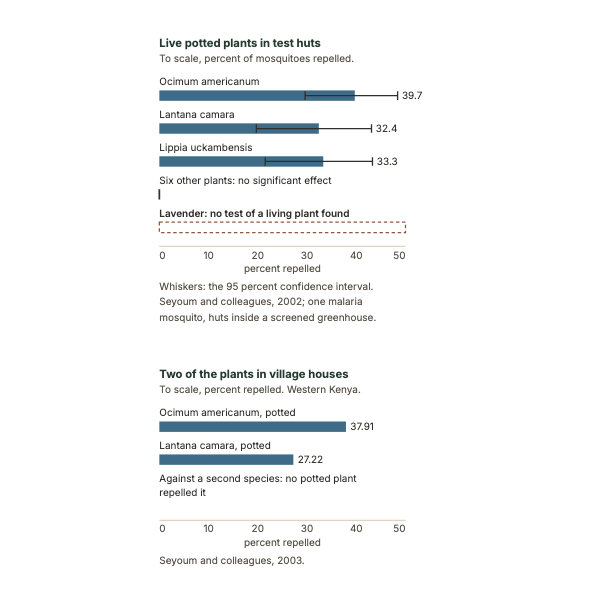
Illinois adds that citronella-scented geraniums are not effective, and NC State says claims for repellent plants lack scientific support.
Standing Water, and How Far Mosquitoes Travel
NC State calls removing breeding sites “the long-term solution to severe mosquito problems”, and EPA says egg and larva measures are generally the most effective and least costly. CDC’s weekly round covers tires, buckets, toys, pools, birdbaths, flowerpot saucers and trash containers. Illinois says half an inch of standing water is enough.
Expect it to work slowly. In a randomized North Carolina study of 16 pairs of neighbors, B. Hollingsworth and colleagues found habitat work alone did not make a significant reduction over the whole period, although numbers were declining and it improved other treatments by day 25. Raleigh work by Richards and colleagues found containers recolonized within several weeks.
Mosquitoes also arrive from elsewhere. Half the tiger mosquitoes in one Italian study stayed within 50 meters, and a Swiss study estimated 90 percent stayed within about 840 meters, from only 49 recaptures.
Both studies put your neighbors in range, at different distances. The North Carolina yards next to treated ones saw reductions that were “rarely significant”.
The strongest neighbor result comes from a northeastern US town, where B. J. Johnson and colleagues found control tracked how many households took part, with a threshold around 80 percent of yards. That was a whole-block effort, partly with traps. If your street can agree on anything, this is a better use of the conversation than most.
For water you cannot empty, EPA says Bti, a bacterial larvicide, affects only the larvae of mosquitoes, blackflies and fungus gnats. We found no backyard trial of Bti dunks using bites as the outcome. Follow the label, and see our piece on collected rainwater if a barrel is part of the problem.
Yard Spraying
Barrier sprays do reduce mosquitoes. A review of 44 studies by C. A. Stoops and colleagues found treated properties averaged 54 percent fewer mosquitoes in one study set, up to 74 percent, and often weeks of effect.
It varied by species: up to 69 percent for Aedes against 32 percent for Culex, with little effect on some others. Rain is the main thing that removes it.
Whether that suits your yard depends on how the mosquitoes live. The review lists conditions: the species must rest in vegetation, the vegetation must be separate from the house, and breeding sites must not sit inside the barrier.
It warns that some studies lacked replication, and it names effects on other insects as a knowledge gap.
That gap matters. We found no field measurement of non-target insects in sprayed home yards. NC State says to avoid spraying when bees and other pollinators are foraging, and a South Dakota State page says not to spray flowers.
Keep children and pets to what the product label says. Foggers last only hours, NC State adds, once the chemical dissipates. If you hire a service, ask which product is used, and read its label.
Traps, Zappers and Sound
Traps can work at scale. In Italy, networks of seven or eight traps of one commercial model across a site cut Asian tiger landings by 64 to 87 percent, at a density of one trap per 150 to 350 square meters, in a study using the maker’s product. NC State’s warning fits a single trap: it may attract mosquitoes without providing control.
Bug zappers have long been shown to miss the target. Iowa State Extension, reporting a Delaware study by Frick and Tallamy, gives 31 biting flies among 13,789 insects killed. Nearly half were harmless aquatic insects. Illinois says mosquitoes are not attracted to light.
Sound devices have the cleanest verdict. A Cochrane review found that all 10 field studies showed no difference with an electronic repeller, and concluded they “have no effect on preventing mosquito bites.” Spend the money on a fan.
Bats and Birds
Bats do eat mosquitoes. DNA work by Hughes and colleagues in the southeastern US found 17 mosquito species in bat guano, but they say future studies are needed on the effect on mosquito numbers.
NC State says bats and birds such as purple martins have no significant impact on populations. We found no trial of a bat house reducing yard mosquitoes.
Local Regulations and Safety Advisory
If you use pest control products, follow the label. Rules on them vary by country and locality, and your pesticide regulator can say what applies where you live. This article is general information, not legal, medical or veterinary advice.
Authorities to consult:
- Pesticide regulatory authority or environmental protection agency
- Poison control service
- Veterinarian or animal poison control service
If a child or pet may have been exposed to a product, contact a poison control service or a veterinarian.
What Remains to Be Explored
No study we found tests any method on a real patio, or a fan alone against landings on a seated person. We also searched for measured flight speed, fan placement, Bti dunks with bites as the outcome, a carbon dioxide trap with a backyard control, and bat houses, and have none to cite.
The largest gap may be the effect of yard spraying on other insects, measured in real home yards, which the main review names as unknown. A simple home trial on matched patios, counting bites with and without a fan, would be cheap to run and would settle the question most people are asking.
Sources
- Mosquito Control Around Homes and in Communities — Michael Waldvogel. NC State Extension, Entomology. May 13, 2020.
- Protect Yourself From Invading Mosquitoes — Illinois Extension. July 17, 2020.
- Preventing Mosquito Bites — CDC. August 28, 2024.
- Success in Mosquito Control: An Integrated Approach — US Environmental Protection Agency. October 8, 2026.
- Find the Repellent That Is Right for You — US Environmental Protection Agency. September 8, 2026.
- Reduction of Mosquito Attacks on a Human Subject by Combination of Wind and Vapor-Phase DEET Repellent — Hoffmann and Miller. Journal of Medical Entomology 39(6):935-938. November 2002. Cited from its abstract.
- Reassessment of the Role and Utility of Wind in Suppression of Mosquito Host Finding — Hoffmann and Miller. Journal of Medical Entomology 40(5):607-614. September 2003. Cited from its abstract.
- Evaluation of the Efficacy of 3% Citronella Candles and 5% Citronella Incense — Lindsay, Surgeoner, Heal and Gallivan. Journal of the American Mosquito Control Association 12(2 Pt 1):293-294. June 1996. Cited from its abstract.
- Performance of Different Spatial Repellents in Mali — Revay et al. Frontiers in Insect Science 6:1811511. April 21, 2026.
- Experimental Evaluation of a Metofluthrin Passive Emanator Against Aedes albopictus — Zarella et al. PLoS ONE 17(5):e0267278. May 10, 2022.
- Volatile Pyrethroid Spatial Repellents for Preventing Mosquito Bites: A Systematic Review and Meta-Analysis — Chen et al. eBioMedicine 119:105891. September 2025. Cited from its abstract.
- A Review of Studies Evaluating Insecticide Barrier Treatments for Mosquito Control From 1944 To 2018 — Stoops, Qualls, Nguyen and Richards. Environmental Health Insights 13:1178630219859004. 2019.
- Efficacy and Spatial Extent of Yard-Scale Control of Aedes albopictus — Hollingsworth, Hawkins, Lloyd and Reiskind. Journal of Medical Entomology 57(4):1104-1110. July 2020. Cited from its abstract.
- Active Dispersal of Aedes albopictus — Vavassori, Saddler and Muller. Parasites & Vectors 12:583. 2019. Cited from its abstract.
- Estimating Spatio-Temporal Dynamics of Aedes Albopictus Dispersal — Marini et al. Scientific Reports 9:10281. 2019. Cited from its abstract.
- Impact of Source Reduction on the Spatial Distribution of Larvae and Pupae of Aedes albopictus — Richards et al. Journal of Medical Entomology 45(4):617-628. 2008.
- Neighbors Help Neighbors Control Urban Mosquitoes — Johnson et al. Scientific Reports 8:15797. 2018. Cited from its abstract.
- Journal Article (Posted Title Not Reproduced; It Names a Commercial Trap): A Trap Network as a Tool Against Asian Tiger Mosquitoes in an Urban Site in Italy — Englbrecht et al. Journal of the American Mosquito Control Association 31(1):16-25. March 2015. Cited from its abstract.
- Electronic Mosquito Repellents for Preventing Mosquito Bites and Malaria Infection — Enayati, Hemingway and Garner. Cochrane Database of Systematic Reviews CD005434. April 18, 2007. Cited from its abstract.
- Consumption of Endemic Arbovirus Mosquito Vectors by Bats — Hughes et al. Journal of Vector Ecology 47(2):153-165. December 2022. Cited from its abstract.
- Differential Mosquito Attraction to Humans Is Associated With Skin-Derived Carboxylic Acid Levels — De Obaldia et al. Cell 185(22):4099-4116. October 27, 2022.
- Bug Zappers Are Harmful, Not Helpful — D. Lewis. Iowa State University Extension. June 14, 1996.
- Bti for Mosquito Control — US Environmental Protection Agency. June 2, 2026.
- These Mosquitoes Are Awful! — Robertson and Bachmann. South Dakota State University Extension. July 16, 2024.
- Malaria: Prevention in Travellers — Croft. BMJ Clinical Evidence, summary. 2014.
- Mosquitoes Are Ruining Our Patio, What Actually Works? (R/HomeImprovement Thread) — multiple community members. Reddit, r/HomeImprovement. Undated.