The cream parts of a variegated rubber plant are the weakest tissue on the leaf: in the plants studied, pale tissue holds almost no chlorophyll and lives on sugar sent from the green. Browning there tells you where a stress landed, not which stress it was.
The shape, place and first color of a patch narrow it down. For a plant sitting beside a bright window, the extension sources point to more light than a rubber plant is listed for, not too little, and thrips are settled by looking for the insects themselves.
The question comes from a thread on r/plantclinic titled simply “Thrips?”. A grower in a sunny, dry place found brown, dead patches on a rubber plant with cream-edged leaves, kept beside a bright window and watered when the top of the mix felt dry.
Replies set the pests aside and split over the cause. The poster noticed the brown sat on the pale parts. Others blamed a room too dim, watering too often for a thick-leaved plant, bottom watering, cold water, dry air after a move indoors, or a difficult cultivar.
What This Article Covers
This article covers brown, dead patches on the pale parts of a variegated rubber plant, Ficus elastica: why pale tissue goes first, what each suspected cause looks like on a leaf, and what to check. It does not name the plant’s cultivar, and it recommends no product.
Why the Pale Parts Go First
No study read measured which part of a variegated rubber plant leaf browns first. What has been measured is how little pale tissue has.
In variegated pothos, white sectors held about 2 percent of the green sectors’ chlorophyll, Araus and colleagues reported in 1986, cited from the abstract.
The same abstract calls the plastids in those white sectors “typical photobleaching mutants”, and puts their respiration in the dark at about half the green’s. Plastids are the cell parts that hold chlorophyll in green tissue; in the white sectors they are fewer and smaller.
Pale tissue is fed by the green. In variegated pelargonium, Milić and colleagues found photosynthesis genes strongly repressed in the white tissue, which they describe as a carbon sink depending on the green. In a variegated coleus leaf, Plomann and Eschrich traced sugar from the green border into the albino center.
The white sectors of a laboratory mutant of Arabidopsis, a small plant used in research, live on imported sugar and show oxidative stress responses switched on, Aluru and colleagues reported in 2009. The green sectors of the same leaves develop extra ways to shed excess light energy.
An earlier paper by the same group read those green-sector changes as compensation for the white sectors’ lack of photosynthesis while keeping the plant from light damage.
All of these are abstracts, and none is a rubber plant, so they explain why pale tissue has little margin, not exactly how a rubber plant leaf fails.
One caution on the word variegated. In milk thistle, Shelef and colleagues found the white patches are air spaces over green tissue, with photosynthesis no different from the green patches. Not every pale patch lacks pigment, and no source read says which kind a rubber plant cultivar has.
Is It Thrips?
Thrips leave a recognizable trace. They feed by puncturing the leaf’s outer layer and sucking out the cells, which leaves stippling, flecking or a silvery sheen, usually with black, varnish-like specks of excrement, according to the UC IPM thrips guide.
The same guide warns that some nonliving causes, diseases, mites and other insects leave similar damage, and says to look carefully for the insects themselves before treating.
Maryland’s table adds that fine stippling is the mark of spider mites. Brown, dead patches without stippling or specks are not the pattern UC IPM describes for thrips.
Most adult thrips are under one-twentieth of an inch long, UC IPM says, and it suggests gently shaking foliage over a light-colored sheet of paper to see them. For why thrips come back after a spray, see the article on why thrips survive treatment.
Too Much Light, or Too Little?
The thread’s light replies said the room was too dim. The extension sources point the other way for a plant beside a bright window.
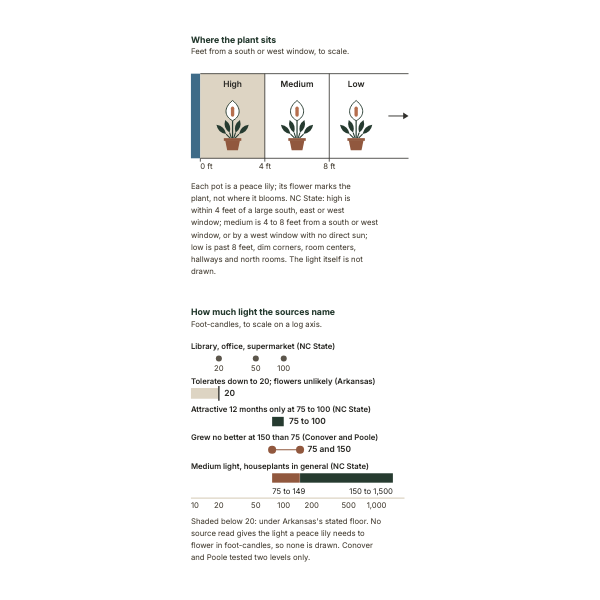
NC State’s container handbook lists rubber plant as a medium-light plant, and Arizona’s interior plants guide places it in medium light, 75 to 150 foot-candles.
Both define the categories by distance. High light is within 4 feet of large windows facing south, east or west, and NC State puts medium light at 4 to 8 feet from south and west windows. A plant right beside a large window facing south, east or west is, by these definitions, in high light.
NC State’s plant record says to grow rubber plant indoors in bright indirect light or partial shade, with protection from the afternoon sun.
Both guides describe what light above a plant’s range does: chlorophyll is destroyed, leaves yellow, and large brown patches of dead tissue may follow, which they call leaf scorch.
Sunburn has a pattern of its own. Purdue says it often starts out looking bleached and then browns, Arkansas’s clinic describes grayish-white areas where chloroplasts were damaged, and UC IPM says the tissue dies first between the veins.
UC IPM defines sunburn as too much light and heat together with too little moisture. Those sources describe garden plants, so applying them to a houseplant by a window is an inference. A patch that bleached before it browned, on the side facing the window, matches what they describe.
The cream is the part with the least to spare
Pale tissue holds almost no chlorophyll and lives on sugar from the green. Where a brown patch sits, and what it looked like first, can narrow down the cause.
| 1. Bleached, then brown | Sunburn starts as a bleached look followed by browning (Purdue), grayish-white where chloroplasts were damaged (Arkansas), and the tissue dies between the veins first (UC IPM). |
| 2. Brown along the edge | Leaf scorch browns the edges (Purdue); too much fertilizer, salts or too little water scorch margins (Maryland), and dry air browns tips and margins (Arizona). |
| 3. Brown toward the center | In pothos, cold or a sudden drop from very warm to moderate gives scattered brown patches, usually in the center of the leaf (Wisconsin). No source read describes it on rubber plant. |
| 4. Pale dots, black specks | Thrips feeding leaves pale stippling or silvering with black specks of excrement (UC IPM). |
Arrows: pale leaf tissue photosynthesizes little or not at all and draws sugar from the green (pelargonium, Arabidopsis, coleus).
In pothos the white sectors held about 2 percent of the green sectors’ chlorophyll. No study read measured which part of a variegated rubber plant leaf browns first.
Too little light looks different in the same guides. NC State lists leaves that do not reach full size, pale color, stems that stretch with long gaps between leaves, and dropped leaves; Arizona lists smaller leaves, less vivid color and leggy growth. Wisconsin says low light can cause loss of variegation in pothos.
Shade is harder on variegated plants than on green ones in the one fig study read: Di Benedetto and colleagues found shading cut the growth of variegated weeping fig more than green. That is growth, not browning. No source read says low light browns the pale parts of a leaf.
Water, Cold Water and Bottom Watering
NC State’s plant record says to water a rubber plant regularly but avoid overwatering, to water less from fall to late winter, and that overwatering can cause leaf loss.
Arizona’s guide says plants in a warm, dry, sunny place need water more often than in a cool, dim one.
Arizona suggests watering when the top inch of the mix feels dry, in pots up to 8 to 10 inches across, then watering thoroughly with a little extra to carry salts out, and emptying the saucer. The poster described watering when the top of the mix felt dry, which is close to that.
Watering faults show at the edges in the sources read. Maryland’s diagnostic table puts scorch along leaf margins or between veins down to too much fertilizer, salts in the mix or too little water. Wisconsin’s pothos page blames blackened margins or tips on overwatering, underwatering or salts.
NC State lists cold water on leaves among the causes of spotted leaves, “particularly African violets”. It also notes that potting mix wets faster with warm water than with cold, which is about wetting the mix, not about harm to the leaves.
No source read ties bottom watering to brown patches. What bottom watering does inside the pot, including where salts collect, is covered in the article on bottom watering. For brown tips in general, see the article on brown leaf tips.
Moving It Indoors, Dry Air and Cold
A move indoors changes more than humidity. NC State’s handbook says plants brought in for winter must adapt to less light and less humidity, and should be kept from cold drafts by outside doors and the drying air of heating ducts.
Arizona’s guide says that in dry air, leaves of plants from moist tropical regions turn yellow or show brown tips and margins.
It also warns that a plant by a window needs protection from heat and strong sun by day and from cold drafts at night.
Cold leaves its own pattern. In pothos, Wisconsin says low temperatures or a sudden drop from very warm to moderate can cause scattered brown patches, usually toward the center of the leaf. No source read describes that pattern on rubber plant, so it is a lead, not a diagnosis.
Maryland says cold injury blackens leaves or shoots, that symptoms can keep appearing for up to a week after the exposure, and to keep plants above 50°F.
NC State’s plant record says rubber plants do not do well with drafts or cold, and that temperature drops or cold drafts can cause leaf loss.
Moves cost leaves in other figs too. Turner and colleagues grew weeping figs in sun or shade and then moved them to dim indoor conditions; sun-grown plants lost the most leaves, and leaf drop came in two or three bouts after the move. For moving plants in and out, see the article on moving houseplants outdoors and back.
Old Leaves, New Leaves
Replies noted that only older leaves were affected. No source read explains why browning would sit on older leaves only.
NC State’s plant record says it is normal for some bottom leaves to turn yellow and drop, and that overwatering or a temperature drop can cause leaf loss.
How a rubber plant’s leaves age, how long they last and what a new leaf can tell you are covered, with the studies behind them, in the article on a rubber plant with small leaves and a bare stem. Older leaves are not covered by any source read on browning.
Will the Brown Patches Recover?
UC IPM says that watering a sunburned plant before discolored tissue is killed can usually bring the green color back. It does not say that dead tissue recovers, and no source read describes brown, dead tissue on a leaf turning green again.
No source read gives advice on trimming the brown parts off a rubber plant leaf. For whether a leaf with little or no green can carry itself, see the article on whether an all-white leaf can survive, which covers the evidence on white tissue in more detail.
Is a Variegated Rubber Plant Harder to Keep?
No study of variegated rubber plants was found. In other plants the variegated forms have less to work with.
Zhang and Fu found green ivy cultivars had a wider light adaptation range and higher photosynthesis than variegated ones, and the variegated cultivars differed from one another more than the green ones did.
Downton and Grant grew variegated and all-green oleander and willow myrtle side by side in growth chambers: the variegated plants made about a third and a sixth to a seventh of the all-green plants’ mass. Both papers are cited from their abstracts.
That is evidence on variegated plants in general, measured in other species. Whether one rubber plant cultivar is harder to keep than another, as a reply said of this one, no source read addresses.
What to Check, in Order
- Look for thrips. Check the leaves for pale stippling and black specks, and shake foliage gently over light-colored paper to see the insects, as UC IPM advises before any treatment.
- Read the patch. Note whether it started bleached or grayish on the side toward the window (sunburn), runs along the edge (scorch), or sits scattered toward the center (cold, as described in pothos).
- Measure the distance to the window. NC State and Arizona list rubber plant as a medium-light plant, and within 4 feet of a large south, east or west window is high light by both. NC State puts medium light 4 to 8 feet from a south or west window, and advises protection from afternoon sun.
- Water by feel, thoroughly. Arizona suggests watering when the top inch is dry and emptying the saucer; NC State advises against overwatering and to water less from fall to late winter.
- Keep it from drafts and heating ducts. NC State and Arizona both name cold drafts, and NC State the drying air of heating ducts, for plants brought indoors.
Local Regulations and Safety Advisory
If you use fertilizer products, follow the label. Rules on them vary by country and locality, and your agriculture department can say what applies where you live. This article is general information, not legal advice.
Authorities to consult:
- Local agriculture department
What Remains to Be Explored
No study was found of browning on variegated rubber plants, of which part of a variegated leaf browns first, or of how much light scorches the pale parts. The pale-tissue evidence is pothos, pelargonium, coleus and a laboratory mutant, all from abstracts.
No source read gives a light level, in foot-candles or anything else, at which a rubber plant scorches; the extension listings give the range the plant prefers. Whether a rubber plant cultivar’s pale parts lack pigment or are structural, as in milk thistle, was not found.
No source read ties bottom watering or low light to browning on pale tissue, explains why only older leaves would brown, or says whether trimming dead patches helps. A measured comparison of variegated rubber plant cultivars by a window would change this answer.
Sources
- Thrips? — multiple community members. Reddit, r/plantclinic. Undated.
- Ficus elastica (Rubber Plant), North Carolina Extension Gardener Plant Toolbox — NC State Extension. Undated.
- Chapter 18: Plants Grown in Containers (Extension Gardener Handbook) — D. Mays, K. Richter, L.K. Bradley, J. Sherk, M. Kistler, and J. Neal. North Carolina State Extension. 2022.
- Interior Plants: Selection and Care (AZ1025) — Elizabeth Davison. The University of Arizona Cooperative Extension. May 1998.
- Sunburn (Flowers) — UC Statewide IPM Program, University of California Agriculture and Natural Resources. Undated.
- Leaf Scorch and Sunburn on Hosta (Picture of the Week) — Rosie Lerner. Purdue University Plant and Pest Diagnostic Laboratory. September 12, 2022.
- Sunburn (Disease Notes) — Sherrie Smith and Jason Pavel. University of Arkansas System Division of Agriculture, Plant Health Clinic. Undated.
- Diagnose Indoor Plant Problems — University of Maryland Extension, Home and Garden Information Center. February 5, 2025.
- Pest Notes: Thrips (Publication 7429) — J. A. Bethke, S. H. Dreistadt, and L. G. Varela. UC Statewide IPM Program, University of California Agriculture and Natural Resources. May 2014.
- Pothos, Epipremnum aureum — Susan Mahr; revised by Bruce Spangenberg. University of Wisconsin-Madison Extension, Wisconsin Horticulture. 2025.
- Structural Differences Between Green and White Sectors of Variegated Scindapsus aureus Leaves — Araus JL, Sabidó J, Aguilá FJ. Journal of the American Society for Horticultural Science 111:98-102. 1986. Cited from its abstract.
- Contrasting Metabolisms in Green and White Leaf Sectors of Variegated Pelargonium zonale: An Integrative Transcriptomic and Metabolomic Study — Milić D, Pantelić A, Banović Đeri B, Samardžić J, Vidović M. International Journal of Molecular Sciences 24:5288. March 9, 2023. Cited from its abstract.
- Chloroplast Photooxidation-Induced Transcriptome Reprogramming in Arabidopsis immutans White Leaf Sectors — Aluru MR, Zola J, Foudree A, Rodermel SR. Plant Physiology 150:904-923. 2009. Cited from its abstract.
- The Arabidopsis immutans Mutation Affects Plastid Differentiation and the Morphogenesis of White and Green Sectors in Variegated Plants — Aluru MR, Bae H, Wu D, Rodermel SR. Plant Physiology 127:67-77. 2001. Cited from its abstract.
- Assimilate Partitioning in the Variegated Coleus Leaf — Plomann M, Eschrich W. Botanica Acta. November 1990. Cited from its abstract.
- Physiological Differences of Green-Leaf and Variegated-Leaf Ivy (Hedera helix L.) Cultivars — Zhang T, Fu Y. Bangladesh Journal of Botany 52(2):539-549. August 31, 2023. Cited from its abstract.
- Photosynthetic and Growth Responses of Variegated Ornamental Species to Elevated CO2 — Downton WJS, Grant WJR. Australian Journal of Plant Physiology 21:273-279. 1994. Cited from its abstract.
- Differential Growth Response of Green and Variegated Ficus benjamina to Exogenous Cytokinin and Shade — Di Benedetto A, Galmarini C, Tognetti J. Ornamental Horticulture 26:259-276. 2020. Cited from its abstract.
- A Comparison of Light Acclimatization Methods for Reduction of Interior Leaf Drop in Ficus spp. — Turner MA, Reed DW, Morgan DL. Journal of Environmental Horticulture 5:102-104. 1987. Cited from its abstract.
- Thermal Benefits From White Variegation of Silybum marianum Leaves — Shelef O, Summerfield L, Lev-Yadun S, Villamarin-Cortez S, Sadeh R, Herrmann I, Rachmilevitch S. Frontiers in Plant Science 10:688. 2019.