If 30 liters poured into a potted tree has never once been seen running out of the bottom, the first thing to find out is whether the pot is holding that water. That matters more than whether you water once or twice a week.
In one olive trial, waterlogged roots plus a root-rot organism killed young plants within weeks, and a dark pot in full sun also heats the mix along its sunny wall. Find out whether the pot drains, look at the roots, then decide how often to water.
The case comes from a thread on r/plantclinic. A grower in the United Arab Emirates bought an olive tree with a thick, gnarled trunk, in a pot, in July. It looked fine for a few weeks, then the south-facing side browned, shriveled and dropped its leaves, until about half the tree looked dead.
The details in the post narrow things down. Summer highs there reach 50°C (122°F). The tree was watered about twice a week in summer, then about 30 liters (about 8 gallons) once a week from early November. The supplier drilled holes and added a drainage layer, yet no water has ever been seen leaving the pot.
A week after watering, the mix still felt damp 30 to 40 cm (12 to 16 inches) down. The replies split between overwatering, a pot that does not drain, a mix too rich in peat, roots cut to fit, reflected heat, a climate too hot for olives, and transplant shock.
Why a Pot That Never Drains Matters More Than the Schedule
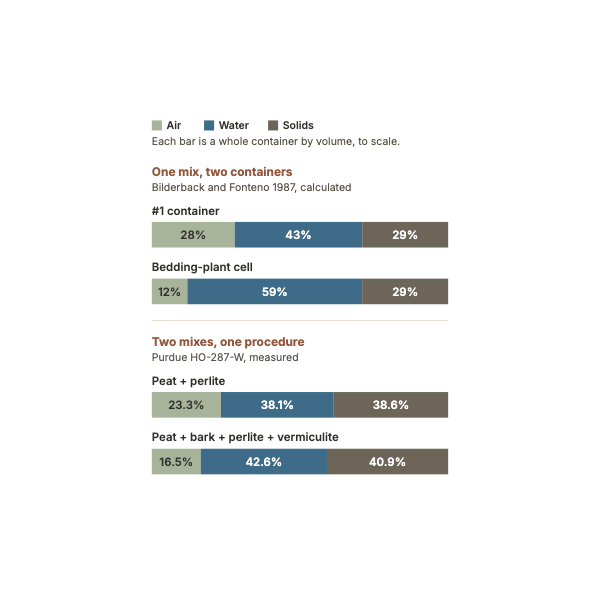
Every pot that drains still keeps a saturated layer at its base after watering. Avery Rowe’s 2025 study in PLOS ONE sums up the earlier work: this perched water table, as it is called, has a depth set by the potting mix, not by the size or shape of the pot.
That layer is normal, and in a taller pot more of the mix sits above it. A pot that never drains at all is a different case. Without drainage, water leaves only as the tree and the mix surface give it off, so each watering adds to what is already there.
The container chapter of NC State Extension’s gardener handbook (Mays and colleagues, 2022) gives the test plainly: water a pot “until the water starts to come out the bottom of the container.”
By that test, a pot that has never let water out has never been watered the way the handbook describes, however much went in.
The same chapter explains why the roots care. When a pot is overwatered, “the water fills all of the pore space in the potting mix and the roots are unable to get enough oxygen.”
It adds that drainage holes are necessary in all containers “to prevent plant roots from standing in water and developing root rot.”
Holes alone are not always enough. For a container that “sits flat on a solid surface such as a paved patio,” NC State advises putting the holes in the side wall, 1/4 to 1/2 inch above the bottom.
The post says the pot had stood on the ground until it was raised about 2 cm, under an inch.
NC State says never to put gravel or rocks beneath the mix, because water collects in the mix just above them. Rowe’s trials found the opposite in most cases: a coarse layer under the mix usually lowered the water held overall and was very unlikely to raise it.
Rowe’s pots were small, 175 mm (about 7 inches) tall, and the study did not test living plants, so neither side settles what happens in a large tree pot. Neither side argues the point that matters here, though. With or without a layer, water that cannot leave the pot stays in it.
There is more under whether pots need drainage holes and root rot as a saturation problem.
What Standing Water Does to Olive Roots
The clearest olive evidence comes from southern Spain. After five years of drought, the wet autumn and winter of 1996 to 1997 left olive trees waterlogged for several months. M. E. Sánchez-Hernández and colleagues, reporting in Plant Disease, saw foliar wilting, dieback and the death of young trees.
They then found extensive root rot. In 46 of 49 affected plantations, a water mold, Phytophthora megasperma, was consistently isolated from the rotted rootlets, especially in plantations of trees from under a year to 10 years old.
Their pot test separated the water from the organism. On rooted olive cuttings kept waterlogged and inoculated with that organism, roots were extensively rotted within two weeks, and the plants wilted and died quickly. Waterlogged plants left uninoculated showed no leaf symptoms and only a little root damage.
Inoculated plants watered weekly instead of waterlogged had some root rot but no visible leaf symptoms. Neither the water nor the organism alone produced leaf symptoms in that test; the two together killed. The paper is cited here from its abstract.
The same organism turned up in Sicily, where S. O. Cacciola and colleagues found three-year-old olive trees with leaf yellowing, wilting, leaf drop and twig dieback, usually followed by death, linked to root rot and cankers at the base of the stem (abstract).
Olives also differ in how long they stand flooded roots. A 2026 study in Korea, where heavy rain and poor drainage flood orchards, held 12 cultivars with flooded roots for up to 15 days (abstract). Leaf water content and regrowth generally fell the longer the flooding lasted.
‘Frantoio’ and ‘Nocellara del Belice’ held up best after 9 to 12 days, while ‘Picual’, ‘Leccino’ and ‘Mission’ declined fast. The post does not name its tree’s cultivar, so where it falls in that range is unknown.
Why the South Side Browned First
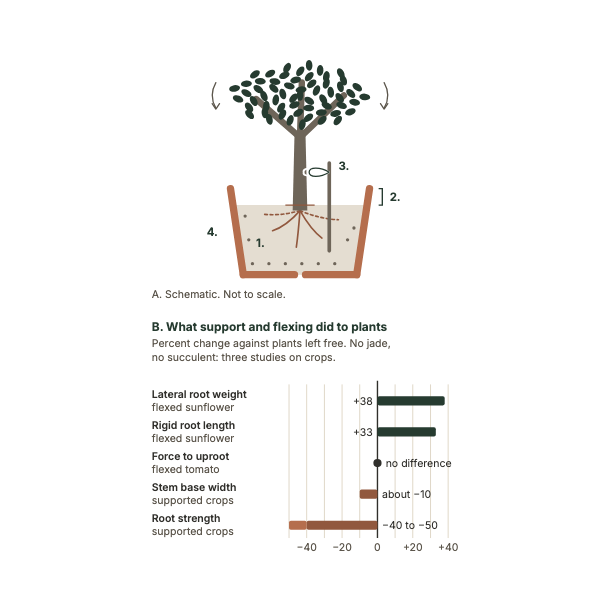
Two causes in the sources act on one side of a plant: heat on the sunny side of a dark pot, and Verticillium wilt. Both are drawn in the figure below. Neither can be confirmed from a photo.
Heat first. NC State’s chapter says dark containers absorb more heat than light ones, and warns: “In the summer, however, the increased heat can burn fragile roots.” It advises against placing dark containers in full sun.
How hot can the mix get? In a Colorado trial comparing black plastic with two fabric containers, Alison Stoven O’Connor, James E. Klett and Anthony J. Koski found black plastic ran hottest. Readings above 30°C (86°F) were frequent in summer, and one of the highest was 54°C (129°F) (full text).
Studies have linked those levels to root damage. Holding the roots of ‘Drake’ elm at 42°C (108°F) for 6 hours a day over 12 weeks cut its survival by half (Martin, Ingram and Nell 1989, abstract).
Barberry and pittosporum roots were damaged at 35 and 40°C, boxwood at 40 and 45°C (Newman and Davies 1988, abstract).
None of those plants is an olive, and no study read measured olive roots at these temperatures. The figures show what a pot mix in sun has reached and where roots of other woody plants were damaged, not a limit for olive.
The leaves themselves also take heat. G. Bongi and S. P. Long found that three hours at 38°C (100°F) in high light cut a measure of olive leaf photosynthesis by 80 percent, but it recovered within four hours of returning to 26°C (abstract).
Why would one side of the crown follow one side of the pot? In some tree species, called sectored, water moves little sideways in the wood on its way up.
George S. Ellmore, Amy E. Zanne and Colin M. Orians measured this in paper birch, sugar maple and red oak, and found red oak far more sectored than birch (abstract).
Olive was not measured. Whether roots on the hot side of this pot supply the side of the crown that browned is a reasonable question the sources cannot answer.
Disease is the other one-sided cause. The University of Arizona’s sheet on Verticillium wilt (Olsen, revised 2011) lists olive among its hosts and says plants “often have symptoms on one branch or one side of the plant.” Individual branches or parts of trees may die in one season.
Where the water and the heat go in a potted tree
Four places to look in a pot in full sun, and the root-zone temperatures studies have linked to root damage.
| 1. The sunny wall | A dark pot absorbs more heat than a light one, and in summer the heat can burn fragile roots (NC State Extension). In a Colorado trial of three container types, black plastic ran hottest, and one of the highest readings in the study was 54°C (O’Connor and colleagues 2013). |
| 2. The wet layer | Every pot that drains keeps a saturated layer at its base after watering; its depth is set by the mix, not the pot (Rowe 2025, reviewing earlier work). In Rowe’s trials a coarse layer under the mix usually lowered the water held and rarely raised it; NC State Extension advises against such a layer. |
| 3. Holes against paving | Water leaves only through the holes. For a pot that sits flat on a hard surface, NC State Extension advises holes in the side wall, 1/4 to 1/2 inch above the bottom. |
| 4. The browned side | Verticillium wilt, a disease of olive, often shows on one branch or one side of a plant (Arizona Extension). Separately, in some tree species water moves little sideways in the wood; how much varies by species, and olive was not among those measured (Ellmore and colleagues 2006). |
Top: blue tint, water held in the mix; pebbles, the coarse layer; red-brown lines, roots, dashed where the drawing marks them as at risk; brown leaves, dead. No depth, volume or temperature is drawn. Bottom: the bar for tree roots and the 30°C line are figures O’Connor and colleagues give from earlier work; the shrubs were barberry, boxwood and pittosporum, the elms ‘Drake’ elm in a growth room; the 54°C reading was one of the highest in a trial of black plastic and two fabric containers in Fort Collins, Colorado.
Before changing how often to water, look at where the water and the heat go: a pot that never drains holds its water at the base, and a dark pot in sun heats the mix along its sunny wall.
Why It Is Getting Worse Now It Is Cooler
The post’s last question is the hardest, and no source read answers it for this tree. Two things in the sources fit the timing, and they point in different directions.
The Arizona sheet calls Verticillium wilt a cool-season disease. The fungus grows best between about 70 and 85°F (21 and 29°C), growth stops when air temperatures pass about 90°F (32°C), and symptoms usually go unseen in low-desert summers. In the low desert, wilt symptoms reappear in fall and spring.
November days of 28 to 32°C (82 to 90°F), as the post reports them, sit at the top of that range and just above it. That is consistent with the timing.
It does not diagnose the tree, and the sheet adds that roots are not rotted in this disease, which a look at the roots can help separate from root rot.
The second fit is water. NC State lists hot weather, wind, a dark pot and full sun among the conditions that raise a container plant’s water needs.
By that list, a pot should lose water more slowly as those ease in November, so a pot that does not drain would stay wet longer after each watering. No study read measured this in an olive pot.
Watering frequency also meets disease in olive. In microplots of soil carrying the Verticillium fungus, M. Pérez-Rodríguez and colleagues found daily irrigation encouraged the disease in the susceptible cultivar ‘Picual’, with 100 percent of plants affected and 63 percent dead (abstract).
The three less frequent schedules, including weekly and deficit watering, gave far less disease in ‘Picual’. ‘Arbequina’ was affected alike under every schedule, and ‘Frantoio’ developed little disease.
The authors judged resistant cultivars more important than the schedule. A second study found higher water rates raised disease in ‘Picual’ too (Santos-Rufo and Rodríguez-Jurado 2021, abstract).
Overwatered or Underwatered? Leaves Cannot Tell You
One reply was puzzled that a tree looking so dry could be overwatered. The leaves cannot settle it. Olive trees shed their leaves under severe drought as a defense, according to Sabina Villadangos and colleagues, who withheld water from young olives for 21 days (abstract).
The rotted cuttings in the Spanish trial wilted and died too, from roots that were sitting in water. Wilting and leaf loss turn up at both extremes, which is why the roots and the mix are the places to look.
NC State’s chapter gives the check, in its answer to the same question about a houseplant. Take the plant out of the pot and look.
Roots of an underwatered plant are white and the mix very dry. Roots of an overwatered plant are brown and soft, and “may have an odor if they are beginning to rot.”
The post already holds half the answer. Mix still damp 30 to 40 cm down a week after watering, in a pot that has never drained, is not a description of a dry root zone. Whether the roots in that wet mix are alive is what only a look can show.
Is the Climate Simply Too Hot for an Olive?
One reply said no amount of care would help in heat like that. No source read tests olive in 50°C summers, so that claim cannot be checked here. What the sources do say does not support it as a blanket rule.
NC State’s plant record for olive says it “performs best in hot/dry summers and mild/wet winters” and is drought tolerant once established. It also says olive needs about two months in the 40 to 50°F range (4 to 10°C) to flower, a condition the record gives for flowering, not for survival.
The same record lists root rot and Verticillium wilt among the problems to watch, and says olive prefers well-drained soil. Bongi and Long’s leaves recovered from 38°C within hours. Heat on the leaves and heat in a dark pot are different problems, and only the second has a fix in the sources: keep the pot out of full sun.
What to Do With the Tree in Front of You
Each step below comes from a source named beside it. Where no source gives a number, none is given.
- Find out whether the pot drains. Water slowly and watch the base, as NC State’s test describes. If nothing comes out, look at the holes. If the base sits flat on paving, NC State’s fix for that case is holes in the side wall, just above the bottom.
- Stop adding water to a pot that has not drained. NC State’s chapter says to water only when needed and warns that overwatering fills the pores so roots cannot get oxygen. Its finger test checks only the top 2 to 3 inches, which says nothing about the mix 30 to 40 cm down, where the post found it still damp.
- Look at the roots. NC State’s description separates the cases: white roots in very dry mix, against brown, soft roots that may smell. Its advice for rotted roots is to trim off the brown ones and repot into a container with drainage holes.
- Keep the pot itself out of the sun. NC State advises against dark containers in full sun because the heated mix can burn roots. Shading the pot is a different job from shading the leaves, which tolerated short heat in Bongi and Long’s test.
- Watch for dead branches with wood stained inside. The Arizona sheet says brown flecking in the wood, especially in roots and lower stems, is commonly used to diagnose Verticillium wilt, though it is not always present. Once a plant is infected, the sheet says, there is no control.
- Repot into a mix that drains, if you repot. NC State names perlite as an ingredient that improves drainage, and advises wearing a dust mask or wetting it down. No source read gives an olive mix, so the reply recommending half inorganic bonsai mix cannot be checked here.
The poster also asked how many weeks a potted olive can safely go without water. No source read gives a number for a potted olive, and the honest answer depends on the pot draining first.
Planting it in the ground came up too. No study read compared potted and planted olives, though one reply said the same thing happened to their potted olive and planting it out brought it back.
If you do plant out, NC State’s call for well-drained soil applies there as much as in a pot. Our article on new trees that brown after planting covers watering a root ball in the ground.
What Remains to Be Explored
No study read measured the water table in a large pot that cannot drain, or how long a mix like this one stays wet in a hot, dry place. Rowe’s pots were small and held no plants.
No study read tested olive roots at the root-zone temperatures a dark pot reaches in a 50°C summer. The temperature figures above come from barberry, boxwood, pittosporum and elm, and the 54°C reading from Colorado. Whether olive is one of the tree species whose water moves little sideways in the wood is also unmeasured.
The Korean flooding trial ran 15 days on 12 cultivars, the Spanish pot test used rooted cuttings, and the Verticillium irrigation trials used microplots and controlled conditions. None of the abstracts describes an old tree moved into a pot, which is what the post shows.
The replies’ claims that the supplier cut the roots to fit, and that a peat-rich mix is wrong for olive, are not tested by any source read. The cultivar of the tree is unknown, and so is whether its decline is root rot, Verticillium wilt, heat, or more than one at once.
What would change the answer: a look at the roots and the wood, and a pot that drains. With those, most of the replies’ argument about how often to water resolves itself, and what is left is which of root rot, wilt disease and heat the roots and wood point to.
Sources
- Olive Tree Healthy in July, Severely Deteriorated… — multiple community members. Reddit, r/plantclinic. Undated.
- Effect of Drainage Layers on Water Retention of Potting Media in Containers — Avery Rowe. PLOS ONE. February 2025.
- Plants Grown in Containers, Chapter 18, North Carolina Extension Gardener Handbook, 2Nd Ed. — D. Mays, K. Richter, L.K. Bradley, J. Sherk, M. Kistler, and J. Neal. NC State Extension. 2022.
- Olea europaea (North Carolina Extension Gardener Plant Toolbox) — NC State Extension. Undated.
- First Report of Phytophthora megasperma and Pythium irregulare As Olive Tree Root Pathogens — M. E. Sánchez-Hernández, A. Ruiz-Dávila, and A. Trapero-Casas. Plant Disease (American Phytopathological Society). October 1997. Cited from its abstract.
- Collar and Root Rot of Olive Trees Caused by Phytophthora megasperma in Sicily — S. O. Cacciola, G. E. Agosteo, and G. Magnano di San Lio. Plant Disease (American Phytopathological Society). January 2001. Cited from its abstract.
- Physiological and Oxidative Stress Responses Associated With Flooding Tolerance Among Olive (Olea europaea L.) Cultivars — Hong Lim Kim, Mock Hee Lee, Kyeong Bok Ma, Jae Ho Joa, Yong Bum Kwack. Korean Journal of Environmental Agriculture. 2026. Cited from its abstract.
- Container Type and Overwintering Treatments Affect Substrate Temperature and Growth of Chanticleer Pear (Pyrus calleryana ‘Glen’s Form’) in the Nursery — Alison Stoven O’Connor, James E. Klett and Anthony J. Koski. Journal of Environmental Horticulture (Horticultural Research Institute). June 2013.
- Supraoptimal Root-Zone Temperature Alters Growth and Photosynthesis of Holly and Elm — Chris Martin, Dewayne Ingram, Terril Nell. Arboriculture and Urban Forestry (Journal of Arboriculture). November 1989. Cited from its abstract.
- High Root-Zone Temperatures, Mycorrhizal Fungi, Water Relations, and Root Hydraulic Conductivity of Container-Grown Woody Plants — Steven E. Newman, Fred T. Davies. Journal of the American Society for Horticultural Science. 1988. Cited from its abstract.
- Light-Dependent Damage to Photosynthesis in Olive Leaves During Chilling and High Temperature Stress — G. Bongi, S. P. Long. Plant, Cell and Environment. April 1987. Cited from its abstract.
- Comparative Sectoriality in Temperate Hardwoods: Hydraulics and Xylem Anatomy — George S. Ellmore, Amy E. Zanne, Colin M. Orians. Botanical Journal of the Linnean Society. 2006. Cited from its abstract.
- Verticillium Wilt (AZ1034) — Mary W. Olsen. University of Arizona Cooperative Extension. January 2011.
- The Influence of Irrigation Frequency on the Onset and Development of Verticillium Wilt of Olive — M. Pérez-Rodríguez, E. Alcántara, M. Amaro, N. Serrano, I. J. Lorite, O. Arquero, F. Orgaz, F. J. López-Escudero. Plant Disease (American Phytopathological Society). April 2015. Cited from its abstract.
- Unravelling the Relationships Among Verticillium Wilt, Irrigation, and Susceptible and Tolerant Olive Cultivars — Antonio Santos-Rufo, Dolores Rodríguez-Jurado. Plant Pathology. August 2021. Cited from its abstract.
- Photo-Oxidative Stress Leading to Oxylipin Accumulation May Trigger Drought-Induced Leaf Abscission in Olive Trees — Sabina Villadangos, Carmen González, Sergi Munné-Bosch. Physiologia Plantarum. May 2023. Cited from its abstract.