None of them prefers it. The plants on a low-light list are the ones that can hold their own in a dim room, and NC State Extension’s gardener handbook prints the difference as two numbers: low-light plants need 25 to 74 foot-candles to maintain them and 75 to 300 to promote growth.
So “low light” on a list names how little a plant can get by on, not the light it grows best in.
In the growth trials found for this article, every common houseplant tested in dim light either grew slowly, held still or lost ground, and none did better in less light than in more.
The quick test: has the plant made new leaves since it came home? The handbook calls a healthy, growing plant “the best indicator that the environmental conditions are agreeable.” A plant that looks fine and has made nothing in months is telling you something about the light.
What a Low-Light Plant List Is Telling You
Illinois Extension sorts indoor light into four levels: low at 75 foot-candles, medium at 150, high or bright at 300, and direct at 1,500. A foot-candle is a measure of brightness falling on a surface; full sun outdoors is 10,000 to 12,000.
Its plant lists carry a word most copies drop. They are headed “Houseplants for Low Light (Minimum)”, and the medium and high lists are minimums too.
Above them sits the page’s own summary: “While most plants will perform best with bright light conditions, some plants can tolerate moderate to low light conditions.”
NC State’s plant records say the same about individual plants. Pothos “prefers bright, indirect light and survives for long periods in low light.”
Snake plant goes where it gets “direct sunlight only part of the day, 2 to 6 hours, as it will tolerate very low light.” ZZ plant, the record adds, “has a slow growth rate”.
Prefers, survives, tolerates. The extension pages keep those words apart. A “best low-light plants” headline merges them, and the merge is the whole misunderstanding.
The lists also draw their lines in different places. Illinois files snake plant and heartleaf philodendron as low-light plants and pothos as medium, all as minimums.
NC State’s handbook table puts snake plant and heartleaf philodendron at high to medium light, and pothos at high to low. The same plant can be a low-light plant on one list and a bright-light plant on another, depending on whether the list gives its floor or its range.
And Illinois’s 75 foot-candle minimum for its low-light list is exactly where NC State’s growing range for low-light plants begins. One service’s floor is the other’s starting point for growth.
Why Holding on and Growing Need Different Amounts of Light
A leaf makes sugar by photosynthesis, which runs only in light, and spends sugar on respiration, which runs all the time. Growth is built from whatever is left over.
The light level where the two exactly balance is the compensation point. Carl Salsedo, an extension agent writing for the interior planting trade in an undated newsletter from about the mid-1970s, defined it as “the point at which food required by the plant in respiration is equal to the amount produced by photosynthesis.”
NC State’s handbook spells out what happens there. If a plant makes food as fast as it uses it, “the plant simply maintains its relative size. This means that new plant tissue is produced at the same rate as old tissue dies.” Above that point the plant grows; below it, it runs down.
Ecologists use the same idea to define the trait itself. Valladares and Niinemets, reviewing it in 2008, call “the minimum light required for survival” the measure of shade tolerance.
A low-light plant, in other words, is a plant with a low floor. Nothing in the definition says the floor is where it does best.
The floor for a whole plant also sits higher than the figure measured on one leaf. Givnish, working through the arithmetic for a tree in 1988, found the leaf-level compensation point “has little meaning for net carbon gain”, because night respiration and the cost of building leaves, stems and roots all have to be paid too.
What the Trials on Houseplants Found
Several studies have measured this on the plants people actually buy, most of them for the trade that grows foliage plants for offices and lobbies.
The floor drops, within weeks. Fonteno and McWilliams in 1978 held heartleaf philodendron, pothos, an umbrella tree (Brassaia) and lucky bamboo (Dracaena sanderana) in dim light for 15 weeks.
Pothos’s compensation point fell from 38 to 6 micromoles of light per square meter per second, about a sixth of where it started.
Heartleaf philodendron fell from 33 to 7 and the umbrella tree from 14 to 4. Lucky bamboo started far higher, at 119, adjusted much more slowly and ended at 15.
Over the same weeks each one cut its dark respiration, the sugar it burns without light, by 53 to 71 percent.
Pass and Hartley in 1979 timed the adjustment. Three foliage plants lowered their compensation points 1.4- to 5-fold over seven weeks; pothos reached its minimum in three weeks and the umbrella tree in five. Boston fern “never reached a fixed light compensation point.”
The floor depends on how the plant was raised. Collard and colleagues in 1977 grew weeping fig under different shade cloths. The compensation point of the sun-grown plants was nearly three times that of plants under 80 percent shade, at the same feeding rate.
Salsedo drew the practical conclusion for the trade: 100 foot-candles “may be sufficient for a shade-grown plant when moved indoors”, while 200 “may not be sufficient for a plant that was grown in the sun.” Two plants of one species on one shelf can sit on opposite sides of their floors.
Plants kept growing at low light, and grew faster with more. In Fonteno and McWilliams’s trial, every plant added leaf area during those 15 weeks, pothos about 108 square centimeters (17 square inches). The plant with the highest compensation point, lucky bamboo, added the least.
Their dim treatment, 27 micromoles for 12 hours a day, works out near 150 foot-candles by the abstract’s own pairing of 57 micromoles with 3,400 lux. Lux is the metric unit of the same brightness a foot-candle measures.
That is Illinois’s medium level, not its low one, so the trial says less about a truly dark corner than the word “dim” suggests.
A 2024 study in Scientific Reports went dimmer. Sugano, Ishii and Tanabe grew pothos, money tree (Pachira aquatica) and Rhaphidophora tetrasperma for 191 days in chambers lit like a windowless office: about 500 lux, roughly 46 foot-candles, for nine hours a day. All of them kept growing, apart from one money tree lost to root rot.
Raising the light to about 1,500 lux (about 140 foot-candles) for 18 hours, about six times the daily total, made pothos and Rhaphidophora grow significantly faster.
Pothos made more leaves at each step up in daily light, and bigger ones at the top level. For money tree the difference was not significant, which the authors put down to its heavy, partly dead stem hiding the change.
Those chambers held a steady 22°C (72°F) and had carbon dioxide added to office levels, so a living room will not match them. In those chambers, dim light slowed growth rather than stopping it.
Some plants lose ground. Not every foliage plant copes as well. Kubatsch and colleagues in 2007 kept Schefflera arboricola for six months at 10, 20 and 80 micromoles.
Lower light cut its fresh and dry weight, and at the two lowest levels the plants could not cut their energy use enough to make up for it: they “lose their marketability within 6 months”, the authors found, especially when warm.
Weeping fig stalled. Fails and colleagues in 1982 found that “No treatments increased total plant dry weight” over 12 weeks in a simulated interior.
Collins and Blessington in 1985 held weeping figs indoors at 10 or 20 micromoles for 12 hours a day and found leaf drop “substantially reduced” at the higher level.
A review of 500 experiments on 760 species, Poorter and colleagues in 2019, adds the general pattern. Growth rises with daily light and then levels off, and in how much they actually grew, shade-tolerant species changed less in response to light than other plants did. Those are averages across every kind of plant, not a houseplant trial.
The light that keeps a houseplant, and the light that grows it
NC State’s handbook gives each group of houseplants two ranges: a lower one to maintain the plant and a higher one to promote growth.
By the handbook’s ranges, an office at 50 foot-candles maintains a low-light plant rather than growing it. The growing range starts at 75, the figure Illinois Extension prints as its low-light minimum.
Why Your Plant Looks Fine and Has Not Grown
At break-even, the handbook says, new tissue replaces old at the same rate, so a plant keeps its size while adding nothing you would notice. Nothing about that looks like a symptom.
Stored reserves stretch that further. NC State warns that a plant moved from bright production into dim light can “starve and gradually decline”, and that because it arrives with food reserves, “its decline may take a few months.”
In sun-grown weeping figs moved to dim light, Fails and colleagues found new leaves made “at the expense of root carbohydrate reserves” while the plant as a whole gained nothing.
Seedlings in a tropical American forest show the same reliance on stores. Myers and Kitajima in 2007 found survival through deep shade went with how much carbohydrate the seedlings held in stems and roots.
That is tree seedlings, not houseplants, but it is the same account of how a plant gets through a lean stretch.
NC State’s handbook also tables how long some plants stay attractive at set light levels. At 15 to 20 foot-candles, snake plant, philodendron and several others are listed at 12 months and dracaena at 30.
Pothos is listed only from 50 to 75 foot-candles up, at 30 months. The handbook cites no study for these, and attractive is not the same as growing.
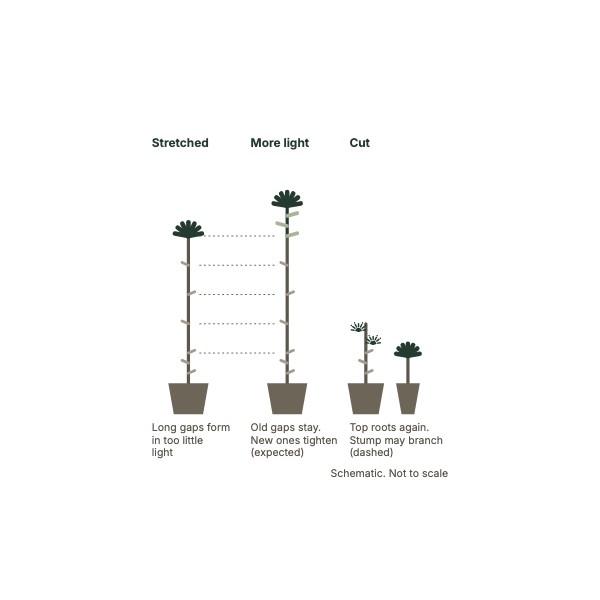
When a plant is short of light, the handbook lists the signs: leaves that do not expand to full size, paler color, long gaps between leaves as the stems stretch toward light, and leaves that drop “because there is little stored energy to support them.” Stretched growth on succulents is covered under whether a stretched succulent can shrink back.
Where the Light in Your Room Actually Falls
Two extension services describe positions rather than numbers, and they broadly agree. Illinois puts low light a few feet from a north window, 3 to 10 feet from an east or west window, or 15 to 20 feet back from a south one.
Illinois’s medium is directly in front of a north window or 3 to 10 feet from a south one, and its high is directly in front of an east or west window or up to 5 feet from a south one.
NC State’s version: low light is more than 8 feet from a window, a dim corner, the middle of a room, a hallway, a north-facing room, or anywhere lit only by lamps.
Medium is 4 to 8 feet from south and west windows, and high is within 4 feet of a large window facing south, east or west.
For a sense of scale, the handbook gives an office as about 50 foot-candles and a supermarket as 100.
Sugano’s team cites a European office standard of 500 lux, which is about 46 foot-candles. By NC State’s ranges an office is low light, and by Illinois’s it is below the low-light minimum.
Your eyes will not tell you which band you are in. NC State notes that they “automatically adjust to differing light levels”.
A light meter or a phone light-meter app gives a number; Iowa State gives the conversion, 1 foot-candle to 10.764 lux. Measuring at leaf level, step by step, is in a Monstera with no holes under a grow light.
These placements assume the northern hemisphere, where south windows get the most sun. South of the equator, swap north and south. Season changes the numbers too: NC State notes that winter brings fewer hours of weaker sun. Plants slow down because of light, not winter takes that up.
What to Do About the Room You Already Have
NC State’s handbook lists the options, and Illinois and Iowa State fill in how. None of these steps has been tested in a trial on houseplants; they are extension guidance.
- Move it closer to the window. The handbook’s first suggestion. By either service’s placements, a few feet toward the glass can move a plant up a band.
- Rotate it. NC State suggests moving plants monthly between brighter and dimmer spots, so a plant with low reserves gets a chance to build some before it goes back.
- Clean the glass. Cleaning windows and removing screens “can increase light penetration by as much as 30%”, the handbook says.
- Add a lamp, for longer days. Illinois says plants in low light benefit from more hours of light, 14 to 16 being enough, and never more than 16, because plants need a dark period.
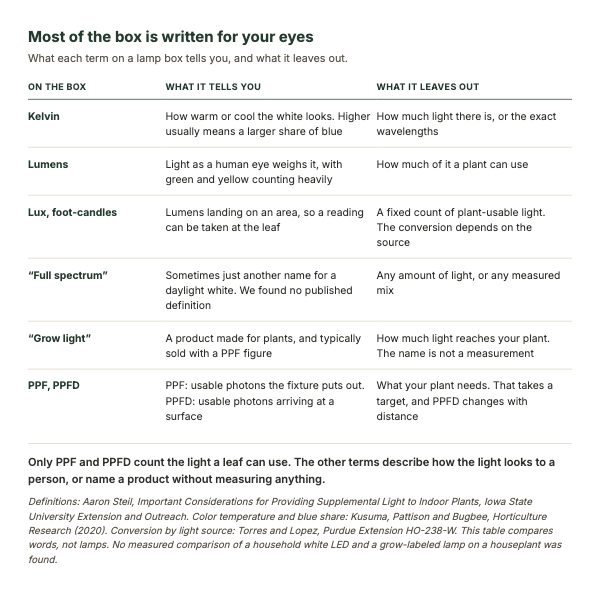
For the lamp, Iowa State’s simple setup is a 4-foot plug-in LED shop light, full-spectrum or “daylight”, 18 inches above the leaves, giving at least 3,000 lumens, on for 14 hours a day, then adjusted by how the plants respond. What the numbers on a lamp’s box mean is in what a grow light label tells you.
If the light cannot change, the handbook’s advice is to slow the plant’s spending to match. “Do not overwater; provide just enough to keep plants from wilting.”
Reduce how much and how often you fertilize, following the product label for anything you do apply. And lower the room a few degrees if you can.
The Schefflera trial points the same way on temperature. Its authors found that at the two lowest light levels the plants’ life span and quality were reduced, “especially at higher temperatures.”
Moving a plant into much brighter light needs care in the other direction. The University of Maryland warns that indoor plants adapted to low light and moved straight outdoors into full sun can scorch, and advises starting with 2 hours of sun a day and lengthening it gradually. The longer version, for a summer outdoors, is in moving a houseplant outdoors and back.
Does Any Houseplant Actually Prefer Dim Light?
Prefer is too strong for any plant found here, but there is a real limit in the other direction.
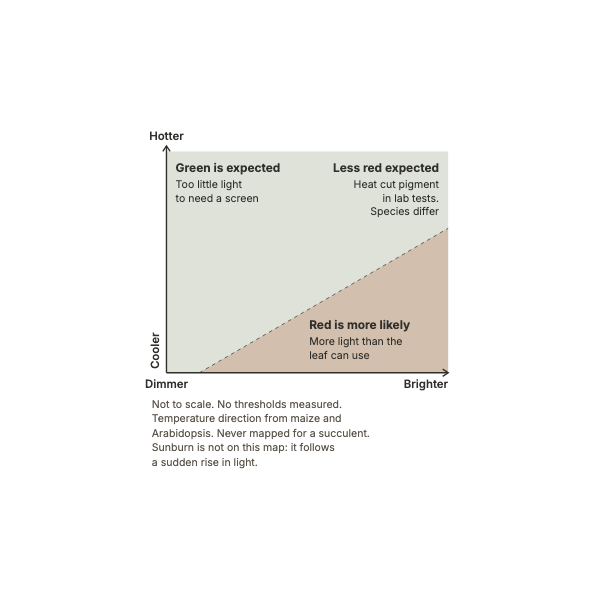
The handbook notes that many tropical houseplants grow wild as understory plants beneath a forest canopy, and that above their best light “chlorophyll can be destroyed”, leaves yellow, new leaves come in smaller, and patches scorch.
Maryland Extension puts it plainly: “Some plants grow best in partial sun or shade. When shade-loving plants are exposed to full sun, leaf scorch or sunburn can occur.”
In a 1969 greenhouse trial, Carpenter and Nautiyal grew African violets in sunlight and dead patches developed on the leaves at every rate of air movement they tried.
So the extension wording that fits is the one NC State uses for pothos: bright, indirect light. By that record, neither a dim corner nor full sun is its best light. Leaf size is a related question with its own answer, taken up in bigger leaves in a dimmer window.
A note for homes with pets and children. NC State’s records list all three plants named most often here as poisonous if eaten. Pothos is rated medium severity, with mouth pain and swelling, drooling, vomiting and skin irritation, and is flagged for cats and dogs.
Snake plant is rated low, with vomiting, nausea and diarrhea, its sap can irritate skin, and it is flagged for cats, dogs and children.
ZZ plant is rated medium, with diarrhea and vomiting “if leaves are consumed in quantity”, and is flagged for cats and dogs. What “toxic to cats” means in practice is covered under what toxic to cats means.
When Low Light Is the Right Choice Anyway
Sometimes slow is the point, and the trade says so openly. Salsedo’s newsletter states that “little growth is desired in most interior situations”: in a lobby or an office, a plant that stays the size it was installed at is the specification.
Sugano’s team makes the same case from the other side. Keeping light at about the office level they tested, they write, “can moderate their growth and minimize the need for frequent pruning” of climbing plants, while extra light suits someone who wants a large space filled quickly.
That is a legitimate choice for a hallway or a desk, made knowingly. Salsedo’s interior minimums, 150 foot-candles for sun-grown plants and 75 to 100 for shade-grown or acclimatized ones, were written for those interiors. Anyone who wants a plant to grow is reading a specification set for something else.
Growers prepare plants for that life. The handbook describes nurseries raising foliage plants in high light and tells buyers to reduce light gradually, and Salsedo reported Florida work in which five weeks under 80 percent shade cut weeping fig’s later leaf drop by half. That is one species, in the trade’s own uncited summary.
Local Regulations and Safety Advisory
If you use fertilizer products, follow the label. Rules on them vary by country and locality, and your agriculture department can say what applies where you live. This article is general information, not legal, medical or veterinary advice.
Authorities to consult:
- Local agriculture department
- Poison control service
- Veterinarian or animal poison control service
If a child or pet may have eaten part of a plant, contact a poison control service or a veterinarian, because toxicity depends on the species, the amount and the individual.
What Remains to Be Explored
No measured response of snake plant or ZZ plant to low light was found; the one trial found that included snake plant, Carpenter and Nautiyal’s, grew it in greenhouse sun. Figures for their compensation points circulate online, but none could be traced to a published measurement, so none is repeated here. The measured species are pothos, heartleaf philodendron, umbrella trees, lucky bamboo, weeping fig, Boston fern, money tree and Rhaphidophora.
NC State’s maintain and grow ranges, and its table of months a plant stays attractive, cite no study. They are the most useful published numbers for a home reader and the least documented.
Every trial here was run in growth chambers or simulated interiors with lamps, steady temperatures and, in the 2024 study, added carbon dioxide. No measurement of a houseplant’s growth across real rooms was found, and the daylighting studies found on how light falls off from a window model offices, not homes.
Most of the papers are cited from their abstracts; Sugano and colleagues was read in full. What would change the answer is a growth trial of the common list plants at true low-light levels, in homes, over a year.
Sources
- Lighting — Illinois Extension, College of Agricultural, Consumer and Environmental Sciences, University of Illinois. Undated.
- Plants Grown in Containers, Chapter 18 — D. Mays, K. Richter, L.K. Bradley, J. Sherk, M. Kistler, and J. Neal; K.A. Moore and L.K. Bradley (eds). NC State Extension, North Carolina Extension Gardener Handbook, 2nd ed.. February 1, 2022.
- Epipremnum aureum (Pothos) — NC State Extension Gardener Plant Toolbox. Undated.
- Dracaena trifasciata (Snake Plant) — NC State Extension Gardener Plant Toolbox. Undated.
- Zamioculcas zamiifolia (ZZ Plant) — NC State Extension Gardener Plant Toolbox. Undated.
- Excess Light on Indoor Plants — University of Maryland Extension, Home and Garden Information Center. March 13, 2023.
- How to Determine How Much Supplemental Light to Provide for Indoor Plants — Iowa State University Extension and Outreach, Yard and Garden. Undated.
- Acclimatization of Foliage Plants — Carl A. Salsedo, Extension Agent — Horticulture. Extension newsletter, scanned and hosted by NC State Extension (hortscans.ces.ncsu.edu). Undated. A scanned extension newsletter written for the interior planting trade.
- Adaptation of Indoor Ornamental Plants to Various Lighting Levels in Growth Chambers Simulating Workplace Environments — Soma Sugano, Masahisa Ishii, Shin-ichi Tanabe. Scientific Reports. 2024.
- Light Compensation Points and Acclimatization of Four Tropical Foliage Plants — W. C. Fonteno and E. L. McWilliams. Journal of the American Society for Horticultural Science 103(1). 1978. Cited from its abstract.
- Net Photosynthesis of Three Foliage Plants Under Low Irradiation Levels — R. G. Pass and David E. Hartley. Journal of the American Society for Horticultural Science 104(6). 1979. Cited from its abstract.
- Influence of Shade and Fertilizer on Light Compensation Point of Ficus benjamina L. — R. C. Collard, J. N. Joiner, C. A. Conover, D. B. McConnell. Journal of the American Society for Horticultural Science 102(4). 1977. Cited from its abstract.
- Light Acclimatization Potential of Ficus benjamina — Barbara S. Fails, A. J. Lewis, J. A. Barden. Journal of the American Society for Horticultural Science 107(5). 1982. Cited from its abstract.
- The Effect of Low Light Intensity and Temperature on Growth of Schefflera arboricola in Interior Landscapes — Astrid Kubatsch, Heiner Grüneberg, Christian Ulrichs. HortScience 42(1). 2007. Cited from its abstract.
- Keeping Quality of Ficus benjamina as Affected by Production Light Levels and Postproduction Light Quality and Level — P. C. Collins and T. M. Blessington. HortScience 20(3). 1985. Cited from its abstract.
- Shade Tolerance, a Key Plant Feature of Complex Nature and Consequences — Fernando Valladares and Ülo Niinemets. Annual Review of Ecology, Evolution, and Systematics. 2008. Cited from its abstract.
- Adaptation to Sun and Shade: A Whole-Plant Perspective — TJ Givnish. Australian Journal of Plant Physiology 15. 1988. Cited from its abstract.
- Carbohydrate Storage Enhances Seedling Shade and Stress Tolerance in a Neotropical Forest — Jonathan A. Myers and Kaoru Kitajima. Journal of Ecology 95. 2007. Cited from its abstract.
- A Meta-Analysis of Plant Responses to Light Intensity for 70 Traits Ranging From Molecules to Whole Plant Performance — Hendrik Poorter, Ülo Niinemets, Nikolaos Ntagkas, Alrun Siebenkäs, Maarit Mäenpää, Shizue Matsubara, ThijsL. Pons. New Phytologist 223. 2019. Cited from its abstract.
- Light Intensity and Air Movement Effects on Leaf Temperatures and Growth of Shade-Requiring Greenhouse Crops — W. J. Carpenter and J. P. Nautiyal. Journal of the American Society for Horticultural Science 94(3). 1969. Cited from its abstract.