A Monstera makes holes only after it has grown out of its small, whole juvenile leaves, and only in leaves that are still forming. On grown plants, leaves in sun carried well over twice the hole area of leaves in deep shade.
So years without holes do point to too little light, or to a plant not yet grown enough. But no study has measured how much light a potted Monstera needs before holes start, so no lamp can be called enough, or too weak, by its name. What can be checked is the light at the leaves, and whether a change raises it.
Leaves browning now are a separate question, about roots, water and salts in the mix, and more light will not answer it.
The question came from a thread on r/plantclinic about a Monstera kept for many years, the last three of them under a grow light.
It had never climbed its pole or made more than a couple of small holes, and its leaves had suddenly begun to brown and yellow.
The replies split twice. Many said the light was far too weak and hung too far away.
When the poster named the lamp, others answered that a lamp of that kind is plenty, and one asked the poster about a light meter. Others argued about the watering: too often for a pot that size, or too little each time.
No light reading appears in the replies we read, and that turns out to be the missing piece. The arguments about holes and about browning both have more evidence behind them than the thread drew on.
Where the Holes Come From
The holes are made while the leaf is still forming. In Monstera and five related genera, discrete patches of cells undergo programmed cell death, dying on the plant’s own schedule, as the blade develops, leaving open perforations, according to a review by Gunawardena and Dengler (2006), cited from its abstract. Holes near the edge break through the thin margin and become the splits.
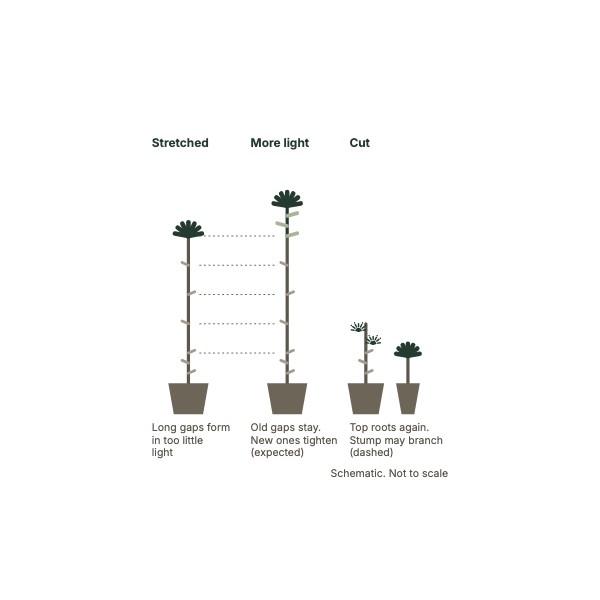
That has a consequence the thread did not mention. A leaf that has already unfurled whole stays whole. A brighter lamp, a pole or a new pot can only change leaves still to come, so any improvement shows in new leaves and nowhere else, however long you watch the old ones.
Holes also belong to a grown plant. Seedlings of Monstera deliciosa start on the ground with small, entire leaves and then climb, Díaz-Valverde, Avalos and Quesada-Fonseca write in a 2025 study, read in full. They describe leaf development in this species as highly plastic and apparently tied to plant age and light conditions.
In a related species, Monstera acuminata, the stem grows thicker and the leaves larger as the plant ascends a tree or other support, López-Portillo and colleagues (2000) report in an abstract.
The adult leaves of M. deliciosa reach 3 feet or more in length, split at the margins and perforated beside the midrib, in UF/IFAS Extension’s description.
Ray (1990), in an abstract on shape changes across the aroids (the arum family, which includes Monstera and philodendron), names Monstera for two kinds of trigger. Some changes follow the gain or loss of contact with a support, and some come once a plant reaches a certain maturity. He adds that aroid shoots can enter holding patterns when conditions do not suit development to the adult form.
Why Monstera has holes at all is still argued. Muir (2013) built a model in which holes steady a plant’s growth under the sunflecks of a forest floor, brief patches of direct sun; his abstract calls it a testable hypothesis, not a finding. For a grower, when holes appear matters more than why, and the when is better documented.
What Light Changes, and What It Does Not
The only direct comparison of light and holes in Monstera deliciosa that we found is that 2025 Costa Rican study.
The team chose 20 plants on a university campus, ten with leaves in sun and ten with leaves below several layers of sun leaves, and measured one mature leaf on each.
Sun leaves averaged 76 square centimeters of holes, about 12 square inches, against 28 square centimeters, about 4, in shade leaves. By the paper’s table that is about 2.7 times as much, though the authors’ discussion calls it twice. Leaves in both groups were about 20 inches long and similar in total area.
Three limits matter. The holes were a small share of each leaf in both groups, under 5 percent in sun and under 2 in shade.
Light was chosen by position and never measured. And with one leaf per plant, the authors note, a leaf now in shade may have formed while it was in sun.
A student study points the same way. Jacobi (2024), in an undergraduate honors thesis cited from its abstract, found more holes on Monstera adansonii plants growing in sun than in shade, while leaf size did not differ with light.
A 2025 review of climbing aroids by Yu and colleagues, also from its abstract, says light intensity regulates leaf form in these vines.
More light has a cost. UF/IFAS’s guide to Monstera in Florida landscapes says vines in full sun are more productive than vines in shade, but their leaves tend to be light green and may show sunburn, and that the plant grows best in light shade, because intense sun may scorch its leaves.
Holes come with size, and more with light
A young Monstera makes whole leaves. Holes arrive on a grown plant, and on grown plants, sun leaves carried more hole area than shade leaves.
A plant that has never made holes may be too young or too dim. No study has set a light level for it.
Is a Grow Light Enough? It Depends on How Far Away It Is
No source we read gives the light a potted Monstera needs before it makes holes, whether in foot-candles, PPFD or daily light.
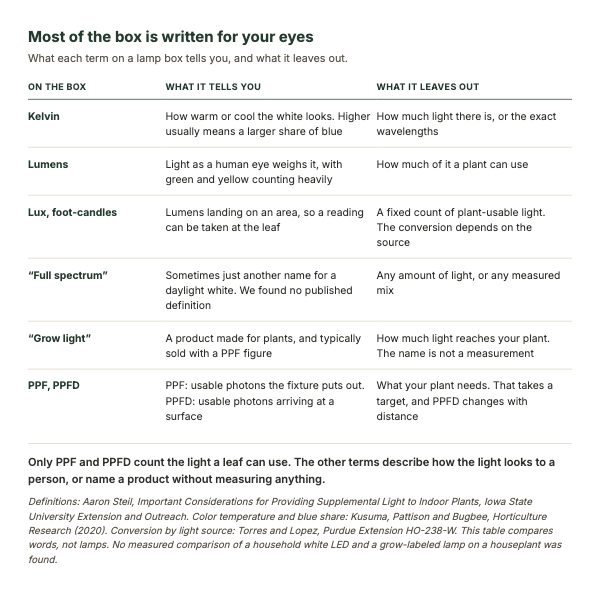
The replies argued over the lamp itself instead, and a lamp’s name cannot settle it, because the light reaching a leaf depends on how far away the lamp hangs and how bright it runs.
Lamp light weakens fast with distance. NC State Extension’s gardener handbook says the intensity of artificial light decreases dramatically as a plant is moved away, while sunlight changes very little across 10 feet.
The handbook’s example is a 40-watt fluorescent tube giving 120 foot-candles at 1 foot and only 75 at 2 feet.
A Virginia Tech Extension guide by Eric Stallknecht sets out the trade-off. Lowering lights significantly raises the light at the plants but spreads it less evenly, so fewer plants are lit well; raising them lowers it. LEDs, it adds, can be dimmed. No source we read gives a lamp distance for Monstera itself.
The thread does not say how high the poster’s lamp hung or how it was set, and several replies judged its height from photos we did not see. Neither side of the argument can be confirmed from what was posted.
A lamp that keeps a plant alive for years has not necessarily been growing it on. A scanned extension newsletter on acclimatizing foliage plants, by Carl A. Salsedo and hosted by NC State, gives interior minimums of 150 foot-candles for sun-grown plants and 75 to 100 for shade-grown ones, 10 to 12 hours a day, and adds that little growth is desired in most interior situations.
Those are figures for holding an indoor plant steady, not for pushing a vine toward adult leaves. Ray’s abstract describes aroid shoots waiting in a holding pattern when conditions do not suit the adult form. Whether a potted Monstera under a weak lamp is in one has not been tested. What a lamp’s box does and does not tell you is in our guide to grow light labels.
How to Check the Light Your Plant Actually Gets
Iowa State Extension’s guide by Aaron Steil offers two routes. The simpler is trial and error: set the lamp up, run it 14 hours a day as a starting point, and watch the plant over the next several weeks, adjusting by what it does.
Its signs of too little light are stretched, spindly growth, leaf drop and yellowing foliage.
The remedies it gives are to move the fixture closer, use a brighter one, add a fixture, or add reflectors or side lights, which it calls particularly useful when symptoms show only on the parts of a plant furthest from the lamp.
Scorched or bleached leaves are its signs of too much light, and the remedy runs the other way: move the fixture further from the plant or use a weaker one. Virginia Tech’s guide agrees: exceedingly high light can damage some leaves, and plants grown too close call for raising the lights.
The second route is to measure. Hold a light meter, or a phone app, at foliage level and read lux. Multiply by a conversion factor, from the lamp’s maker or a published table, to get PPFD, the light plants can use, per square meter each second, then multiply PPFD by the hours the lamp is on and by 0.0036 to get the daily light integral, the day’s total.
Take readings where the leaves are, including those furthest from the lamp, which Iowa’s guide singles out. No source we read gives a daily light target for Monstera holes, so a reading cannot pass or fail a lamp. What it can show is whether a change, a lower lamp or a second fixture, actually raised the light at the leaves.
Does It Need a Pole?
The poster’s plant never climbed its pole, and one reply blamed a pole left dry. Ray names contact with a support as one trigger of shape change in Monstera, and López-Portillo’s team describes leaves enlarging as M. acuminata climbs.
NC State’s plant profile says a sturdy support is needed to keep the stems from breaking.
No trial we found tested whether a pole brings holes on a potted Monstera, or whether keeping a pole moist matters. The Yu review lists the roughness and material of a support among the things that change how well aroid vines attach.
Our article on pothos and moss poles covers what has been tested in that plant, and bigger leaves in dimmer light covers leaf size across the light range.
Why the Leaves Are Browning Now
The browning is a different problem from the holes. Colorado State Extension lists brown leaf tips, yellowing leaves and unexplained wilting as signs that salts have built up in the mix, and a whitish crust around the lip of the pot or on the soil surface as the most obvious sign.
Salts come in with water, especially softened water, and with fertilizer, and stay behind as the mix dries.
The same page says to water until it drains from the bottom, throw away what drains out, and never leave the pot standing in it. That bears on one reply’s idea that light, frequent watering lets salt build up.
To leach, Colorado State says to scrape off the crust and the top half inch to an inch of mix, set the pot in a sink with its holes clear, and fill it to the top with tepid tap water a couple of times, letting it drain between. Replace the mix you removed. In extreme cases, it says, repot.
On how often to water, the thread ranged from twice a week to once every two or three weeks. No source we read gives a Monstera interval in days.
NC State gives a method instead, and it speaks to both overwatering and underwatering: water thoroughly each time, then let the top quarter to third of the mix dry before the next. UF/IFAS adds that Monstera does not tolerate excessively wet soil.
How to tell when the mix is dry, by finger, stick or the pot’s weight, is in how to tell when a houseplant needs water.
Why roots rot when a mix stays wet, whatever the pot’s size, is in root rot is a saturation problem, and hard and softened water are compared in what water houseplants need.
Yellowing does not point one way. Iowa lists yellowing foliage among signs of too little light, Colorado State lists it among signs of salts, and leaf drop appears in both of Iowa’s columns, too little light and too much. That overlap is the reason to check the mix and roots before blaming the lamp.
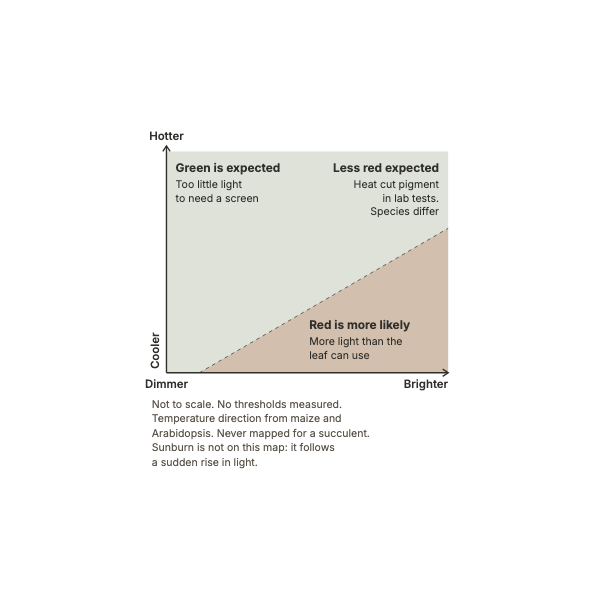
Two other ideas in the thread, heat from the lamp scorching the top leaves and yellow rings meaning fungus, cannot be settled from anything we read. If the top leaves are bleached or scorched, the responses the extension guides give are Iowa’s remedy for too much light and Virginia Tech’s: raise the lamp, or, where an LED can be dimmed, turn it down.
What to Do Now
- Check the mix before the lamp. Feel it or weigh the pot, and if it seems to stay wet, look at the roots and read about saturation before anything else.
- Look for a white crust on the pot’s lip or the soil. If you see one, or tips are browning, leach the mix as Colorado State describes.
- Water until it drains, throw the runoff away, and let the top quarter to third of the mix dry before the next watering, as NC State advises.
- Measure the light at foliage level, at the top leaves and the ones furthest from the lamp, and work out the daily total.
- If growth is stretched or yellowing, lower the lamp or add light, run it about 14 hours, and dim or raise it if leaves bleach or scorch.
- Give the stem a sturdy support it can grow up.
- If you feed, use the rate on the product’s label and no more; fertilizer is one of the sources of salt.
- Judge the result by new leaves. Leaves already open will not gain holes.
Local Regulations and Safety Advisory
If you use fertilizer products, follow the label. Rules on them vary by country and locality, and your agriculture department can say what applies where you live. This article is general information, not legal advice.
Authorities to consult:
- Local agriculture department
What Remains to Be Explored
No one has published the light level, in any unit, at which a potted Monstera deliciosa starts making holes, or how big a plant must be first. A study growing young plants under measured lamps at several heights would answer the thread’s question directly.
The one measured comparison of sun and shade leaves recorded no light level, sampled one leaf per plant on outdoor plants, and found holes under 5 percent of the leaf.
The M. adansonii result is a student thesis known from its abstract, and the developmental and climbing studies are cited from abstracts too.
No trial has tested poles, or moist poles, for holes on a potted Monstera, and no source gives a watering interval for it in days. Why the holes exist remains a hypothesis. Each of those gaps, filled, could change parts of this answer.
Sources
- Phenotypic Differences in Sun and Shade Leaves of Monstera deliciosa (Araceae) — Valeria Díaz-Valverde, Gerardo Avalos, Julián Quesada-Fonseca. Revista de Biología Tropical 73:e56794. June 30, 2025.
- Effects of Sun vs Shade and Leaf Age on Leaf Morphology, Herbivory, and Physical Defenses in the Swiss Cheese Plant (Monstera adansonii) — Adriana Jacobi. University of Colorado Honors Journal. April 30, 2024. Undergraduate honors thesis, cited from its abstract
- How Did the Swiss Cheese Plant Get Its Holes? — Christopher D. Muir. The American Naturalist 181(2):273-281. 2013. Cited from its abstract
- Alternative Modes of Leaf Dissection in Monocotyledons — Arunika H. L. A. N. Gunawardena, Nancy G. Dengler. Botanical Journal of the Linnean Society 150(1):25-44. 2006. Cited from its abstract
- Hydraulic Architecture of Monstera acuminata: Evolutionary Consequences of the Hemiepiphytic Growth Form — Jorge López-Portillo, Frank W. Ewers, Guillermo Ángeles, J. B. Fisher. New Phytologist 145(2):289-299. 2000. Cited from its abstract; Monstera acuminata
- Metamorphosis in the Araceae — Thomas S. Ray. American Journal of Botany 77(12):1599. 1990. Cited from its abstract
- Diverse Climbing Strategies in Aroid Vines: Functional Adaptations and Environmental Drivers — Pinfeng Yu, Shufei Weng, Bo Zhang, Yichun Huang, Fei Xu. Frontiers in Plant Science 16:1692444. 2025. A review, cited from its abstract
- Monstera Growing in the Florida Home Landscape (HS1071) — Jonathan H. Crane, Carlos F. Balerdi. UF/IFAS Extension, EDIS. Undated.
- Monstera deliciosa (North Carolina Extension Gardener Plant Toolbox) — NC State Extension. Undated.
- How to Determine How Much Supplemental Light to Provide for Indoor Plants — Aaron Steil. Iowa State University Extension and Outreach, Yard and Garden. December 2023.
- Acclimatization of Foliage Plants — Carl A. Salsedo, Extension Agent, Horticulture. Extension newsletter, scanned and hosted by NC State Extension (hortscans.ces.ncsu.edu). Undated.
- 1339 – Leaching Salts From Potting Mixes — Colorado State University Extension, PlantTalk Colorado. Undated.
- 18. Plants Grown in Containers (North Carolina Extension Gardener Handbook, AG-831) — Diane B. Mays, Kim Richter, Lucy Bradley, Julie Sherk, Mark Kistler, Joe Neal. NC State Extension Publications. February 1, 2022.
- Calculating and Using Daily Light Integral (DLI): An Introductory Guide (SPES-720NP) — Eric Stallknecht. Virginia Cooperative Extension, Virginia Tech. 2025.
- Why Are My Monstera Leaves Turning Yellow Like… — multiple community members. Reddit, r/plantclinic. Undated.