Putting a clear plastic bag over a houseplant can work for a short trip, and extension services suggest it. The bag does not water the plant. It slows the water already in the pot from leaving, and the same cover holds in heat, wet air and a soggy pot if you seal one in. How long it lasts depends on the setup, and no one has timed a bagged houseplant at home.
The closest published numbers run to days and weeks. Illinois Extension gives a bagged plant set over a pan of wet pebbles 7 to 8 days. Croton cuttings sealed in bags for up to 15 days lost under 7% of their leaves in most treatments, but far more at the warmest, longest setting.
Readers stretch it further. In a thread on r/houseplants, a grower bagged a windowful of plants in semi-clear bags for about two and a half weeks and came home to all of them alive, minus a few leaves.
Replies to that thread described a month away with more than sixty plants, asked whether the bags needed air holes, and reported plants that rotted. This article sets out what decides which of those outcomes you get, and what to do before you seal anything.
Why a Bag Keeps a Plant Watered
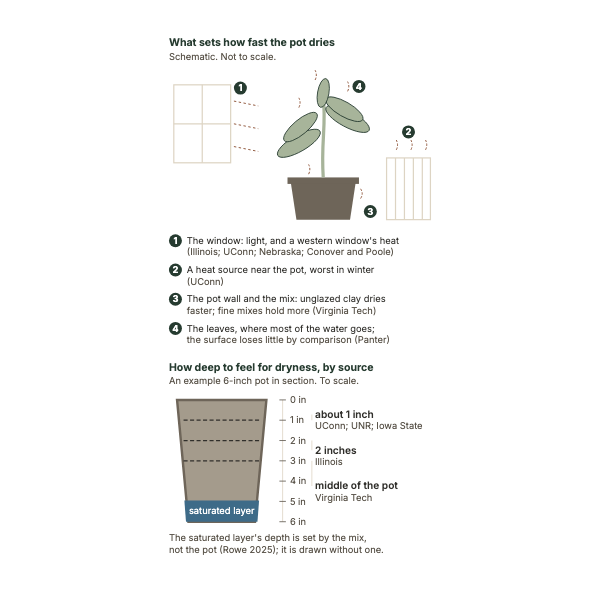
A plant loses water through its leaves, a process called transpiration, and the potting mix loses water from its surface too.
Virginia Cooperative Extension puts the rule in one sentence: “Warm air and low humidity increase the rate of transpiration from a plant, whereas temperate air and high humidity decrease the rate of transpiration.”
A bag changes the humidity. The same Virginia Tech publication adds that in humid conditions houseplants “need less frequent watering because the potting soil doesn’t dry out as quickly.” UF/IFAS Gardening Solutions describes the bag as creating “a greenhouse effect,” helping the plant “retain moisture.”
Retain is the right word. Water that evaporates inside the bag condenses on the plastic and stays in the enclosure instead of drifting into the room.
Nothing new arrives. The plant is living on the water that was in the pot when the bag went on, spent more slowly.
Some of that condensed water can get back to the leaves. Studying cuttings under polythene, K. Loach found, in a 1977 paper cited here from its abstract, that the previous day’s water stress mattered little, “probably because cuttings were able to take up water overnight from condensation on the under surface of the polythene.”
That is recycling, not supply. Loach’s comparison also bears on light: propagation under polythene did better than mist “in the lower radiation conditions of winter but the reverse occurred under high radiation conditions.” The extension advice on where to put a bagged plant, below, points the same way.
How Long a Bagged Plant Lasts
No study has timed a potted houseplant bagged at home, and the two published figures for enclosures describe different setups.
Illinois Extension says a clear bag over a plant set in a shallow pan of pebbles and water “should be sufficient for 7-8 days,” and for a longer trip, to ask someone to check on the plants.
Iowa State University Extension says many closed terrariums need water only every 3 to 6 months. That is a permanent glass container planted for it, not a bag pulled over a potted plant, and its months cannot be stretched to cover the bag.
Between those two sit trials that held plants without care and measured what they lost. None of them is a bagged houseplant either, so the figure below draws each on its own row rather than as one scale.
How long the closest setups ran
No one has timed a houseplant bagged at home. These are the nearest
published lengths: two extension guides, and three trials of plants sealed in bags, shipped
or kept dark.
In the trial of cuttings sealed in bags, leaf loss stayed under 7% in most
treatments and climbed at the warmest, longest setting: 15 days at 30°C (86°F).
Houseplants; A. Steil, Iowa State University Extension and Outreach, How to Propagate
Houseplants by Stem Tip Cuttings (reviewed January 2025) and How to Create and Care for a
Terrarium (reviewed January 2024). Trials, each cited from its abstract: Y.-T. Wang,
HortScience, 1987, croton cuttings in light or darkness; R. T. Poole and C. A. Conover,
HortScience, 1983, areca palm, dracaena, weeping fig and schefflera; N. C. Peterson and
T. M. Blessington, HortScience, 1981. Three to six weeks is drawn as 21 to 42
days.
The nearest is Y.-T. Wang’s 1987 study, cited from its abstract. Croton cuttings were “enclosed in polyethylene bags” at 15, 20 or 30°C (59, 68 or 86°F) for 5, 10 or 15 days, in light or darkness. Leaf loss was under 7% in most treatments.
The exception was the warmest and longest. After 15 days at 30°C, cuttings held in darkness lost 31% of their leaves and those in light 56%.
These were unrooted cuttings, not potted plants, but they were sealed in bags, and the loss rose where heat and time were both at their highest.
Whole plants have been held longer in shipping trials. R. T. Poole and C. A. Conover held areca palm, dracaena, weeping fig and schefflera in simulated shipping for 7 to 28 days at 10 to 19°C (50 to 66°F), and report, from the abstract, up to 21 days “without significant loss of quality” for all four species.
The best temperature differed: 10°C (50°F) for schefflera, 10 or 13°C for the fig, 13 to 19°C for the palm and dracaena.
Darkness has its own cost. N. C. Peterson and T. M. Blessington kept weeping figs in the dark for 0, 4, 8 or 12 days and then held them for 10 weeks in a simulated indoor setting.
Under fluorescent lamps, figs that had spent 8 or 12 days in the dark lost more leaves and were no longer saleable.
Against those numbers, the thread’s two and a half weeks is longer than Illinois’s 7 to 8 days and within the 21 days that shipping trials reached, on other plants in other conditions.
For absences longer than 4 weeks, UF/IFAS recommends sending plants to a plant-sitter’s home, or having a sitter visit at least once a week, because pests “can get out of hand quickly when plants are stressed.”
Sealed, or With Air Holes
The two extension guides that address sealing both write about cuttings, not vacations, and give opposite advice. Iowa State’s guide to stem cuttings says to enclose the pot in a bag or dome and “Do not seal the bag tightly to allow for air exchange.”
Nebraska Extension’s guide to propagating house plants says the opposite for some cuttings: “Slip an airtight polyethylene bag over the cuttings and around the container. No further watering will be necessary.” For individual pots it says to fasten the plastic securely to the sides of the container.
Iowa State’s terrarium guidance gives the middle course. If condensation builds up, “crack the lid to reduce the excess moisture,” and if it builds heavily, uncover the terrarium until some evaporates, then cover it again. That advice is written for terrariums, which you are home to tend.
What no source has measured is how much water a hole costs or how much condensation it prevents, for any size of hole. An opening lets humid air leave, which is why it lowers condensation, and that same air is the water the bag was there to keep.
Before You Seal It
Water, then let it drain. Iowa State’s cutting method says to water the rooting medium and let it drain for a few minutes before covering, and Nebraska says the medium “should be moist but not soggy” before the airtight bag goes on. UF/IFAS, for other vacation methods, says to water thoroughly before you leave.
The reason to drain is roots. Virginia Tech explains that “When the potting soil is wet for long periods of time, water fills the pore spaces, and oxygen availability will decrease,” which causes roots to stop growing and eventually die.
A bag slows drying, so a soggy pot stays soggy for longer. The thread’s grower watered two days before bagging. How saturation damages roots, and why it causes rot, is covered in root rot is a saturation problem.
Hold the plastic off the leaves. UF/IFAS says to “be sure the plastic doesn’t touch the plant.” Iowa State suggests “chopsticks, straws, and wire loops” as supports, and Nebraska suggests stakes or a wire hoop pushed into the pot away from the plant, with the bag slipped over them.
Choose indirect light, never direct sun. UF/IFAS says to keep a bagged plant “out of direct light.” Nebraska explains why: in direct sun “the heat will be absorbed, rapidly raising the temperature inside the plastic.” Iowa State adds that too much light can burn foliage, “especially under plastic bags or domes.”
Too little light has a cost of its own: Iowa State warns that cuttings given too little may rot or dry out before rooting.
UF/IFAS’s vacation advice is to move plants away from warm windows to indirect light, since for a couple of weeks they “can survive on lower light and they will take up less water.”
Iowa State’s terrarium guide names an east or north window as a good choice for a closed container. The thread’s grower used an east window with the blinds half closed. Illinois specifies a clear bag, without giving a reason.
Mind the thermostat. Iowa State’s houseplant guide says to avoid temperatures below 55°F (13°C), and to remember that if you leave home in winter.
At the other end, Wang’s sealed cuttings lost the most leaves in the warmest, longest setting, 15 days at 30°C (86°F).
Why Some Bagged Plants Rot or Drop Leaves
Three things can go wrong in a bag. The first is the pot, if it went in saturated. The second is wet leaves. The third is heat or darkness held for too long, which shows up as falling leaves rather than rot.
Wet leaves matter because of fungi such as gray mold, Botrytis cinerea. In a laboratory test, B. A. Latorre and M. E. Rioja found its spores did not germinate without free water, whatever the humidity. They note, from the abstract, that in high humidity “imperceptible condensation can occur,” supplying that water.
Time counts as well. In greenhouse tomatoes, M. A. Eden and colleagues found that infection of flower parts rose with the length of exposure to humidity near 100%, and that breaking long humid spells with drier ones did not reduce it. Those were tomato flowers, not houseplant leaves.
Virginia Tech gives the general rule: in high humidity, “Air circulation should also be improved to prevent diseases on foliage.” A sealed bag has almost none. Why leaves that stay wet for hours give disease its opening is explained in does watering at night matter.
Leaf drop has its own causes. Wang’s warm, long setting cost the bagged crotons nearly a third of their leaves in darkness and more than half in light, and Peterson and Blessington’s figs lost more after 8 or more days of darkness.
How much falls also differs by plant: J. Ben-Jaacov and colleagues found that leaf drop after 2 weeks of dark storage depended on the fig clone, and called genetic background a major factor.
When You Come Home
The leaves to watch are the ones that grew inside the bag. D. Fanourakis and colleagues, in a 2011 study of roses cited from its abstract, note that plants grown at relative humidity of 85% or more “develop stomata that fail to close fully” when the leaf runs short of water.
Stomata are the pores a leaf opens and closes to control water loss. In that study, stomatal function depended on “the humidity at which the leaf completed its expansion.” Leaves moved into high humidity even late in their expansion functioned poorly, while leaves that had finished expanding were no longer affected.
S. Torre and colleagues found a similar result in roses grown at 90% humidity. Moved to 40%, their leaf conductance, a measure of how freely a leaf loses water, stayed almost the same over three days, while it fell in roses grown at 70%.
Fanourakis’s 2016 review describes plants grown at 85% or more as “prone to lethal wilting” when moved to conditions of high evaporative demand, where air draws water from leaves quickly.
Whether a bag fogged for two weeks reaches those levels for long enough has not been measured, and roses are not pothos. On a trip of a few weeks, though, a growing plant may unfold new leaves under the plastic, and those are the leaves these studies describe.
None of these studies tested how to take a bag off. They identify which leaves carry the risk, not a schedule for removing the cover. Dry room air raises that demand, and Virginia Tech notes that indoor humidity is lower than outdoors, especially when the heat is running in winter.
Plants to Leave Out
Iowa State’s terrarium guide names the exception plainly: the humid environment “is good for any houseplant except cacti and succulents, which suffer in a humid environment.” Nebraska, writing that cuttings should never be allowed to dry out, makes an exception too: “some succulents and cacti.”
Those plants also go longest between waterings in ordinary care. Virginia Tech says succulents and cacti “rely on thorough but infrequent waterings, for example, once or twice a month,” where tropical houseplants need water “sometimes once or twice a week.”
Virginia Tech also names African violets, begonias and cyclamens as plants “that cannot tolerate wet leaves at all,” and recommends watering them from below, covered in what bottom watering does. No source read says whether bagging suits them.
For a group of humidity-loving plants, raising humidity without a sealed cover is the subject of what actually raises humidity.
What Remains to Be Explored
No one has measured how long a potted houseplant lasts in a bag at home, at any temperature or light level.
The nearest data are cuttings sealed in bags for 15 days, foliage plants in simulated shipping for up to 28, and figs kept dark for 12. Illinois’s 7 to 8 days cites no test.
Nor has anyone measured what air holes do: how much water an opening costs, or how much condensation and disease it prevents. The two extension guides that address sealing disagree, and both were written for cuttings. A trial of sealed against vented bags on potted plants would settle it.
The humidity studies on new leaves were done on roses, and none timed how quickly stomata recover after a plant leaves high humidity. Whether a few weeks in a bag is long enough to matter, and how best to remove the cover, are both untested.
The thread’s grower also found aerial roots on plants after the trip. No source read explains why, or whether it does the plant any harm.
Sources
- Properly Watering Container Houseplants (SPES-804P) — Kristopher S. Criscione and Ashton Holliday-Goulart. Virginia Cooperative Extension, Virginia Tech. May 2026.
- Care | Houseplants — University of Illinois Extension. Undated.
- Houseplant Care — UF/IFAS Gardening Solutions. Undated.
- Vacation Plant Care — UF/IFAS Gardening Solutions. Undated.
- How to Create and Care for a Terrarium — Aaron Steil. Iowa State University Extension and Outreach. January 2024.
- How to Propagate Houseplants by Stem Tip Cuttings — Aaron Steil. Iowa State University Extension and Outreach. January 2025.
- How to Care for Houseplants — Aaron Steil. Iowa State University Extension and Outreach. October 2023.
- Propagating House Plants (G1853) — David E. Lott and Dale T. Lindgren. University of Nebraska-Lincoln Extension. December 2012.
- Leaf Water Potential and the Rooting of Cuttings Under Mist and Polythene — K. Loach. Physiologia Plantarum. 1977. Cited from its abstract.
- Effect of Temperature, Duration, and Light During Simulated Shipping on Quality and Rooting of Croton Cuttings — Yin-Tung Wang. HortScience, American Society for Horticultural Science. 1987. Cited from its abstract.
- Influence of Simulated Shipping Environments on Foliage Plant Quality — Richard T. Poole and Charles A. Conover. HortScience, American Society for Horticultural Science. 1983. Cited from its abstract.
- Postharvest Effects of Dark Storage and Light Source on Keeping Quality of Ficus benjamina L. — N. C. Peterson and T. M. Blessington. HortScience, American Society for Horticultural Science. 1981. Cited from its abstract.
- Clonal Variability in Response to Light Intensity During Growth and to Subsequent Dark Storage of Ficus benjamina and Ficus retusa — J. Ben-Jaacov, D. Ziv and B. Steinitz. HortScience, American Society for Horticultural Science. 1985. Cited from its abstract.
- The Effect of Temperature and Relative Humidity on Conidial Germination of Botrytis cinerea — B.A. Latorre and M.E. Rioja. International Journal of Agriculture and Natural Resources (Ciencia e Investigación Agraria). 2002. Cited from its abstract.
- The Influence of Inoculum Concentration, Relative Humidity, and Temperature on Infection of Greenhouse Tomatoes by Botrytis cinerea — M. A. Eden, R. A. Hill, R. Beresford and A. Stewart. Plant Pathology. 1996. Cited from its abstract.
- Avoiding High Relative Air Humidity During Critical Stages of Leaf Ontogeny Is Decisive for Stomatal Functioning — Dimitrios Fanourakis, Susana M. P. Carvalho, Domingos P. F. Almeida and Ep Heuvelink. Physiologia Plantarum. 2011. Cited from its abstract.
- Leaf Anatomy and Stomatal Morphology of Greenhouse Roses Grown at Moderate or High Air Humidity — Sissel Torre, Tove Fjeld, Hans Ragnar Gislerød and Roar Moe. Journal of the American Society for Horticultural Science. 2003. Cited from its abstract.
- Improving Stomatal Functioning at Elevated Growth Air Humidity: A Review — Dimitrios Fanourakis, Dimitrios Bouranis, Habtamu Giday, Dália R.A. Carvalho, Abdolhossein Rezaei Nejad and Carl-Otto Ottosen. Journal of Plant Physiology. 2016. Cited from its abstract.
- Update on Dexter-Ing My Plants While I Was on Vacation — multiple community members. r/houseplants, Reddit. Undated.