Yes, you can mix LECA into potting soil, and we found no measurement showing it harms a plant. But the warning against it explains only a layer, the reassurance measures nothing, and the nearest research suggests a porous stone does less than its reputation.
LECA, short for lightweight expanded clay aggregate, is the fired clay pebble sold for growing plants without soil.
Nobody we could find has tested it blended into potting mix, which is why two confident answers can sit side by side on one results page.
That question is what started a long r/houseplants thread, where one owner found a university page saying no and another answer saying yes. The closest measured work is on pumice, another porous stone, in bark, and it leads to one practical rule: measure your pot rather than trust a ratio.
Where the Two Answers Come From
The “no” comes from the Elisabeth C. Miller Library at the University of Washington, and it is blunt: “Definitely do not mix clay balls with potting soil, and do not use them in the bottom of containers.” The page is unsigned and undated, and it cites no test.
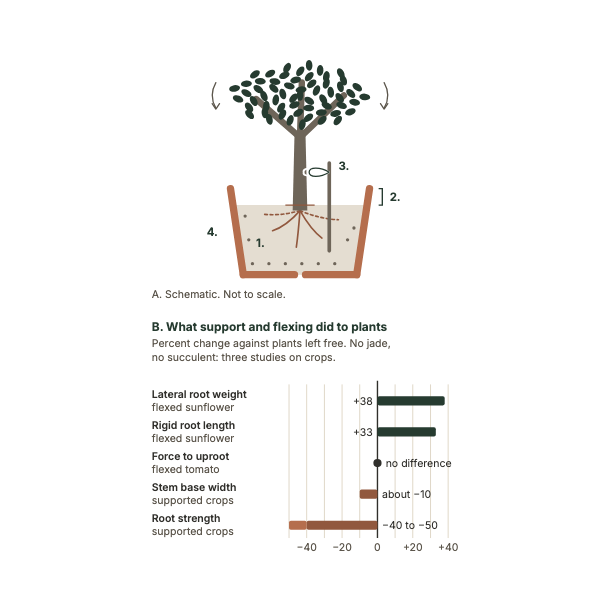
The one mechanism it gives concerns the second half of that sentence. Don’t “create a perched water table”, it says, by putting clay balls, broken pottery or rocks in the bottom of the pot, because water then sits above the layer.
That warning has since been tested. In a 2025 PLOS ONE study, Avery Rowe found that “any drainage layer was likely to reduce water retention of any medium, and almost never increased it,” and that warnings about a raised perched water table “should be considered inaccurate.” The test used pots with a hole and no plants, so it cannot say how a plant would fare.
A blend is a different thing. Pebbles scattered through a mix do not form a continuous layer across the pot, and the page gives no separate reason for its ban on mixing.
One reader in the thread spotted exactly that: the page never explains its objection to LECA in a mix.
The “yes” is no stronger. The usual line is that LECA improves aeration and drainage while retaining water, and we found no measurement behind it. Neither answer tells you what the pebbles do in your pot.
Does LECA Hold Water?
Less than the other mineral media it has been measured against. In a 2026 laboratory study in Horticulturae, cited here from its abstract, Schabauer and colleagues compared nine mineral materials.
Expanded clay came last on water content, at 11.0 percent by volume, and last on water a plant can use, at 2.7 percent.
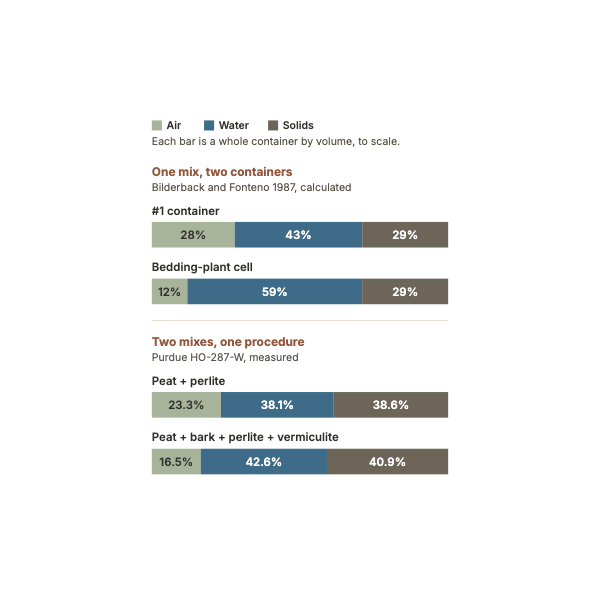
That second number is the one to keep, because holding water and giving it up are separate properties. Purdue Extension describes the pores behind both: “Wide pores are good because they provide spaces for air exchange. Narrow pores are good because they hold water.”
Water held too tightly in the narrowest pores is usually unavailable to plants. Schabauer’s team name “pore interconnectivity, rather than total porosity” as what decides hydraulic behavior, which suggests a pebble can be full of holes and still pass little water to a root.
Those figures describe each material alone, with no plant present, so they say nothing direct about a blend.
Don’t let the word “clay” mislead you here. The same study measured clay granules, a different product, at the top of its range for usable water: 30.9 percent, about 11 times the figure for expanded clay. The word on the bag says little about how a material behaves with water.
Readers also disagree on whether roots get inside. One reports roots gripping the pebbles, while another says the pebbles fill space that roots are unable to enter. We found no study of either for LECA.
In pine bark, a different material, Pokorny and Wetzstein found water inside a particle was available if roots grew within it, per the abstract of their 1984 paper. Whether fired clay behaves the same way is unknown.
Which Way the Water Moves
The thread holds three claims that cannot all be the whole story: the soil sucks water out of the pebbles, the pebbles pull water out of the soil, and pebbles keep the soil moist for longer. Basic soil physics suggests these describe one exchange seen from different sides.
Water in unsaturated material moves toward the drier zone. Cornell’s soil science notes put it simply: “water flows from zones of wet soil to zones of dry soil.”
So a dry pebble in wet mix should take up some water, and a wet pebble in drying mix should give some back as far as its pores allow.
That step, from soil to a pebble in a pot, is our inference, because we found no measurement of it. If the 2.7 percent figure carries over, though, the exchange is small either way. LECA in a mix would then sit closer to one reader’s comparison with stones than to a sponge or a thief.
What a Porous Stone Did in a Measured Mix
The nearest real test we found uses pumice, which is a porous volcanic rock rather than fired clay. Altland and colleagues, writing in HortTechnology in 2011, packed Douglas fir bark, with and without pumice, into 6-inch cores and tracked air space over time.
Their reason for testing is familiar. Pumice, they write, is usually added to nursery substrates at 10 to 20 percent “because it is perceived to increase aeration and drainage.” Substrate is the trade’s word for whatever a plant is rooted in, soil or not.
What a porous stone did to air space
Air space measured in bark with no pumice, 15 percent and 30 percent, the nearest test we found to LECA in a mix.
Adding pumice lowered air space at the start. It was ahead with coreopsis at 48 days and level with holly at 382 days. We found no equivalent test of LECA in potting mix.
In this coarse bark, that perception failed its first measurement. Bark alone started at 41 percent air space, and adding pumice took it down to 35 percent at the 15 percent rate and 37 percent at the 30 percent rate.
Container capacity, the water left after draining, stayed about the same, at 38 to 40 percent. The paper does not say why air fell. Air space is also the fairest test of what people mean by better drainage here: how much stays open once the water has run out.
Then the plants grew in. After 48 days with coreopsis, plain bark had fallen to 26 percent air while the richest pumice mix held 34 percent.
That looks like vindication until the holly run. After 382 days the plain bark had 31 percent and both pumice mixes 29, a difference that was not significant.
The clearest result is the one the authors state outright: air space falls “as roots fill void spaces.” That happened in every planted core. It also bears on the reader who adds LECA to stop soil compacting: Altland’s team saw some support for pumice holding air, but barely any shrinkage to prevent in bark.
An earlier paper from the same group, Gabriel and colleagues in HortScience in 2009, reported that pumice in bark reduced available water, per its abstract. It also reported lower container capacity, where the later study found no change at the start. So the direction on water is less settled than the direction on air.
Why Nobody Can Give You the Ratio
One popular reply says the answer turns on the proportion used and the species. That is right, and it is also as far as anyone can go.
Gabriel’s team tried to predict blended substrates from the properties of their ingredients. Bulk density could be predicted, but “all other physical properties could not be accurately predicted.”
If air space and water could not be calculated for known bark, peat and pumice, a ratio for LECA and an unnamed bag of potting mix is a guess. The 15 and 30 percent rates above were tested in bark, and the 10 to 20 percent nursery habit rests on the perception just described. Neither transfers to LECA.
What changes the result can be named, even without a number. One factor is the mix you start from.
Gabriel found fine peat in coarse bark reduced air space, so a coarse pebble in a fine mix may do the reverse. That is our inference, and it would explain why a stone gained nothing in bark that was already airy.
Grain size is another. Schabauer found finer pumice held about 16 percent more water. Gizas and Savvas, in the abstract of a 2007 study of pure pumice, found fine grades short of air and coarse grades quick to lose water. Crushed LECA, which one reader mentions, may shift the same way, though nobody has tested it.
The plant matters too. Gizas and Savvas found gypsophila and cucumber responded more strongly to the air and water balance than roses and lettuce. None was grown as a houseplant, but they show that one mix can suit one crop and not another, which is one honest reading of readers who say their plants thrive in it.
As for the claim that perlite and orchid bark do the same job, we found no head-to-head test in a mix.
Perlite has the longer record in extension guidance: Iowa State says it “holds a good balance of water and air” for rooting cuttings. That is a reason to reach for it first, not proof it wins.
What to Do With Your Pot
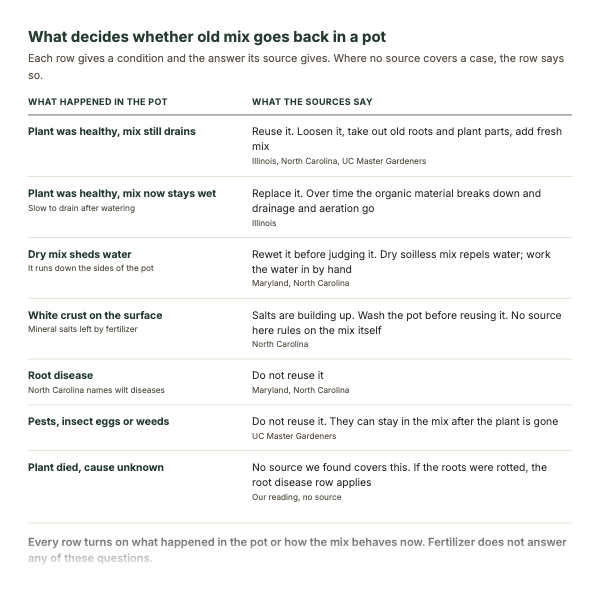
If you already mixed LECA in and the plant is growing, leave it. Nothing measured suggests it needs to come out, and digging it out disturbs roots for no known gain. Wait for a real reason to repot, which is covered in what to check first.
If the pot stays wet or dries too fast, measure rather than guess. Saturate the mix, let it drain 10 to 15 minutes into a catch tray, and divide the water that ran out by the pot’s volume.
The full steps are under root rot as a saturation problem. Purdue’s general guideline for production substrates is 20 to 25 percent air space.
If you want to add LECA anyway, blend it through the mix, in a pot with a drainage hole. Miller is right that the pebbles do not replace one. Add a small amount to a spare potful of the same mix, then repeat the measurement on both. That shows what your bag does before you commit a plant to it.
Wet the pebbles before mixing them in. No study requires this. It follows from the direction of water: dry pebbles can only take from the mix around them, and wetting them first removes the question at no cost. Fragile new roots are a separate case, covered in rooting cuttings in LECA.
What Remains to Be Explored
The central test does not exist as far as we can find. We looked for any measurement of LECA or expanded clay blended into potting mix, covering air space, water, drying speed or plant growth. We found hydroponic, construction and water-treatment work, and none of it answers this question.
Pumice in Douglas fir bark is a stand-in, and pumice varies by volcanic source.
The closest study also used outdoor nursery crops, and its coreopsis run stopped at 48 days after herbicide damage. A test in a peat-based mix, the bag most readers own, would change this answer more than anything else.
Whether water really moves between pebble and mix as described above is unmeasured, as is the amount. Whether roots enter LECA is unanswered. Schabauer, Gabriel, Gizas and Pokorny are all cited from abstracts, so their methods could not be examined. No ratio has been published with a measurement behind it that we could find.
Sources
- Effect of Drainage Layers on Water Retention of Potting Media in Containers — Avery Rowe. PLOS ONE 20(2):e0318716. February 25, 2025.
- LECA Balls — Elisabeth C. Miller Library, University of Washington Botanic Gardens. Undated.
- Water Retention and Evaporation Dynamics of Mineral Growing Media for Indoor Horticulture Systems — Schabauer, Streit, Korjenic, Peterkova, Zach and Sulejmanovski. Horticulturae 12(4):501. April 21, 2026. Cited here from its abstract.
- Influence of Pumice and Plant Roots on Substrate Physical Properties Over Time — Altland, Owen and Gabriel. HortTechnology 21(5):554-557. October 2011.
- The Effect of Physical and Hydraulic Properties of Peatmoss and Pumice on Douglas Fir Bark Based Soilless Substrates — Gabriel, Altland and Owen. HortScience 44(3):874. 2009. Cited here from its abstract.
- Particle Size and Hydraulic Properties of Pumice Affect Growth and Yield of Greenhouse Crops in Soilless Culture — Gizas and Savvas. HortScience 42(5):1274. 2007. Cited here from its abstract.
- Internal Porosity, Water Availability, and Root Penetration of Pine Bark Particles — Pokorny and Wetzstein. HortScience 19(3):447. 1984. Cited here from its abstract.
- Understanding the Pores of a Soilless Substrate (HO-287-W) — Krishna Nemali. Purdue Extension. Undated.
- Soil Water (Course Notes, CSS 260) — Cornell University. Undated.
- How to Propagate Houseplants by Stem Tip Cuttings — Aaron Steil. Iowa State University Extension and Outreach, Yard and Garden. January 2025.
- Well… What *Is* It?! Yes or No? — multiple community members. r/houseplants, Reddit. Undated.