A mushroom in a houseplant pot is neither a good sign nor a bad one. Many of these fungi feed on dead organic matter in the mix, which most bagged mixes contain, and they are not expected to harm the plant. If a child or pet could reach it, remove it now: no source read for this article shows that it is safe to eat.
That is two separate questions. Whether the mushroom will hurt the plant has a fairly settled answer. Whether it could hurt someone in your home does not, and that question comes first.
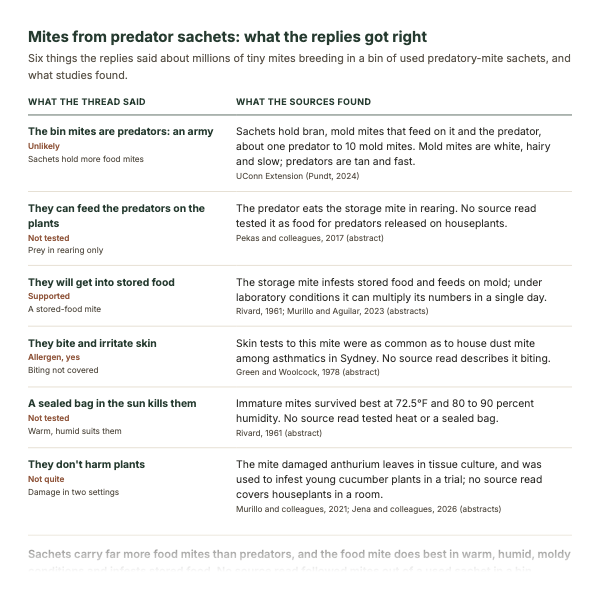
In one thread on r/houseplants, a grower asked whether tiny fungi beside a jade plant were friend or foe, and commenters named them bird’s nest fungi.
Some replies took them as good luck and a mark of healthy soil, and one said fungi like these are safe for people and animals. Others said the soil was too wet for a jade. All of them were looking at the same pot.
First, Who Else Can Reach the Pot?
The reassurance in that thread has no source behind it here. The University of Wisconsin–Madison’s fact sheet on bird’s nest fungi (Gibbs and Hudelson, 2024) describes where they grow and what to do about them in a yard, and says nothing at all about whether they are toxic. Silence on a fact sheet is not clearance.
The best-documented pot mushroom is a small yellow one, Leucocoprinus birnbaumii, the yellow houseplant mushroom. Iowa State University Extension says it is most commonly found year-round with potted plants or in greenhouses, and that its mushrooms “are regarded as poisonous to people and animals”.
Its advice is direct: “If pets or small children reside in the home, it would be wise to remove the mushrooms as they appear.” That is the one instruction among the sources read that is written for exactly this situation, a pot indoors in a home with children or pets.
How poisonous it is, if at all, is not settled in anything read for this article. Thomas Volk, a mycologist at the University of Wisconsin–La Crosse, wrote in 2002 that “There are conflicting reports about the toxicity of this fungus”, with some evidence of stomach upset in a very small percentage of people and other animals. He advised not eating it.
Two years later, answering readers on his page about fungi in mulch and pots, Volk called the same species “not known to be harmful to people or other animals”.
The University of Washington’s Miller Library quotes Michael Kuo, from a version of his MushroomExpert page, calling it “probably poisonous; do not eat it.”
Kuo’s page as it stands, dated October 2016, no longer says either way: a note on it reads that the site “contains no information about the edibility or toxicity of mushrooms.” Set side by side, the statements run from “regarded as poisonous” to “not known to be harmful”.
None of the five pages behind them cites a feeding study or a poisoning case for this fungus. Published records of the species describe where it grows and what it is made of, and no case report of anyone poisoned by it was found.
The one chemistry abstract read (Brkljača and Urban, 2015) reports fatty acids with antimicrobial activity, and no toxicity test.
Is the yellow pot mushroom poisonous? Five answers
Five statements about one pot mushroom, the yellow houseplant mushroom: four dated, oldest first, then one undated. This is not a guide to identifying a mushroom.
| Who, and when | What they say about eating it |
|---|---|
| Thomas Volk
UW–La Crosse
2002 |
“Conflicting reports”, with some evidence of stomach upset in a very small share of people and other animals. Advises not eating it. |
| Thomas Volk
UW–La Crosse
2004 |
“Not known to be harmful to people or other animals”. |
| Michael Kuo
MushroomExpert
2016 |
No information on whether it can be eaten or is toxic, the page says. |
| Iowa State
University Extension
2025 |
“Regarded as poisonous to people and animals”. Remove the mushrooms as they appear if pets or small children live in the home. |
| Michael Kuo
Quoted by the UW Miller Library
Undated |
“Probably poisonous; do not eat it.” |
None of the five pages cites a feeding study or a poisoning case, and their statements range widely. Iowa State’s advice is the cautious one: with pets or small children at home, remove the mushrooms as they appear.
Those statements are about one species, and nothing here helps you decide that yours is that species.
A University of Florida guide to mushrooms in potted plants (Karlsen-Ayala, Gazis and Smith, 2024), cited here from its abstract, names the wider worry: unknown fungi concern homeowners “because of potential toxicity to pets and children.”
The University of California’s pest note on lawn mushrooms (Farrar and Messenger-Sikes) makes the general point plainly. Small children tend to put anything, mushrooms included, in their mouths, and pets “also can be harmed by ingesting poisonous mushrooms.” For a lawn, it advises removing obvious fruiting bodies before a child plays there.
Dogs do eat mushrooms, and some fall seriously ill. A UK out-of-hours emergency service recorded five dogs with signs of mushroom poisoning between August 2010 and January 2011, with drooling, diarrhea and vomiting; four recovered and one was euthanized (Hall and Barton, 2013).
Five dogs seen eating Inocybe mushrooms all recovered with supportive care (Seljetun and von Krogh, 2017). Neither concerns a pot mushroom.
So with pets or small children at home, remove the mushrooms when you see them, as Iowa State advises, and do it again each time more come up. Its phrase is “as they appear”, which treats removal as a repeating chore rather than a cure.
On touching them, Volk calls being poisoned by touch “completely false, unless you are allergic to the mushroom”, and the Miller Library’s quotation of Kuo says that handling it “won’t hurt you.” Both are about touching, not eating, and neither is a statement about your pot in particular.
If a Child or Pet Has Eaten One
Call first, and do not wait to see what happens. The Northern New England Poison Center says most harmful mushrooms irritate the stomach, usually within 30 minutes, but that more dangerous ones “may take 6 hours or more to cause symptoms”.
That page is about wild mushrooms, and nobody can tell from a pot which fungus is growing in it.
- A child: take any pieces out of the child’s mouth, keep the mushroom as whole as possible and throw nothing away, then call your local poison control service. The poison center says it may ask for photos with a coin for size, and where the mushroom was growing. If someone has passed out or is not breathing, call your emergency number.
- A cat or dog: call your veterinarian, an emergency veterinary clinic or an animal poison control service.
What the Mushroom Is Actually Doing
A mushroom is the reproductive part of a fungus. Iowa State describes the rest of it as a thread-like body, called a mycelium, living out of sight in the soil or debris.
New Mexico State University’s garden column (2006) adds that “a large mass of fungi must grow” before mushrooms form, so what you see is the visible end of something already established.
University of California pest managers describe the same sequence in lawns: once the mycelium has developed far enough it can fruit, and fungi generally survive in soil for years and produce mushrooms only when conditions suit them, such as after long wet weather. Picking the mushroom does not kill the network underneath.
What that fungus eats is the point. The University of Florida guide says many of these fungi are saprotrophic, meaning they feed on dead material, here the organic matter in the potting soil or mulch: tree bark, wood chips, pine straw, moss or leaves.
In the jade plant’s thread, one reply pointed to wood chips visible in the mix.
Iowa State says the yellow houseplant mushroom “breaks down dead organic matter in the potting soil.” Wisconsin says bird’s nest fungi grow and reproduce on decomposing organic matter, in a fact sheet written for yards.
Neither statement extends to every mushroom that could appear in a pot, and the Florida abstract says “many”, not all.
The yellow species seems to depend on pots more than on open ground. Researchers who recorded it fruiting in soil outdoors in Malaysia called that habitat rarely reported, and concluded from its absence in their survey that it prefers humus-rich, composted soil in plant pots (Halit and colleagues, 2025, cited from the abstract).
Is It a Sign of Healthy Soil?
No source read measures soil health or nutrients against mushrooms in a pot. What the fungus shows is that dead organic matter is present, and New Mexico State notes that “Most commercial potting soils contain compost”.
So most bags have that food in them, and finding a mushroom tells you little you did not already know.
The healthy-soil idea has a real source, but in a different setting. The University of California calls most lawn fungi beneficial because they decompose organic matter and release nutrients the grass can use. That is a statement about lawns, not about a pot of bagged mix.
For a pot, the one source that speaks to it points partly the other way. New Mexico State says the fungi are continuing to decompose the mix into humus, and that if the compost was properly made they “should be no problem”. But if it was not properly heat-treated, “the quantity of active fungi will be very high.”
Neither reading is a reason to feed the plant or to stop. No source read ties a mushroom in a pot to the mix’s nutrient level, so a mushroom is not a fertilizer signal in either direction, and the plant’s own needs still decide.
Does It Mean You Overwatered?
Maybe, and it cannot prove it. New Mexico State’s answer to this exact question, about geraniums, was that “Excessive soil moisture from overwatering may contribute to the problem”, followed at once by “However, there can be mushrooms in potting soil even if you don’t overwater.”
The same column says that “High levels of soil moisture contribute to mushroom development”, and that a lack of humidity should not cause mushrooms. Iowa State, writing about basements and yards in 2019, says mushrooms thrive in high humidity and that anything that lowers humidity can help reduce them.
Mushroom farming shows how much water and air at the surface matter, though in a very different setting.
In a study of cultivated mushrooms, yields were higher with a large amount of water on the casing soil laid over the mushroom compost, its top raked up, and gas exchange restored just before fruiting (Visscher, 1975, cited from the abstract). That is a farm crop, not a houseplant pot.
So a mushroom says the mix has been moist enough, recently enough, for a fungus to fruit. It does not say for how long, or how wet. No source read gives a moisture level at which mushrooms appear, or says they mean the roots have been sitting in saturated mix.
That is why both camps in the jade thread could feel right. Whether the moisture is a problem depends on the plant: New Mexico State tied its drying advice to geraniums being succulent plants that tolerate drying between waterings, so its advice is for plants that can take it.
If you suspect the mix stays wet too long for your plant, that is worth checking with or without a mushroom. Root rot comes from how long a mix stays saturated, and for succulents in particular, why easy succulents keep dying covers what they need.
Will It Hurt the Plant?
The sources are about as consistent here as they get. Iowa State says the yellow houseplant mushroom “does not harm living plants and mushrooms do not need to be removed for the plant’s sake.”
Volk says the mushrooms “are not known to harm plants”, and Kuo’s current page says it won’t hurt your plant.
Wisconsin says bird’s nest fungi “are not harmful to living plants”, in a page about yards.
The University of Florida’s wording is more careful and covers more fungi: “not necessarily harmful to the plants”, though fruiting bodies can make plants unmarketable for growers. That careful phrase is the one to carry away, because no one can vouch for every fungus.
A different thing can matter. The University of Maryland Extension says a thick mat of fungus or algae on the surface of the mix can dry into a crust that resists water, and can feed fungus gnats, whose larvae feed on roots.
That is a surface mat, not a mushroom. For a white film, see what the white stuff on your plant is.
A plant that is declining and also has mushrooms has two facts, not one explanation. No source read says a mushroom causes yellowing, so the mushroom does not explain the leaves, and the plant needs looking at on its own.
Should You Remove It, Repot, Scrape or Treat It?
For the plant’s sake, none of them is needed: Iowa State says the mushrooms do not need removing for the plant. Removal is a safety step where children or pets live. The rest is a choice about whether you want mushrooms, and the sources are not hopeful about any of it.
Do not reach for a fungicide. Iowa State says “Fungicide treatments are generally not effective against mushrooms”, and Wisconsin says fungicides “are not recommended” for bird’s nest fungi. No home remedy passed around for this has a source behind it here either, so none is suggested.
Pick them if you want fewer spores about. University of California pest managers say picking mushrooms soon after they appear might keep their spores from spreading to new sites, while adding that most spores blow in from a distance anyway. That was written for lawns, not pots.
Allow some drying, only if the plant can take it. New Mexico State says you can reduce fungal growth and mushrooms “by allowing some drying”, for geraniums, which tolerate it.
Wisconsin’s yard version is to cut irrigation and rake the area. Neither is a reason to dry out a plant that needs to stay moist.
Repot only if you have another reason. Kuo’s page says there is no getting rid of the yellow species “short of replacing all the soil in your planter (and even then it might reappear).”
Volk said the same of fungi in mulch: removing all of it might not do it. One reply in the jade thread argued for a repot because of the chips in the mix, which is a reason about the mix, not the mushroom.
Before any repot, check what the roots are telling you. Scraping off the top layer of mix is Maryland’s advice for a surface mat of fungus, not for mushrooms, whose mycelium runs through the mix. No source read tests scraping against mushrooms.
How It Got Into the Pot
Most likely it came with the mix, or arrived later on the air. Iowa State gives both routes: the mycelium “could have been introduced to the pot in the potting mix”, or a spore “may have floated through the air and landed in the pot”. Volk says the yellow mushrooms “likely came in with the potting soil”.
New Mexico State adds that fungi are part of how compost is made, that compost not properly heat-treated carries more active fungi, and that new fungi can get in after a bag is opened.
Nothing read says how often each route applies, so a mushroom is not proof that you or the bag did anything wrong.
The yellow species is a warm-climate fungus. A record from Pakistan, where it was found on a wood log, describes it as growing in tropical and subtropical areas on five continents (Ijaz and colleagues, 2023).
Volk calls it common wherever soil is rich in organic matter and warm, and says he gets lots of email about it in winter, when little else fruits in the far north where he works.
Other growths in and around pots are covered elsewhere: black growth on top of the mix, and mushrooms coming out of a bathroom wall, where the wall, not the fungus, is the problem.
Local Regulations and Safety Advisory
This article does not identify mushrooms, so eat none on the strength of it. If a child may have eaten one, contact a poison control service or your local emergency number; if a pet may have, contact a veterinarian or an animal poison control service. No fungicide is suggested here, because the sources cited say fungicides generally do not work against mushrooms. This article is general information, not medical or veterinary advice.
Authorities to consult:
- Poison control service, and a veterinarian or animal poison control service
What Remains to Be Explored
Whether the yellow houseplant mushroom is poisonous, and how much, is the largest gap. The statements run from “regarded as poisonous” to “not known to be harmful”, none cites a study, and no case report for the species was found.
For most other fungi in pots, including bird’s nest fungi, no toxicity statement was found at all.
No measured link between mushrooms and watering in pots turned up. The overwatering answer rests on one 2006 extension column, on statements about basements and lawns, and on mushroom farming, not on any count of pots. A study relating mix moisture to mushrooms appearing would change that section most.
The common home fixes are untested on pot mushrooms. No source read says whether picking them early reduces how many come back, whether scraping the top layer does anything, or how long a repotted plant stays clear.
Holding off water for weeks, as one reply in the jade thread advised, has no source behind it, and no plant should be put on a schedule because of a fungus.
The University of Florida guide is cited here from its abstract, so its species list and cultural recommendations are not used. A survey of which fungi occur in houseplant pots, and how often, would tell readers how far the yellow species’ record speaks for the mushroom in front of them.
Sources
- Will Yellow Mushrooms Harm My Houseplant? — Iowa State University Extension and Outreach, Yard and Garden. January 14, 2025.
- Mushrooms in the Basement? — Lina M Rodriguez Salamanca. Iowa State University Extension and Outreach, Yard and Garden. June 7, 2019.
- Mushrooms in Potting Soil (Southwest Yard & Garden, April 15, 2006) — New Mexico State University, Desert Blooms archive. April 15, 2006.
- Bird’s Nest Fungi (UW Plant Disease Facts D0016) — Amy Gibbs and Brian Hudelson. University of Wisconsin-Madison Division of Extension. February 28, 2024.
- Tom Volk’s Fungus of the Month for February 2002: Leucocoprinus birnbaumii — Thomas J. Volk. University of Wisconsin-La Crosse. February 2002.
- Mushrooms, Fungi and Slime Molds That Grow in Mulch or Potted Plants — Tom Volk. University of Wisconsin-La Crosse. 2004.
- Yellow Houseplant Mushroom Called Leucoprinus — Michael Kuo, MushroomExpert.com, quoted by the library. University of Washington Botanic Gardens, Elisabeth C. Miller Library. Undated.
- Leucocoprinus birnbaumii — Michael Kuo. MushroomExpert.Com (Michael Kuo’s reference site). October 2016.
- Pest Notes: Mushrooms in Lawns (Publication 74100) — J.J. Farrar and B. Messenger-Sikes. University of California Statewide IPM Program. Undated.
- Algae and Fungal Growth on the Soil of Indoor Plants — University of Maryland Extension. March 13, 2023.
- Mushrooms (Poisons A to Z) — Northern New England Poison Center. October 11, 2017.
- A Basic Guide to Mushrooms Commonly Encountered in Potted Plants in Florida (PP377) — Karlsen-Ayala, Gazis and Smith. UF/IFAS EDIS; abstract deposited with Crossref. September 30, 2024. Cited from its abstract.
- From Pots to Soil – a First Verified Record of Outdoor Leucocoprinus birnbaumii (Corda) Singer in Pahang, Malaysia — Halit, Mohamed Azhar, Azizi, Mohd. Izam, Farinordin, Azuddin, Rosli and Ismail. Bioresources and Environment 3(3): 85-92. October 28, 2025. Cited from its abstract.
- Molecular Phylogeny and Morphological Characterization of Leucocoprinus birnbaumii From Punjab, Pakistan — Ijaz, Mureed, Yasmeen, Naseer, Hussain and Jabeen. Advancements in Life Sciences 10(2). June 30, 2023. Cited from its abstract.
- Rapid Dereplication and Identification of the Bioactive Constituents From the Fungus, Leucocoprinus birnbaumii — Brkljača and Urban. Natural Product Communications 10(1). January 2015. Cited from its abstract.
- Crossref Works Search: Leucocoprinus birnbaumii (20 Records) — Crossref REST API. Undated.
- Mushroom toxicosis in Dogs in General Practice Causing Gastroenteritis, Ptyalism and Elevated Serum Lipase Activity — Hall J. and Barton L. Journal of Small Animal Practice. February 9, 2013. Cited from its abstract.
- Acute Inocybe Mushroom Toxicosis in Dogs: 5 Cases (2010-2014) — Seljetun and von Krogh. Journal of Veterinary Emergency and Critical Care. February 2017. Cited from its abstract.
- Structure of Mushroom Casing Soil and Its Influence on Yield and Microflora — Visscher H.R. Netherlands Journal of Agricultural Science 23(1). February 1, 1975. Cited from its abstract.
- Are These Friend or Foes? (R/Houseplants Thread) — multiple community members. Reddit, r/houseplants. Undated.