Check the light first: the label never said how much. Illinois Extension calls lack of sunlight the biggest challenge of growing succulents indoors.
“Succulent” means only a plant that stores water, and the plants sold under that word range from cacti that grow best in partial shade to cacti that barely break even there.
So a succulent bought as the plant you cannot kill can fail in an ordinary room without any mistake you would recognize. Too little light shows first as stretching, as the plant reaches for the window.
Rot from a pot that stays wet is the other common killer. The guidance treats the two as linked, though no source read here measures the link, and the section on watering below sets out what is and is not known.
If you have reached the point of the r/succulents thread titled Help! I am about to give up on my succulents, the first thing to check is which plant you have and which window it sits in, because those two decide whether the light matches.
What the Word “Succulent” Actually Means
In botany, succulence is a way of surviving drought. A 2022 review in the Journal of Experimental Botany describes succulents as a large group of drought-resistant plants that store water in specialized tissues. That is the whole definition, and light appears nowhere in it.
Water storage has also evolved many times over. Grace’s 2019 review in Plants, People, Planet notes that the trait has arisen repeatedly among flowering plant lineages, in thousands of species, on every continent except the polar regions.
Those plants share a strategy, not an ancestor or a habitat. A desert floor, a forest canopy and a rocky hillside can all produce one.
The shelf at a garden center shows it. In North Carolina State Extension’s plant database, snake plant is in the asparagus family and zebra haworthia in the day lily family. Echeveria sits with the jade plants, the African milk tree with the spurges, and the Thanksgiving cactus with the cacti.
Five families, and five different homes in the wild. The label groups them because they all store water, which tells you something real about watering. About light it tells you nothing.
Cacti Do Not Agree With Each Other About Light
The clearest evidence comes from inside the cactus family itself. Two cacti have been studied against daily light, the total light a plant receives over a whole day, and they sit at opposite ends of it.
Two cacti, one scale of daily light
Both are cacti, and both studies report daily light in the same unit.
The daily light at which this epiphytic cactus did best is about where the prickly pear only broke even.
Epiphyllum phyllanthus grows on trees in tropical forest. Studying it in Panama, Andrade and Nobel found that partial shade enhanced its growth. Plants at about 4 moles of light per square meter per day took up about twice the carbon dioxide of plants at 2.4 or 7.7.
The prickly pear Opuntia ficus-indica reached only its break-even point for carbon dioxide uptake near that same 4. Nobel and Hartsock measured it reaching 90 percent of its maximum near 22.
Even this sun cactus has a ceiling. Above 36, the acid it builds up overnight began to fall, and its chlorophyll content dropped substantially over a week, at light levels just above those it meets in the field.
Holiday cacti are epiphytes too, and they have been tested. A 2025 greenhouse trial in Greece, by Lykokanellos and colleagues and cited from its abstract, grew Schlumbergera under no shade and under 30, 50 and 70 percent shade cloth.
Moderate shade, 30 and 50 percent, gave the most compact growth and the best flower bud formation. Plants with no shade showed signs of light damage despite photosynthesizing faster.
At 70 percent shade the plants stretched and flowered poorly. Both ends failed, in opposite directions, which is the pattern a single light rule for “succulents” cannot describe.
North Carolina State Extension says the same in plainer words. The Thanksgiving cactus is native to the rainforests of southeastern Brazil, where it grows on trees or rocks, and it prefers partial shade. It is a cactus, and the desert advice does not fit it.
Even Desert Cacti Start Life in Shade
Desert cacti have a complication of their own. In the Sonoran Desert, Franco and Nobel found 89 percent of saguaro seedlings growing under the canopy of shrubs, which shield them from soil surface temperatures that reached 71°C (about 160°F) in the open.
The shade had a price. A saguaro seedling at the center of one shrub received 77 percent less daily light, which the authors calculated would cut its carbon dioxide uptake by 90 percent. Shade, they concluded, helped seedlings survive but markedly reduced their growth.
That is the distinction a care label blurs. A plant can tolerate a level of light, surviving in it, without growing well there. This study was of wild seedlings, not houseplants, so it shows the trade between surviving and growing, not a figure for a room.
What the Care Guides Say About the Plants You Can Buy
Extension guidance for individual species spreads just as widely. North Carolina State Extension lists echeveria for full sun, defined as six or more hours of direct sun a day, or partial shade. It lists zebra haworthia, the Thanksgiving cactus and the African milk tree for partial shade.
Read that word carefully. The database is written for gardens as well as homes, and its “partial shade” means direct sunlight for two to six hours a day. Even the shade-tolerant plants on that list are rated against a few hours of sun.
Some genuinely ask for less. The same database says zebra haworthia is somewhat tolerant of low light but prefers bright indirect light, and that snake plant will tolerate very low light, though it suggests a spot with two to six hours of direct sun.
For cacti as a group, Brooklyn Botanic Garden’s guide, written in 2000, asks for a full blast of sun at least four hours a day, preferably from a south-facing window, except for the epiphytic species.
In the same breath it warns that many other succulents do best in strong indirect light, and that it is a mistake to assume they all tolerate strong direct sun. One guide, two opposite instructions, each meant for different plants.
Illinois Extension’s advice for indoor succulents generally is at least six to eight hours of bright sunlight, which it says can be difficult in the average home. At UC Davis, horticulturist Marlene Simon names echeverias and sedums as succulents that will do better outdoors.
How That Compares With a Room
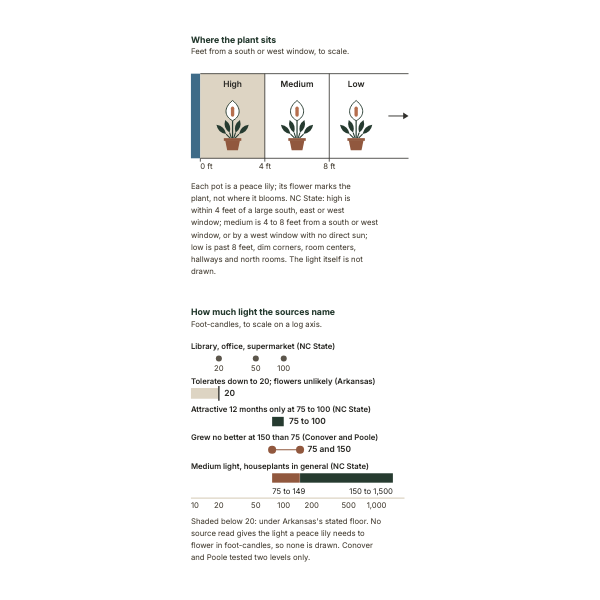
Illinois Extension also says how much light different spots indoors receive, measured in foot-candles, the brightness reaching a surface. Its brightest indoor category, direct light at 1,500 foot-candles, is listed in one position only: directly in front of a south-facing window.
An east or west window, or a south window up to five feet away, gives about 300 foot-candles. A north window directly in front gives about 150. For scale, the same source puts outdoor sun at 10,000 to 12,000 foot-candles, several times the brightest spot indoors.
Those positions assume the northern hemisphere. South of the equator, the north window is the bright one. Latitude and season change the numbers again, which is covered under why plants slow down because of light, not winter.
A foot-candle reading is a moment’s brightness, not a day’s total, so these positions cannot be placed on the figure’s scale above. What they do show is how fast light falls away from the glass.
Why Low Light and Overwatering Arrive Together
Overwatering is the other half of the story. Illinois Extension calls it the biggest mistake people make with succulents. Its release also lists available light among the things that decide how much water a succulent needs.
Marlene Simon gives the pot-level version. A pot too big for its roots holds wet mix that the small root system cannot use, and that, she says, can rot the plant. Snake plant’s database entry carries the same warning: overwatering may cause root rot.
So the guidance ties the two common killers together: light helps set how much water a succulent needs, and mix that stays wet is what rots it. What none of these sources measures is how much longer a pot stays wet in a dim spot than a bright one.
What to Do With the One You Already Have
Find out what it is. Look up the species, not the category. A plant database entry like North Carolina State’s gives a light rating for one species, and the gap between “full sun” and “tolerates very low light” is the gap this whole article is about.
Move it to match. A cactus or echeveria wants the brightest window you have, close to the glass. Illinois Extension suggests rotating succulents between sunny windows, or adding fluorescent or LED lighting where windows fall short. What a grow light’s label tells you is covered separately.
Mind the jump into sun. For succulents moved outdoors, Illinois Extension warns that unfiltered sun can burn leaves, and advises starting in indirect light and moving toward sunnier spots gradually. No source read here gives a pace for moves within a home.
Brooklyn Botanic Garden’s guide offers the indoor tool: blinds, or more distance from the glass, to soften light that is too strong for the plant in front of it.
Water by the mix, not the calendar. Illinois Extension’s method is to water only when the mix is completely dry, then water deeply until it runs from the drainage holes. Simon’s advice is not to give a small root system a big pot.
Turn the pot regularly, too. Illinois Extension notes that plants grow toward the light source, and rotating keeps the growth even.
Read stretching as the early warning. Simon notes that a cactus kept inside can stretch, and may eventually stretch enough to die.
Whether stretched growth can tighten again, and what cutting it back does, is covered under whether a stretched succulent can shrink back. Color changes are covered under why succulents turn red or stay green.
When a Succulent Genuinely Is the Easy Choice
The easy reputation was earned by part of the group. Brooklyn Botanic Garden named snake plant, Euphorbia trigona and Euphorbia lactea as suited to lower light. North Carolina State calls snake plant durable, easily grown and difficult to kill, and zebra haworthia easy to grow.
Those are the succulents to try where no window is bright. Even they are rated for some direct sun, and Illinois Extension notes that most plants perform best in bright light, so expect survival and slow growth. No houseplant likes low light explains why.
Two of them carry a safety note. North Carolina State rates snake plant as low severity: toxic if eaten, causing vomiting and other stomach upset, and a problem for cats, dogs and children. Its sap can irritate skin.
It rates the African milk tree, Euphorbia trigona, as medium severity. Its milky sap can cause skin irritation, blisters and severe eye irritation, and swallowing it can cause severe stomach and intestinal illness, vomiting, diarrhea and convulsions.
Euphorbia lactea was not checked for this article. Look it up by species in a plant toxicity reference before placing it where children or pets can reach it.
Local Regulations and Safety Advisory
Plant toxicity depends on the species, the amount and the individual, and a poison control service or a veterinarian can say whether a particular plant is a concern for your household. This article is general information, not medical or veterinary advice.
Authorities to consult:
- Poison control service
- Veterinarian or animal poison control service
If a child or pet may have eaten part of a plant, contact a poison control service or a veterinarian.
What Remains to Be Explored
No study read for this article measures succulent houseplants at real window positions. The light evidence comes from a farmed prickly pear, a forest epiphyte, greenhouse holiday cacti and wild desert seedlings. It can show that cacti differ, not give a number for your windowsill.
No source read here converts Illinois Extension’s foot-candles into daily light, so the indoor positions and the figure’s scale stay separate. A daily light reading at a real window, alongside the species ratings, would close that gap.
The four-hour minimum for cacti rests on one guide from 2000 that cites no sources of its own. A 1998 study of shade on two climbing fruit cacti, by Raveh, Nerd and Mizrahi, has no abstract on record and was not read, so its findings are not used here.
Most of the primary evidence, including the figure, is cited from abstracts. The full papers may qualify what the abstracts report, especially on the conditions behind each light level.
Sources
- Cacti and Other Succulents as Houseplants — Julia Solarz. Brooklyn Botanic Garden. December 1, 2000. A handbook chapter from 2000; the light figures are the part we rely on.
- Lighting — Illinois Extension, University of Illinois. Undated.
- Did You Forget to Water Your Plants? Try Low-Maintenance Succulents — Nancy Kreith. Illinois Extension, University of Illinois. January 8, 2024.
- 6 Tips for Caring for Succulents — Narimes Parakul. University of California, Davis. November 10, 2020.
- Dracaena trifasciata (Snake Plant) — North Carolina Extension Gardener Plant Toolbox, NC State University. Undated.
- Schlumbergera truncata (Thanksgiving Cactus) — North Carolina Extension Gardener Plant Toolbox, NC State University. Undated.
- Euphorbia trigona (African Milk Tree) — North Carolina Extension Gardener Plant Toolbox, NC State University. Undated.
- Haworthiopsis fasciata (Zebra Haworthia) — North Carolina Extension Gardener Plant Toolbox, NC State University. Undated.
- Echeveria — North Carolina Extension Gardener Plant Toolbox, NC State University. Undated.
- Effect of Nurse Plants on the Microhabitat and Growth of Cacti — Augusto César Franco, Park S. Nobel. Journal of Ecology 77(3). 1989. Cited from its abstract.
- Habitat, CO2 Uptake and Growth for the CAM Epiphytic Cactus Epiphyllum phyllanthus in a Panamanian Tropical Forest — José Luís Andrade, Park S. Nobel. Journal of Tropical Ecology 12(2):291-306. 1996. Cited from its abstract.
- Relationships Between Photosynthetically Active Radiation, Nocturnal Acid Accumulation, and CO2 Uptake for a Crassulacean Acid Metabolism Plant, Opuntia ficus-indica — Park S. Nobel, Terry L. Hartsock. Plant Physiology 71(1):71-75. 1983. Cited from its abstract.
- Effect of Shading Levels on the Growth and Flowering of Schlumbergera spp. under Greenhouse Conditions — Georgios Lykokanellos, D. Zoumadakis, N. Semkova, V. Ivanova. Agricultural Science and Technology 17(4). 2025. Cited from its abstract.
- Succulent Plant Diversity as Natural Capital — Olwen M. Grace. Plants, People, Planet 1(4):336-345. 2019. Cited from its abstract.
- Elastic and Collapsible: Current Understanding of Cell Walls in Succulent Plants — Marc Fradera-Soler, Olwen M. Grace, Bodil Jørgensen, Jozef Mravec. Journal of Experimental Botany 73(8):2290-2307. 2022. Cited from its abstract.
- Help! I Am About to Give up on My Succulents… (R/Succulents Thread) — multiple community members. Reddit, r/succulents. Undated.