Red on a succulent is a pigment the leaf makes when it takes in more light than it can use, and temperature seems to matter too. Cool, bright conditions appear to bring color out, while summer heat can hold it back. That is the likely reason a plant in full sun stays green. Green is not a failure, and red is not a score.
One limit belongs up front. The light half of that answer has been studied in succulents. The temperature half comes from maize and a laboratory weed, and we found nobody who has separated the two on a succulent.
Outdoors since May, about four hours of direct sun, barely watered, and the succulents still would not color up. That was one grower’s complaint in a long thread.
The replies pulled in different directions. The view that temperature is a major factor drew strong support, one reader said the brightest color comes in winter and spring, and another said four hours was nowhere near enough.
Those answers mostly describe the same thing from different ends, and the map further down shows how they fit.
What the Red Is
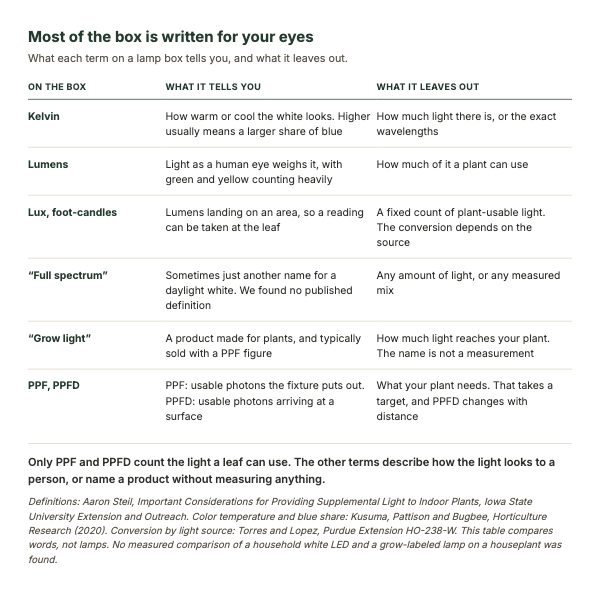
Red and orange on a leaf are pigments, and they come in more than one kind. Anthocyanins are water-soluble and sit in the cell’s storage compartment, the vacuole. Carotenoids are fat-soluble, yellow to red, and made in the chloroplasts, according to a Plant Journal review cited from its abstract.
Both turn up in succulents. Leaves of Kalanchoë blossfeldiana, a relative of jade, hold fifteen forms of anthocyanin and built up several of them when detached leaves sat in natural light for five days. That study is cited from its abstract, and a detached leaf is not a whole plant.
Aloe arborescens does it differently. Strong sunlight, alone or with drought, makes its leaves build a red carotenoid called rhodoxanthin, according to a 2005 paper cited from its abstract.
North Carolina Extension describes the visible result in jade without naming a pigment: the leaf “margins will acquire a red tint in direct sun”. On that account a red edge is simply a trait of the plant in strong light.
The likely reason is that the pigment works as a screen. A leaf can use only so much light, and the rest can do damage. Anthocyanins build up in tissue exposed to strong light, when capture runs ahead of what the leaf can process, and the pigment may shade what lies beneath.
That account comes from a 2002 review in New Phytologist, cited from its abstract, which calls the subject “contentious” and offers the screen as a proposal. The aloe paper calls the same role “possible”. Treat it as the best explanation available, not a settled one.
Why Cold Brings It Out and Heat Can Take It Away
If red tracks light the leaf cannot use, then anything that slows the leaf down should bring red on sooner, and cold is the obvious candidate. A review of plant stress, cited from its abstract, lists cold temperatures alongside visible and UV light and water stress as things that can induce anthocyanins.
The clearest test we found is in maize. At cool temperatures, anthocyanins collect on the lit surface of some maize lines.
At 5°C (41°F), a pigmented line took much more light than a pigment-free line before showing the same damage signal. That paper is cited from its abstract, and maize is not a succulent, so it shows a principle rather than a figure to use.
Heat pushes the other way. Researchers working on Arabidopsis, a small weed used in laboratories, note that high temperatures reduce anthocyanin “in many plant species”.
Their seedlings moved to 28°C (82°F) for a day held significantly less pigment than seedlings kept at 17°C (63°F). Heat broke down a protein that the pigment genes depend on.
Put those together and full sun stops being a single setting. The same brightness can be more than a leaf can use on a cold day and within its reach on a warm one. Applying that to succulents is our inference, and the map below is drawn on that basis.
Where red is more likely on a succulent
Light runs across and temperature runs up. This shows direction only, not amounts.
Full sun alone does not set the color. On this map a green plant in hot sun is where you would expect it to be, and the cooler the day, the less light red should take.
The one test we found on succulents themselves supports the idea only partly. In a 2024 Korean study, plants spent about three weeks outdoors in strong sun at an average near 30°C (86°F), going indoors on the hottest days to prevent leaf burn. The comparison plants stayed in indoor shade near 20°C (68°F).
Echeveria ‘Black Bear’ started reddish-black and ended pale green in the sun and deep green in the shade. Adromischus maculatus went the other way, with its red spots growing stronger in the same sun and heat.
So under one treatment, one plant lost its red and the other gained some. The upper right of the map is drawn with that in mind: less red is expected there, and this is the exception that shows species differ.
That study has real limits. Light and temperature changed together, so it cannot say which did what.
It analyzed twelve leaves, did not measure anthocyanin itself, and its tables and text do not fully agree, so we use only its stated end colors.
That species differ matches the wider picture. A 2011 review of evergreens, cited from its abstract, finds that reddening generally rises with sunlight, yet red and green species share the same bright sites.
Why one reddens and another does not, it says, “remain unclear”. Some plants on your shelf may never do it, whatever you give them.
Why Yours Stayed Green
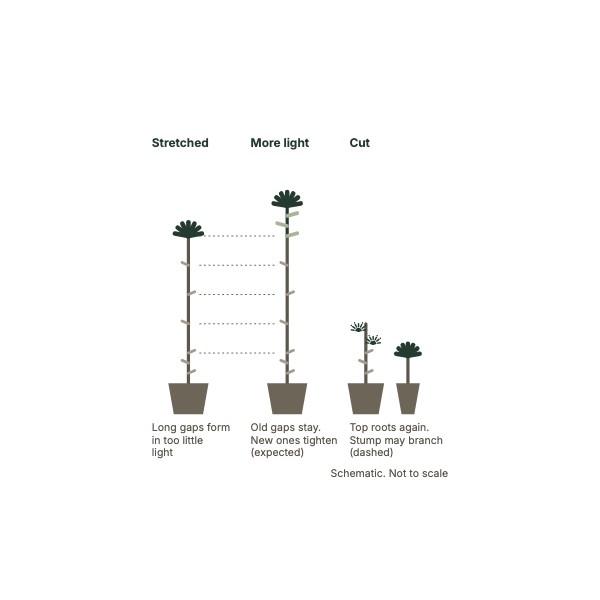
Work through the possibilities in order, because the first is the one you can see. Check whether the plant is compact or stretched.
Pale leaves with long gaps of stem between them mean too little light, which is why stretched succulents fail.
A Washington State Master Gardener handout lists “spindly growth and pale leaves” as signs of an unhealthy plant. A deep, even green on a tight rosette is a different thing.
If the plant is compact and firm, the next suspect is the season. Warm weather sits in the upper part of the map, so plenty of sun can still leave a plant green. Readers who see their strongest color in winter and spring fit that pattern, though nobody has tested it on succulents.
Then there is the amount of sun. We found no published number of hours that produces color in any succulent, so neither four hours nor the twelve one reader suggested is a measurement.
North Carolina’s plant database calls six or more hours full sun and two to six partial shade, so four hours is not full sun on its definition.
Those categories describe growing conditions rather than color, but they are a useful check on the word “plenty”.
Last comes the plant itself, which may simply not be a kind that colors much.
Is Sun Stress Bad for the Plant?
Nobody has measured a long-term cost in a succulent, so the honest answer has two halves. The first is reassuring.
The 2002 review describes anthocyanin build-up as “usually transient”, and the evergreens in the 2011 review lose their winter red with spring warmth. Neither is a study of succulents.
In the maize comparison, photosynthesis did not differ between the pigmented and pigment-free lines. Those were different genetic lines, so this says the pigment itself carried no penalty there. It says nothing about what the conditions that produced it may have cost.
The second half is less comfortable. In the aloe, reddening came with real change inside the leaf.
Chloroplasts converted to a different kind of structure, membranes broke down, and under some conditions chlorophyll was lost. “Stress” is a fair word for that, in the one species examined, known here from its abstract.
So a red leaf is a leaf coping with more light than it can use. It is not proof of health, and on its own it is not proof of harm. If the plant looks good and you like the color, nothing here says you must change anything.
What to Do About It
If the plant is green and compact, nothing is wrong with it on anything we read, so leave it alone unless you want a more colorful plant. Your best chance then is cool, bright weather.
Wait for the season rather than pushing harder in summer. On the map, that means moving down, not further right.
Cool does not mean freezing. Arizona warns that many showy succulents originated in frost-free climates, and freeze damage first shows as blackening of exposed parts. Find out whether your plant takes frost before you leave it out for the color.
If it is green and stretched, it needs more light, and it needs it slowly. Arizona Extension, writing about landscape agave, aloe and cactus, says greenhouse plants can be acclimated by “gradually moving them out into full sun over a period of weeks”. Start in bright shade and shift the pot toward stronger sun in steps, checking the leaves after each move.
If it has turned red and you are worried, look for the yellow and straw-colored signs described next. Without them, a red flush is what North Carolina describes in jade, and a color change alone gives no reason to move the plant.
If you see pale, yellow or white patches on the sunny side, suspect sunburn rather than color. Arizona’s description is: “Sunburned plants turn yellow. As the damage progresses, the epidermis turns straw yellow and dies.” The epidermis is the plant’s outer skin.
The reader whose jade turned pale with white blotches in 85°F (29°C) heat may have been seeing this, though a description cannot confirm it.
Move a burned plant out of the strongest sun, then bring it back gradually if you still want it there. Arizona suggests cheesecloth or 30 percent shade cloth over newly bought plants. Nothing we read says dead patches recover, so expect them to stay.
Allow for a delay as well. A University of Connecticut article, written about foliage houseplants moved outdoors, says sun damage “can take weeks to fully appear”, so a plant that looks fine soon after a move has not necessarily escaped. Moving a plant outdoors covers the wider process.
The word that matters is “acclimated”. Arizona says parts of a plant that “have not been acclimated to direct sun will burn easily”, which makes sunburn largely a matter of how suddenly the light rose. That is why it does not appear on the map, whose axes show conditions rather than change.
Should You Hold Back Water to Bring Out Color?
Drought is a real trigger. Water stress is on the list of things that can induce anthocyanins, and in the aloe, drought worked alongside strong sun. It is easy to see why readers suggest cutting water.
One in this thread proposed a percentage. Nothing supports that number, so we are not repeating it.
We found no university or research source that recommends withholding water to color a succulent, and the aloe paper shows what that combination can do inside a leaf. Should you stop watering to stress the plant? We would not.
North Carolina’s advice for jade is to “water in moderation when the soil is dry”.
That same page warns that leaf fall and root rot can result from overwatering, so the opposite mistake is real too. If the mix is dry and the plant is shriveling, water it, whatever that does to the color. Indoors in winter, the limit is often light, which is covered in why plants slow down.
What Remains to Be Explored
Whether the map holds for succulents. Nobody we found has grown a succulent across a range of light and temperature, holding one steady while changing the other, and measured its pigment.
That single experiment would confirm this article’s central inference or overturn it.
How much light produces color. We searched for a published figure in hours or light level and found none. A Korean study of Echeveria agavoides is cited elsewhere as showing that more light raised anthocyanin. We have not read it, and it may hold the first real numbers.
What color costs. We found no study following a succulent kept red for months against one kept green. Whether a long spell of stress color slows growth or shortens a plant’s life is unknown, and a claim in either direction is a guess.
Which pigment is on your plant. The aloe uses a carotenoid and Kalanchoë uses anthocyanins, and we found no such analysis for popular echeverias, sedums or jades. Cacti are left out because nothing we read covers their color, so do not assume any of this applies to them.
Sources
- Environmental Significance of Anthocyanins in Plant Stress Responses — Linda Chalker-Scott. Photochemistry and Photobiology. July 1999. Cited from its abstract.
- Anthocyanins in Vegetative Tissues: A Proposed Unified Function in Photoprotection — W. J. Steyn, S. J. E. Wand, D. M. Holcroft and G. Jacobs. New Phytologist. 2002. Cited from its abstract.
- Winter Leaf Reddening in ‘Evergreen’ Species — Nicole M. Hughes. New Phytologist. 2011. Cited from its abstract.
- Anthocyanin Accumulation in the Illuminated Surface of Maize Leaves Enhances Protection From Photo-Inhibitory Risks at Low Temperature, Without Further Limitation to Photosynthesis — Fabrizio Pietrini, Maria Adelaide Iannelli and Angelo Massacci. Plant, Cell & Environment. 2002. Cited from its abstract.
- High Ambient Temperature Represses Anthocyanin Biosynthesis Through Degradation of HY5 — Sara Kim, Geonhee Hwang, Seulgi Lee and colleagues. Frontiers in Plant Science. 2017.
- Optical Properties of Rhodoxanthin Accumulated in Aloe arborescens Mill. Leaves Under High-Light Stress With Special Reference to Its Photoprotective Function — Mark Merzlyak, Alexei Solovchenko and Sergei Pogosyan. Photochemical & Photobiological Sciences. 2005. Cited from its abstract.
- Exposure to Light of the Abaxial Versus Adaxial Side of Detached Kalanchoe blossfeldiana Leaves Affects Anthocyanin Content and Composition Differently — Wieslaw Wiczkowski, Marian Saniewski, Agnieszka Marasek-Ciolakowska and colleagues. International Journal of Molecular Sciences. March 1, 2024. Cited from its abstract.
- Changes of Biologically Active Compounds in Echeveria spp. and Adromischus maculatus Depending on Leaf Color Changes — Yooran Lee and Haejin Bae. Korean Journal of Environmental Biology. 2024.
- Biosynthesis of Plant Pigments: Anthocyanins, Betalains and Carotenoids — Yoshikazu Tanaka, Nobuhiro Sasaki and Akemi Ohmiya. The Plant Journal. 2008. Cited from its abstract.
- Crassula ovata (Plant Profile) — NC State Extension Gardener Plant Toolbox. Undated.
- Problems and Pests of Agave, Aloe, Cactus and Yucca (AZ1399) — Jack Kelly and Mary W. Olsen. University of Arizona Cooperative Extension. March 2011.
- Plants Enjoy Summer Too! — Matthew Lisy, UConn adjunct faculty. UConn Home and Garden Education Center. June 21, 2025.
- Growing and Caring for Succulents — Patti Milos. WSU Chelan County Master Gardeners. August 2008.
- Help! I Am About to Give up on My Succulents… — multiple community members. r/succulents. Undated.