Push a finger about 2 inches into the mix and water if it feels dry there. That is the check most of the extension pages we read name first, and it suits an ordinary pot. A deep pot needs a stick pushed to the bottom, a pot you can lift will tell you by its weight, and the leaves only tell you to go and look.
No study we could find has compared these checks on houseplants, so nobody can honestly rank them. What can be said is what each one reads. They disagree so often because they are measuring different things, and knowing which is which settles most of the argument.
The argument itself is lively. In a thread on how anyone learns to water, one grower listed chopsticks, scales, meters and dirty fingers, and asked for a way out.
The replies offered no such thing: some lift every pot, others squeeze leaves or wait for a droop, and a few admit that they learned by killing things.
What Each Check Reads
The table runs from the mix to the plant to the instrument. That order is not a ranking. Each row answers a slightly different question about the same pot, which is why two careful growers can check one plant and reach opposite conclusions without either of them being wrong.
Six checks, six different readings
Not ranked, because no study has compared them on houseplants. Each one answers a slightly different question about the same pot.
| The check | What it reads | Where it stops |
|---|---|---|
| Finger
1 to 3 inches down
|
The mix near the top | Lower mix in a deep pot, where it can stay wet after the top dries |
| Stick or dowel
Pushed to the bottom
|
The depth of the pot, by damp mix clinging or darkening the wood | No source says how much damp at the tip is acceptable |
| Lifting the pot
Against its weight just after watering
|
The total water in the pot | Not where that water sits. Awkward with large pots |
| Clear pot
Looking through the wall
|
Mix and roots at the wall | No source found that tests it as a check |
| Leaves
Droop, softness, wrinkling
|
Water in the plant, not in the pot | Root rot and dry mix can look the same |
| Moisture meter
Probe in the mix
|
A reading that fertilizer and soil type can also move | Clemson: products “vary widely in accuracy” |
Use the leaves as a prompt and the mix as the answer. A wilted plant in wet mix needs its roots checked, not more water.
The Finger Test, and How Far Down to Go
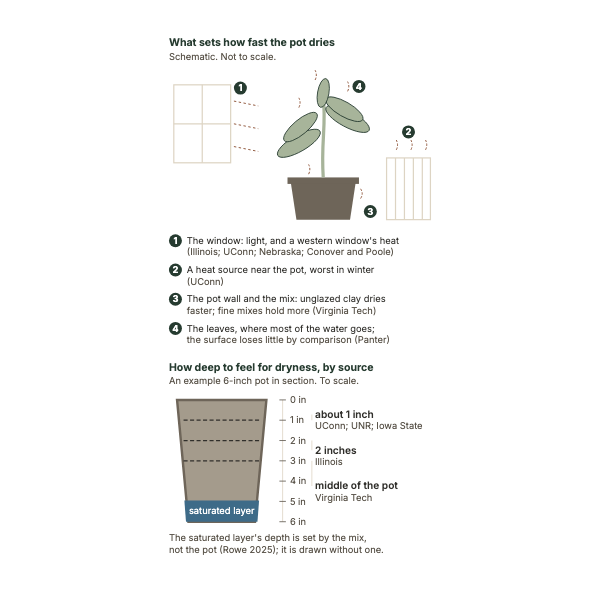
Illinois Extension calls the finger the “best method for determining when to water”, to a depth of 2 inches. Clemson calls touch the “most accurate gauge” and stops at the first joint. Those are expert judgments rather than test results: neither page cites a comparison, and we found none elsewhere.
The published depths do not agree either. UConn says about an inch below the surface, Nebraska and Washington State say 1 to 2 inches, and NC State says 2 to 3.
Virginia Tech, describing how to confirm that a pot has wetted through, says 1 to 3 inches depending on the size of the container.
We found no test of which depth works best, so read the spread as a range, with the deeper end suiting the bigger pot.
For what you are feeling for, Washington State is the clearest: if the mix “feels cool and moist, wait to water.” Dry at the fingertip means the plant probably needs water.
The limit is reach. Virginia Tech notes that “the upper few inches of potting soil will typically dry faster in a taller container.”
Purdue’s Krishna Nemali adds that some mix at the bottom of a container never drains at all, whatever the drainage holes do. So a dry fingertip in a deep pot says little about the bottom.
A Stick Reaches What a Finger Cannot
For large containers, the University of Maryland Extension suggests a stick or dowel “long enough to reach the bottom of the pot”, and explains how to read it: “Moist soil will stick to the dowel or discolor it slightly.” Readers use chopsticks, skewers and pencils the same way.
Two succulent pages add detail. Iowa State says that if a chopstick comes out with moisture on it, “as indicated by a darker color”, the plant can wait. K-State’s Butler County office leaves a wooden kabob stick at the bottom of the pot for 10 minutes, and wants it completely dry before watering.
That is a strict standard, written for plants that prefer to stay on the dry side. Bear Purdue in mind here too, since the bottom of the pot is the last place to dry. No source says how much damp at the tip is acceptable for a plant that should not dry out.
Lifting the Pot
This was the method readers praised most, and it has the plainest physical basis. “As plants use water, the potting mix will dry out and become lighter in weight,” Maryland says, and its instruction is to lift the pot now and then, and compare it with how it felt just after watering. Clemson agrees that a dry mix brings “a definite loss in weight”.
The comparison is the whole method, because a pot is only light or heavy against its own wet weight. So lift it straight after a full watering, and again every so often after that.
We found no source giving a weight or a percentage at which to water a houseplant, and each pot, mix and plant will differ.
Weight has a second use that a finger lacks. Virginia Tech suggests lifting the container after watering: if it still feels light, the mix may have shed the water rather than absorbed it. What weight cannot tell you is where in the pot the remaining water sits.
Should You Wait for the Leaves to Droop?
Readers split hardest here. Several water only when a plant goes soft or flops, and call that the most reliable signal there is. The sources support half of that.
Virginia Tech says wilting is the first symptom of an underwatered plant, so the signal is real. The trouble is that it has more than one meaning.
“Although wilting is often an indication of the need to water, it is not always so,” Clemson says, because any root injury cuts water uptake, and in that case “watering may make the problem worse.”
Illinois makes the same point, and Virginia Tech says the symptoms of too little and too much water can resemble each other. A droop tells you to check, as our piece on a drooping peace lily sets out.
Whether a droop does harm is less clear. NC State’s handbook says “temporary wilting can be harmful to the plant.” The nearest measurement comes from maize, in a 1971 Plant Physiology paper by Edmundo Acevedo and colleagues (cited from its abstract): as water ran short, leaf growth stopped before carbon dioxide uptake noticeably fell.
The same abstract is more forgiving about recovery. After mild, short stress, a burst of growth “completely made up for” what was lost, and leaves stressed for a day or more still reached almost the length of unstressed ones. It is one crop, and it does not record when the leaves wilted, so it cannot settle the question for a pothos.
Succulents are the fair exception, because their leaves hold a store. K-State says the time to water is when leaves start “to get slightly soft”, Iowa State reads wrinkled lower leaves as too dry, and South Dakota State says wrinkled leaves mean “the plant is thirsty.”
Yet Iowa State also warns that root rot can shrivel them too, so the mix still gets the final word.
Clear Pots
Many readers have moved plants into clear plastic nursery pots so they can see the mix darken and lighten, and they say it has made watering far less mysterious.
That may well be true for them, but none of the extension pages we read mentions it, and we found no test of a clear pot as a watering check.
What a clear pot shows is the mix and roots against the wall, with the middle of the root ball out of sight.
Whether light through the wall affects ordinary houseplant roots is also unsettled: we found no trial. Clear pots for orchids are a separate argument about the roots themselves, and they are not covered here.
Moisture Meters
Clemson is the plainest source on these: “These products vary widely in accuracy. The readings can be influenced by factors other than soil moisture content. Fertilizer and soil type can affect the reading.” Illinois says a probe “can be useful, but may not always be reliable”, and keeps the finger as its best method.
Virginia Tech and Washington State mention meters as an option, with no comment on accuracy. We found no independent test of a consumer meter in potting mix.
The closest work is on research-grade sensors in salty silty loam: Qi and colleagues reported in Sensors in 2024 that moisture was overestimated, and increasingly so as salinity rose.
That study used different instruments in a different medium, and at its lower salinity levels the sensors performed reasonably well. It shows only that dissolved salts can push a moisture reading upward, which fits Clemson’s warning about fertilizer. It does not tell you how far to trust the meter in your own pot.
Schedules, Apps and the Weekly Round
“Often people want to adhere to a schedule, but this usually does not work,” Illinois says, and UConn, Clemson and Virginia Tech all say much the same.
Several readers keep a fixed weekly day anyway and do well. The useful distinction is UConn’s: replace watering by the calendar with checking often. A set day to check, and water only what needs it, fits that advice.
A date cannot do the rest because the rate keeps moving. Virginia Tech says higher light, warmth and low humidity all mean more frequent watering, and that growth is slowest in winter.
Small pots hold less water, and unglazed clay dries faster than plastic. A reminder app fills the same role as a set day; we found no test of one.
Reading Two Checks Together
The top is dry, but the stick comes up damp. Iowa State’s advice for succulents is direct: “If damp, wait a few days.”
Other plants are held to a different standard: NC State says of containers generally that they should never dry out completely. No source draws an exact line for a damp lower pot.
The plant is wilted, and the mix is wet. Do not water. Clemson warns that it may make things worse, and NC State says leaves that stay wilted after watering most likely mean rotted roots.
Slide the plant out and look at the roots: the steps are under a drooping peace lily, and the cause is in root rot and saturation.
The plant is wilted, and the mix is dry. Water until it runs from the bottom, then empty the saucer, as NC State instructs.
The pot still feels light after watering. The water may have run through. Maryland says that mix pulled away from the sides of the pot “may need several applications of water to rehydrate”, and UConn describes water running down the sides without wetting the root zone. Nebraska suggests standing a very dry pot in a pan of tepid water, and bottom watering has trade-offs of its own.
What Remains to Be Explored
The central gap is a comparison. We searched for a study testing finger, stick, weight, meter or leaf signs against measured moisture in houseplant pots, and found none.
Every “best method” in print is experienced judgment. A trial that weighed pots while running each check side by side would change this answer more than anything else.
Smaller gaps sit underneath it. Nobody has tested the best depth for a finger, or published a weight loss at which to water a houseplant.
We found no independent test of consumer meters in potting mix, no test of clear pots as a check, and no houseplant measurement of what repeated wilting costs. The advice to check the mix rests on extension experience, not on trials.
Sources
- Watering — Illinois Extension, University of Illinois. Undated.
- Properly Watering Container Houseplants (SPES-804P) — Kristopher S. Criscione and Ashton Holliday-Goulart. Virginia Cooperative Extension, Virginia Tech. June 2, 2026.
- Watering Houseplants — Dawn Pettinelli. UConn Extension, University of Connecticut. December 24, 2013.
- Indoor Plants – Watering (HGIC 1459) — Debbie Shaughnessy and Al Pertuit. Clemson Cooperative Extension, Home and Garden Information Center. June 21, 2024.
- Guide to Growing Houseplants (G2205) — Frederick P. Baxendale, Stephen N. Wegulo, David E. Lott and Dale T. Lindgren. University of Nebraska-Lincoln Extension. July 2013.
- Tip Sheet #15: Houseplants — Washington State University Extension, Jefferson County. Undated.
- Overwatered Indoor Plants — University of Maryland Extension. March 13, 2023.
- 18. Plants Grown in Containers — Diane B. Mays, Kim Richter, Lucy Bradley, Julie Sherk and colleagues. North Carolina Extension Gardener Handbook, NC State Extension (AG-831). February 1, 2022.
- Understanding the Pores of a Soilless Substrate (HO-287-W) — Krishna Nemali. Purdue Extension, Purdue Horticulture and Landscape Architecture. March 2018.
- Growing Succulents Indoors — Aaron Steil. Iowa State University Extension and Outreach, Yard and Garden. December 2024.
- Common Problems and Issues of Succulents — Aaron Steil. Iowa State University Extension and Outreach, Yard and Garden. August 2023.
- Succulents — K-State Research and Extension, Butler County. June 30, 2026.
- Jade Plant: Houseplant How-To — Kristine Lang, Sydney Paulsen and Cindy Schnabel. South Dakota State University Extension. April 25, 2024.
- Immediate and Subsequent Growth Responses of Maize Leaves to Changes in Water Status — Edmundo Acevedo, Theodore C. Hsiao and D. W. Henderson. Plant Physiology 48(5):631-636. November 1971. Cited from its abstract.
- Performance of Soil Moisture Sensors at Different Salinity Levels: Comparative Analysis and Calibration — Qiuju Qi and colleagues. Sensors 24(19):6323. September 29, 2024.
- How Did You Learn How to Water Your Plants? (R/Houseplants Thread) — multiple community members. Reddit, r/houseplants. Undated.