Cut each stem just above a pair of leaves, and leave at least half of the plant in place. Take off flower buds as soon as they appear, because a basil that flowers and sets seed turns woody and stops producing. And no source we read gives basil a lifespan in years, short or long.
The question came from a post on r/IndoorGarden: a basil grown indoors under an inexpensive LED light, in a fabric pot, that had become a monster.
Most of the replies told the poster to make pesto. As plant advice, that is better than it sounds, because for basil the harvest is the pruning.
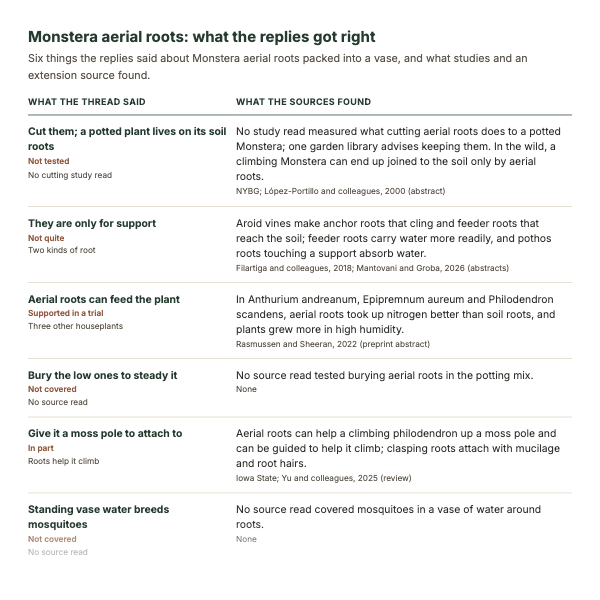
The replies that were about the plant disagreed. One said to cut the whole top, another a third, another to repot and then take a fifth to a quarter of the branches, and another to go back to the last two pairs of healthy leaves.
One reply said store-bought pots are crowded with seedlings, and others that the trimmings root in water.
One reader guessed a basil like this lives five to eight years at most. The poster said it had been droopy and yellow in its first month until they started feeding it heavily, and that a tray of water poured in each morning was gone by the next. Some of those claims have a source behind them, and some have none.
Where to Cut: Just Above a Pair of Leaves
Basil grows its leaves in pairs. NC State Extension’s plant database describes them as “opposite in arrangement at right angles to each other”, on a square stem that “has a branching tendency”.
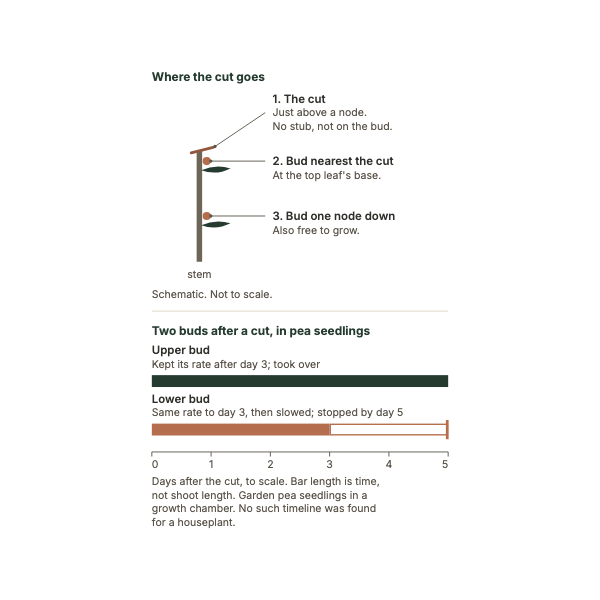
Each place where a pair meets the stem is a node, and the angle between each leaf and the stem holds a bud, called an axillary bud. Those buds are held back by the growing tip above them.
A review of how plants control branching puts it directly: “Auxin derived from an intact shoot apex suppresses axillary bud outgrowth”, while removing the tip “releases the axillary buds from their dormancy and they begin to grow out” (Shimizu-Sato, Tanaka and Mori, 2009, cited from its abstract).
Where to cut an overgrown basil
Cut each stem just above a pair of leaves, and keep at least half of the plant. The buds where that pair meets the stem are where the new growth starts.
Every cut should leave a pair of leaves below it: that pair holds the buds the plant regrows from.
University of Illinois Extension turns that into an instruction. Horticulture educator Brittnay Haag advises cutting “the whole stem just above a pair of leaves,” and says new growth “will appear at the cut point within a week.”
That week is for garden basil in an Illinois summer, so a pot indoors may be slower or faster.
The pair below the cut is the point of the exercise. It holds the buds the stem will regrow from, which is why every cut should leave one. Our article on what happens when you cut a houseplant back covers the same mechanism in vining plants, where the nodes are harder to see.
How Much You Can Take at Once
The one limit we found comes from the same Illinois advice: cut “leaving at least half of the plants.”
Measured against it, most of the thread’s answers fall within it. A third, a quarter, or the top of each stem all leave more than half. Cutting a tall plant back to its last two pairs of leaves may not.
That last answer has a source, but for a different situation. A Master Gardener column from UC Cooperative Extension in Placer County, California, says to clip stems “just above the second set of leaves (counting from the bottom)”, but for the first harvest of a plant 6 to 10 inches tall. A plant that has outgrown its corner is a different case.
Basil also stands up to repeated cutting. In a trial of the cut-and-come-again harvests common in basil growing, the second harvest showed “a modest reduction of yield (−20%)” against the first (Corrado and colleagues, 2020, cited from its abstract). Lower, then, but the plants regrew enough to give a second crop.
The way the cut is made made no measurable difference in one trial. A hydroponic study compared two harvesting methods, tipping and cutting, and found that “Harvesting method did not have a significant effect on yield” (Maboko and Du Plooy, 2013, cited from its abstract). The abstract does not say how far down each method cut.
What no source we read covers is cutting past the halfway mark, or cutting into the woody lower stem of an old plant. Neither has been tested in anything we found, so Illinois’s half is the only limit with a source behind it, and the yield trials show a plant can be cut again once it regrows.
The Flowers Are the Real Deadline
Illinois calls keeping basil from blooming “an important task when growing basil for culinary uses.” If it “flowers and develops seeds, the plant will become woody, stop producing and the foliage will become bitter tasting.”
Its herb guide says flower buds “should be removed by pinching as soon as you see them form”, and NC State also advises pinching off flower buds.
Both sources keep removing flowers, and they give different advice once a stalk is already flowering. The Placer County column warns that pinching off only the spike “simply makes way for the next flower stalk”, and advises cutting “at least four leaf nodes down the stem” instead. Illinois says only to “continue to remove blooms all season.”
Both sources below agree on removing the flowers, and they weigh the flavor loss differently. An expert answering through the Ask Extension service in 2021 wrote that “most aren’t that sensitive to the minor change” after flowering. Illinois says leaving the buds on “will affect the flavor of the leaves.” The practical advice is the same.
Light matters more than day length, according to a 2025 study. Researchers grew several basils under different day lengths and light levels, and in their second experiment more total light per day shortened the time to the first open flower for every cultivar, or variety, tested except lemon basil (Garcia, Lopez and Currey, 2025, cited from the abstract).
Day length mattered less. Under low light, every cultivar behaved as day-neutral, flowering regardless of day length, and only some flowered sooner under long days once the light was brighter.
The authors conclude that “photoperiod alone”, meaning day length alone, “is not an effective method to manage the flowering responses”.
Putting that study beside the seedling light study below is our inference, not a finding of either: the same bright light that builds a big plant indoors can also bring its flowers sooner. Checking the tips for buds then becomes a regular job.
The Placer column puts flowering down to daytime heat above 80°F instead. That study held its plants at 25°C (77°F) throughout, so it does not test heat either way, and the two claims are not in conflict.
Why a Store-Bought Pot Has so Many Stems
The reply about crowded supermarket pots describes how basil is often grown for a windowsill. Illinois’s own advice for growing basil indoors is to “sow several seeds in a small pot”. Sown that way, one pot holds many seedlings, each competing with the rest for the same light and root space.
A review of 334 plant density experiments describes what that competition does. Crowding “increases standing crop per area, but decreases the mean size of its individuals, mostly through reduced tillering and branching”, tillering meaning side shoots from the base,, mainly because the plants shade each other (Postma and colleagues, 2021, cited from its abstract). That review spans many crops and was not about basil.
So a crowded pot is not simply a mistake. In the hydroponic basil study, the densest planting gave the most yield per square meter in one season and did no worse than the next two densities in the other.
A full pot can give plenty of leaves while each plant in it stays small and branches little. We found no study of splitting a store-bought pot into separate plants. The reader who suggested rooting cuttings instead was pointing at a route the sources do support, covered below.
Whichever you choose, keep the plant warm on the way home: a study of potted basil sold at retail says it “is easily damaged by temperatures below 12 °C” (about 54°F) (Begum and colleagues, 2023, cited from its abstract).
Turning the Trimmings Into More Basil
The trimmings from a big cut can become new plants. NC State lists stem cuttings alongside seed as a recommended way to propagate basil, and Illinois says basil grows easily “from tip cuttings of overwintered plants.” Neither gives a method in detail.
The Ask Extension answer gives the simplest one: “Basil can easily be propagated in water. Just pop it in a glass of water and it will root within a few days to a week and you can pot it up.”
That is one expert’s experience, not a trial, and the question it answered was about stems cut from a plant that had already flowered.
Water rooting has its own failure points, such as the part of the stem sitting under water, which our article on rooting cuttings in perlite and LECA takes apart. For basil, the sources we read describe it as easy, and none reports a failure rate.
How Long a Basil Plant Lasts
No source we read gives basil a lifespan in years. That includes the five to eight years suggested in the thread: nothing we found supports a figure like that, and nothing sets a shorter limit for a plant kept indoors either.
What the sources do describe is a tropical plant treated as a summer crop. NC State lists basil’s life cycle as both annual and perennial, gives its origin as tropical Africa and Asia, and rates it hardy only in USDA zones 10a and 10b.
Illinois calls it “a tender annual” that “will not survive Illinois winters outside.”
Cold is the first limit. Illinois says cold “can even cause damage and blackened leaves at 50 degrees,” meaning 50°F (10°C).
A storage study of cut basil found chilling injury “severe at storage temperatures of 5C and below”, with moderate injury at 7.5 and 10°C (Lange and Cameron, 1994, cited from its abstract).
Indoors, Illinois suggests bringing garden plants in before the first freeze to extend their season “by a couple of months.” That is a suggestion for a garden plant, not a measured limit.
In practice, the sources point to flowering and woodiness as what ends a plant’s useful life, and to cuttings as the way to start again.
Water, Food and Light for a Plant This Size
Basil needs plenty of water, and pots dry out quickly. Illinois says plants in containers “will dry out faster”, and that basil “overwatered or underwatered may develop weak, spindly growth or roots may rot.”
The Placer column calls basil “a tropical annual that needs lots of water”. Our guide on how to tell when a houseplant needs water explains how to check.
The poster’s early trouble, droopy and yellow until fed, matches a sign Illinois describes: when growth slows and leaves turn pale green, basil can be fed with a liquid fertilizer, “following directions on the manufacturer label.” Follow the label for amount and timing, because no source we read sets either for a pot.
More is not better. Illinois warns that “over-fertilizing herbs can result in decreased aroma and taste.”
In a field trial of five nitrogen doses, basil’s height, mass and yield all peaked at intermediate doses rather than the highest (Sampaio and colleagues, 2021, cited from its abstract). Illinois ties feeding to a sign, pale leaves and slow growth, rather than to the size of the plant.
Light shapes the plant as well. A study of potted basil notes that the plant “could reach more than 60 cm” (about 2 feet) and stretches “particularly in low-light environments” (Kurniawati and colleagues, 2023, cited from its abstract).
In a growth chamber study, seedlings given the brightest light tested, against the dimmest, grew into plants with “56% more branches” three weeks after transplanting (Walters and Lopez, 2022, cited from its abstract). Our article on reading a grow light label explains the numbers.
What to Do With the Plant You Have
- Remove the flowers first. Pinch off buds as soon as you see them, per Illinois. If a stalk is already in flower, the Placer column advises cutting it at least four leaf nodes down the stem.
- Cut one stem at a time, just above a pair of leaves. Illinois says to cut the whole stem just above a pair. Leave every stem with at least one healthy pair below the cut, because that pair holds the buds it regrows from.
- Stop at half. Illinois’s limit is “at least half” of the plant left. On a plant this large, that still means a big harvest, and the regrowth gives a second one.
- Keep the trimmings at room temperature. Illinois says cut basil “is best held in a glass of water at room temperature,” and that the refrigerator discolors the leaves. Stems you want to keep growing can root in that same glass, per Ask Extension.
- Look for new shoots at the cuts. Illinois expects them within a week outdoors in summer. Check the tips for new flower buds while you look, especially under a strong light.
- Keep it warm. Potted basil is easily damaged below 12°C (about 54°F), according to the retail study, and Illinois reports blackened leaves at 50°F (10°C).
- Feed only a pale, slow plant. Use a liquid fertilizer as its label directs. Illinois warns that over-fertilizing lowers aroma and taste.
Local Regulations and Safety Advisory
If you use fertilizer products, follow the label. Rules on them vary by country and locality, and your agriculture department can say what applies where you live. This article is general information, not legal advice.
Authorities to consult:
- Local agriculture department
What Remains to Be Explored
No source we read gives basil a lifespan in years, indoors or out, so the claim of five to eight years and any shorter estimate are equally unsupported.
A plant kept from flowering indoors under steady light has not, in anything we found, been followed to see how long it keeps producing.
No study we found tests cutting more than half of a basil plant, or cutting into old woody stem, and none measures regrowth time for a pot plant indoors.
The yield trials ran in a greenhouse and a hydroponic system, and their abstracts do not say how much of each plant was cut.
We found no study of splitting a store-bought pot of basil into single plants, and no feeding rate for basil in a pot.
Whether heat triggers flowering, as the Placer column says, is untested in the light study, which held temperature constant. Any of these, measured on a houseplant, would sharpen the answer.
Sources
- Flavor Your Summer With Backyard Basil — Brittnay Haag, horticulture educator. University of Illinois Extension (news release). June 10, 2020.
- Basil — University of Illinois Extension, Herb Gardening. Undated.
- Ocimum basilicum (Sweet Basil) — North Carolina State University Extension, Plant Toolbox. Undated.
- Bolted Basil Propagation — An Ask Extension expert, unnamed. Ask Extension. July 18, 2021.
- Maximizing Your Basil Harvest (Ask a Master Gardener) — Trish Grenfell, Placer County Master Gardener. University of California Cooperative Extension, Placer County. Undated.
- Photosynthetic Daily Light Integral Has a Greater Impact on Basil Flowering Than Photoperiod — Charlie Garcia, Roberto G. Lopez, Christopher J. Currey. HortScience 60(8):1341-1349. August 2025. Cited from its abstract.
- Successive Harvests Affect Yield, Quality and Metabolic Profile of Sweet Basil (Ocimum basilicum L.) — Giandomenico Corrado and colleagues. Agronomy 10(6):830. June 11, 2020. Cited from its abstract.
- High-Plant Density Planting of Basil (Ocimum basilicum) During Summer/Fall Growth Season Improves Yield in a Closed Hydroponic System — Martin Makgose Maboko, Christian Phillipus Du Plooy. Acta Agriculturae Scandinavica, Section B – Soil & Plant Science 63(8):748-752. November 2013. Cited from its abstract.
- Dividing the Pie: A Quantitative Review on Plant Density Responses — Johannes A. Postma and colleagues. Plant, Cell & Environment 44(4):1072-1094. April 2021. Cited from its abstract.
- Auxin-Cytokinin Interactions in the Control of Shoot Branching — Sae Shimizu-Sato, Mina Tanaka, Hitoshi Mori. Plant Molecular Biology 69(4):429-435. March 2009. Cited from its abstract.
- Basil Seedling Production Environment Influences Subsequent Yield and Flavor Compound Concentration During Greenhouse Production — Kellie J. Walters, Roberto G. Lopez. PLOS ONE 17(8):e0273562. August 25, 2022. Cited from its abstract.
- Improved Chilling Tolerance in Glasshouse-Grown Potted Sweet Basil by End-Of-Production, Short-Duration Supplementary Far Red Light — Firdous U. Begum and colleagues. Frontiers in Plant Science 14:1239010. August 16, 2023. Cited from its abstract.
- Postharvest Shelf Life of Sweet Basil (Ocimum basilicum) — Diana D. Lange, Arthur C. Cameron. HortScience 29(2):102-103. February 1994. Cited from its abstract.
- Productive and Physiological Responses of Basil to Nitrogen Fertilization — Italo MG Sampaio and colleagues. Horticultura Brasileira 39(3):335-340. September 21, 2021. Cited from its abstract.
- Effect of Growth Regulator Paclobutrazol on Size Fitting of Basil as a Potted Plant — Ani Kurniawati, Krisantini Krisantini, Nadia Putri Firdausa, Ketty Suketi. Ornamental Horticulture 29(1):7-13. March 2023. Cited from its abstract.
- What Do I Do With This Monster Basil. (R/IndoorGarden Thread) — multiple community members. Reddit, r/IndoorGarden. Undated.