Not in any way that has been measured, and not enough to replace watering. No study found shows a staghorn fern living on water it draws from humid air.
In the one controlled test of a staghorn left unwatered, at 60 percent humidity, the plants kept most of the water in their leaves while their photosynthesis fell to about a tenth of watered plants. A staghorn needs water at its roots, which sit behind the brown shield fronds.
The question comes from a post on r/plantclinic. A staghorn living in a bathroom was dropping fronds one at a time and had not made a new one in a while. Its owner barely watered it, having been told the plant takes its water from the air.
The replies could not agree on whether the fern was parched or soggy. One said staghorns are dry ferns and the bathroom was giving it too much moisture. Others said it looked dehydrated and wanted more water and more light.
A grower of decades wrote at length that ferns do not drink from the air at all. The dry-fern camp and the dehydrated camp were each partly right. Staghorns really are built to survive drought, but surviving drought and living on air are different things, and the plant hides the difference well.
Where the Idea Comes From
The belief did not start on a forum. The University of Florida’s Gardening Solutions page defines the plant’s way of life in one line: “This plant is an epiphyte, meaning it gets moisture and nutrients from the air.”
An epiphyte is a plant that grows on another plant, usually a tree. The New York Botanical Garden goes further than Florida. Its research guide says these plants “take in water from the air as well as from their growing medium,” and advises both misting and soaking.
Neither page cites a measurement of water entering a staghorn frond. NC State Extension’s Plant Toolbox defines the word more narrowly: an epiphyte “perches on other plants but does not parasitize its host. It uses its host only for support.”
On that definition, the tree supplies a place to sit, and where the water comes from is left open. What the three sources share matters more than how they define the word: every one of them tells readers to water the plant.
The belief in the thread took the loose definition and dropped the watering. No source read recommends that.
What the Research on Leaves and Water Describes
Leaves can take in water. A 2018 review led by Z. Carter Berry, cited here from its abstract, states that “nearly all plant families, represented across most major biomes, absorb water directly through their leaves.” The process is called foliar water uptake.
The same review frames when it can happen. Water moves into a leaf only when the plant and the atmosphere create “a gradient for water flow” toward it. Put plainly, the water outside the leaf has to be more available than the water inside it.
The benefits that research describes come from wet leaves. Todd Dawson and Gregory Goldsmith, in a 2018 review cited from its abstract, note that leaf surfaces are wet “for significant periods” and that “leaf wetting can improve plant-water relations.”
The same holds for wild epiphytes. An isotope study, which traces water by its chemical signature, of 30 epiphyte species in an Asian cloud forest, published in 2024 by Yang and colleagues and cited from its abstract, found that rainfall supplied almost all of their leaf water in the wet month and fog in the dry month.
Epiphytes, the study adds, “cannot tap xylem water from host trees,” meaning the water-carrying tissue of the tree they sit on. Rain and fog are water already condensed into drops. Humid room air holds its water as vapor.
No study found measures a staghorn frond taking up water from humid air. The claim on the institutional pages is untested rather than disproved, and the evidence that would settle it has not been found.
Air plants are the clear case of plants that drink through their leaves, and even they take up liquid water through scales called trichomes, as our article on air plants after flowering sets out. Misting an air plant is watering it.
The One Test of a Staghorn Left Without Water
The closest thing to an answer is a 2023 experiment by Jakub Oliwa, Andrzej Skoczowski, Grzegorz Rut and Andrzej Kornaś. They kept 10 eight-year-old Platycerium bifurcatum, the common staghorn, in a climate chamber at 60 percent relative humidity.
Half the plants went unwatered for six weeks. The other five were watered weekly to a constant weight, which was the study’s control and not a schedule for a home. Both groups breathed the same humid air; what differed was watering, and the control water also carried a nutrient solution.
The difference was large. The unwatered plants’ vitality index, a measure of how well the leaf’s photosynthetic machinery is working, began falling in the first week. From the fifth week it stayed under 10 percent of its starting value.
By the sixth week, gross photosynthesis in the unwatered plants was “about 10% of the control value.” Stomatal conductance, a measure of how open the leaf’s pores are, was 28 percent lower than in watered plants. Proline, a compound plants build up under stress, had more than doubled.
Yet the leaves themselves barely changed. Their water content fell by 10 to 15 percent, most of it between the first and second weeks, and then held.
The authors found no change in the form or anatomy of the leaves. These were plants that had lost about nine-tenths of their photosynthesis, in leaves that had kept their shape and most of their water.
Humid air did not stand in for watering
A staghorn’s roots sit behind its shield fronds, where watering has to reach. In the one controlled test found, unwatered plants in humid air kept most of the water in their leaves while photosynthesis collapsed.
A staghorn short of water can keep its leaves full: they held 85 to 90% of their water while photosynthesis fell to about a tenth.
The study has limits. It used five plants per group, one humidity and one collection of plants, and it did not rewater them to see how they recovered. Because it tested only 60 percent, it says nothing directly about more humid air.
What it does settle is narrower and still useful. Humid air at 60 percent did not keep an unwatered staghorn working. Whatever the fronds took from the air, if anything, was not enough to stop its photosynthesis from collapsing.
Why a Thirsty Staghorn Can Still Look Fine
The leaves held their water for the same reason the dry-fern reply had a point. Oliwa’s team describes mature staghorn leaves as about 2 to 3 millimeters thick, “covered with a layer of cuticle and trichomes, which additionally protect the plant against water loss.”
Their leaf sections also show water storage tissue. A 2024 glasshouse comparison of four ferns by Larissa Ivanova and colleagues, cited from its abstract, found the thickest leaf tissue in the staghorn and tied it partly to light absorption and partly to “the water-storage function of fern fronds.”
The shield fronds go further. G. Rut and colleagues reported in 2008, in a study cited from its abstract, that staghorn cover leaves showed signs of crassulacean acid metabolism under strong light and drying, while the antler-shaped fronds did not.
CAM, as it is known, opens a leaf’s pores at night to take in carbon dioxide. A 2010 review by Fernanda Reinert and Robert Blankenship, cited from its abstract, notes that it is “often associated with water stressed environments.”
A related species, Platycerium veitchii, which grows on rocks, showed what Joseph Holtum and Klaus Winter called “characteristics of weak CAM” in a 1999 study, also cited from its abstract. Staghorns carry several tools for getting through dry spells.
Tolerating drought is not the same as wanting it. The plants in the 2023 test survived six weeks, but with their pores partly closed and their photosynthesis down to a tenth. That is a plant protecting itself, not one thriving.
The plant in the thread lost fronds slowly and made no new ones, with no sudden wilt. Whether a staghorn kept short of water stops making fronds for this reason has not been tested: the 2023 study measured leaves, not new growth.
The Brown Shields Are Supposed to Be Brown
The flat fronds pressed against the mount are not dying because something went wrong. NC State describes them as “pressed to the growing surface,” trapping “falling leaf litter” and covering “the root crown,” and says they “often turn brown at maturity.”
A 2025 study of the genus by Riccardo Ciarle, Katrijn de Bock and Kevin Burns puts it more bluntly. These nest fronds “senesce almost immediately after maturation but do not abscise after death.”
Senescence is the planned aging of a leaf, and abscission is a leaf falling off. In the common staghorn, shields die on schedule and stay where they are; the same study notes earlier work suggesting that in some solitary species they stay green.
Dead or not, they keep working. The University of Florida says the shields “cover the root structure” and help the plant by “collecting water and fallen plant debris.” Ciarle’s team describes the lower nest fronds in a wild colony as giving “storage, protection and grip onto the host.”
So a brown shield, on its own, is not a sign of thirst or of rot. Brown felt on the tips of the antler-shaped fronds is not a problem either: the University of Florida identifies it as the plant’s normal spore-bearing structures.
No source read gives a way to tell a dead shield from a merely mature one.
Is a Bathroom the Problem?
Not by itself. A bathroom can be humid, but humidity is not water at the roots, and light matters too. The New York Botanical Garden says staghorns are “best grown in strong, indirect light,” because in the wild they sit high in the canopy.
NC State gives dappled sunlight to partial shade. The University of Florida warns that “conditions with very low light are likely to encourage disease and pest development.”
A bathroom with a bright window can meet that description. A windowless bathroom is the very low light the University of Florida warns about.
Humidity can also be too high. NC State notes that “black spot may occur when the humidity is too high,” and the botanical garden prefers “an airy, well-ventilated room.” Neither source gives a humidity level for either problem.
If the room is kept humid for the plant’s sake, our article on raising humidity around a houseplant covers what works and what only seems to. None of it replaces water at the roots.
What to Do for the Staghorn You Have
If yours has been watered sparingly on the belief that it drinks from the air, the fix is getting water to the right place and judging when to give it. The sources agree on where. They disagree on how dry to let it get.
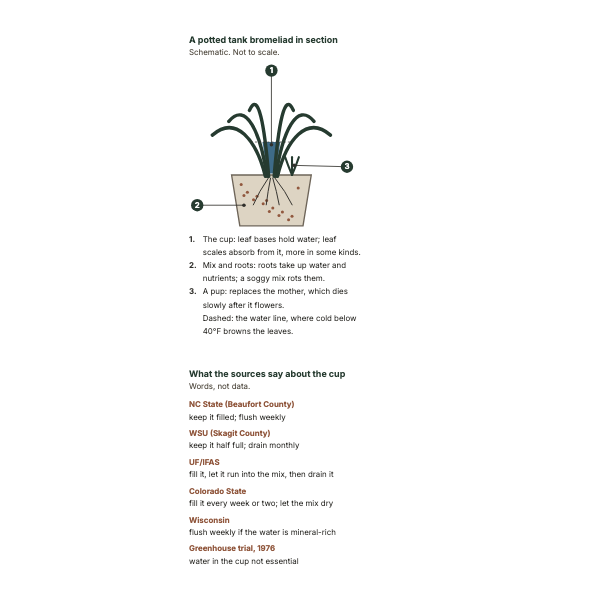
Water the root mass, not just the fronds. The roots sit in the moss or mix behind the shields. NC State says to water the plant’s crown regularly.
For a mounted plant whose shields cover the moss, the New York Botanical Garden says to “immerse this brown portion of the plant in a large container of water until saturated,” then let it drain before rehanging it.
For a potted plant, water the mix. NC State says “potted plants can be watered from the bottom,” and our article on bottom watering explains what that does to the pot.
Decide how dry to let it get, knowing each source read sets its own limit. NC State says to let the roots “dry slightly between waterings but never letting them dry out completely.”
The University of Florida, writing mostly for outdoor plants in Florida, says to wait until the fern “wilts slightly” before watering, because “an overwatered fern will rot and die.”
The botanical garden asks for a growing medium “kept evenly moist but not waterlogged during the growing season” and says over- and under-watering “are both problematic.” None of the three gives an indoor interval.
The 2023 test did not record wilting. What it did record was photosynthesis falling for weeks while the leaves kept most of their water, which is worth knowing before relying on a wilt.
The University of Florida concedes that “it can be hard to tell how moist or dry the planting medium is.” Our article on telling when a houseplant needs water covers the ways of checking, including the weight of a pot you can lift.
Give it more light. The botanical garden asks for strong, indirect light and warns that direct light on the fronds “will bleach them of color.”
NC State is more permissive, listing dappled sunlight and partial shade, which its database defines as direct sun for part of the day.
Leave the shields alone. They are meant to be brown, and the sources describe them covering the roots and holding water. None of the sources read recommends removing them.
A pot is allowed. One reply insisted a staghorn must never be grown in soil, and another said potted ones can thrive. NC State gives a potting mix for staghorns, “an epiphytic orchid or sphagnum moss mixture.”
The botanical garden lists a pot of free-draining compost as one option, while saying a board or a basket is “much preferred.”
If you mount it, the University of Florida suggests sphagnum moss against a slab of wood, tree fern fiber or rock, held with plastic strips, nylon hose or wire, “as long as it’s not copper.”
Look for pests while you are at it. One reply saw thrips and spider mite damage on the fronds. NC State lists spider mites, aphids and mealybugs as the pests to watch for, and our article on spider mite predators indoors covers one route.
What Remains to Be Explored
No study was found that measures water entering a staghorn frond from humid air, at any humidity. The institutional pages that say it happens cite nothing, and the research read on water entering leaves describes wet leaves, rain and fog, not room air.
The drought result rests on one experiment, with five plants per group at a single humidity and no rewatering phase. A test at higher humidity, or one that rewatered the plants and tracked new fronds, would say much more about a houseplant.
How dry to let a staghorn get, from never fully dry to a slight wilt, was not tested indoors by any source read. No source gives a way to tell a dead shield from a mature one, or a humidity at which black spot starts.
Sources
- Platycerium bifurcatum (Staghorn Fern) — North Carolina State University Extension, Plant Toolbox. Undated.
- Staghorn Fern — University of Florida IFAS Extension, Gardening Solutions. Undated.
- Staghorn Fern (Platycerium Spp.) research Guide — New York Botanical Garden, LuEsther T. Mertz Library. Undated.
- Water-Deficit Stress in the Epiphytic Elkhorn Fern: Insight Into Photosynthetic Response — Jakub Oliwa, Andrzej Skoczowski, Grzegorz Rut, Andrzej Kornaś. International Journal of Molecular Sciences 24(15):12064. July 2023.
- Evolutionary Origins and Life-History Correlates of Coloniality in the Epiphytic Fern Genus Platycerium (Polypodiaceae) — Riccardo Ciarle, Katrijn de Bock, Kevin C. Burns. PLOS ONE 20(8):e0329099. August 1, 2025.
- Crassulacean Acid Metabolism in the Epiphytic Fern Patycerium bifurcatum — G. Rut, J. Krupa, Z. Miszalski, A. Rzepka, I. Ślesak. Photosynthetica 46(1). March 2008. Cited from its abstract.
- Degrees of Crassulacean Acid Metabolism in Tropical Epiphytic and Lithophytic Ferns — Joseph A. M. Holtum, Klaus Winter. Australian Journal of Plant Physiology 26(8):749-757. December 1999. Cited from its abstract.
- Evolutionary Aspects of Crassulacean Acid Metabolism — Fernanda Reinert, Robert E. Blankenship. Oecologia Australis 14(2). 2010. Cited from its abstract.
- Foliar Water Uptake: Processes, Pathways, and Integration Into Plant Water Budgets — Z. Carter Berry, Nathan C. Emery, Sybil G. Gotsch, Gregory R. Goldsmith. Plant, Cell & Environment 42(2):410-423. October 2018. Cited from its abstract.
- The Value of Wet Leaves — Todd E. Dawson, Gregory R. Goldsmith. New Phytologist 219(4):1156-1169. June 2018. Cited from its abstract.
- The Contributions of Rainfall and Fog to Leaf Water of Tree and Epiphyte Communities in a Tropical Cloud Forest — Q. Yang, Z. Zhang, H. Zhang, H. Yang, S. Pandey, R. John. Frontiers in Plant Science 15:1488163. 2024. Cited from its abstract.
- Frond and Mesophyll Traits Related to Photosynthetic Capacity and Water-Use Efficiency in Ferns With Different Life-Forms Ex Situ — Larissa A. Ivanova, Alyona S. Tretyakova, Evgeniy Savitsky, Polina K. Yudina, Leonid A. Ivanov. Annals of Applied Biology 185(3):396-409. August 2024. Cited from its abstract.
- Is My Staghorn Fern Okay? It Is Very Slowly Dropping Leaves and Hasn’t Grown a New One in Awhile. (R/Plantclinic Thread) — multiple community members. Reddit, r/plantclinic. Undated.