Not in itself. Extension services disagree on the season, and no trial comparing repotting seasons for houseplants was found. What research on roots, mostly in tree seedlings, does say is that roots have no built-in winter rest: they grow when the root zone is warm, and on what the leaves are making.
So in a heated room the month matters less than three things you can check: how warm the pot is, how bright the spot is, and whether the old mix still takes water.
The question came up in a thread on r/houseplants from someone house-sitting for relatives, with their blessing to look after the plants.
Almost all of the collection sat straight in decorative ceramic pots, in years-old mix, mostly peat, gone so dry and crisp that it shed water. The plant in the post was the only one the sitter had found with any drainage, and the repot was in November.
One reply, from someone who repots friends’ plants each spring, worried about the timing. In November, it said, plants are dormant or getting there, the days are short, and heat vents and cold drafts make it hard to settle new roots. The same repot six months later would have a better chance.
The sitter’s answer was that they would usually wait, but this mix no longer took water, the plant had been sitting in a dim spot, and the house is kept warm and humid all winter. The two were arguing about different variables, and the research has something to say about each.
Two Extension Answers
Illinois Extension is direct about timing: “Re-potting is best accomplished when the plant is actively growing. Typically this is done in spring or early summer.” Colorado State University Extension’s PlantTalk says houseplants “typically respond best to transplanting in the springtime when they are starting active growth.”
Jessica Strickland of NC State Extension’s Wayne County office gives the reason the others imply. Spring is best, she writes, “so they have time during the growing season to get established in their new container.” That is an argument about recovery time rather than harm, and it is the strongest form of the wait-for-spring advice.
Purdue’s Rosie Lerner takes the other side. Her column for Indiana gardeners says “repotting houseplants can be a good wintertime activity,” with the caveat that “not all plants will need, or even benefit from, repotting.” It was first published in 1996, last modified in 2017, and it says nothing about light or temperature.
None of the four cites a trial, and no study comparing repotting seasons in potted foliage plants was found. All four also write for a Northern Hemisphere year. If you live in the Southern Hemisphere, the months swap, so advice keyed to “spring” means September to November there, not March to May.
What Dormant Means, and Where the Word Comes From
The clearest account of dormancy in this reading comes from tree nurseries. Gary A. Ritchie, a forest scientist writing in a 2003 USDA Forest Service proceedings, describes the yearly cycle of a tree seedling’s shoots: growth in spring and early summer, a pause he calls quiescence by late summer, then a winter rest.
During that rest, he writes, “growth will not resume until after the shoot has been exposed to a prolonged period of low temperature.” Only once that chilling is done does the shoot return to a pause that warmth can end. That is dormancy in the strict sense, and in his account it belongs to shoots.
“Roots do not adhere to this schedule,” Ritchie writes. “Roots exhibit no innate cycle of growth and dormancy as do shoots.”
They are “opportunistic growers,” and if the temperature suddenly rises to 68°F (20°C) in November, while the shoots are dormant, “roots would suddenly begin to grow.”
M. J. Considine, introducing a 2024 special issue of the Journal of Experimental Botany, defines quiescence as “a reversible state of arrested growth” and stresses “the need to carefully distinguish between different types of growth cessation.” In Ritchie’s terms, growth held back by outside conditions is quiescence, not rest.
Whether any tropical houseplant has a true winter rest was not tested in anything found for this article. What was found is a second surprise in the outdoor advice. Iowa State University Extension’s guide to moving trees and shrubs says “the recommended time for moving trees and shrubs is during the dormant season.”
Early spring is generally best, the same guide says, because “conditions should be ideal for rapid root growth.” So where dormancy is real, in outdoor trees, it is when transplanting is recommended, not a reason to avoid it. The reply’s other worries, short days and cold drafts, are closer to what the research actually names.
How Warm the Pot Is
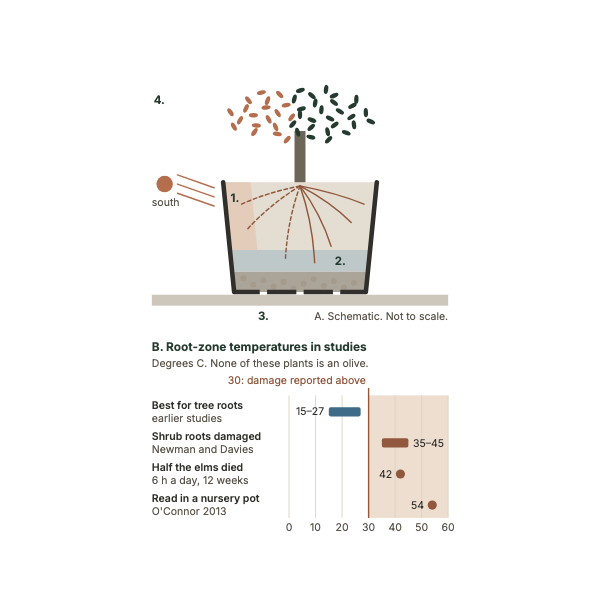
Ritchie calls soil temperature possibly “the most important environmental factor controlling root growth.” For tree seedlings native to the Pacific Northwest, he writes, roots do not grow below about 46°F (8°C), and growth climbs between about 54°F (12°C) and 68°F (20°C). Those figures are for forest seedlings, not houseplants.
For tropical foliage plants, the closest evidence comes from propagation, growing new plants from cuttings and seed.
Richard T. Poole and Will E. Waters reported in HortScience in 1971 that heated soil “accelerated development of cuttings and seedlings of tropical foliage plants in central Florida,” cutting propagation time by “up to 50% during the cool months.” Plants at 75°F generally did as well as those at 85°F.
Yin-Tung Wang found something similar in 1988 with weeping fig and croton cuttings. A rooting medium heated to about 82°F (28°C) improved weeping fig rooting and lengthened croton roots, though the head start made little difference to shoot growth weeks after potting. Both studies are cited from their abstracts, and both concern cuttings making first roots.
What carries over is the variable, not the numbers. A pot on a cold windowsill or beside an outside door can sit cooler than one in the middle of a room held warm all winter, and the calendar cannot tell you which you have.
No source read gives a root-zone temperature for any houseplant below which a repot should wait.
What “wait until spring” stands in for
Extension advice splits between repotting houseplants in spring and repotting them in winter, and no trial comparing the two was found. Research on roots names what a season changes.
In a heated room, check the conditions, not the month: how warm the pot is, how bright the spot is, and whether the mix still takes water.
How Bright the Spot Is
Light is the part of winter a thermostat cannot change, and the research ties it to new roots.
R. van den Driessche, in the Canadian Journal of Forest Research in 1987, gave Douglas-fir and Sitka spruce seedlings radioactively labeled carbon dioxide in October and set them growing in January. Little of the October carbon turned up in the new roots.
Carbon taken up after the seedlings started growing did. The paper concludes that “current photosynthate was the primary carbon source for new roots,” meaning sugars the leaves were making at the time rather than stores, and that new root growth of Douglas-fir transplants “was proportional to light intensity.” Lodgepole pine showed no such link. The paper is cited from its abstract.
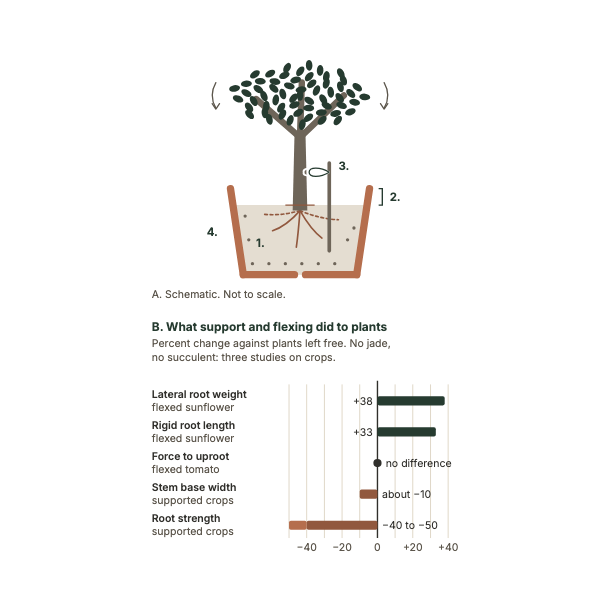
Ritchie summarizes related Douglas-fir experiments in which seedlings held in darkness, stripped of their leaves or girdled, with a ring of bark cut from the stem, made few or no new roots. He adds that Sitka spruce gave different results, so not every conifer responds this way, and nothing in this work involves a houseplant.
The houseplant evidence is thinner. In Wang’s croton cuttings, more light also lengthened the roots.
Iro Kang and Roberto G. Lopez, in HortScience in 2024 and cited from its abstract, rooted cuttings of six foliage and succulent plants under different amounts of daily light.
More light raised root mass by 376 percent in dolphin plant and 50 percent in baby rubber plant, but the authors say it did “not necessarily” raise root mass in every genus they tested.
Indoors in winter, light is low almost everywhere. Sarah Browning of Nebraska Extension puts it plainly: “almost all indoor winter locations are ‘low light’.”
By inference from conifers and cuttings, not from a houseplant trial, a plant repotted into a dim winter spot should be expected to regrow roots more slowly than one in a bright spot.
That is where the thread’s two sides meet. The reply’s worry about fewer hours of sun is the variable this research names, and the sitter’s plan to give the plant better light addresses the same variable. Why winter slowdowns follow light rather than the calendar is covered in our article on why plants slow down because of light, not winter.
Whether the Mix Still Takes Water
The sitter’s reason for not waiting was the mix, and that is a separate problem from the season. Stan Durand and colleagues, writing in Agronomy in 2021, begin from an established finding: “Peat substrates are well known to become hydrophobic during desiccation,” which means water-repellent as they dry out.
Measuring contact angles, the angle a water drop makes where it meets a surface, they found peat moved toward water-repellent “with a decrease in the ability to rewet” that tracked “the intensity of drying.”
The harder it had dried, the worse it took water back. Jeb S. Fields and colleagues reported in 2014 that how well substrates hydrated depended in part on how dry they started.
Both are laboratory studies of substrates, the trade word for potting media, cited from their abstracts, not years-old mix in a ceramic pot.
But they describe the kind of mix the sitter found: peat that has dried until it repels water. Illinois Extension lists a plant that “wilts between normal waterings” among its signs that repotting is due.
Nothing in that mechanism depends on the month. A plant in mix that will not wet gets less water than its waterings suggest, in any season, until the mix is rewetted or replaced.
Gentle ways to rewet dried peat are in our article on a dried-out African violet, and what to do with old mix is in our article on reusing potting mix.
The pots were the other half of the problem. University of Maryland Extension notes that glazed ceramic pots “commonly lack sufficient drainage holes,” and suggests using one with “a clay or plastic pot inside to allow for drainage.”
Browning is shorter: “Make sure your plant containers all have drainage holes!” Why it matters is in our article on drainage holes.
Watering a Plant Repotted in Winter
The firmest winter warning in the sources is about water, not repotting. Browning writes that once houseplants are back indoors in fall, “their water requirements are drastically reduced,” and that “more houseplants die from overwatering than from any other cause.” Most plants, she adds, benefit when the soil is allowed to dry between waterings.
Maryland’s instruction for a freshly potted plant is to “water thoroughly but avoid further watering until the soil dries at the top.” Browning’s test for the next watering is that “the top one-inch of soil feels dry or the plant begins to wilt slightly.” Neither gives an interval in days.
For mix that has been shedding water, Browning describes a soak that wets the whole root ball.
Set the pot in a sink of water and leave it “until air bubbles have stopped coming from the planting container,” then move it to an empty sink to drain for several minutes. Her method is written for watering in general, not as a rescue.
Pot size is the other lever. Lerner advises “a pot of only the next larger size,” because soil in pots that are too large “tends to stay excessively moist for too long and can lead to root rot.”
Colorado State puts the step at one to two inches wider than the old pot. Why a wet pot rots roots is in our article on root rot.
If You Have Already Repotted, or Are Deciding Now
If the repot is done, nothing in the sources says it was a mistake. What they give you is the list of things to watch, and it is the same three: how warm the pot sits, how much light the plant gets, and how wet the mix stays.
In practice that means noticing whether the pot sits in one of the cold drafts the reply worried about, whether its spot is one of the brighter ones in the house, and feeling the mix before each watering.
If you are deciding now, Purdue’s check settles more than the month does. Tip the pot over, ease the plant out and look at the outside of the root ball.
“If many roots are visible at the outside of the soil ball, the plant will probably appreciate a larger pot. If roots are not visible, repotting is not needed.”
A plant that is already as big as you want can get fresh mix without a bigger pot. Purdue says repotting then “should only consist of replanting in fresh soil in the same size pot.”
Illinois adds that “some plants seem to do well when pot-bound while others do not,” and what to check before you repot covers the other signs.
For the roots themselves, Colorado State says healthy ones are “white and firm,” that black, mushy ones “should be cut out and discarded,” and that the roots of a root-bound plant can be teased apart, or scored with a sharp knife if they are too tightly bound.
Maryland says to remove “any dead, brown roots.” Iowa State, writing about trees, adds that any transplant destroys “a large portion of the absorbing root area.”
Plants in bud or flower raise questions of their own, which differ by plant. For holiday cacti, they are covered in our article on an old Christmas cactus that was never repotted, including why a settled old plant sometimes dies after a careless repot.
What Remains to Be Explored
Whether the season of a repot changes how a houseplant recovers was not tested in any study found for this article. A trial repotting the same foliage plants in winter and in spring, in a warm room and a cool one, under bright and dim light, would settle what this article can only infer.
No root-zone temperature has been published, in anything found here, for any houseplant below which roots stop regrowing after a repot. Ritchie’s thresholds are for Pacific Northwest tree seedlings, and the tropical foliage studies measured cuttings making their first roots, not established plants regrowing them.
The link between light and new roots rests on conifer seedlings, with partial support from croton and from two of six foliage plants grown from cuttings. Whether a pothos or a dracaena regrows roots in proportion to light after a repot is not known, and neither is how much light is enough.
The water-repellency findings come from laboratory tests on peat and other substrate components. How repellent a mix becomes after years in a pot, and how reliably it can be rewetted, has not been measured in houseplant pots in any study found here.
And the one extension source favoring winter is a short column first written in 1996. A current extension treatment of the season question, with its reasoning laid out, would be worth more than any of the four quoted here.
Sources
- Repotting Houseplants Good Winter Activity — Rosie Lerner. Purdue University, Indiana Yard and Garden – Purdue Consumer Horticulture. Published 1996-01-04, modified 2017-06-30 (page metadata).
- Repotting — University of Illinois Extension, Houseplants. Undated.
- 1316 – Houseplants: Repotting — Colorado State University Extension, PlantTalk Colorado. Undated.
- How to Repot a Houseplant — Jessica Strickland. NC State Extension, Wayne County Center. Updated April 14, 2022.
- Winter Care of Indoor Plants — Sarah Browning, Nebraska Extension Educator. Nebraska Extension in Lancaster County. December 8, 2018.
- Potting and Repotting Indoor Plants — University of Maryland Extension, Home and Garden Information Center. Updated March 10, 2023.
- Transplanting Trees and Shrubs (F-359) — Jeff Iles, Paul H. Wray (page credits the former ISU extension horticulturist and forester). Iowa State University Extension and Outreach, Natural Resource Stewardship. Undated.
- Root Physiology and Phenology: The Key to Transplanting Success — Gary A. Ritchie. USDA Forest Service, Rocky Mountain Research Station, National Proceedings: Forest and Conservation Nursery Associations 2002, RMRS-P-28: 98-104. 2003.
- Importance of Current Photosynthate to New Root Growth in Planted Conifer Seedlings — R. van den Driessche. Canadian Journal of Forest Research 17(8):776-782. August 1, 1987. Cited from its abstract.
- Quiescence and Dormancy Underpin Plasticity and Resilience: The Virtue of Being Idle — Considine MJ. Journal of Experimental Botany 75(19):6007-6010. October 16, 2024.
- Soil Temperature and Development of Cuttings and Seedlings of Tropical Foliage Plants — Richard T. Poole, Will E. Waters. HortScience 6(5):463-464. October 1971. Cited from its abstract.
- Influence of Light and Heated Medium on Rooting and Shoot Growth of Two Foliage Plant Species — Yin-Tung Wang. HortScience 23(2):346-347. April 1988. Cited from its abstract.
- Photosynthetic Daily Light Integral Effects on Rooting and Vegetative Growth of Cuttings of Six Foliage Plants — Iro Kang, Roberto G. Lopez. HortScience 59(12):1757-1762. December 2024. Cited from its abstract.
- The Use of Wood Fiber for Reducing Risks of Hydrophobicity in Peat-Based Substrates — Stan Durand, Brian E. Jackson, William C. Fonteno, Jean-Charles Michel. Agronomy 11(5):907. May 5, 2021. Cited from its abstract.
- Hydration Efficiency of Traditional and Alternative Greenhouse Substrate Components — Jeb S. Fields, William C. Fonteno, Brian E. Jackson. HortScience 49(3):336-342. March 2014. Cited from its abstract.
- House Sitting for My in-Laws and Noticed Some Of… — multiple community members. Reddit, r/houseplants. Undated.