A yucca cane gone soft where the leaves meet the trunk is rotting there, by the poster’s account and the thread’s replies, and none of the sources read describes a way to reverse that in place. Propping it up holds the top steady; no source says it does anything for the rot.
What the sources describe instead is starting new plants from firm, healthy tissue: NC State lists stem cuttings and suckers from the base for this yucca. How a cut cane seals and roots has been measured only in other plants, and the sources disagree on whether the cut should dry first.
The question comes from a thread on r/plantclinic. A potted yucca cane kept outdoors went soft and soggy where its leaves join the trunk after about a week of rain. It was watered every two weeks, had been shedding leaves and had been repotted not long before.
The poster asked whether propping it up would save it or whether to cut off the top and hope it budded from below, and later said it had been watered too much at first and set too deep in its pot.
Replies said it was rotten and would not recover on its own, that rot starts at the roots and the question is whether it reaches the top, and that the crown could be cut off, dried and rooted.
Others suggested cutting the stump back to clean trunk and sealing it, or listed overwatering, wounds, frost, weevils, humidity and deep planting as causes.
What This Article Covers
This article covers the cane yucca sold as a houseplant, Yucca gigantea, formerly Yucca elephantipes: what a soft spot at the top of the trunk means, what the sources say about cutting the top and the stump, and the plant’s toxicity. It names no product and recommends no rooting hormone or sealant.
What the Soft Spot Means
NC State Extension’s plant record for this yucca calls it drought tolerant and says overwatering can be a problem and can cause root rot. For a pot it recommends one part potting mix to three parts perlite or sand, for drainage.
The record lists few other troubles: the plant is generally free of insects and diseases, with mealybugs, aphids, scale, black weevil and yucca moth borers to watch for.
Outdoors it is hardy only in zones 10 to 12, should come indoors when temperatures drop below 50°F, and can be damaged or die back in cold.
No source read describes rot starting where a yucca’s leaves meet the trunk, or says how far down a cane such rot runs. The reply that rot begins at the roots and climbs is a reader’s account; NC State names root rot, not crown rot.
Why Propping Does Not Help
None of the sources read addresses propping a soft cane. What they describe for a plant that is failing is taking healthy tissue and rooting it: Purdue says to take cuttings only from healthy plants, and notes that the wound of a cut is open to disease.
A yucca cane soft at the top: what the sources cover
Where the soft part sits, what the sources say about the trunk below and the pot, and how long a cut cane took to seal and to root in other cane plants.
| 1. Soft zone | No source read describes rot where a yucca’s leaves meet the trunk or says how far down it runs. NC State names overwatering as the cause of root rot in this plant. |
| 2. Firm trunk | NC State lists stem cuttings and basal suckers for propagation. Cane sections of Dracaena and dumb cane send new shoots from buds on the stem (Iowa State; Illinois); no source read says a yucca stump will. |
| 3. Roots, mix | NC State: one part potting mix to three parts perlite or sand; overwatering causes root rot. |
Panel B: Dieffenbachia cane cuttings held at 16 to 37°C, sealing fastest at 91 to 100 percent humidity (Marlatt 1970); the 8 to 10 weeks is Iowa State’s for cane cuttings in general.
A cut Dieffenbachia cane sealed over days in one study, and an extension guide gives weeks for cane cuttings to root; no source read times either for yucca.
Saving the Top
Purdue’s guide to cuttings explains the problem a cut top faces: once severed, it can no longer take up water, and it must form roots before it dries out.
It says to use clean tools and pots, fresh soilless mix, and a mix that drains, because cuttings in a continuously waterlogged mix have no air and rot rather than root.
On drying the cut, every guide read wants a cut that does not rot, and they take different routes to it. Iowa State’s guide to succulents says to let the cut end of a stem cutting dry and callus for several days, because “By callusing the cut end, the propagule is less likely to rot.”
Illinois Extension says the same for succulents, cacti and rubber plant: let the cut surface air-dry and heal before it goes into the mix.
The trials read point both ways. In a study of a stonecrop from Kırşehir province in Turkey, cuttings planted after 3 days of waiting rooted at 30.15 percent and those planted at once at 28.59, not a significant difference (Ekici and Altun 2024).
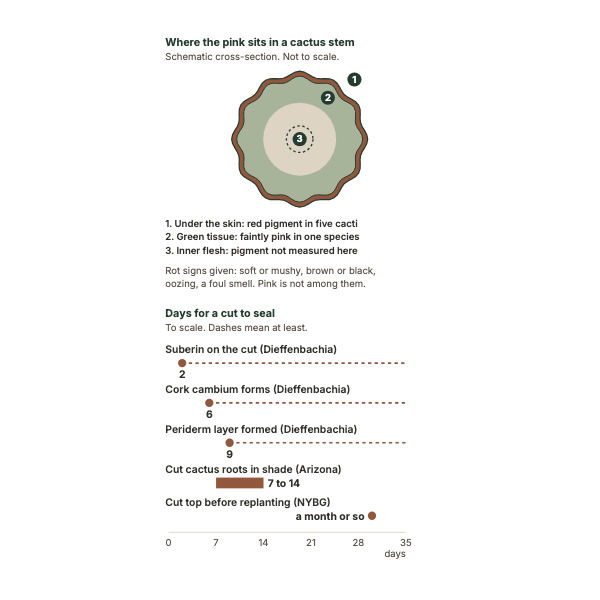
In Dieffenbachia, a cane plant, cut stems needed at least 2 days to lay down suberin, a waxy sealing layer, near the cut, and at least 9 days to form a periderm, a corky skin over it.
That sealing was fastest at 91 to 100 percent humidity, not in dry air (Marlatt 1970, abstract). Neither study was on yucca.
Water is the weaker medium in the sources. Iowa State says most succulents do not root well in a glass of water, and in a study of fig and chrysanthemum cuttings, still water ran short of oxygen right at the stem, slowing and reducing rooting (Soffer and Burger 1988, abstract).
How long a yucca top takes to root, no source read says. Iowa State gives 8 to 10 weeks for cane sections of plants such as Dracaena and dumb cane to form roots and shoots, and Arkansas four to six weeks for cuttings kept in a plastic bag. The thread’s within a month is a reader’s estimate.
For how a rootless succulent piece behaves in water and in mix, see the article on a succulent pup that won’t root.
Will the Stump Sprout?
The poster’s hope that the trunk will bud from below has support for other cane plants, not for this one.
Iowa State says new stems and roots emerge from buds on the thick stem of cane cuttings, and Illinois that cane sections of Dieffenbachia and Dracaena form new leaf clumps at exposed nodes.
For this yucca, NC State lists stem cuttings and suckers that come up at the base as ways to propagate it. No source read says a yucca cane with its top removed will sprout from the trunk, how long that would take, or whether sealing the cut helps.
What Caused It
Of the causes in the thread, overwatering is the one NC State names for root rot in this plant. Cold is the other NC State names, for damage and dieback below the plant’s range.
Planting too deep, heat and too little light were also blamed in the thread; no source read on this yucca addresses them. For how a pot’s drainage decides how wet the roots stay, see the article on root rot, and for why succulents often fail indoors, the article on dying succulents.
Pets and Children
NC State rates this yucca’s poison severity as low and says its leaves and roots are toxic to humans, cats, dogs and horses if eaten, from saponins, with vomiting the listed sign in dogs and cats.
Local Regulations and Safety Advisory
Plant toxicity depends on the species, the amount and the individual, and a poison control service or a veterinarian can say whether a particular plant is a concern for your household. This article is general information, not medical or veterinary advice.
Authorities to consult:
- Poison control service
- Veterinarian or animal poison control service
If a child or pet may have eaten part of a plant, contact a poison control service or a veterinarian.
What Remains to Be Explored
No study was found on rot in yucca canes, on how far a soft crown spreads down the trunk, or on whether a yucca stump sprouts once its top is cut. The cutting advice here is general practice for houseplants and succulents.
Whether a yucca cutting should dry before planting is untested in yucca; the two trials read point different ways and were on a stonecrop and on Dieffenbachia. No source read gives a rooting time for yucca, or covers planting depth, heat or light as causes of the soft spot.
Sources
- YUCCA TREE IS FLABBY — multiple community members. Reddit, r/plantclinic. Undated.
- Yucca gigantea (Giant Yucca, Spineless Yucca) — NC State Extension. NC State Extension Gardener Plant Toolbox. Undated.
- How to Propagate Houseplants by Stem Section (Cane) Cuttings — Aaron Steil. Iowa State University Extension and Outreach, Horticulture and Home Pest News. 2025-01 (last reviewed).
- How to Propagate Succulents — Aaron Steil. Iowa State University Extension and Outreach, Yard and Garden. August 2023.
- Cuttings (Houseplants) — University of Illinois Extension. Undated.
- New Plants From Cuttings (HO-37-W) — Purdue University. Undated.
- Propagating Houseplants (FSA-2095) — University of Arkansas Cooperative Extension. University of Arkansas Cooperative Extension Service. Undated.
- Suberin and Periderm Formation in Dieffenbachia — Marlatt RB. Journal of the American Society for Horticultural Science. 1970. Cited from its abstract.
- Effects of Dissolved Oxygen Concentrations in Aero-Hydroponics on the Formation and Growth of Adventitious Roots — Soffer H, Burger DW. Journal of the American Society for Horticultural Science. 1988. Cited from its abstract.
- Effects of Different Cutting Types, Rooting Media, IBA Doses and Waiting Times on Propagation of Native White Stonecrop (Sedum album L.) — Ezgi Ekici, Bahadır Altun. International Journal of Agriculture and Wildlife Science. August 25, 2024.