Usually, if the brown is low on an old stem and firm. Corking is old surface tissue browning and hardening, and it normally starts near the base. Browning high up or all over a plant is a different case, and calling it natural does not explain it. We found no study comparing these causes on potted cacti, so this is expert guidance, not measurement.
Start with two checks. Press gently on the brown area to see whether it is firm or soft, then note where it sits. Those are the two things the sources sort these cases by.
The hard case came up on r/succulents, where a grower’s Echinopsis had browned over the whole plant in the two years after a repot, was growing again, and faced removal from the room because the poster’s mother found it ugly.
Much of the thread took the plant’s side in the household dispute. On the botany, replies split. Some saw ordinary aging and no cause for concern.
Others suspected pests, naming broad mites and thrips, and a few pointed to wet skin or poor watering. Both camps can be partly right, because corky brown skin has more than one cause.
What Corking Is
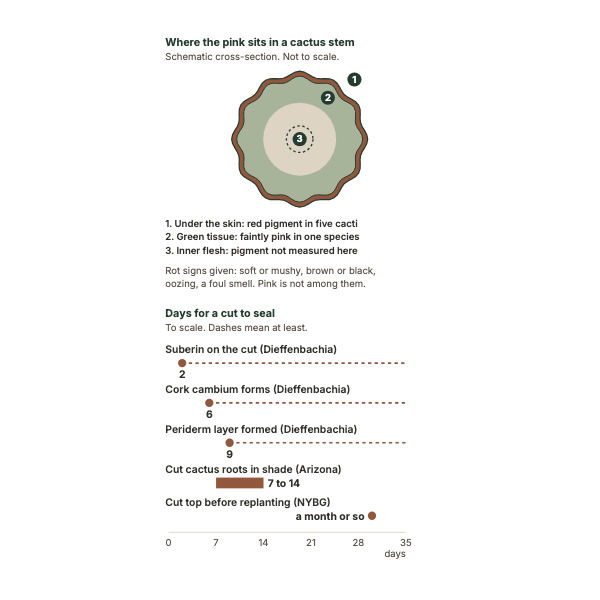
A cactus specialist quoted by University of Maryland Extension describes it as “somewhat analogous to bark formation as old epidermal (surface) tissue loses its active chlorophyll tissue, browns, and hardens.” Chlorophyll is the green pigment that captures light, so a corked area has stopped doing the work the green skin did.
Position is part of most descriptions. The same answer says, “This usually occurs on the oldest stem tissue near the base of the plant.” New Mexico State said much the same in 1997: “On older parts of a cactus plant, corky, often light brown or tan areas form naturally.”
Other sources agree on age. A University of Vermont Extension Master Gardener answer calls it “a normal and natural process where the base of the plant changes from green to a rough, brown, bark-like texture.” That answer speaks of cacti, though a later reply treated the plant in question as a pencil euphorbia.
The New York Botanical Garden describes corking as brown dry spots that some cacti develop “along their columns over the years,” which places it above the base too.
So the common reply is sound for the case it describes: an older cactus, browning from the bottom, slowly. The trouble comes when it is applied to any brown cactus.
Where It Sits and How It Feels
The sources point to four patterns. None is a diagnosis, and expert answers rather than studies stand behind them, but they tell you which question to ask next.
Where the brown sits, and how it feels
Four patterns to compare with your plant. Press gently on the brown area as well as looking at it.
Firm browning low on old tissue is usually aging. Higher up, it can point to growing conditions. Separate scars can point to injury or pests. Rot is usually soft, but it can dry out and turn hard, so a firm patch does not rule it out.
Softness is the first warning. The Vermont answer says, “If the brown stems are soft or have a smell it could be rot.”
The Maryland specialist describes bacterial lesions on tropical cacti as usually starting low and “usually soft to the touch.” Fungal disease there begins as tan spotting, often with a yellow border.
Firmness is less reassuring than it sounds. “Sometimes a plant can rot due to excessive watering, but then dry out and become hard,” the Vermont answer warns. So a firm patch does not rule out rot that has dried.
Spots have their own test. Try scratching one with a fingernail. If it comes away, the Vermont answer says it is “most likely scale,” an insect pest.
New Mexico State adds that a scale insect can leave a yellowish area or no mark at all, and that a fungus also scrapes off but leaves “a distinct blemish.” A spot that stays put may be a scar, or corking in the New York Botanical Garden’s sense.
Scars are easy to mistake for corking, because they are corky too. New Mexico State lists “Insect feeding, scratching by the spines of another cactus or a wound due to having something dropped on the plant, pet damage” as causes of “such a corky scar.”
When It Starts High up or All Over
This is the case the thread needed. The Maryland answer comes closest, though it speaks of younger parts of a plant rather than a whole plant. After describing the usual pattern, it says, “if the overall health of the plant is poor due to inadequate environmental or cultural conditions, the corking can appear on younger parts of the plant.”
The answer goes on to name causes. On tropical cacti, it says, the main one is a water deficit, from dry potting mix or “insufficient root mass to absorb adequate water.” Too little light can play a part as well. In its summary, “excessive tissue corking is usually caused by poor growing conditions.”
Two limits apply. That answer was about a tropical cactus, a type that needs more water than desert kinds, so it may not carry over to an Echinopsis. It is also one specialist’s judgment, relayed by Extension staff, with no study behind it in the answer.
No source we found says repotting causes corking. Maryland names too little root mass as a route, but nothing we read joins repotting and corking on a cactus. The thread’s timing settles nothing either way.
For the reader, the useful conclusion is narrower than a cause. Browning that runs high or keeps spreading is a reason to review water, roots and light, rather than to accept the word natural and stop looking.
Could It Be Mites?
It could, and the evidence is weaker than the thread suggested. Broad mites do produce corky tissue on other plants. Virginia Tech says infested plants “may develop patches of russeting or scabby, corky tissue,” and Mississippi State reports “russeting on leaves and stems” on heavily infested plants. Russeting is rough, brownish skin.
Neither source mentions cacti. Their lists of affected plants run to peppers, tomatoes, begonias, impatiens and similar plants, and we found no extension or peer-reviewed report of broad mites on a cactus. Absence from a list is not proof. It does mean the claim rests on reader reports, so far as we could find.
The mite theory is also hard to disprove on your own plant. Virginia Tech says females are about 0.2 mm long, that finding them takes “a very strong hand lens (20x) or a microscope,” and that they “often leave badly damaged plants.”
It adds, “Feeding damage by broad mites will persist even after the mites are gone.” So a clean inspection today would not clear them.
New growth is the place to look. Broad mites favor young tissue, and Virginia Tech describes “stunted, puckered, or otherwise distorted plant growth.”
Those descriptions come from leafy crops and flowers, and we found none for a cactus. A lens on twisted new growth is the check the sources support, and none says what normal growth would rule out.
Spider mites are better documented on cacti. An Ask Extension answer quotes Clemson University naming “Aphids, spider mites, and mealy bugs” as the major pests of cacti.
That answer concerned tan patches on an indoor prickly pear. It suspected an insect or mite problem and said, “if the areas are getting larger, it means the problem is still present.”
Iowa State’s check for houseplants in general is simple: “hold a sheet of white paper under a stem and then shake or tap the stem against the paper,” and look for moving specks.
The thrips suggestion has less behind it. We found no source linking thrips to corking on a cactus, though the general problem of treating them is covered in why thrips survive the treatment. Spider mite control has its own article.
If you confirm a pest and decide to spray, the Clemson advice is the rule to follow: “Make sure that the spray you use is labeled for cacti and follow label directions carefully.”
We found nothing supporting a spray on suspicion, and Virginia Tech says the damage stays after the mites have gone.
Natural Is Not the Same as Harmless
The word natural carries more comfort than the evidence supports, at least for some cacti. Lance Evans and colleagues have spent decades on bark on wild columnar cacti. Their 1994 study of 400 plants in Argentina and Chile, including Echinopsis chilensis, found more injury on sun-facing sides. The authors call tan to red-orange discoloration scaling, and a heavier dark buildup barking.
The abstract puts barking on the crests, the ridges of the stem, at as much as five times greater on those sides, while the discussion’s largest stated gap is four times. The authors concluded the injuries “are related to total incident irradiance.” They note that similar injuries on saguaros result “in premature death of individual saguaros.”
A 2021 paper by Evans and Dombrovskiy, cited from its abstract, states as background: “Periderm coverages lead to cactus morbidity and mortality.” Periderm is the botanical term for bark tissue. The study the abstract describes compared anatomy, not survival.
That work should not be stretched too far. These are tall, long-lived plants outdoors in strong sun, and it is not clear their barking is the same process as corking at the base of a pot plant. The 1994 paper ties barking to a buildup of surface waxes, where Maryland’s corking is the tissue itself browning and hardening.
The 2021 abstract also reports that, among five species at one site, “no pair of species showed the same responses.” We found no equivalent work on potted cacti.
What it does establish is that bark on these columnar cacti is not automatically benign. We found no measurement of whether corking harms a pot plant, so for now that is unknown.
Water on the Skin, and Scab
One reply put corking down to water landing on the plant. We found no source for that, in either direction. Scab, a separate condition with a corky look, does have a link to water, though not that one.
A University of Maryland answer on prickly pear says a corky brown zone “looks like scab, which is also a physiological condition and may be due to over-watering (ironically) since it is thought to be tied to edema.”
Physiological there means damage from growing conditions, not infection. Edema is cell damage from a plant holding more water than it can lose. That answer is hedged and specific to prickly pear, and it concerns the wetness of the plant, not droplets on its skin.
Damp at the stem base is a separate concern: the New York Botanical Garden warns of “a dry sort of rot” where water does not evaporate from the soil around the base. See root rot and saturation.
What to Do With Your Plant
Do not expect the brown to turn back. We found no source saying corked tissue recovers its green, and the description of what happens to it gives no reason to expect that. The question is whether new growth above it looks healthy. Vermont’s houseplant specialist, writing about that pencil euphorbia, expects “healthy green growth above the corked area.”
- Press it. If it is soft, dark or smelly, treat it as suspected rot and read root rot and saturation first.
- Try to scratch any spots. Anything that lifts off may be scale; anything that stays may be a scar or corking.
- Look at new growth. Check whether it is even and normal in shape, and use a lens if it is twisted.
- If the brown is high up or spreading, review the basics. Check whether the plant has been left too dry, whether the roots are sound and whether it gets enough light. Push a finger about an inch into the mix: the Vermont answer reads wet, mushy soil as overwatering or poor drainage. Tropical cacti need more water than desert kinds, so go by the kind you have.
- If you cannot tell, get it seen. New Mexico State’s advice still holds: take it to your local Extension office so staff can look at it and describe it to an entomologist or plant pathologist.
If more light looks like the answer, a sudden move into strong sun carries its own risk, as moving plants outdoors explains. Its evidence concerns leaves, and we found none on cactus skin.
As for throwing it out, nothing we read says a firm, corked plant must go. Heavy pests are the exception: the Clemson excerpt says a plant heavily infested with scale might have to be discarded, and Virginia Tech says to consider disposing of badly infested plants.
Beyond that, whether a brown but healthy plant stays is a matter of taste.
Local Regulations and Safety Advisory
If you use pest control products, follow the label. Rules on them vary by country and locality, and your pesticide regulator can say what applies where you live. This article is general information, not legal advice.
Authorities to consult:
- Pesticide regulatory authority or environmental protection agency
What Remains to Be Explored
The basic comparison is missing. We searched for any study of corking on potted cacti and found none: not its rate, not how much green tissue a plant can lose, and not whether heavy corking shortens a pot plant’s life. What exists is expert answers for houseplants and field studies of wild columnar cacti.
Several specific claims have no citable source. We found nothing confirming broad mites on a cactus, nothing linking thrips to corking, nothing on water droplets as a cause, and nothing showing that repotting brings corking on.
We also found no anatomical account of base corking in a pot plant, or evidence on whether it is the same process as the barking Evans describes.
Two kinds of work would settle most of this. A microscope and a 20x lens on corked plants with and without distorted growth would test the mite claim directly.
Dated photos of potted cacti, recording where browning started and how the plant was watered and lit, would show whether browning high on the stem really does track poor conditions.
Sources
- Cactus Type and Disease? (Ask Extension Question 633312) — University of Maryland Extension, Home & Garden Information Center, via Ask Extension. May 13, 2020.
- Plant Disease or Old Age Question (Ask Extension Question 917832) — University of Vermont Extension Master Gardener Program, via Ask Extension. September 20, 2025.
- Why Is the Bottom of My Cactus Turning Brown? — New York Botanical Garden, Mertz Library Plant Information. January 19, 2021.
- Yard and Garden Column, December 29, 1997 — New Mexico State University, Southwest Yard & Garden. December 29, 1997.
- Native Prickly Pear Cactus Disease (Ask Extension Question 928635) — University of Maryland Extension, via Ask Extension. April 17, 2026.
- Opuntia Cactus Discoloration (Ask Extension Question 890390) — Ask Extension, quoting Clemson University Extension. December 5, 2024.
- Broad Mite (ENTO-587NP) — Theresa A. Dellinger, Eric Day and Alejandro Del-Pozo. Virginia Cooperative Extension, Virginia Tech. March 27, 2024.
- Broad Mites (Bug’s Eye View Vol. 2 No. 16) — Blake Layton. Mississippi State University Extension. 2016.
- How Can I Determine If My Houseplant Has Spider Mites? — Iowa State University Extension, Yard and Garden. March 4, 2022.
- Surficial Injuries of Several Cacti of South America — L.S. Evans, C. McKenna, R. Ginocchio, G. Montenegro and R. Kiesling. Environmental and Experimental Botany 34(3):285-292. July 1994.
- Anatomical Characteristics of Sunlight-Induced Bark (Periderm) Coverages on Columnar Cacti of Central Mexico — Lance S. Evans and Phillip Dombrovskiy. Journal of Plant Studies 9(2):1-20. December 2021. Cited from its abstract.
- Areole Changes During Bark Formation for Columnar Cactus Species — Lance S. Evans and Catherine A. McDonough. Haseltonia 26. February 26, 2020. Cited from its abstract.
- Two Years Ago I Repotted My Echinopsis Subdenudata and Corking Started All Over the Whole Plant (R/Succulents Thread) — multiple community members. Reddit, r/succulents. Undated.