Cut it if it has good light and you can find a live bud to cut above, and wait if it has neither. On an avocado, a cut wakes only the first few nodes below it that still hold a bud, and a fast stem has already shed many of its buds. That is why the same cut can make one plant branch and leave another as a bare stick.
One limit belongs up front. We found no trial of cutting a seed-grown avocado indoors. The bud behavior below comes from orchard trees described in 1958, and applying it to a seedling in a jar or pot is our inference, though it fits what readers report.
One r/houseplants poster had a seed-grown avocado about three feet tall with almost no leaves, and had already tried direct sun, indirect sun and changing the water temperature. An earlier cut had done nothing, so the knife looked like a poor bet.
One reply wanted it taken down hard, to about a foot, expecting it to fork and leaf out. Another reader had cut a similar plant and got only a kink, then more straight stem. Others blamed light, keeping it in water, or too little feeding.
The opposite case came up in a second thread, where a poster came home to find their avocado reduced to a stump. There the argument was whether it could ever be a healthy tree. Both threads turn on one question: what is left on the stem below the cut?
Why the Stem Grew Like This
A tall, thin avocado is partly a normal young avocado. Frank Venning and Francis Lincoln, writing in the Proceedings of the Florida State Horticultural Society in 1958, describe a “slender pyramidal growth habit” in seedlings and read it as the growing tip holding back the buds below.
A trial on young potted seedlings shows how strong that hold can be. In a 1971 California Avocado Society report, McCarty and colleagues recorded that “No axillary buds sprouted on any of the non-treated control trees.” Axillary buds sit where a leaf joins the stem, so a seedling with no side branches is not failing at anything.
Dim light then stretches that habit into something stranger. Venning and Lincoln write that “seedlings grown indoors in dim light develop long whip-like or vine-like stems, with much elongated internodes, reduced linear leaves, and few or no branches.”
Internodes are the lengths of stem between leaves, so the plant is making more stem and less leaf.
Avocado also grows in bursts. Thorp and Sedgley, at the 1992 World Avocado Congress, describe a “rhythmic pattern of growth.” Venning and Lincoln add that each burst, called a flush, begins with small bract-like leaves and short gaps before full leaves appear.
Moving the plant into direct sun, as the first poster did, changes what grows next.
We found no source saying a stretched avocado stem shortens or refills, and the evidence on stretched succulents points the same way. No source says how long better light takes to show.
What a Cut Does on an Avocado
The general rule is that removing the tip releases buds below it. Avocado narrows that rule considerably. Venning and Lincoln found that a cut does not stimulate the buds along the rest of the stem: “only the buds at the first few nodes below the cut are stimulated.”
Worse, those nodes may have nothing left to stimulate. Each node starts with one bud, but the paper reports that buds formed while the tip grows fastest either become branches at once or are mostly dropped.
Lee Reich, quoted by the University of Washington’s Miller Library, puts it simply: “avocados shed many buds along their stems.”
The buds that tend to stay are the ones formed as a flush starts or stops. Those sit at a band of closely spaced scars on the bark, left by the scales of a resting bud.
On orchard trees, the paper says a cut can end up stimulating buds “from one to three feet below the actual pruning cut,” because the first surviving buds sit there. That distance comes from large branches, and whether a seedling matches it is unmeasured.
The piece of branch left above them is a stub. Left in place it “quickly decays,” and the paper says the decay runs far down, weakening or killing the branch.
Venning and Lincoln also saw no adventitious buds in avocado, meaning buds formed new on old wood. Every shoot they traced came from a bud laid down when that part of the stem was young. If that holds for a seedling, a stretch with no buds cannot make one.
A cut wakes what sits just below it
The same stem cut in two places. With no live bud between them, the higher cut does not raise the new growth: it still starts at the first live buds below.
A cut does not wake the whole stem, only the first few nodes under it that still hold a bud. On a bare stretch, those can be a long way down.
Why One Cut Branched and Another Did Not
Two findings help explain the reader who got a split plant and the reader who got one more straight stem. The first is what the new growth does.
Venning and Lincoln describe the shoots after a cut as “distinctly vertical,” replacing what was removed rather than filling out the plant.
The second is competition among buds. In the California trial, seedlings given certain other growth regulators lost their tips, and “one of the upper axillary buds assumed near vertical growth and became the dominant leader in the tree.”
That was a chemical trial, not a cut, but the outcome matches that reader’s kink and straight regrowth.
The strength of that takeover also varies by parent. Thorp and Sedgley found apical dominance strong in Sharwil and weak in Gwen and Reed, with Hass between them.
A store pit is a new seedling with an unknown pollen parent, so its habit cannot be read in advance. That last step is our inference.
Light decides what those shoots become. C. A. Schroeder, in a 1979 tissue culture study, cut seedlings about 120 centimeters tall (roughly 47 inches) back to 30 centimeters (about 12 inches) and moved them into darkness.
The buds grew, but as “thin, long, white stems” with “very small vestigial leaves,” sometimes 100 centimeters or more long.
Total darkness is an extreme, and the study was after tissue, not houseplants. It is still the nearest thing we found to the cut suggested in the thread.
It carries two messages. A hard cut can wake buds on a tall seedling, and a cut does nothing about the conditions that made the stem bare in the first place.
If You Decide to Cut a Tall Stem
- Fix the light first. Reich’s advice is “the brightest window in the coolest room,” because warmth exaggerates the stretch. North Carolina lists the species for full sun, so step a dim plant up gradually, as with a houseplant going outdoors.
- Look for a band of close scars. Run your eye up the stem for a section where the marks crowd together, or for a small bump where a leaf once sat. Venning and Lincoln’s advice is to cut “immediately above the region where a growth flush terminated.”
- Cut just above it. That puts the buds there first in line and leaves no stub. If you can find no band, cut just above a leaf or node and accept that the cut is partly blind. If shoots then appear well below it, the orchard remedy is a fresh cut “just above the region where the new sprouts are emerging,” made before they develop.
- Keep the new growth short. The 1958 paper says shaping works best on young plants through “the frequent removal of succulent terminal initials,” meaning soft new tips. Reich recommends pinching too.
How low to go has no tested answer at this size. New York Botanical Garden’s advice covers a plant 6 or 7 inches tall: cut it midway, leave at least 3 inches, and expect about a week or two before it restarts.
Nothing we read scales that up, so the one-foot figure is one reader’s suggestion.
Orchard work suggests a cost to going lower. In a California stumping trial reported by Ben Faber in 1991, trees cut to 6, 10 and 15 feet were rated for regrowth, and there was “a significant lag time in regrowth of the 6-foot treatments.”
He attributes the lag to lost stored carbohydrates, fewer buds and buds long held dormant.
Timing has thin evidence too. University of Arkansas Extension told one reader to wait until the plant went back outdoors, because indoors it “needs all the leaves it can get now.” One reply in the second thread reports cutting only in midspring. We found no test of season on an indoor avocado.
Leave the Seed Alone
The old pit on a tall stem can look finished, but it may still be feeding the plant. In a glasshouse trial published at the 1995 World Avocado Congress, Barrientos-Priego and colleagues removed the seed halves from young plants.
Plants of 1 to 2 and 6 to 8 centimeters (up to about 3 inches) “did not survive more than 28 and 35 days.” Taller plants survived, though they grew unequally, and stem thickness still suffered at 30 to 35 centimeters.
The authors put the handover at “6 to 8 leaves,” and saw seed halves stay attached for more than 180 days. A long stem with only a few leaves may be short of that point. That is our inference, because the trial used uncut plants in soil, so leave the seed in place.
Water, Soil and Feeding
Several replies suggested moving the first poster’s plant out of water, and Colorado State University Extension points the same way: once the stem pushes through the top of the seed, plant it in a well-drained medium. Roots do change in that move, as water roots and soil roots explains.
Soil will not solve this alone. One reader reported the same bare habit on a plant already in soil, and it is dim light, not water, that the 1958 paper names.
Potting mix also brings its own risk, because avocado “is one of the most sensitive tree fruit species to flooded or poorly drained soil conditions,” according to a Chilean thesis study.
That makes a jar-grown avocado a small puzzle, and we found no measurement of how its roots cope in still water.
In mix, the warning is plainer. North Carolina notes root rot when soil stays too wet, and Colorado State lists curled leaves and soft stems as signs of too much water.
One reply suggested hydroponic nutrients and another a little fertilizer. The 1958 paper names mineral nutrients among the things that influence flushing, but no source tested feeding on a stretched seedling. If you feed it, follow the product label.
If It Has Already Been Cut to a Stump
A stump is not the end of it, and neither side of that thread was simply right.
Stumping, as Arpaia and colleagues describe it, is “cutting a mature tree back down to a height of 3 to 5 feet,” after which “vigorous growth results all over the tree stump.”
Young plants have a reserve of their own near the bottom. R. Lamour, observing nursery trees in Algiers in 1936, described latent buds “at the base of the original sprout,” hidden between the seed halves. He saw trees wilt to the ground before a strong new shoot came from low down.
So we found no support for the blanket claim that a beheaded avocado can never be healthy, though it has a real basis on old wood.
Venning and Lincoln call the joint where a long-dormant bud becomes a branch “structurally imperfect and inherently weak.” They meant mature limbs, and we found nothing on seedlings.
The opposite claim, that it returns stronger, has no evidence behind it either. New York Botanical Garden’s line that “the plant will eventually recover” rests on no trial we could find, and Faber’s lag suggests a plant cut low takes longer.
No source gives a time for a seedling, so we cannot say when to stop waiting.
Practically, keep the seed, keep it in the same bright, cool spot, and do not let the mix stay wet.
After frost, Faber’s advice is to wait before cutting, because “Buds push from the least damaged wood.”
Other Fixes Readers Suggest
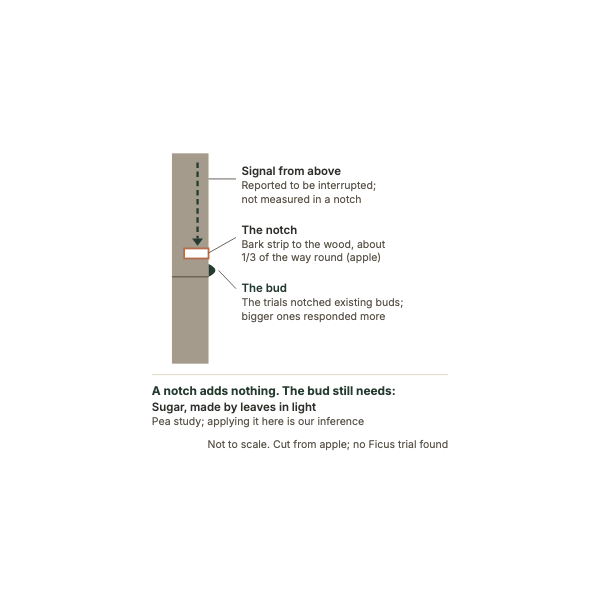
A notch above a bud came up as a way to keep the top. Notching can only wake a bud that exists, and we found no test on avocado, so the bud problem applies in full.
Bending the stem over is another idea. One reader put it to Ask Extension, the reply did not address it, and we found no source.
A small fan was another suggestion, on the idea that a breeze tells the plant to stop climbing and make leaves. Movement can thicken a stem, but we found no avocado test and no source linking a breeze to new leaves.
Will It Ever Fruit?
Do not keep it for fruit. In Israeli breeding plots, seedlings first flowered at 3 to 11 years and first fruited at 4 to 11, with single trees taking 14. Those trees were planted out in the field. Lavi and colleagues, in a 1992 paper cited from its abstract, found the wait differed significantly between parent lines.
Colorado State says it “may take as long as 20 years or more” and suggests starting a new plant every three or four years in a small home.
North Carolina lists a grown tree at 30 to 60 feet. We found no record of a pit-grown avocado fruiting indoors, which is not proof that none has.
A reply said you would need a pair. That is close but too strong. Gad Ish-Am, in the 2008 California Avocado Society yearbook, describes two complementary flowering types, so that one sheds pollen while the other’s flowers are receptive. He also records that some cultivars overlap on a single tree.
Pets and Birds
Treat cut stems, leaves and the seed as a hazard around animals. In a veterinary study cited from its abstract, Shropshire and colleagues gave budgerigars plant samples by tube, and avocado was one of 6 of 19 plants that caused illness. If you keep caged birds, keep the plant and its trimmings well apart.
A 2022 report in Toxicon, also cited from its abstract, states that poisoning “has been confirmed in sheep, goats, dogs, rabbits and ostriches.”
It found persin, the compound blamed, in leaves and in fruit including the seed. North Carolina’s database flags the plant as a problem for horses.
We have not confirmed the risk a houseplant poses to a cat, a dog or a child, so we offer no reassurance. If a pet or child chews one, the advisory below says who to call. Our guide to what toxic to cats means explains how to read these warnings.
Local Regulations and Safety Advisory
If you use fertilizer products, follow the label. Rules on them vary by country and locality, and your agriculture department can say what applies where you live. This article is general information, not legal, medical or veterinary advice.
Authorities to consult:
- Local agriculture department
- Poison control service
- Veterinarian or animal poison control service
If a child or pet may have eaten part of a plant, contact a poison control service or a veterinarian, because toxicity depends on the species, the amount and the individual.
What Remains to Be Explored
The central gap is simple: nobody appears to have cut seed-grown avocados at different heights indoors and counted what came back. The 1958 bud work has not, as far as we found, been repeated on seedlings, so we do not know how many buds a stretched stem keeps, or whether it forms scar bands at all.
We searched for a safe cutting height for a tall seedling, a regrowth time for a stump, a test of season on an indoor plant, a measurement of avocado roots in a jar, and tests of bending or a fan. We found none, and we have left those numbers out.
The pet evidence here comes from abstracts and does not cover cats.
A simple side-by-side would change this answer: matched seedlings under one light, cut at a scar band, cut on a bare stretch, and left alone, with shoots counted over a year.
Until then, the bud is the thing to look for, and the height of the stem matters less than the thread suggests.
Sources
- Developmental Morphology of the Vegetative Axis of Avocado (Persea Americana L.) and Its Significance to Spacing, Pruning Practices, and Yields of the Grove — Frank D. Venning, Francis B. Lincoln. Proceedings of the Florida State Horticultural Society 71:350-356. 1958.
- Shoot Growth and Tree Architecture in a Range of Avocado Cultivars — T. Grant Thorp, Margaret Sedgley. Proceedings of the Second World Avocado Congress, 1992, pp. 237-240. 1992.
- Chemically Induced Sprouting of Axillary Buds in Avocados — C. D. McCarty, S. B. Boswell, R. M. Burns. California Avocado Society 1971-72 Yearbook 55:117-119. 1972.
- Etiolation and Avocado Bud Elongation In Vitro — C. A. Schroeder. California Avocado Society 1979 Yearbook 63:86-89. 1979.
- Response of Cotyledons Detachment Over the Development of Nursery Seedlings of Avocado (Persea americana Mill.) — Alejandro F. Barrientos-Priego, Manuel J. Morales-Nieto, Gustavo Almaguer-Vargas, Michal W. Borys, Ma. Teresa Martinez-Damian, Facundo Barrientos Perez. Proceedings of The World Avocado Congress III, 1995, pp. 211-216. 1995.
- Observations on Budding and Planting of Avocado Trees — R. Lamour. California Avocado Association 1936 Yearbook 21:120-122. 1936.
- Orchard “Slenderizing” — Ben Faber. California Avocado Society 1991 Yearbook 75:57-62. 1991.
- The Use of Naphthaleneacetic Acid (NAA) to Control Vegetative Vigor in Avocado Trees — Mary Lu Arpaia, Mauricio Tapia, Reuben Hofshi. California Avocado Society 2007 Yearbook 90:131-148. 2007.
- Avocado Breeding in Israel — Emanual Lahav, Uri Lavi, Chemda Degani, Shmuel Gazit. Proceedings of The World Avocado Congress III, 1995, pp. 106-113. 1995.
- The Genetics of the Juvenile Phase in Avocado and Its Application for Breeding — Uri Lavi, Emanuel Lahav, Chemda Degani, Shmuel Gazit. Journal of the American Society for Horticultural Science 117(6):981-984. 1992. Cited from its abstract.
- Daily Patterns of Avocado Bloom and Honeybee Activity — Gad Ish-Am. California Avocado Society 2008 Yearbook 91:105-127. 2008.
- Effect of the Soil Water-To-Air Ratio on Water Status, Net CO2 Assimilation, Biomass and Vascular Anatomy of Avocado Trees — Pilar M. Gil and colleagues. Thesis chapter, Pontificia Universidad Catolica de Chile, via AvocadoSource. 2008.
- Evaluation of Selected Plants for Acute Toxicosis in Budgerigars — Shropshire CM, Stauber E, Arai M. Journal of the American Veterinary Medical Association 200(7):936-939. 1992. Cited from its abstract.
- Acetogenin-Induced Fibrotic Heart Disease From Avocado (Persea americana, Lauraceae) Poisoning in Horses — Freitas MS and colleagues. Toxicon 219:106921. 2022. Cited from its abstract.
- Should I Cut Back (Prune) My Avocado Plant? — Anita Finkle. New York Botanical Garden, Mertz Library Plant Information. February 12, 2021.
- 1304 – Avocado — Colorado State University Extension, PlantTalk Colorado. Undated.
- Growing Avocado Plant Indoors — University of Washington Botanic Gardens, Elisabeth C. Miller Library. Undated.
- Avocado (Reference Desk) — University of Arkansas Division of Agriculture, Cooperative Extension Service. December 26, 2015.
- Persea americana — North Carolina Extension Gardener Plant Toolbox. Undated.
- How Do I Prevent the Leaves of My Avocado Plant From Withering and Falling Off? — New York Botanical Garden, Mertz Library Plant Information. Undated.
- Avocado Plant – Potted and Leggy! #736840 — Ask Extension. January 18, 2021.
- Avocado Plant Grown From a Seed- Will Not Form Leaves! Looking for Any Help, It Is Currently 3Ft Tall & I Really Don’t Want to Cut It! Any Advice Is Appreciate… — multiple community members. r/houseplants, Reddit. Undated.
- My Mum Cut My Avocado Plant Without Telling Me While I Was Away… — multiple community members. r/houseplants, Reddit. Undated.