Not necessarily. A poinsettia can regrow from buds on bare stems, and the warning sign extension sources name is a stem that shrivels, not a missing leaf. But “dormant” is not much of a diagnosis either: those sources read leaf drop as stress from cold, water or light. Check the stems and roots, then fix the cause. We found no study that follows leafless poinsettias to see which ones recover.
The replies to one thread show how little bare stems settle. Its owner asked whether a leafless plant with green stems was resting or dying, and answers ran from sure recovery to the compost heap.
One reader said the thread made them regret every poinsettia they had ever thrown out. Another had cut off the bare stems the night before.
A second thread starts earlier in the same decline. Its owner had a small plant in a small pot, had read that it should stay moist, and saw the lower leaves yellow within about three weeks. Replies said a euphorbia hardly needs water. We do not know how either plant fared.
What This Article Covers
This article covers how to tell a dead poinsettia from a resting one, why it lost its leaves, how much light and water it needs, what to do with the plant in front of you, whether it needs a rest, how to turn it red again, whether it can live outdoors, how long it lasts, and whether it is poisonous.
What a Bare Poinsettia Is Telling You
Leaf fall is not simple decay. Abscission, the shedding of an organ, is “a highly regulated and coordinated developmental process,” in the words of a 2015 paper by Hvoslef-Eide and colleagues, cited from its abstract. Its poinsettia work concerns flowers rather than leaves.
For leaves, a 2015 review by Islam and Joyce, also cited from its abstract, says “Ethylene is central to the leaf and cyathia abscission.” Ethylene is a plant hormone. Cyathia are the small true flowers at the center of the colored bracts, which are modified leaves.
Why a plant sheds is the useful question, and New Mexico State answers it: “The fact that the leaves fell from the plant indicates the plant experienced some environmental stress. This stress could have been low temperatures, too little light, or drought.” Unlike “dormant,” that gives you something to check.
The word is not empty, though. Illinois Extension tells owners to reduce watering once about half the leaves have dropped, and says “This will cause the plant to go dormant.” In that account, dormancy is something you do to a plant that has finished its display.
The wild plant gives the idea some footing. NC State calls it a “deciduous to semi-evergreen shrub or small tree,” found along coasts and in dry tropical forests. We found nothing linking that habit to a potted plant losing its leaves in a living room.
Timing helps sort the two. Vermont Extension says some leaf drop may appear in January as bracts turn green, and Iowa State says a well-kept plant should stay attractive for two to three months. A plant bare within weeks of purchase has fallen well short of that.
Then look at the stems. Readers treat green as proof of life, but no source we read gives that test. The nearest is New Hampshire’s warning against depriving the plant of “so much water the stem shrivels and dries, as that will kill the plant.” Illinois sets the same limit.
So a firm stem is a reason to wait, because New Mexico State says new sprouts come from buds on the stems. Plants that regrow from rhizomes, or underground stems, are judged differently, so advice for one does not carry to the other.
Why Did It Lose Its Leaves?
Several causes end in the same place, so the symptom alone will not name one. Look at the conditions around the plant, not only at the leaf.
| Cause | What the sources describe | Source |
|---|---|---|
| Cold | Premature leaf drop below 50°F; yellowing and fast drop when too cold | Clemson; Texas A&M |
| Heat and moving air | Warm, dry air from a register, or rapid temperature swings near a door | Iowa State |
| Too wet | Lower leaves yellow and drop; roots turn brown and mushy | Iowa State; Texas A&M |
| Too dry | The plant wilts, then drops leaves | Iowa State |
| Poor light or nutrition | Premature leaf drop | Clemson |
Yellow lower leaves do not settle it. Iowa State ties them to over-watering, but Clemson says excess heat also yellows leaves, and Texas A&M reports the same from cold and from root rot.
The second thread’s owner was told it looked like overwatering, despite watering when the soil dried, which is the test Iowa State recommends. Only the mix and the roots can check that verdict.
Roots are where the worst case sits. Texas A&M says Pythium, a root-rotting organism, turns roots from clean white to brown and mushy, and “As the roots are destroyed, the plant will begin yellowing and dropping leaves.” Standing water in a shop sleeve with no holes encourages it.
Trejo and colleagues, in a 2012 paper cited from its abstract, name vulnerability to cold and to pathogens such as Pythium among the shortcomings of cultivated poinsettias.
Islam and Joyce add that variety selection can lessen the risk of leaf drop, so one owner’s rule may fail on the next plant.
Do Poinsettias Need Direct Sun?
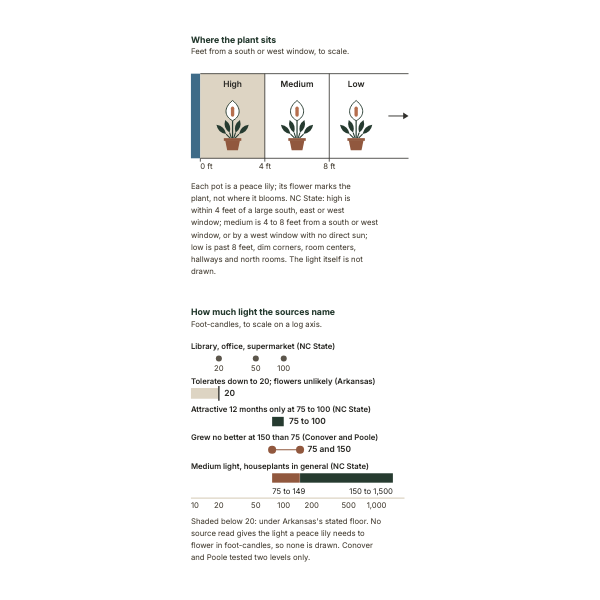
The extension sources do not say so. They differ on direct sun, and all of them want bright light. One reply’s claim, that a plant away from a window loses every leaf within a couple of weeks, is stronger than anything we found.
Maryland Extension says bright natural light “but avoid direct sunlight.” Clemson asks for at least six hours of bright, indirect sun and warns that direct sun may fade bracts. Vermont names south, east or west windows, with leaves off the glass.
Advice shifts with the stage. Once new growth appears, Iowa State and Illinois move the plant to a sunny window.
The closest measurement comes from growers. Nell and colleagues held ‘Freedom,’ a named cultivar or variety, at a low 10 micromoles of light per square meter per second, 12 hours a day, near 70°F.
In 1992 they reported leaf drop under 25 percent after 30 days. That is a conference abstract, one cultivar and not a home.
It does not make light irrelevant. Clemson lists poor light as a cause of early drop. Guo and colleagues found in 2018 that plants left in sleeves, with less light mid-canopy, ended with fewer leaves through abscission. Embry and Nothnagel described one cultivar as poor and another as superior for indoor longevity in 1994.
Both papers are cited from their abstracts. Together they suggest that low light can cost leaves, and that the speed depends on the plant.
Keep It Moist, or Let It Dry?
Each side of the second thread can find a source, and the sources sit closer together than the argument does.
| Source | Soil instruction |
|---|---|
| Clemson | Water when the surface feels dry; “Never let the potting mixture completely dry out” |
| UC Master Gardeners, Placer County | “evenly moist (not soggy)” |
| Vermont | Moist but not wet; water thoroughly when dry |
| Iowa State, Maryland, Texas A&M | Water when dry to the touch |
| NC State | Water when the surface feels dry; tagged drought tolerant |
Clemson’s line shows how these fit. Dry at the surface is the signal to water, and it does not mean a dry pot. None of these sources gives an interval, so one watering in three weeks has no support as a rule.
Iowa State says to check the soil daily. Being a euphorbia does not settle it, because Iowa State also says plants left too dry wilt and drop leaves. The mix tells you more than the calendar does.
Growers do dry poinsettias on purpose. Guo’s team compared 20 and 40 percent moisture in the substrate, or growing mix. Drier plants were more compact with better quality afterward, and constantly wetter plants dropped more bracts in 2016. But drier plants also lost photosynthesis and root and shoot weight.
Alem and colleagues reported in 2015 that lowering substrate water kept plants shorter with no effect on bract size or color. Both are cited from their abstracts, and both held moisture to a target in a greenhouse. Neither tested a dry pot on a windowsill.
How you water matters too. Iowa State says to lift the plant from its cover, water in the sink until water runs from the bottom, and put it back. Maryland suggests removing the foil or poking holes in it, for the reasons a pot needs a way out.
What to Do With the Plant You Have
Work through these in order, because each step rules something out before you change anything else.
- Check the stems. Feel along each one for firm stems against shriveled, dried ones. New Hampshire warns that drying to that point kills the plant.
- Check the mix. Take off any foil or sleeve, pour out standing water and push a finger in. Compare what you find with the wet and dry rows of the table above.
- Check the roots if the mix stayed wet. Ease the plant from its pot. Texas A&M describes clean white roots as healthy and brown, mushy ones as rotted. We found no rescue for a badly rotted poinsettia.
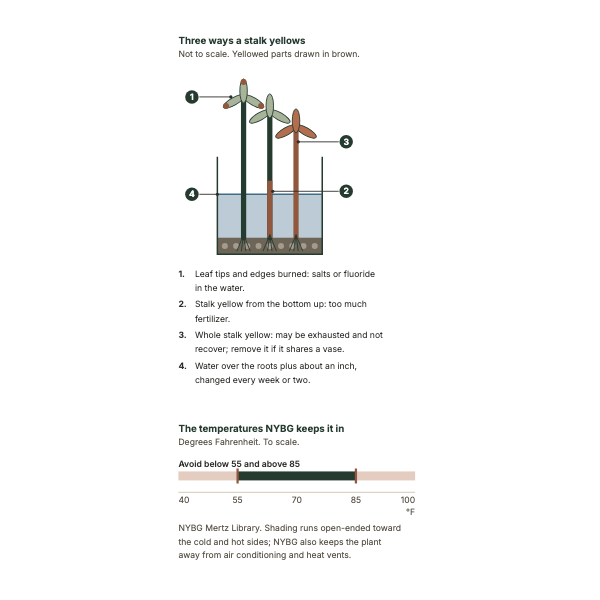
- Move it. Choose bright light, away from doors, vents, fireplaces and cold glass. Texas A&M gives 60 to 70°F, and Clemson warns of chilling below 50°F.
- Water by the surface. When the top feels dry, water until it drains, then empty the cover.
- Decide whether you want a rest, then wait. New Mexico State expects sprouts within a few weeks once a pruned plant is bright, warm and watered.
Is a Rest Required?
No source we read says it is. Calendars aiming at the same December result disagree on this one point, which is easy to miss when you read them one at a time.
One plant, four published calendars
What four extension sources tell owners to do through the year, for a poinsettia kept to bloom again.
Two of the four include a rest and two state none. All four give long nights from about the start of October.
Illinois dries the plant fully and stores it somewhere cool and dark until growth starts. New Hampshire reduces water from April at about 60°F. New Mexico State calls a semi-dormant spell, cool and barely watered, an option for when growth is not yet wanted.
Iowa State and UC Placer mention no rest, Clemson describes none, and Vermont’s easier route treats the plant like any other houseplant. We found no trial comparing the two approaches, so neither can claim to be better.
One caution applies to any cool rest. New Mexico State’s 50°F sits exactly at the line where Clemson warns of chilling injury, so that advice leaves no margin.
On cutting back, the heights agree better than the dates.
Iowa State cuts to 4 to 6 inches in March, UC Placer to about 6 inches in March, Clemson to about 8 inches in March or April, and New Hampshire to 3 to 6 inches in May.
Illinois cuts to 4 to 6 inches once new growth starts, usually in early May. Clemson says new growth emerges from nodes along the stem. Why buds wake after a cut is covered in what happens when you cut a houseplant back.
If you already cut yours in a panic, New Mexico State’s answer to a January question about bare plants is some comfort: it says stems can be pruned after they drop their leaves, once you are ready to encourage growth.
Wear gloves. The stems bleed milky sap wherever they are cut, and New Hampshire advises rinsing it off. NC State says it can cause contact dermatitis and, in the eyes, “temporary to permanent damage to the cornea.”
For a summer outdoors, Iowa State hardens plants over 7 to 10 days, like other houseplants.
Will It Turn Red Again?
It can, though Clemson calls the process “somewhat demanding.” Poinsettias are short-day plants, which flower in response to long nights. South Dakota State says phytochrome, a light-sensing pigment, is how plants read the dark period.
Time is the first correction. One reply put the change at about two weeks of long nights. New Hampshire says most varieties need eight to 10 weeks of short days, Clemson agrees, and New Hampshire’s example starts on October 9 for color by December 18.
The sources agree on long nights and give different hours. UC Placer says buds set with dark periods of 12 hours or more, while Clemson, Maryland and Vermont say 14.
Iowa State, Illinois, New Hampshire and UC Placer all prescribe 5 p.m. to 8 a.m., which is 15 hours and covers the others.
Stray light is the classic failure. South Dakota State says lights near greenhouses can delay a crop by several weeks, and Maryland warns “Even a small light leak will prevent flowering.”
Dose may matter. Zhang and Runkle, in a 2019 paper cited from its abstract, found two hours of very dim added light did not change flowering time, while most four- and six-hour treatments delayed it. That is two cultivars under specific LEDs, not permission to leave a lamp on.
Vermont describes a route with no closet, where color develops as days shorten. UC Placer expects an old plant left alone to bloom in January or February. Maryland adds that rebloomed plants are unlikely to match greenhouse size and quality.
Readers split on whether this is worth doing, and neither side is wrong. Iowa State says to toss the plant when you tire of it, and UC Placer suggests simply buying new ones for the holidays.
Can a Poinsettia Live Outside?
Year round, only where it does not freeze. Vermont Extension rates poinsettias hardy in USDA zones 9 to 11 and says they will not survive outdoors all year in the Northeast.
In their native Mexico and Central America, it adds, they grow into shrubs 10 to 15 feet tall that bloom year after year.
Where winters allow it, the University of Florida’s Gardening Solutions suggests planting a holiday poinsettia in the landscape after the last frost.
Remove the faded bracts, choose a spot in full sun for most of the day with moist, well-drained, fertile soil, and pinch the plant back several times over the summer.
The same page calls poinsettias tropical plants that must be protected from frost and freezing weather. It also warns that artificial light at night in the fall can delay flowering or prevent it altogether.
One trial showed what that light does. Wilfret grew plants in containers in a shade house and lit them for four hours in the middle of the night; bract color was delayed in direct proportion to lighting past early October, and lit plants made more leafy nodes before flowering, according to Wilfret’s 1994 meeting abstract.
Elsewhere a potted poinsettia can spend the summer outside. The sources agree on waiting for warm nights and differ on the mark: Illinois Extension’s houseplant page says nights above 50°F, and New Hampshire says a minimum consistently above 60°F, in a partly shaded spot.
Illinois moves the plant into direct sun gradually over a week or two, sinks the pot where it gets six to eight hours of sun with some afternoon shade, and brings it back inside when nights fall to 55 to 60°F. New Hampshire brings it in at the end of August or start of September.
Why It May Not Turn Red on Time
Warm nights can slow the color too. Illinois Extension says night temperatures above 70 to 75°F may delay or prevent flowering, and growers’ research explains why: temperature shifts the night length the plant needs.
For one older cultivar, a bulletin in NC State’s horticulture library reports the critical day length for starting flowers as more than 13 hours at 60°F but only 9 to 10 hours at 80°F. At 80°F, then, that cultivar needed nights of 14 hours or more.
Alden and Faust, in HortScience in 2021, found that under a 12-hour night, typical of September and early October, plants progressed toward flowering about half as fast as under 13 or 14 hours, and warm days slowed them further. Under 14-hour nights, warm days had relatively little effect.
In a later study, the same team found that nights of 12 hours or more gave only small differences in how the flowers developed once started, and that 13 hours or more was best, with 11 hours falling short.
Millar and colleagues, in 2025, located the most sensitive hours: temperatures of 26°C (79°F) or more during the last six hours of the night and the first two hours of the day delayed flowering most, during the first two weeks of long nights.
Cultivars differ. In Millar and colleagues’ 2023 greenhouse study, one cultivar was sensitive to heat from early September to the start of October, and another from early September to late October.
How Long Does a Poinsettia Last?
As a holiday display, weeks to months. Illinois Extension says that depends on the maturity of the plant, when you buy it and how you treat it, and that some varieties stay attractive for months.
The University of Florida says plants can keep their color until March if they are not exposed to freezing temperatures.
As a plant, much longer. Vermont Extension calls the poinsettia a perennial, and New Hampshire describes reblooming the same plant for several years, with plants attractive for four to six weeks after the date they come into color. No source read gives a lifespan in years for a potted poinsettia.
Cold shortens the display. Illinois warns that even a few minutes of low temperature on the way home can damage the bracts and leaves, and says to keep the plant between 55 and 70°F, with about 65°F ideal for color.
Are Poinsettias Poisonous?
Their toxicity is low, but they are not harmless, and one reply’s claim that they are not poisonous at all goes past the evidence.
Krenzelok and colleagues analyzed 22,793 poinsettia cases reported to US poison centers, cited from the 1996 abstract. There were no deaths, 92.4 percent developed no toxicity, and 96.1 percent were not treated in a health care facility.
Most of those cases involved children, and they were reported calls, not confirmed ingestions.
A later review of 19,862 poinsettia ingestions, by Krenzelok and Mrvos, also recorded no deaths but logged one major effect from poinsettia. Across the three holiday plants it studied, 77.6 percent of exposures had no follow-up, so outcome data are thinner than the case count suggests.
The plant’s reputation, according to a 2012 review by Evens and Stellpflug, traces to a single unconfirmed death of a child in Hawaii in 1919. NC State rates it low severity, and Clemson says eating foliage may lead to stomachache, diarrhea or vomiting.
Pet Poison Helpline calls poinsettias “only mildly toxic to cats and dogs,” with vomiting, drooling and rarely diarrhea, plus skin or eye irritation from the sap. It says there is no antidote and treatment is rarely needed unless signs are severe. “Toxic to cats” covers a wide range.
Latex allergy is the group to take seriously. Evens and Stellpflug, drawing on an earlier paper, report that 40 percent of people with a latex allergy develop cross-sensitivity to poinsettia.
They note rare anaphylaxis reports in infants with atopic eczema and latex allergy, and say such families may want to avoid the plant.
The chemistry is unsettled in what we read. Evens and Stellpflug say this species lacks the irritant diterpenes of its genus, while Pet Poison Helpline says the sap contains diterpenoid esters.
Vogg and colleagues, in a 1999 abstract, found cultivars free of one class, ingenol derivatives, which does not cover every compound.
Local Regulations and Safety Advisory
Plant toxicity depends on the species, the amount and the individual, and a poison control service or a veterinarian can say whether a particular plant is a concern for your household. This article is general information, not medical or veterinary advice.
Authorities to consult:
- Poison control service
- Veterinarian or animal poison control service
If a child or pet may have eaten part of a plant, contact a poison control service or a veterinarian.
What Remains to Be Explored
We found no study that follows leafless poinsettias in homes, and no tested sign of life. Green stems as proof comes from readers, and the shriveled stem warning comes from extension advice.
A record of bare plants, with stem condition at the start and regrowth at the end, would change this answer.
We also found no trial comparing a rest with no rest.
The trials on moisture and low light come from production settings, on named cultivars, and most are cited here from abstracts. We found no home trial of watering by feel against a fixed interval.
No study read gives a poinsettia’s lifespan in years, or measures how long one survives outdoors near the edge of its hardiness. The heat and night-length trials used greenhouse cultivars under controlled conditions, not a plant on a porch.
The 50°F chilling line is extension guidance, and we found no measured threshold by cultivar or length of exposure. Nor do we know how long a plant can sit at that temperature while resting, or how either thread’s plant turned out.
Sources
- What Should I Do With My Poinsettia After the Holidays? — Iowa State University Extension, Yard and Garden. December 3, 2024.
- My poinsettia Has Lost Several Leaves. What Is the Problem? — Iowa State University Extension, Yard and Garden. Undated.
- Poinsettia Care After the Holidays — University of Illinois Extension, Good Growing. December 26, 2018.
- Poinsettias: Care and Reflowering [Fact Sheet] — University of New Hampshire Extension. Undated.
- Getting a Poinsettia to Rebloom — UC Master Gardeners of Placer County. Undated.
- The Perennial Poinsettia — University of Vermont Extension. December 13, 2022.
- Poinsettia — Clemson Cooperative Extension, Home and Garden Information Center. Undated.
- Caring for Your Poinsettias at Home — Texas A&M, Texas Plant Disease Diagnostic Lab. Undated.
- Poinsettias — University of Maryland Extension. Undated.
- Helping poinsettia Recover After Flowering — New Mexico State University, Southwest Yard and Garden. January 20, 2008.
- Euphorbia pulcherrima, North Carolina Extension Gardener Plant Toolbox — NC State Extension. Undated.
- Are You Photoperiodic? Poinsettias Are: An Explanation of This Unique Plant Process — South Dakota State University Extension. Undated.
- Poinsettia — Pet Poison Helpline. Undated.
- Holiday Plants With Toxic Misconceptions — Evens ZN, Stellpflug SJ. Western Journal of Emergency Medicine 13:538-542. 2012.
- Poinsettia Exposures Have Good Outcomes…Just as We Thought — Krenzelok EP et al. American Journal of Emergency Medicine 14:671-674. 1996. Cited from its abstract.
- Toxic Christmas and New Year Holiday Plants…or Are They? — Krenzelok EP, Mrvos R. Asia Pacific Journal of Medical Toxicology 4:64-67. 2015.
- Tumor Promoters in Commercial Indoor-Plant Cultivars of the Euphorbiaceae — Vogg G et al. Environmental Health Perspectives 107:753-756. 1999. Cited from its abstract.
- Primary and Secondary Abscission in Pisum sativum and Euphorbia Pulcherrima-How Do They Compare and How Do They Differ? — Hvoslef-Eide AK et al. Frontiers in Plant Science 6:1204. 2015. Cited from its abstract.
- Postharvest Behavior and Keeping Quality of Potted Poinsettia: A Review — Islam MA, Joyce DC. Research in Agriculture Livestock and Fisheries 2:185-196. 2015. Cited from its abstract.
- POSTPRODUCTION CHARACTERISTICS OF `FREEDOM’ POINSETTIA AS AFFECTED BY PRODUCTION AND POSTPRODUCTION CONDITIONS — Nell TA et al. HortScience 27:602f. 1992. Cited from its abstract.
- Leaf Senescence of Postproduction Poinsettias in Low-Light Stress — Embry JL, Nothnagel EA. Journal of the American Society for Horticultural Science 119:1006-1013. 1994. Cited from its abstract.
- Reducing Substrate Moisture Content During Greenhouse Production of Poinsettia Improves Postproduction Quality and Economic Value — Guo Y et al. HortScience 53:1618-1628. 2018. Cited from its abstract.
- Controlled Water Deficit as an Alternative to Plant Growth Retardants for Regulation of Poinsettia Stem Elongation — Alem P et al. HortScience 50:565-569. 2015. Cited from its abstract.
- Regulating Flowering and Extension Growth of Poinsettia Using Red and Far-Red Light-Emitting Diodes for End-Of-Day Lighting — Zhang M, Runkle ES. HortScience 54:323-327. 2019. Cited from its abstract.
- Poinsettia’s Wild Ancestor in the Mexican Dry Tropics: Historical, Genetic, and Environmental Evidence — Trejo L et al. American Journal of Botany 99:1146-1157. 2012. Cited from its abstract.
- Is My Poinsettia Going Into Dormancy or on Deaths Door? If It’s the Latter, What Can I Do to Help It? (R/Plantclinic Thread) — multiple community members. Reddit, r/plantclinic. Undated.
- Poinsettia Unhappy. Got this Plant About 3 Weeks Ago and the Leaves at the Bottom Are Yellowing. I’ve Been Watering When Soil Dries Out. Help Please! (R/Plantclinic Thread) — multiple community members. Reddit, r/plantclinic. Undated.
- Poinsettia — UF/IFAS Extension. University of Florida IFAS Extension, Gardening Solutions. Undated.
- Caring for Poinsettias — University of Illinois Extension. University of Illinois Extension (Houseplants). Undated.
- Basic Facts About the Response of Poinsettias to Daylength and Temperature — NC State Extension Horticulture Document Library. NC State Extension, Horticulture Document Library. Undated.
- Unravelling the Role of Temperature and Photoperiod on Poinsettia Heat Delay — Michael J. Alden, James E. Faust. HortScience (American Society for Horticultural Science). 2021. Cited from its abstract.
- Determining the Optimum Night Length for Flower Development in a Modern Poinsettia Cultivar — Michael J. Alden, James E. Faust. HortScience (American Society for Horticultural Science). 2022. Cited from its abstract.
- Identifying the Temporal Sensitivity of Poinsettia Flowering to High Temperatures — Paul D. Millar, James E. Faust, H. Brent Pemberton, Ruth S. Kobayashi. HortScience (American Society for Horticultural Science). 2023. Cited from its abstract.
- Identifying the Diurnal Sensitivity of Poinsettia Flowering to High Temperatures — Paul D. Millar, Ana María Borda, James E. Faust. HortScience (American Society for Horticultural Science). 2025. Cited from its abstract.
- EFFECT OF EXTENDED LIGHTING ON POINSETTIA `ECKESPOINT FREEDOM’ — Gary J. Wilfret. HortScience (American Society for Horticultural Science). 1994. A meeting abstract, not a full paper.