Check the mix first, then the leaves. A pearl that starts to shrivel in dry mix needs water, while one that shrivels in wet mix may have dead roots and needs the opposite. The popular rule of watering when the leaf window closes is a grower’s sign, and we found no study that has measured it.
That rule has a following, and a public argument. When one grower posted a care guide after killing a third plant, a reply offered it as the tip: the windows close when the plant is saving water, and that means it can safely take more.
Years later, a long photo essay told growers not to bother with the sign, and the same account returned, now identifying as the botanist behind the advice, to defend it.
The botanist’s case is that the window admits light for photosynthesis, which uses water, so a plant running low closes it.
The essay’s author answered that with a fast-drying mix the sign is unnecessary, and that closed windows and shriveled leaves can be only days apart. Neither reply offers a measurement, so the question is what has been measured.
What the Window Is
Each leaf is a small sphere, and the darker line along its side is the window. University of Wisconsin Extension calls it an “epidermal window” that lets light into the leaf.
It is built in from the start: Hillson’s 1979 study, cited from its abstract, found it marks the position of a growth zone that gives the leaf its round shape.
What the window is, and what is only reported
The same leaf cut through twice. The left side is documented. The narrowing on the right is a growers’ observation.
The window lets light into the leaf. We found no measure of whether it narrows as the plant runs short of water, and a shrunken leaf can also mean dead roots in wet mix, so check the mix first.
Light does get in. In a 2008 study, cited from its abstract, Egbert and colleagues put a fine probe inside the leaves of six window-leaved succulents, this plant among them.
Light levels at most points were high, near those at the window surface. Under a window, Krulik wrote in 1980 of window-leaved plants in other families, the “water storage tissue is transparent.”
The usual explanation, repeated on the Wisconsin and NC State pages, is that this adds area for photosynthesis. The research is less tidy.
A 2002 study on seven succulents including this one, also from its abstract, found “the efficiency of the photosynthetic mechanism was not significantly influenced” by the extra light through the window, taking each species alone.
The 2008 abstract mentions earlier findings that taping over windows did not cut photosynthetic activity. The botany writer behind In Defense of Plants says research “suggests that reality is not that simple.”
Does the Window Close When the Plant Is Thirsty?
We could not find out. We looked for any study linking the width of the window to water in this plant, and found none.
The abstracts of the anatomy and light papers above do not mention it, and neither extension page on this plant uses the window as a watering sign.
That does not make the rule wrong. These leaves store water, and a 2022 review in the Journal of Experimental Botany, cited from its abstract, says the cell walls in succulent tissues can fold during extended drought, “permitting reversible volume changes.”
A 2022 perspective article says that if stored water can be mobilized during drought, succulents can dehydrate while holding their internal water status at safe levels. Both papers speak of succulents in general, and no source we read connects shrinking tissue to the width of the window.
The stronger objection is about what the sign can tell you, even if it is real. At most it would show that a leaf holds less water. It could not show why. For that you need the mix.
Why a Shriveled Plant Is Not Always a Thirsty One
This is the mistake that makes things worse. Iowa State Extension explains that waterlogged soil is low in oxygen, so roots die. “With fewer roots to absorb water, plants begin to show symptoms of water stress by dropping leaves or shriveling up.” It adds, “These symptoms are often confused for underwatering and more water is added further exacerbating the problem.”
NC State says much the same of this plant: “Wilting leaves can occur from underwatering or overwatering.” Wisconsin calls root rot from overwatering “the most common cause of its demise.”
So the sign in the leaf points two ways, and the pot separates them. Iowa State gives a further clue for succulents generally: overwatered plants have “soft and mushy leaves and stems” and a wet or damp soil surface, while underwatered ones may turn wrinkled and mottled. See root rot and saturation for why wet mix does the damage.
Long drought does harm too, which supports the essay’s warning. Iowa State says that when succulents go too dry, “Roots die due to lack of water,” and that when finally watered they “may not recover well because the root mass is not large enough.”
The essay’s author goes a step further: too long without water, dead roots, then rot once the plant is watered. That last step is a grower’s account.
Dry Out Completely, or Never?
Here the extension sources take two positions that cannot both be followed, and none of the three pages cites a trial.
| Source | Advice on drying | Sign to water |
|---|---|---|
| University of Wisconsin | “dry out completely between waterings” | Leaves “start to look a bit shriveled” |
| Iowa State, succulents generally | “let the soil dry completely” | Soil dry several inches down |
| NC State | “Never allow your plant to completely dry out” | None given |
Readers split the same way, with reports of success from frequent watering, watering from below, and neglect. We found no comparison testing those reports against each other.
Iowa State offers every two to three weeks as a starting point for succulents generally, with a soil check first, and says frequency “depends on light, soil, container type, temperature, and humidity.”
Wisconsin adds the season for this plant: more water in summer than in winter, when it is not actively growing, with a winter rest in cool conditions of 55 to 60°F. Iowa State’s rule for a pot still damp several inches down is to wait a few days.
All three warn against a pot that stays wet, and Iowa State and NC State warn against too little water as well. Where they part is how close to dry the mix should get, and on that point we cannot tell you who is right. Wisconsin’s sign, a slight shrivel, is the only one in the table that is specific to this plant.
Water From the Top, or Soak It From Below?
A second set of rules comes up when a plant has gone very dry. In a thread about a neglected string of pearls that looked far better after a good soaking, replies advised soaking the pot from below for 20 to 30 minutes, longer after a long drought.
Replies also warned that watering from the top rots the pearls, and that mix left to dry out turns water-repellent. The last of those claims has support. Virginia Tech Extension’s 2026 guide to watering container houseplants says dry potting soils, “especially peat or bark-based ones,” can become hydrophobic, meaning the mix repels water.
The guide adds that fast, heavy drainage “usually indicates that the potting soil did not hydrate sufficiently.” Water that runs straight out of the hole is not proof the plant drank.
The research points the same way. In a 2021 study, cited from its abstract, Durand and colleagues found peat-based mixes became more water-repellent and less able to rewet the harder they had been dried, while wood fiber stayed easy to wet.
A 2014 study of peat, coir, pine bark, perlite and other mix ingredients, also from its abstract, found that how well each took up water depended partly on how dry it was to begin with. NC State’s Extension Gardener Handbook says peat or pine bark “that is excessively dry is very difficult to rehydrate.”
That sits awkwardly beside the advice to let the mix dry completely, and no source we read addresses the two together. None measured how dry a string of pearls pot gets, or how a gritty mix like Iowa State’s, two-thirds mineral, rewets.
Virginia Tech gives two checks for mix that is shedding water. Lift the pot after watering: if it still feels light, the water did not go in. Or push a finger into the mix to find dry pockets left in the middle of the pot.
It gives two ways to fix it. From the top, “two or three slow applications of water will help hydrate dry potting soils.” From below, set the pot in a shallow basin of 2 to 3 inches of water for 15 to 30 minutes, depending on how dry the mix is. The pot needs a drainage hole.
Water-repellent mix may take longer to soak up water, and the guide says to repeat the soak until the mix feels moist. A moist surface shows the pot has taken up enough. Nebraska Extension’s houseplant guide gives the same rescue for mix that is excessively dry.
Both guides set limits. Virginia Tech says houseplants “should not be left in basins of water for an extended period of time (more than 60 minutes), or root rot could occur,” which is shorter than the longest soaks the thread suggested. Iowa State says water should never sit in trays, sleeves or double pots under succulents “for more than a few hours.”
Soaking is not always the better way to wet a mix. In a 2020 study, cited from its abstract, Schulker and colleagues found that watering from the surface got more water into peat and coir than watering from below, whatever their starting moisture, and the first watering captured the most. That study tested mix ingredients, not a potted string of pearls.
Colorado State Extension says that in general it is better to water from the top, because watering from below can build up salts in and on the mix, and advises watering from the top now and then if you usually water from below. What bottom watering does to the pot covers where those salts collect.
Whether top watering rots the plant is untested. Virginia Tech says some plants do not tolerate wet foliage, naming African violets, begonias, cyclamens “and some cacti,” and advises watering onto the mix, below the leaves. No source we read names string of pearls among them, and none compared top and bottom watering on this plant.
Pot and Mix
This is where the essay and the extension sources agree: pot and mix should let water leave quickly. Wisconsin says, “Use a shallow container since the plants will not produce an extensive root system,” and warns that a plant unable to draw moisture from a large soil volume is more open to rot.
Wisconsin prefers clay, because “the material allows evaporation through the sides so the soil will dry out more quickly.”
For mix, Wisconsin suggests cactus mix, or potting medium with gravel, sharp sand, grit or pumice at up to 1:1. Iowa State suggests one-third organic material to two-thirds mineral.
Why succulents keep dying covers the wider problem.
The essay’s argument is that with the right pot and mix you can stop watching for signs and water often, and its author’s own plants are the evidence offered.
The author grants that the sign can help where the soil holds too much organic material or the pot keeps moisture in. We found no trial of that argument against the window rule, though it fits Wisconsin’s reasoning on shallow pots and clay.
How Much Light?
The sources are cautious here, and readers go both ways. Wisconsin says it “only needs bright light” and notes that in the wild it often grows under bushes or between rocks, which gives some protection from intense sun.
NC State recommends bright, indirect sun indoors, and warns, “Scorching of the leaves can occur from direct sunlight.”
The essay’s author, using a grow light, argued that the plant wants more than what is usually called bright indirect, while also saying these plants do not like direct sun. One reply reported success only out of direct sun, and another keeps its plants outdoors in full sun for part of the year. A third reader blamed a dead plant on sunburn from a shaded patio.
We found no measured light requirement, so the fair summary is bright, with care about strong direct sun. Changes should be gradual, as moving plants outdoors explains, and Wisconsin says the same of this plant.
What to Do With the Plant You Have
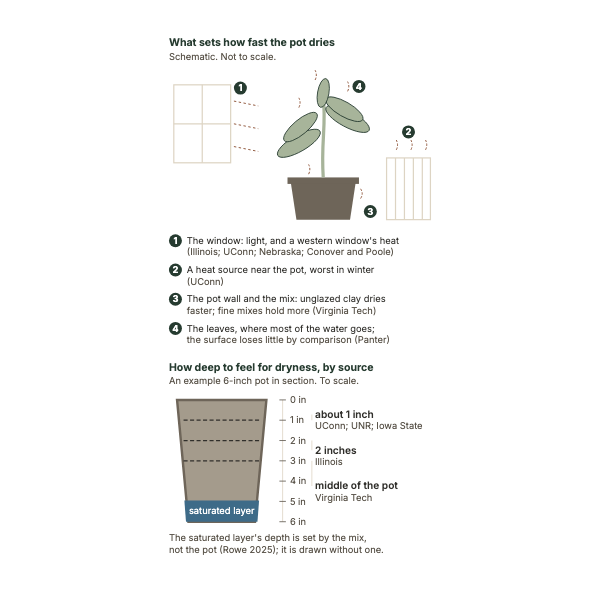
- Feel the mix. Each moisture check reads something different, so use more than one. Iowa State’s method is a chopstick: push it into the mix, and if it comes out dark with moisture, the plant does not need water yet. If the mix is wet and the pearls are soft or shrinking, stop watering.
- If it keeps declining in wet mix, treat it as root rot. Let the mix dry. Iowa State says plants “can recover from root rot when allowed to dry out,” but that rot can be too advanced for recovery, and that soil too organic or fine should be replaced with sharp-draining soil.
- If the mix is dry and pearls are shriveling, water thoroughly, wetting the whole root ball until it drains, as Iowa State advises, and do not leave it in a full saucer. If the pot still feels light afterward, the mix has not taken the water: give two or three slow waterings, or soak it from below for 15 to 30 minutes and no longer than an hour, as Virginia Tech describes.
- If you like the window sign, use it alongside the mix, not instead of it.
- Take cuttings instead of saving a failing plant. NC State says these plants “tend to die back after several years” and advises, “Propagate by stem cuttings instead of trying to revive the older plant.” Iowa State also says to “propagate healthy-looking segments.” Wisconsin’s method is a 3 to 4 inch stem tip with 3 to 4 leaves stripped from the bottom, placed in or on moist potting mix with the last few nodes, the points where leaves join the stem, lightly covered.
We found no measurement of whether shriveled pearls plump up again on this plant. The review above describes reversible volume changes in succulent tissue generally, and Iowa State warns that a plant that lost roots to drought may not recover well.
The botanist in the thread says waiting until leaves shrivel does harm that builds up in the foliage, which runs against Wisconsin’s sign and which no source we read measures.
Keep it away from pets and small children, and wear gloves when handling it, as NC State advises. NC State says, “This plant is toxic to both humans and pets,” flags it as a problem for cats, dogs, horses and children, and says eating the leaves can cause vomiting and diarrhea, rating the severity low. Wisconsin says the sap may irritate sensitive skin.
If a pet or child eats it, the advisory below says who to call.
Local Regulations and Safety Advisory
Plant toxicity depends on the species, the amount and the individual, and a poison control service or a veterinarian can say whether a particular plant is a concern for your household. This article is general information, not medical or veterinary advice.
Authorities to consult:
- Poison control service
- Veterinarian or animal poison control service
If a child or pet may have eaten part of a plant, contact a poison control service or a veterinarian.
What Remains to Be Explored
We found no test of the central claim. We searched for any measurement of the window narrowing as water falls, and found none, and no study of how long separates that change from visible shriveling. The closest work we read on this plant concerns light and photosynthesis.
Two papers by Egbert and Martin, one from 1999 on this plant and one from 2000 on desert succulents with leaf windows, are ones we have not read, and they may hold more direct data.
We also found no comparison of watering from the top and from below on this plant, and no measure of how dry its mix can get before it starts to shed water.
Nor did we find a trial of watering frequency, soil type or pot type on this plant, no measured light requirement, and no record of how far shriveled leaves recover. The disagreement between extension services stands because we found no one who has run the comparison.
The window question would be cheap to settle. Photograph the same marked pearls daily through a drying cycle, weigh the pot, and note when the window narrows, when the leaf softens and when the mix dries. That would show whether the sign leads the shrivel or merely accompanies it.
Sources
- String of Pearls, Curio rowleyanus — Susan Mahr. University of Wisconsin-Madison Extension, Wisconsin Horticulture. October 2026.
- Curio rowleyanus, North Carolina Extension Gardener Plant Toolbox — NC State Extension. Undated.
- Common Problems and Issues of Succulents — Iowa State University Extension, Yard and Garden. August 2023.
- Growing Succulents Indoors — Iowa State University Extension, Yard and Garden. December 2024.
- The Influence of Epidermal Windows on the Light Environment Within the Leaves of Six Succulents — Egbert KJ, Martin CE, Vogelmann TC. Journal of Experimental Botany 59(7):1863-1873. 2008. Cited from its abstract.
- The Influence of Leaf Windows on the Utilization and Absorption of Radiant Energy in Seven Desert Succulents — K.J. Egbert and C.E. Martin. Photosynthetica 40(1):35-39. March 1, 2002. Cited from its abstract.
- Light Transmission in Window-Leaved Plants — Gerald A. Krulik. Canadian Journal of Botany 58:1591-1600. July 15, 1980. Cited from its abstract.
- Leaf Development in Senecio rowleyanus (Compositae) — Charles J. Hillson. American Journal of Botany. January 1979. Cited from its abstract.
- Elastic and Collapsible: Current Understanding of Cell Walls in Succulent Plants — Fradera-Soler M et al. Journal of Experimental Botany 73(8):2290-2307. 2022. Cited from its abstract.
- Are Cell Wall Traits a Component of the Succulent Syndrome? — Fradera-Soler M et al. Frontiers in Plant Science 13:1043429. 2022.
- Your String of Pearls (and Its Cousins) Are All Members of the Daisy Family — In Defense of Plants. November 12, 2019.
- Properly Watering Container Houseplants (SPES-804P) — Kristopher S. Criscione and Ashton Holliday-Goulart. Virginia Cooperative Extension, Virginia Tech. May 2026.
- 18. Plants Grown in Containers — North Carolina Extension Gardener Handbook, NC State Extension. Undated.
- 1318 – Houseplants Watering — Colorado State University Extension, PlantTalk Colorado. Undated.
- Guide to Growing Houseplants (G2205) — Frederick P. Baxendale, Stephen N. Wegulo, David E. Lott, Dale T. Lindgren. University of Nebraska-Lincoln Extension. July 2013.
- The Use of Wood Fiber for Reducing Risks of Hydrophobicity in Peat-Based Substrates — Stan Durand, Brian E. Jackson, William C. Fonteno, Jean-Charles Michel. Agronomy 11(5):907. May 5, 2021. Cited from its abstract.
- Hydration Efficiency of Traditional and Alternative Greenhouse Substrate Components — Jeb S. Fields, William C. Fonteno, Brian E. Jackson. HortScience 49(3):336-342. March 2014. Cited from its abstract.
- Comparison of Water Capture Efficiency Through Two Irrigation Techniques of Three Common Greenhouse Soilless Substrate Components — Brian A. Schulker, Brian E. Jackson, William C. Fonteno, Joshua L. Heitman, Joseph P. Albano. Agronomy 10(9):1389. September 14, 2020. Cited from its abstract.
- You Don’t Suck at Keeping Strings of Pearls Alive, You’ve Just Been Set up to Fail: A Photographic Essay (R/Houseplants Thread) — multiple community members. Reddit, r/houseplants. Undated.
- After Killing My Third String of Pearls I Decided to Make a Care Guide (R/Houseplants Thread) — multiple community members. Reddit, r/houseplants. Undated.
- Been Thoroughly Neglecting My String of Pearls, but What a Difference a Good Soaking Makes. (R/Succulents Thread) — multiple community members. Reddit, r/succulents. Undated.