You can, and it may help, but it is optional. Movement really does make trees shorter and thicker. We found no test of a weekly shake on a fiddle leaf fig, though, so no one can say how much it would do. If your fig is leaning or leggy, fix the light first: the New York Botanical Garden (NYBG) ties leggy, unstable growth to too little light.
The tip has an unusually public history. A post on r/houseplants showed an owner spraying and shaking a fig each week as a home hurricane, on the reasoning that the plant comes from the tropics and misses its storms. Many readers were delighted, and others asked whether it worked.
The replies split. One side said shaking thickens the trunk. The other said nothing happens, that a bending fig needs more sun, and that a few minutes of shaking cannot stand in for wind. Both sides have something, and the evidence shows which part of each holds up.
What Movement Does to a Stem
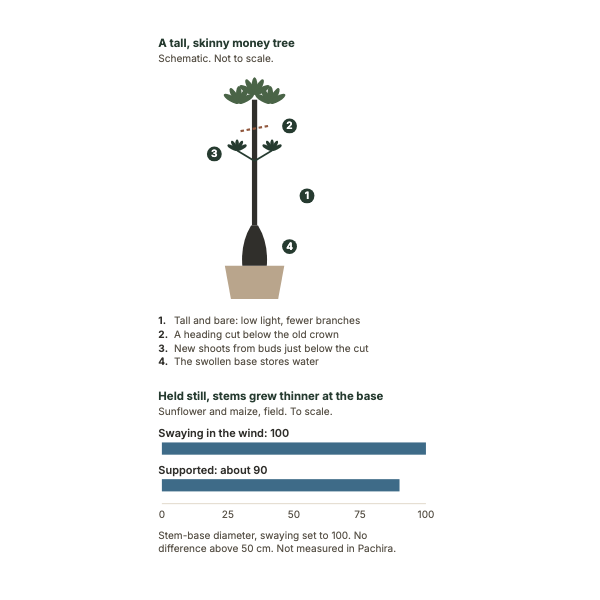
The effect is real, and it has a name: thigmomorphogenesis, growth changed by touch or movement. Frank Telewski’s 2021 review sums up the response of trees and other plants to bending as “a reduction in extension/height growth, increase in radial growth, and increased allocation from above-ground to below-ground tissues.” Radial growth means getting thicker.
The combined result is a differently shaped tree. The same review says the pattern “increases stem taper,” meaning the trunk widens toward its base.
It lists wind as the main cause in trees, along with rain and passing animals. Most trees show it: “With a few notable exceptions,” the broadleaf and conifer trees studied “exhibit some degree of a thigmomorphogenetic response.”
What movement does to a young tree
The general response reviewed for trees, drawn to show direction only. How much of it a weekly shake produces is unknown.
Bending slows height growth and adds thickness, so a stem tapers, and it shifts growth toward roots. The response depends on dose, and we found no test on a fiddle leaf fig.
It can also act fast. A table in the review times the first steps in minutes, with stem elongation stopping within 4 to 8 minutes of a stimulus and shoot growth recovering within the hour.
A review in Plant, Cell & Environment, cited from its abstract, says “Prolonged mechanical stress for days to weeks culminates in cellular changes that strengthen the plant architecture.”
One early demonstration is short and striking. In 1971, Neel and Harris reported in Science, cited from its abstract, that “Moderate shaking of Liquidambar trunks for 30 seconds daily reduced height growth to only 20 to 30 percent of that of trees not shaken.” Liquidambar is sweetgum. So seconds can count, at least on that tree.
That result also carries a caution, because what it reported was lost height, on sweetgum and not on a fig. Six of the eight shaken trees also set terminal buds within three weeks, ending their growth for the time being.
Shaking is a brake on the top as well as a boost to the base, so a grower hoping for a taller tree should weigh that.
Has Anyone Tested This on a Houseplant?
Not on this one, as far as we can find. We searched for any study of movement on Ficus lyrata, the fiddle leaf fig, and found none. NYBG’s care guide and NC State’s plant profile do not mention it.
What exists is a trade claim: one retailer’s plant doctor told Gardeningetc that most tall houseplants need no shaking, but that figs “can grow quite weak and do not support themselves very well” and should get a good shake from time to time. He gives no study or measurement.
The two nearest studies point opposite ways. For the tip, Marler’s 2019 study, cited from its abstract, bent the stems of shade-grown Serianthes nelsonii plants in containers “two times daily for a 14 wk nursery production period.” The flexed plants were shorter and stronger. The untouched ones showed “undesirable lean of the main stem.”
Against it stands a real houseplant. Langer and colleagues gave Pilea peperomioides six weeks of brushing, steady wind or both, and reported, again from the abstract, that “neither the petiole nor the transition zone showed significant thigmomorphogenetic acclimations.”
The petiole is the leaf stalk, so this is leaf tissue and not a trunk. It does not settle the matter for a tree, but it shows that six weeks of movement can leave a houseplant’s leaf stalks without a significant change.
A fig is a tree, and the review says most woody tree species respond to some degree. No source we read says whether the fiddle leaf fig is among them or among the exceptions.
Does a Weekly Shake Count?
This is the strongest objection in the thread, and the evidence cannot answer it. The review says the response “has been shown to be dose dependent,” which means its size depends on how much movement the plant gets, so the reader who doubted that a brief shake can stand in for wind has a point in principle.
The studies with clear results moved plants far more often than the weekly routine in that post. Sweetgum was shaken daily, and Marler’s plants were bent 90 degrees twice a day.
We found no test of a weekly schedule, and no dose shown to work on any houseplant. So any instruction you see for a fig, such as how many seconds or how many times a week, has no trial behind it that we could find.
Shaking, a Fan or Brushing
Some readers suggested a fan instead. No study we found tested a fan on a fig, so no source says it beats shaking.
NYBG’s guide asks for “good air circulation,” yet also says, “Protect it from all drafts,” naming air conditioning vents, open windows, open doors and heat vents. It does not mention fans.
Nurseries offer the nearest experience. UConn Extension says, “Mechanical stress reduces stem elongation and improves stem strength,” but adds that for vegetable transplants “brushing is more effective than using wind or shaking the transplants.”
The same sheet shows the limits. It says transplants “resume their normal growth about 3 days after the brushing stops,” and that “brushing may damage tender plant species such as peppers.”
That is seedlings, not a woody fig, yet it is a reminder that this is a stress you are applying on purpose. NYBG also says young fig leaves are “easily damaged by touch,” though it says so about wiping them.
Sources agree the effect is real and give different durations. Those seedlings were back to normal in days, while the Plant, Cell & Environment review says the changes “can persist throughout growth without continued stimulation.”
One claim in the thread is that shaking breaks root hairs. We found no evidence for or against that.
Why Is It Leaning, Then?
Check light before you blame the trunk. NYBG says a fig needs the brightest room in the home, and states, “Leggy or unstable growth indicates inadequate light. The entire plant may grow tall and weak, with a frail trunk.” The reader who said a leaning fig wants more sun was on firm ground, with one caution: NYBG means bright, indirect light, not direct rays.
For a lean, it advises, “Turn the tree a quarter turn every time you water so that all sides receive equal light and a balanced shape is maintained.” For leggy branches, it says to prune to a node in the spring and move the plant somewhere with brighter, indirect light.
Light may not be the whole story, at least in another species. All of Marler’s plants were shade-grown, yet the unflexed ones leaned while the flexed ones stayed close to upright.
Singapore’s National Parks Board notes that “Potted young trees tend to assume leggy monopodial form, with single non-branching stem,” so a thin single stem is also common in a young potted fig. It advises pruning the growing tip “from an early age to encourage branching.”
Stretching in dim light is covered in why no houseplant likes low light and whether stretched growth recovers. Cutting back is covered separately.
Do They Need Storms?
The hurricane story finds no support in what we read about the plant’s home. NYBG says the species “grows in lowland, tropical rainforests,” and that the immature plants we keep “would be growing under the natural protection of a leafy, tropical canopy of mature trees.”
NC State and Singapore’s parks board place it in tropical western and central Africa. None of those sources describes a stormy home.
That does not undo the mechanism, because the review states its pattern for most woody trees and does not limit it to windy places. It does leave the idea that a fig is missing its storms with no support. The story and the biology are separate things, and only the biology has evidence behind it.
The spraying half of the routine has less behind it. A brief mist does little for humidity, as what actually raises humidity explains.
Clean leaves are a separate job. NYBG says accumulating dust “interferes with photosynthesis,” and advises wiping the leaves with a damp cloth, supporting each leaf as you wipe.
What to Do With Your Fig
- Sort out light first. Give it your brightest room, just far enough from the window that direct sun does not touch it, and turn it a quarter turn each time you water, as NYBG advises.
- Treat shaking as an experiment, if you try it. The studies above moved plants daily or twice daily, and sweetgum got a moderate shake. We found no schedule tested on a fig.
- Do not expect it to fix a sick plant. NYBG says, “Too much water is among the most frequent causes of fig failure,” and that figs react to temperature swings by dropping leaves. See root rot and saturation.
Handle it with some care. NC State says, “The stems have a milky sap that can irritate the skin,” recommends gloves when handling the plant, particularly when pruning or propagating, and warns, “This plant is toxic to humans, cats, and dogs if ingested.” Keep it away from pets and children; the advisory below says who to call if any of it is eaten.
Local Regulations and Safety Advisory
Plant toxicity depends on the species, the amount and the individual, and a poison control service or a veterinarian can say whether a particular plant is a concern for your household. This article is general information, not medical or veterinary advice.
Authorities to consult:
- Poison control service
- Veterinarian or animal poison control service
If a child or pet may have eaten part of a plant, contact a poison control service or a veterinarian.
What Remains to Be Explored
We could not find the central trial. We searched for any test of shaking, flexing or fans on a fiddle leaf fig, or on any potted Ficus, and found none. We also found no dose shown to work on any houseplant, no test of a weekly schedule, and no evidence on whether shaking harms roots.
The evidence on how long the effect lasts is mixed, and what we read comes from vegetable seedlings and a review of the short-lived annual Arabidopsis and other species, not from houseplants in a home.
A simple test would settle it. Take matched young figs in the same light, flex half for a few seconds daily, and measure stem diameter near the base with calipers for a year.
Until someone does, a weekly hurricane is a routine with a true idea behind it and no measured result, and light remains the better supported fix.
Sources
- Mechanosensing and Plant Growth Regulators Elicited During the Thigmomorphogenetic Response — Frank W. Telewski. Frontiers in Forests and Global Change 3:574096. January 18, 2021.
- Thigmomorphogenesis and Biomechanical Responses of Shade-Grown Serianthes nelsonii Plants to Stem Flexure — Marler TE. Plant Signaling & Behavior 14:1601953. 2019. Cited from its abstract.
- Acclimation to Wind Loads and/or Contact Stimuli? A Biomechanical Study of Peltate Leaves of Pilea peperomioides — Langer M, Hegge E, Speck T, Speck O. Journal of Experimental Botany 73:1236-1252. 2022. Cited from its abstract.
- Mechanical Stress Acclimation in Plants: Linking Hormones and Somatic Memory to Thigmomorphogenesis — Brenya E, Pervin M, Chen ZH, Tissue DT, Johnson S, Braam J, Cazzonelli CI. Plant, Cell & Environment 45:989-1010. 2022. Cited from its abstract.
- Mechanosensing and Thigmomorphogenesis, a Physiological and Biomechanical Point of View — Coutand C. Plant Science 179:168-182. 2010. Cited from its abstract.
- Managing Plant Height of Vegetable Transplants — Leanne Pundt. UConn Extension, Integrated Pest Management Program. 2024.
- Fiddle-Leaf Fig Care Guide — New York Botanical Garden, Mertz Library. Undated.
- Ficus lyrata, North Carolina Extension Gardener Plant Toolbox — NC State Extension. Undated.
- Ficus lyrata, Flora and Fauna Web — National Parks Board, Singapore. Undated.
- Indoor Plant Expert Warns Against the Latest House Plant Shaking Hack — Gardeningetc. Undated.
- Motion-Induced Inhibition of Elongation and Induction of Dormancy in Liquidambar — Neel and Harris. Science 173(3991):58. July 2, 1971. Cited from its abstract.
- They Say “Plants Are Boring,” yet I Have to Create a Hurricane for My Fiddle Leaf Fig Every Week […] (R/Houseplants Thread) — multiple community members. Reddit, r/houseplants. Undated.