Nobody has tested what one spilled cup of coffee does to a houseplant, so nobody can promise it will be fine. What is known points to one step: rinse the pot with plain water.
Brewed coffee holds about twice the caffeine concentration that slowed seedlings in a laboratory test, and caffeine dissolves readily in water. So run plain water through the pot a couple of times, let it drain, and then let the mix dry out before you water again.
Feeding, acid and repotting all came up in the replies to the thread below. None of them has evidence behind it here, and the sections that follow say why.
The question arrived in its best possible form. On r/houseplants, one grower asked, purely hypothetically, twice, what would become of a string of hearts that had a cup of coffee tipped over it while it sat draining in the sink.
Many replies were jokes about a plant with a new caffeine habit. The serious ones split. Several said a long rinse under the tap would clear it. Others said coffee feeds plants, or that its acid suits this one.
Some thought the heat would matter more than the coffee, or that cream or sugar would be the real trouble. One said to change the soil and wash the roots. Each of those claims can be checked against what has been measured.
What Is in a Cup of Brewed Coffee
USDA’s FoodData Central lists brewed coffee at 40 mg of caffeine per 100 g, with 49 mg of potassium, 3 mg of phosphorus and 0.12 g of protein. Taking 100 g as about 100 mL, that is roughly 400 mg of caffeine per liter.
Plant studies give caffeine in millimolar (mM), a count of molecules per liter rather than a weight. PubChem lists caffeine’s molecular weight as 194.19 grams per mole, so 400 mg per liter is about 2.06 mM. The arithmetic is ours; the inputs are USDA’s and PubChem’s.
A second measurement lands in the same place. McCusker, Goldberger and Cone found a mean of 188 mg of caffeine in a 16-ounce cup of coffee-shop brewed coffee. That works out to about 397 mg per liter, or 2.05 mM.
They also found servings ranging from 58 to 259 mg, so any single cup can differ from the average. The figure here is a typical cup, not yours.
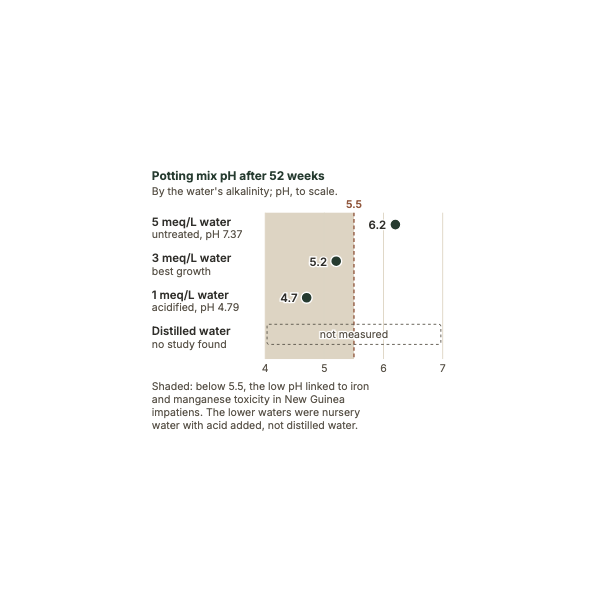
Coffee is also mildly acidic. Rao and Fuller measured hot and cold brews of light roasts at pH 4.85 to 5.13, on a scale where 7 is neutral and lower numbers are more acidic. What that means for a pot comes further down.
What Caffeine Does to Plants in Laboratory Tests
Caffeine has been tested on seedlings directly, as a possible weedkiller and as a stress. Mohanpuria and Yadav grew seedlings of tobacco and Arabidopsis, a small weed used as a laboratory plant, on nutrient agar, a jelly growing medium. Growth slowed at 1 mM caffeine, and “retarded further” at 5 mM.
Their seedlings had smaller roots and shoots, yellowed, and lost chlorophyll, which the authors read as early aging, or senescence. They also found less activity in Rubisco, the enzyme that captures carbon in photosynthesis, and offer that as one reason growth slowed.
Alkhatib and colleagues grew tobacco for 14 days in nutrient solution with caffeine from 25 to 5,000 micromolar, which is 0.025 to 5 mM. Photosynthesis did not drop significantly at any dose except the top two, 1 and 5 mM.
At those two doses the roots were damaged under the microscope. The outer cells were deformed, the cortex, the layer between the root’s skin and its core, had fewer cells, and the vascular tissue that carries water was misshapen.
Pham and colleagues found that pure caffeine halved the root growth of lettuce seedlings at 75 micrograms per mL, about 0.39 mM. They also found its effect “highly selective” between species, so one plant’s sensitivity does not predict another’s.
Set brewed coffee’s 2.06 mM against those results. It sits at about twice the 1 mM that slowed Mohanpuria and Yadav’s seedlings and about five times the lettuce figure. The highest dose tested, 5 mM, is nearly two and a half times the cup’s concentration. All three papers are cited from their abstracts.
Now the limits, which matter as much as the numbers. Every one of these tests kept seedlings or roots in caffeine continuously, in agar or nutrient solution. None used a potted plant, and none used a string of hearts.
A spill is a single dose that then mixes with whatever water is already in the pot, and how far it is diluted was not measured anywhere we looked. So the comparison says a cup is strong enough to deserve a response. It does not say a spill harms a plant.
Why a Rinse Is the Step With a Reason Behind It
Caffeine moves with water. PubChem gives its solubility as 21.6 mg per mL at 25°C (77°F), about 54 times the concentration in brewed coffee. In a spill, all of it is already dissolved in the liquid that soaked into the mix.
A spilled cup, and what rinsing does
Brewed coffee holds about twice the caffeine concentration that slowed seedlings in a laboratory test. Caffeine dissolves readily, so plain water can carry it out of the pot.
The tests kept plants in caffeine; a spill is a single dose. Rinse the pot with plain water, let it drain, then let it dry out completely before watering again.
Soil holds some caffeine back. In five farm soils, Zhang, Tang and Thiele-Bruhn found caffeine was sorbed, meaning held on soil particles, more strongly than sulfadiazine and less strongly than atenolol, the two other drug compounds they tested.
That paper is cited from its abstract, and it tested farm soil, not potting mix. Potting mix may hold caffeine more tightly, for a reason the next source gives.
A review of 137 sorption studies by Alhalabi and colleagues found that more soil organic carbon goes with more sorption of drug compounds in general. Virginia Cooperative Extension notes that popular potting soils are often made of organic materials like peat moss, pine bark, wood fiber or coconut coir.
Put together, plain water can carry dissolved caffeine down and out of the drainage hole, and some may stay behind on the organic material. How much one rinse removes from a potting mix has not been measured, so we cannot say a rinse gets it all.
Whatever stays can be broken down in principle. Bacteria that can live on caffeine as their only source of carbon and nitrogen have been known for over 40 years, according to a review by Summers and colleagues. How fast that happens in a houseplant pot is unknown.
The rinse itself is borrowed. Colorado State University Extension gives it for washing built-up salts out of potting mix. Using it for coffee is our inference, on the reasoning that both jobs mean moving something dissolved out through the drainage hole.
Is Coffee Plant Food?
This was the most confident claim among the replies: coffee carries potassium and phosphate, so it feeds the plant. It does contain both, at USDA’s 49 mg of potassium and 3 mg of phosphorus per 100 g.
Whether a plant gains anything from that is another matter. We found no trial of watering houseplants with brewed coffee, so any benefit is unknown, and the potassium arrives with the caffeine.
Most of the research on coffee and plants is about the grounds, a different material. Horgan and colleagues write that spent grounds “contain caffeine and other toxins that inhibit plant growth.”
In their trial, grounds aged seven months or less held back radish and tomato seedlings when mixed into soil, while grounds aged 14 months helped them. Spread on the surface instead, seven-month grounds helped too.
A 2024 review by Hu and colleagues found the same across studies of raw grounds: plant growth “often limited owing to its phytotoxicity and induced N immobilization.” That last phrase means soil microbes taking up nitrogen the plant would otherwise use.
Neither paper tells you what brewed coffee does, and both are cited from their abstracts. But nothing in that research supports pouring coffee into a pot on purpose. The article on coffee-ground compost covers the grounds in detail.
Readers also described school experiments and office plants that got coffee for years. None of those is a controlled test we could check. If you feed this plant, use a houseplant fertilizer and follow its label.
Will It Make the Mix Too Acidic?
Brewed coffee is acidic, at pH 4.85 to 5.13 in Rao and Fuller’s samples. Their hot brews also held more titratable acid, the total amount of acid present rather than its strength. One reply argued that acid would suit a string of hearts.
We found nothing either way. Neither the NC State Extension profile of this plant nor the University of Wisconsin’s gives a soil pH preference.
We also found no measurement of how much one cup changes the pH of a potting mix. The acid worry and the acid reassurance rest on the same missing evidence.
Sugar, Milk and Heat
What was in the cup changes the question. For sugar, the closest evidence is ecological. Ruwanza, Musil and Esler added sugar to soil in field and greenhouse trials in fynbos, a southern African shrubland.
They hoped soil microbes would tie up nitrogen and hold back faster-growing annual plants. Instead, the plants they introduced, annual and perennial alike, lost chlorophyll and photosynthetic efficiency, and made less growth.
The damage was worse in unsterilized soil, which pointed at microbes. But soil nitrogen did not fall to match, and total bacterial numbers did not change, though coliform bacteria rose.
So the authors leaned toward “a likely abiotic mechanism,” meaning one that does not run through living organisms. That was a deliberate dose spread over land, not a sweet coffee in a pot.
Milk has its own gaps, covered in the article on milk and houseplants: no test on a houseplant, and a risk of odor. Neither sugar nor milk has been tested in a pot, and the rinse is still the only step available.
Heat was the replies’ other worry, and roots are sensitive to it. MacDonald found chrysanthemum roots held in nutrient solution for 30 minutes were “severely damaged” at 45°C (113°F) or above.
In potting mix, the roots warmed more slowly and the same temperatures did less damage. MacDonald also infected roots with Phytophthora, a water mold that causes root rot. In potted plants, rot damage was highly significant where roots had been heated to 40°C (104°F) or more.
In Ingram and Buchanan’s test, cut citrus roots held for 20 minutes reached the midpoint of their injury curves at about 52 to 54°C (125 to 128°F). Both are cited from their abstracts.
Those were roots held at a set temperature, not a hot drink poured onto a pot. We found no measurement of how hot a root zone gets when that happens, especially in mix that is already wet, so we cannot say whether a spill reaches those temperatures.
What to Do Now
- Rinse it in the sink. Colorado State’s method: take away the saucer, set the pot where water can drain freely and check that the drainage holes are not plugged. Then, “Using tepid tap water, rinse the potting mix by filling the pot to the top with water a couple of times,” and let it drain well between rinses.
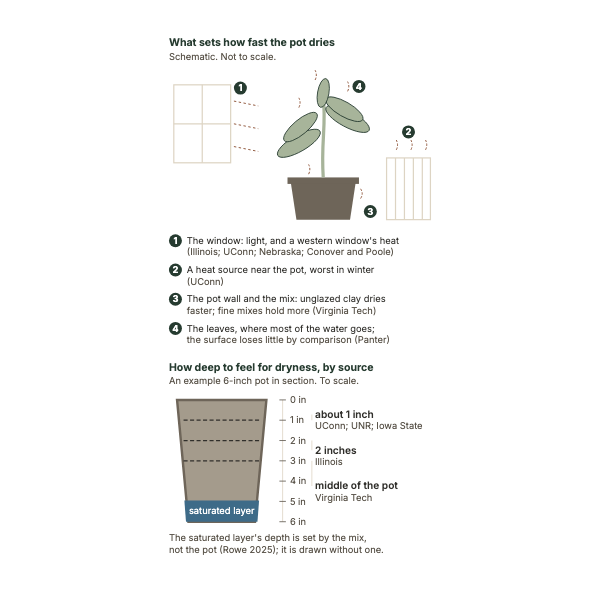
- Let it finish draining. Virginia Tech says to let the container drain “until water stops dripping out the bottom.” If it sits in a tray, it says not to leave it in water for more than 60 minutes.
- Do not count the rinse as overwatering. Virginia Tech puts it plainly: “Overwatering is not about how much water you apply; it’s about how often you water.” A heavy rinse once is not the same as watering often.
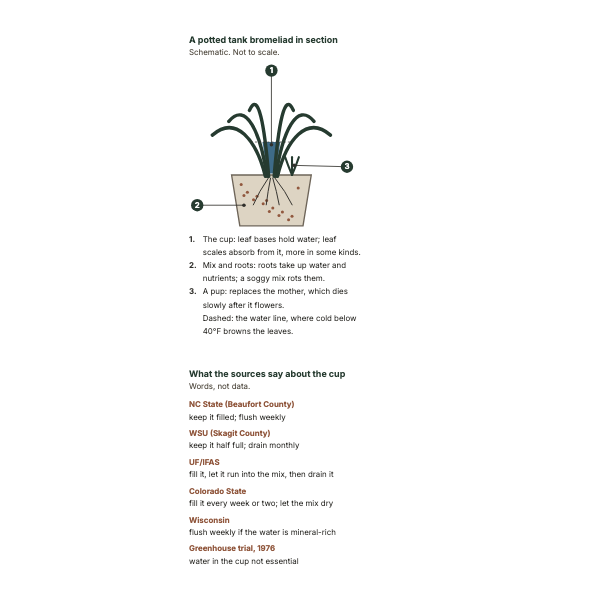
- Then let it dry out completely. NC State says this plant “should be allowed to dry out completely between waterings,” and to water even less in winter, when it is dormant. Wisconsin says it “is easily killed by overwatering.” For a plant that is not a succulent, Virginia Tech notes that tropical houseplants are watered more often. The article on telling when a houseplant needs water covers how to tell when the mix is dry.
- Leave the roots in the pot. We found no source that supports repotting or washing roots after a spill. NC State says repotting “should be deferred until necessary,” and Wisconsin says to repot only when necessary. Colorado State reserves changing the soil for extreme cases of salt build-up.
- Watch it afterward. NC State lists root rot and yellow leaves as results of overwatering, and wilted leaves as a result of underwatering. Virginia Tech adds mushy leaves and stems, dropped leaves and rotten-smelling mix. Root rot and saturation covers what to do if that happens.
One caution on reading those signs. Yellowing shows up both in the caffeine studies and in the overwatering lists, so a yellow leaf will not tell you which one caused it.
How dry a trailing succulent’s mix should get before the next watering is answered differently by the sources, and our article on watering a string of pearls sets those answers out.
Local Regulations and Safety Advisory
If you use fertilizer products, follow the label. Rules on them vary by country and locality, and your agriculture department can say what applies where you live. This article is general information, not legal advice.
Authorities to consult:
- Local agriculture department
What Remains to Be Explored
The basic test has not been done. We searched for any trial of coffee spilled on, or used to water, a houseplant and found none.
We also found no measurement of how much caffeine a rinse removes from a peat or bark mix, or how fast what is left breaks down in a pot. Every caffeine result here comes from seedlings or roots kept in caffeine continuously.
Smaller gaps sit around those. We found no measurement of how one cup changes the pH of a potting mix, no pH preference published for string of hearts, and no record of the root-zone temperature after a hot drink is poured into a pot. We found nothing on coffee left sitting on the leaves.
The test that would settle it is not hard. Take matching potted plants and give some a cup of coffee, some the coffee followed by a rinse, and some plain water. Then measure growth and the caffeine left in the mix.
Until someone does, the rinse is the step with a mechanism behind it, and nothing more is known.
Sources
- Retardation in Seedling Growth and Induction of Early Senescence in Plants Upon Caffeine Exposure Is Related to Its Negative Effect on Rubisco — Prashant Mohanpuria and Sudesh Kumar Yadav. Photosynthetica 47(2):293-297. 2009. Cited from its abstract.
- Physio-Anatomical Responses of Tobacco Under Caffeine Stress — Rami Alkhatib and colleagues. Photosynthetica 56(4):1140-1146. 2018. Cited from its abstract.
- Caffeine: The Allelochemical Responsible for the Plant Growth Inhibitory Activity of Vietnamese Tea (Camellia sinensis L. Kuntze) — Van Thi Thanh Pham and colleagues. Agronomy 9(7):396. 2019. Cited from its abstract.
- Caffeine Content of Specialty Coffees — McCusker RR, Goldberger BA, Cone EJ. Journal of Analytical Toxicology 27(7):520-522. October 2003. Cited from its abstract.
- Beverages, Coffee, Brewed, Prepared With Tap Water (FDC ID 171890) — USDA Agricultural Research Service, FoodData Central (SR Legacy). Undated.
- Caffeine (CID 2519), Solubility — National Library of Medicine, PubChem. Undated.
- Acidity and Antioxidant Activity of Cold Brew Coffee — Niny Z. Rao and Megan Fuller. Scientific Reports 8:16030. 2018. Cited from its abstract.
- Interaction of Pig Manure-Derived Dissolved Organic Matter With Soil Affects Sorption of Sulfadiazine, Caffeine and Atenolol Pharmaceuticals — Wei Zhang, Xiangyu Tang and Sören Thiele-Bruhn. Environmental Geochemistry and Health 43(10):4299-4313. 2021. Cited from its abstract.
- Sorption of Pharmaceutically Active Compounds to Soils: A Review — Ahmad M. Alhalabi and colleagues. Environmental Sciences Europe 36:161. 2024. Cited from its abstract.
- Genetic Characterization of Caffeine Degradation by Bacteria and Its Potential Applications — Ryan M. Summers and colleagues. Microbial Biotechnology 8(3):369-378. 2015. Cited from its abstract.
- Spent Coffee Grounds Applied as a Top-Dressing or Incorporated Into the Soil Can Improve Plant Growth While Reducing Slug Herbivory — Finbarr G. Horgan and colleagues. Agriculture 13(2):257. 2023. Cited from its abstract.
- Spent Coffee Ground and Its Derivatives as Soil Amendments—Impact on Soil Health and Plant Production — Yi Hu and colleagues. Agronomy 15(1):26. 2024. Cited from its abstract.
- Sucrose Application Is Ineffectual as a Restoration Aid in a Transformed Southern African Lowland Fynbos Ecosystem — Sheunesu Ruwanza, C.F. Musil and Karen Joan Esler. South African Journal of Botany 80:1-8. 2012. Cited from its abstract.
- Heat Stress Enhances Phytophthora Root Rot Severity in Container-Grown Chrysanthemums — J.D. MacDonald. Journal of the American Society for Horticultural Science 116(1):36-41. 1991. Cited from its abstract.
- Lethal High Temperatures for Roots of Three Citrus Rootstocks — Dewayne L. Ingram and David W. Buchanan. Journal of the American Society for Horticultural Science 109(2):189-193. 1984. Cited from its abstract.
- Ceropegia woodii, North Carolina Extension Gardener Plant Toolbox — NC State Extension. Undated.
- String of Hearts, Ceropegia woodii — University of Wisconsin-Madison Division of Extension, Wisconsin Horticulture. Undated.
- 1339 – Leaching Salts From Potting Mixes — Colorado State University Extension, PlantTalk Colorado. Undated.
- Properly Watering Container Houseplants (SPES-804P) — Virginia Cooperative Extension. Undated.
- Hypothetically, What Do You Think Would Happen to a String of Hearts That Accidentally Had a Cup of Coffee Dumped on It While It Was Draining in the Sink. Hypothetically. (R/Houseplants Thread) — multiple community members. Reddit, r/houseplants. Undated.